To avoid these ads, REGISTER NOW!

1950's Craftsman 10" Table Saw - Fence "Squareness" Issues

Placeholder17

Well-known member
Joined
Feb 25, 2024
Messages
109
Location
Maryland
Hello all,

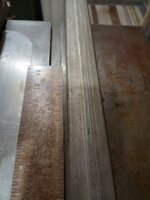
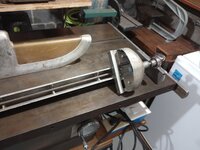
I finished cleaning up an old 10" Craftsman table saw (113.29920, 27" deep table-top) over the holidays and while squaring the blade and the fence to the table, found that the fence wobbled slightly while being moved, even using the geared fine adjustment knob, such that the far end of the fence will be about 1/16" - 1/8" off of square.

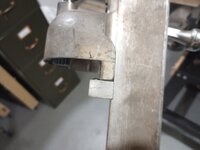
The original manual says that the spring-loaded balls in the fence contact surface (with the rail edge) are supposed to keep it in alignment, but these don't exert nearly enough force to oppose the drag from the self-weight of the fence and friction with the table as it is moved horizontally. I've oiled the contact surfaces of the fence and even put felt pads under the fence at the far end to avoid any steel to steel contact with the top of the table, but that didn't stop the misalignment after movement.

In the end, it's easily fixed by putting a large square on the table and pushing the far end of the fence into square after I've got the near end where I want it (takes 30 seconds at most). However, I was wondering if this is normal for this old stock fence, or if the fence ball springs have slacked?
 

Attachments

  • IMG_20250106_124635211_HDR.jpg
    IMG_20250106_124635211_HDR.jpg
    491.1 KB · Views: 30
  • IMG_20250106_124630528.jpg
    IMG_20250106_124630528.jpg
    832.6 KB · Views: 30
  • IMG_20250106_124535036.jpg
    IMG_20250106_124535036.jpg
    426.9 KB · Views: 29
  • IMG_20250106_124528834.jpg
    IMG_20250106_124528834.jpg
    509.5 KB · Views: 27
  • IMG_20250106_124511792.jpg
    IMG_20250106_124511792.jpg
    615.7 KB · Views: 36
  • IMG_20250102_171056433.jpg
    IMG_20250102_171056433.jpg
    732.7 KB · Views: 35
  • IMG_20250101_194121749_HDR.jpg
    IMG_20250101_194121749_HDR.jpg
    572.9 KB · Views: 36
To avoid these ads, REGISTER NOW!

seagiant

Well-known member
Joined
Sep 16, 2011
Messages
308
Hi,
I have the same saw with the wings on the sides...

Got tired of the crummy OEM Fence and put a Delta T2 on it!

While not a Unisaw, does all I want now, and a pleasure to use!

Just sayin!
 

exmaxima1

Well-known member
Joined
Jun 25, 2011
Messages
6,353
Location
Midwest
In the end, it's easily fixed by putting a large square on the table and pushing the far end of the fence into square after I've got the near end where I want it (takes 30 seconds at most). However, I was wondering if this is normal for this old stock fence, or if the fence ball springs have slacked?
That is exactly how I used my CM saw for almost 40 years. Place a carpenter square against the fence and then clamp it with a large Vise-Grip welding pliers. I clamped both ends if I was sawing large panels as the fence might otherwise shift. Ultimately I installed a Biesemeyer fence and a few years after that---bought a Unisaw!
 

CKS1955

Well-known member
Joined
Oct 12, 2014
Messages
491
Location
Michigan
Good evening,

A tip shared often over on Owwm.org is to push the fence into the face of the cast iron top prior to engaging the fence lock mechanism. This may help.

Jay
 

Sub Dude

Well-known member
Joined
Mar 8, 2023
Messages
81
Location
West Michigan- The Other West Coast
I've worked on over a dozen of these vintage Craftsman 10" saws and they fence system is rather fiddly, I'll admit.
I can spend up to a few hours getting everything set up properly. I like the Craftsman clamping strategy better than the Delta tube style fence system but the Craftsman design creates a lot of friction in the head to work properly.

I read your post a few times and I have a few thoughts. The spring loaded balls should force the little steel bar that they are located in towards the fence rail. Is there always some tension on the ball springs? If so the head-on theory should always be roughly square with the fence body that slides over the top of the saw. If there is to much play there then the head would be loose and would require some work every time you clamp it. The only way that could happen is if the fence rail is to far from the top. Any spacers/washers between the fence rail and the top.
Also if there are sticky spots as the head moves along the rail that could be an issue. I at times put a file vertically along the back of the fence rail and slide it along the rail to knock off any high spots that cab be binding. I also use paste wax on every area of the head. The head bears on the fence rail and both are Zamac which makes for a bad bearing surface.

If working as designed, the fence should snap back to the same position relative to the top every time you move it even before you clamp it down. The little balls should never have any "slop".

I'm sure you discovered the 4 small screws that allow you to adjust the fence relative to the head.

I'm not sure the little felt pads will last
They may come off soon after you slide the fence over the miter slots.
That little "web" of material adjacent the the felt pads was actually slightly convex origiannlay which meant the back of the fence was always riding on a small spot. This area wore off and that makes it difficult to slide. Ideally that area should be built up with weld across the width and then shaped to be convex so the fence rides maybe a 1/16" or less above the top. I've considered using a small piece of UHMW tape in this area but the shape of the part still needs to be convex.

I understand your frustration with this. I think they weren't the best design but the fences doesn't break often on the Cman. Delta design has a few weak spots that can break.

Stick with it. I've had some that I couldn't seem to get right and then all of a sudden it works OK.

Sub
 
To avoid these ads, REGISTER NOW!
OP
P

Placeholder17

Well-known member
Joined
Feb 25, 2024
Messages
109
Location
Maryland
Thanks CKS and Sub Dude.
  1. I had already adjusted the 4 handle screws to square the fence to the handle when I worked on the whole saw. They do not affect the horizontal gap between table and fence handle.
  2. I tried moving the fence, then pushing the handle into the table from the center of the handle. This helps move the fence closer to square, but I'm still off by about 1/16" at the far end of the table. I think the handle contact surface with the table is slightly worn on each side of center from being moved both and forth unlubricated, and the tendency of the fence to wobble, creating friction while moving on only one half of the contact surface, then on the other when moving the fence in the opposite direction, creating a natural convex wear surface.
  3. Miraculously, the spacing of the felt pads is such that the fence glides over the miter slots without any hesitation.
  4. If I pull the fence handle away from the saw, towards me, fully compressing the ball springs, about 1/16" of gap opens between the table and fence handle contact surface. This slight gap is predominantly what allows the fence to wobble. I don't have UHMW-PE tape, so I just tested layering (6) pieces of vinyl electrical tape, the full length of the fence handle, between the ball springs. It closes the gap such that I can't feel any movement if I try to push or pull the fence handle in the center towards or away from the table, but there is still just enough wobble from the worn handle contact surface and the compressibility of the tape that after moving the fence either way, it's about 1/32" off at the end.
  5. I'll just stick with manually squaring the fence off each movement with the carpenter's square; it's really not a big deal. I appreciate the feedback.
 

Sub Dude

Well-known member
Joined
Mar 8, 2023
Messages
81
Location
West Michigan- The Other West Coast
If I pull the fence handle away from the saw, towards me, fully compressing the ball springs, about 1/16" of gap opens between the table and fence handle contact surface. This slight gap is predominantly what allows the fence to wobble.
I'm still trying to understand what is going on here.

With the clamp released there should still be some tension holding the fence head in place. There should be no gap. In other words, with the clamp released, you should be able to move the fence and have it snap back to the same spot. With the clamp released you should have some tension on the fence head as you slide it along the fence rail. If the head is "sloppy" at any point then you have some unusual wear or the fence rail is spaced to far away from the top.

Sub
 

rsanter

Well-known member
Joined
Dec 22, 2007
Messages
18,555
Location
visalia ca
I had a similar saw with that same fence on it, what a piece of junk.
But hey, that’s what I had back in the day.

I hot a piece of square stock and made a new piece that was a couple inches wide on both sides, that made a big difference.
Then I learned that when I move the fence to grab the fence hear the far end and lift it slightly to help it alight square.

Eventually I bought a deal on a Vega fence and that was a nite/day improvement

Now days I use a Tsquare fence on a unisaw
 
To avoid these ads, REGISTER NOW!
Top Bottom