To avoid these ads, REGISTER NOW!

1st Welds Since 1976!

Dan in Pasadena

Well-known member
Joined
Feb 18, 2009
Messages
13,162
Location
Pasadena, CA
Okay, here's the photo (iPhone photo, sorry)
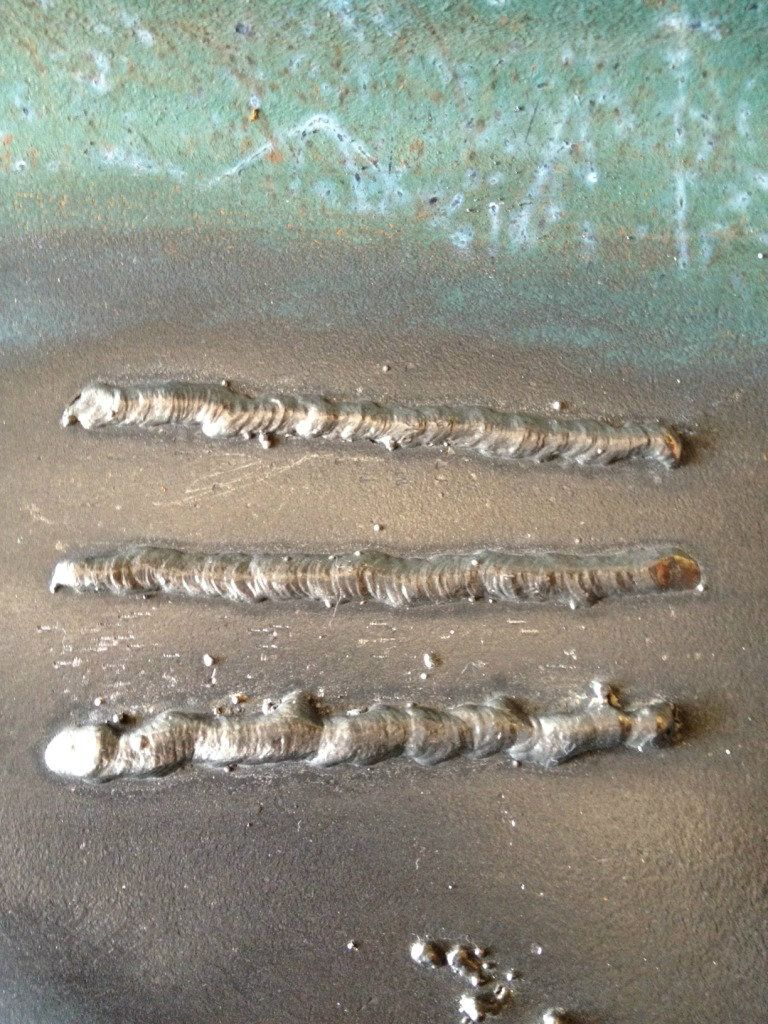
FluxCoreWelds5-11-12.jpg


This is flux core .030" wire in a Hobart Handler 140 on the web of a 10" deep, 4" wide flanges I beam. These welds are on the web which is probably at least 3/16" thick. I've not welded since college. That was stick and oxy-acetylene and I SUCKED at it especially the stick welding. BUT, I've been studying....Youtube videos, reading here and elsewhere.

The middle bead was "pulling" w/comfortable body position. I'm left handed so progress was right-to-left.

For the top bead I switched sides, pushed and rested my hand along the flange to try to steady. I think the results are, "Eh...":dunno: Probably should have used the flange but pulled.

Bottom bead was done w/poor body position frankly and I THINK my progress was too fast, that's why the filler piled up instead of penetrating like the other beads(?)

I had a machine malfunction as I started - I'm sure it was my fault somehow but the wire broke entering the gun. I probably wasted 10 ft of wire figuring out how to fix it, but I did and all was well after that..I just ran out of wire fairly quickly.

Feel free to criticize. If it *****, tell me. If you have suggestions, let me know.

I am doing some structural work in my garage welding beams together to open the rear. (A $700 welder quote will make you do all sorts of things, lol)After that, I'll likely ONLY be doing sheet metal repair on my '55 Chevy truck. I'll be using MIG and .023" wire. MUST I go back to flux core for the beam work or will the mig work? Too small?

Lay it on me fellas!
 
Last edited:
To avoid these ads, REGISTER NOW!

welder4956

Well-known member
Joined
Apr 8, 2010
Messages
3,081
Location
Birmingham, AL USA
I would say you have the fundamentals down and need to keep running beads to get used to looking at the puddle and keep an eye on all 4 sides of the puddle (front, back and both sides of the bead). Maybe kick the voltage up 1 notch on the machine to get the bead to flatten out.
 

Jagmandave

Well-known member
Joined
Nov 6, 2011
Messages
6,305
Location
Overland Park, Ks.
What size are the beams you're going to weld?

and what are they going to hold up?

If you're saying they're 3/16" thick your 140 might be a bit light, especially if they're going to be structural.

In that case, I think I'd ask around for another quote, and/or see if you can borrow a more powerful welder.

Run many more beads, and try to slow down a bit, both for better penetration and to learn better control.

The middle bead looks like a position you were comfortable with, it was the most even of the ones you posted.
 

Zeke

Well-known member
Joined
Aug 13, 2009
Messages
17,176
Location
Long Beach CA, the sewer by the sea.
Dan, that material is too thick to get anywhere using the 140. Find some thinner stock or get up on the edge of the beam. Welding is mostly about joining two pieces. Pieces have edges and edges get hot. Out in the middle of heavy material is not the ideal place. Practice using connected cursive "C's" and "E's." Keep your stick out between a 1/4 and 3/8ths.
 

lotsoftools

Well-known member
Joined
Oct 22, 2011
Messages
1,317
Location
Inland Empire
For structural use the flux core for better penetration, probably .035 if your machine will handle it. Also use the pull method for more penetration. I have successfully and safely welded 1/4" ****, tee and lap joints with my Lincoln 140. I had to grind bevels and do multi-pass on the ****-joint.
 

MoonRise

Well-known member
Joined
Nov 5, 2010
Messages
4,031
Location
NJ
California = seismic codes almost certainly apply.

The small diameter fluxcore wires that a 120V wirefeed welder can even run are typically NOT 'agency-approved' for structural work. Look up Northridge earthquake. Structural welding Codes usually call for wires with CVN properties.

YMMV, but although FCAW wires (of certain 'types' ) can and are used succesfully and 'to Code', a 120V welder running some 0.030 or even 0.035 diameter FCAW-S wire of probably type AWS E71T-11 (Lincoln Innershield NR-211-MP or Hobart Fabshield 21B are two wires in this category, there are lots of others as well) is NOT in that category for either the wire or the machine.
 

lotsoftools

Well-known member
Joined
Oct 22, 2011
Messages
1,317
Location
Inland Empire
California = seismic codes almost certainly apply.

The small diameter fluxcore wires that a 120V wirefeed welder can even run are typically NOT 'agency-approved' for structural work. Look up Northridge earthquake. Structural welding Codes usually call for wires with CVN properties.

YMMV, but although FCAW wires (of certain 'types' ) can and are used succesfully and 'to Code', a 120V welder running some 0.030 or even 0.035 diameter FCAW-S wire of probably type AWS E71T-11 (Lincoln Innershield NR-211-MP or Hobart Fabshield 21B are two wires in this category, there are lots of others as well) is NOT in that category for either the wire or the machine.

Dumb codes... just kidding. Good point, just because we can do some things doesn't mean that we should.
 
OP
D

Dan in Pasadena

Well-known member
Joined
Feb 18, 2009
Messages
13,162
Location
Pasadena, CA
Thanks everyone. Milt nailed what my concern was - the 140 just isn't enough machine. I was hoping I could pull this off. I DID plan to bevel and do multipass...but truthfully I'm no real welder and getting this strucutral frame in right is probably not the place to be less than sure the welds are right.

The machine has four voltage settings: 1 - 4. These welds were at the max setting already w/ .030". The table on the machine says it WILL accept .035" though.
I did these using the cursice "e-e-e-" method - well, as best I could.

The beams are much larger than I need but I got 'em cheap off CL so that's why I went that big. Maybe I can hire one of the certified welders off my job (I-405 Sepulveda Pass Widening) to do the work and skip trying to make the 140 do what it doesn't do well with an unqualified welder!

I'll keep practicing, practicing, etc. Gonna go get a mig bottle and .023 wire next week for the truck repair and leave this to others.
 

Zeke

Well-known member
Joined
Aug 13, 2009
Messages
17,176
Location
Long Beach CA, the sewer by the sea.
Dan, you can buy a used stick machine and glue that stuff together in a breeze (literally).

Come on down to LB and borrow my Lincoln tombstone. With just a few minutes of practice and some fresh 6011 rod, you'll be all over this.
 

Falcon67

Well-known member
Joined
Jun 11, 2009
Messages
18,371
Location
Merkel, TX
From experience, your 140 is going to be good up to .125 ish mild steel tube, with bevels. For what you are doing, you should have taken the $700 quote or bought a Hobart 190 240V unit. You might get it on a multi-pass with the 140, but you'd best tet the hell out of several pieces before you do the real deal.
 
OP
D

Dan in Pasadena

Well-known member
Joined
Feb 18, 2009
Messages
13,162
Location
Pasadena, CA
Milt, Thanks for the offer...and I might even take you up on it but don't those old tombstone style buzz boxes go pretty cheap on Craigslist?

Remember I told you I absolutely sucked at stick welding back in the day. I remember STICKING the rod to the little test piece I was practicing on!! Ha ha. Hopefully I'd be better today with an auto darkening helmet. The "nod" action was too hard for me but then again so was uh....WALKING and chewing gum! Stupid question coming: Will a used stick welder run on 110v?
 
To avoid these ads, REGISTER NOW!
OP
D

Dan in Pasadena

Well-known member
Joined
Feb 18, 2009
Messages
13,162
Location
Pasadena, CA
No, it will not run on 110 - that is, it won't make enough amps to weld with, you need 220.....

DOH!:lol:

Well, for what I'm doing I can use the 220v outlet in th kitchen (next to the back door) and drag beam near the door. A pro welder with portable arc welder is looking better and better though!!
 

dude67

Well-known member
Joined
Feb 25, 2010
Messages
119
Just remember welding on sheet metal will be totally different than welding on thick metal. Sheet metal is done in a line or series of spot welds. They are also welding in different places as not to warp the sheet from overheating. Don't know If you have seen the youtube videos on sheet. I think I would have bought the 220V MIG welder. You can always turn it down, but ya can't make a 110v have more amps. The 220v stick welder will be fine for welding the structural steel. This way you could have MIG'd both projects. Welding with a MIG is much easier to learn. If you have done any welding, it's like riding a bike. I also think the 110v MIG is great for sheet metal.
 
Last edited:
OP
D

Dan in Pasadena

Well-known member
Joined
Feb 18, 2009
Messages
13,162
Location
Pasadena, CA
Just remember... Sheet metal is done in a line or series of spot welds. They are also welding in different places as not to warp the sheet from overheating.

Thanks, yeah very aware. I'm on 67-72chevytrucks.com. This is the very reason I bought the Hobart.


...I think I would have bought the 220V MIG welder. You can always turn it down, but ya can't make a 110v have more amps.

I bought Jack Olsen's used Hobart Handler 140. He gave me a friendly price and we've helped each other out off & on since. Yeah, depressing....Jack's a helluva nice guy on top of having a great garage!

I figured (at the time) if he could build his nice front yard steel picket fence I wouldn't need anything bigger. I was right except for this ONE situation so I'm wondering if its even worth it to consider buying the stick welder?:dunno:
 

Zeke

Well-known member
Joined
Aug 13, 2009
Messages
17,176
Location
Long Beach CA, the sewer by the sea.
Dan, I paid 50 bucks for mine 10 years ago. It's my 2nd one. I stupidly sold the first one. Those CL ads are not a good price for those, but I do see the prices going up as copper gets sky high. Lots of copper in an old transformer machine. What you want in a stick welder is DC. With DC you could even do some TIG welding using the scratch start method. At least that's good enough for fooling around and learning.

However, the AC machines will cut the mustard using 6011 rod which is designed for AC SMAW welding. Come on down, it's only gas. I hardly ever use it. Might even sell it to you if you get interested. But if you just have the one project, come get it. Or, I'll come up and weld that up for you if you have a plug or we can tap your meter box. I just don't have much by the way of power cables. Only the pig tail and receptacle.

Let's go to PM for any other talk.
 

dude67

Well-known member
Joined
Feb 25, 2010
Messages
119
I have always been told that the older cracker box or buzz box stick welder are better than the new one. Because they have more windings in them. I don't know if this is true or not, but it does seem right to me as manufactures are cutting corners thru the years.
 

Zeke

Well-known member
Joined
Aug 13, 2009
Messages
17,176
Location
Long Beach CA, the sewer by the sea.
I have always been told that the older cracker box or buzz box stick welder are better than the new one. Because they have more windings in them. I don't know if this is true or not, but it does seem right to me as manufactures are cutting corners thru the years.

There are some old Monkey Ward and other brands of light duty stick welders for really cheap and they work because of what you said. Few electronics, just a transformer and a switch. I think there are some old Centurys that have an infinite current lever. You can dial in a weld nicely when you have that feature.

Century= MW PowerKraft:

150942d1262562234-looking-diodes-montgomery-ward-welder-welder.jpg


And when I said "light duty," I wasn't talking about duty cycles. Some of these have 100% duty cycle! Look at the panel.
 

Cheap5.0

Well-known member
Joined
Oct 19, 2011
Messages
487
Location
The thumb (Michigan)

Dan, I paid 50 bucks for mine 10 years ago. It's my 2nd one. I stupidly sold the first one. Those CL ads are not a good price for those, but I do see the prices going up as copper gets sky high. Lots of copper in an old transformer machine. What you want in a stick welder is DC. With DC you could even do some TIG welding using the scratch start method. At least that's good enough for fooling around and learning.


My eyes bugged out of my head when i seen those prices! I bought my lincoln AC 225 for $100 a few years back.
 
OP
D

Dan in Pasadena

Well-known member
Joined
Feb 18, 2009
Messages
13,162
Location
Pasadena, CA
I've since found THESE that are a bit cheaper:

http://losangeles.craigslist.org/lgb/tls/3013460778.html

http://losangeles.craigslist.org/lac/tls/2978943147.html

...but I'm not sure I'm that interested in owning an arc welder. I don't really intend to do anything structural in the future (I know, I know) and if I ever do I think I'd rather have a larger mig unit - Yes, I know code doesn't allow use of MIG for many structural applications. I'm talking about around the house stuff, NOT putting together buildings.

I found out I can rent an arc welder at Home Cheapo for $35 for four hours and $50 for twenty four hours. I am also trying to get a guy from work to come out and do this small amount of work for me. Just so you know I didn't drop $300+ for an older used unit.
 

MoonRise

Well-known member
Joined
Nov 5, 2010
Messages
4,031
Location
NJ
pssst, actually MIG IS 'allowed' for most stuctural work. The 'problem' is wind blowing the shielding gas away. Which is the same problem if you were using an FCAW-G electrode (aka Dual-shield). But 'typical' MIG filler (ER70S-3 or ER70S-6 for 70ksi filler, or ER80S-D2 or other 80 ksi solid wire filler/electrode) all meet CVN and other 'Code' requirements.

Note: You are in California and you say you are doing some "structural" welding with some steel I-beams. Building "Codes" usually mean that 'structural' and 'welding' and 'seismic' all mean that you just can't DIY with a little 120V welder with a 'non-rated' wire electrode. Sorry.

'Structural' and 'welding' and 'seismic' all mean using the right materials and the right machines and the right process. All done by a "certified" welder. Sorry, it's not a DIY job. Unless you already happen to be a 'certified' structural and seismic welder.

btw, got permits and approvals for this beam modification or other structural changes/mods? Engineer-approved beam plans, etc, etc, etc?

Hey, I'm all for DIY. But sometimes you (not calling out you, but 'you' in general) don't quite have the correct tools or materials or knowledge or 'certifications' to do the job. And in some locales (Cali for lots of things, almost anywhere for structural welding, Chicago for pretty much any electrical work even in your own private single-family residence, etc, etc) even if you have the tools and materials and know-how you still don't meet certain paperwork 'requirements' because you aren't a 'licensed professional blah-blah'.

The 120V Hobart 140 is a fine machine within its limits. Auto sheet metal with some 0.023/0.025 solid steel wire and C25? Sure.

Welding a 'structural' beam? You have to use 'approved' filler/electrode with the appropriate machine and the appropriate parameters. And have the appropriate certification(s) to 'prove' you are qualified to do seismic/structural welding.

That said, an inexpensive (relatively) stick welder is almost always a handy thing to have around.

There are units that can run on 120V power, but they are rather limited on output power (because they are being limited on the input power from the 120V 15 or 20 amp circuit).

There are units that can run on 120V or 240V power, and they can do a bit more power output when run on 240V power. There are 240V-only units, that can do most anything. There are AC-output units, there are DC-output units, there are AC/DC output units. There are big-a$$ 'industrial' units that draw more power at once than your entire house and run off of 3-phase 460V (or higher) power. Etc, etc, etc.
 
To avoid these ads, REGISTER NOW!
Top Bottom