To avoid these ads, REGISTER NOW!

2-12.5 amp infared heaters on a 30 Amp Circuit?

tlmartin84

Well-known member
Joined
Apr 23, 2012
Messages
1,085
Location
West Virginia
That is going to put me at 25 amps, I know it doesn't meet code, as fully loaded it would be running at 83% capacity.

Regardless of meeting code, would it be safe to push the limits just a bit?
 
To avoid these ads, REGISTER NOW!

rjkobbeman

Active member
Joined
Nov 18, 2015
Messages
25
All you risk is possibly tripping the breaker after a long continuous run. Since the breaker should hold 80% forever, 83% may take a really, really long time... if ever to trip.


Sent from my iPhone using Tapatalk
 

Speedy Petey

Well-known member
Joined
Apr 22, 2012
Messages
1,430
Location
NY State
All you risk is possibly tripping the breaker after a long continuous run. Since the breaker should hold 80% forever, 83% may take a really, really long time... if ever to trip.


Sent from my iPhone using Tapatalk
WHY in the world would the breaker trip??? A breaker can run at 100% and never trip, although it's not designed for it.
Where did you get this extreme misinformation that a breaker trips at over 80%???
 

Speedy Petey

Well-known member
Joined
Apr 22, 2012
Messages
1,430
Location
NY State
That is going to put me at 25 amps, I know it doesn't meet code, as fully loaded it would be running at 83% capacity.

Regardless of meeting code, would it be safe to push the limits just a bit?
It will only not meet code if the load is or would be considered a continuous load, as per the NEC definition.

Continous Load. A load where the maximum current is expected to continue for 3 hours or more
The key word here is expected. If these heaters will only be run together for a couple of hours at a time maximum then it is FINE where it is.
 
OP
T

tlmartin84

Well-known member
Joined
Apr 23, 2012
Messages
1,085
Location
West Virginia
OK Speedy,

Having said that, on a 20 amp circuit you can run multiple 15 amp receptacles.

Does that hold true for a 30 Amp circuit?
 
OP
T

tlmartin84

Well-known member
Joined
Apr 23, 2012
Messages
1,085
Location
West Virginia
Let me clarify my comptemplating......

I plan to use ONE heater, possible two and the flexibilty to hook a second one up across the room. These are just off the shelf 120V 12.5A normal plugin heaters.

My thought is that if I pigtail an outlet in at location 1, instead of transferring current across it and then run to receptacle 2 from the pigtail I will only be pulling 12.5 amps across each receptacle and should be fine.........

This is of course on a 10-2 circuit with 30 Amp Breaker.

Is there a 30A "normal" receptacle out there? Everything I run across is like a twist lock or something....
 
Last edited:

Syberia

Well-known member
Joined
Jan 13, 2014
Messages
1,451
Location
Perris, CA
You cannot use 15 or 20 amp receptacles on a 30 amp breaker. What you are proposing is a code violation, and potentially dangerous if you ever try to draw more than 20 amps through a single receptacle.

Each heater will need its own circuit.
 
OP
T

tlmartin84

Well-known member
Joined
Apr 23, 2012
Messages
1,085
Location
West Virginia
You can't per code...........

As long as you don't draw more than 15 amps through the outlet though you should be fine? Am I correct?
 

Syberia

Well-known member
Joined
Jan 13, 2014
Messages
1,451
Location
Perris, CA
It will "work" but it won't be right. It shouldn't be much more expense, if you're going to have two outlets in different spots anyways, to put them on different circuits.
 
Last edited:

Norcal

Well-known member
Joined
Mar 16, 2008
Messages
13,792
All you risk is possibly tripping the breaker after a long continuous run. Since the breaker should hold 80% forever, 83% may take a really, really long time... if ever to trip.


Sent from my iPhone using Tapatalk

Breaker will run at 134% for a indefinite period, but putting the heaters on a 30A circuit is not a good or code compliant idea. Put the heaters on a 20A multi wire circuit, unless AFCI's come into the picture.
 

66cj225

Well-known member
Joined
Nov 4, 2011
Messages
332
Location
NH
Since you want to push the limit, the answer is in the details. E still equals IR. On a short run close to the panels, close to the pole, close to the transformer with all the panel screws tight, yup it'll be fine. Anything else, nope.
 

Syberia

Well-known member
Joined
Jan 13, 2014
Messages
1,451
Location
Perris, CA
Since you want to push the limit, the answer is in the details. E still equals IR. On a short run close to the panels, close to the pole, close to the transformer with all the panel screws tight, yup it'll be fine. Anything else, nope.
It will still be against code.
 

Speedy Petey

Well-known member
Joined
Apr 22, 2012
Messages
1,430
Location
NY State
Since you want to push the limit, the answer is in the details. E still equals IR. On a short run close to the panels, close to the pole, close to the transformer with all the panel screws tight, yup it'll be fine. Anything else, nope.
This is a really, REALLY, bad answer.
 
OP
T

tlmartin84

Well-known member
Joined
Apr 23, 2012
Messages
1,085
Location
West Virginia
If I pigtail the first outlet it will only draw what is plugged into it right?

And then at the pigtail where the second receptacle ties in the current will double up through that run back to the panel?

I know it would be against code but there are several factors playing into this. One of which is the fact that my 40 space panel is nearly out of circuits.

The other is it is 10' in the air so i dont worry about someone accidently plugging something else in. Anotjer factor is the fact that everyone and there brother uses the "space" heaters and simply plugs them in without any consideration as to where they are plugging them. Typically standard 15amp outlets with god knows what else is on the circuit. Almost all of these heaters have an overload device built in so that plays a part in my reasoning too. I could cut the plug off and witre on a twist lock.....while that fixes the receptacle it still doesnt protect the device cord....so I dont see much difference in that and just using a receptacle as long as Im not pulling more than its rating through it.


Have you all seen a 30 amp normal receptacle??
 
Last edited:
OP
T

tlmartin84

Well-known member
Joined
Apr 23, 2012
Messages
1,085
Location
West Virginia
Fella's I'm not trying to be hardheaded or stubborn. I'm looking for a solution. It just has to be inexpensive as possible and meet the following criteria.


-Maximum of 2 circuits.

-MUST BE 4 Infared heaters, 5000BTU minimum. Totalling 20000 btu. (can be hardwire, can be 240, I prefer 240 but I can't find any reasonably priced. I keep saying the plug in ones because they are disposable and can be had for under 50.00 a piece. No more than I use them they will last for years.)

So please throw some ideas at me.

I am using them for occasionally drying paint, but they will see more time deicing my tractor in the winter.......hence the infared. I can put them on the four corners. Not saying regular heaters won't work, I just like the infared. We use them at work and they are proven.

I respect code as well, I am a PE and make a living off of codes. I also know that code is applicable in all situations. If we followed all our codes and specifications to a T, our bridges either wouldn't get built, or would cost 10x what they do. So while in this instance I do not care about the code, I also want it to be as safe as possible.
 
To avoid these ads, REGISTER NOW!

wyliesdiesels

Well-known member
Joined
Aug 14, 2012
Messages
20,236
Location
Modesto, CA
You can't per code...........

As long as you don't draw more than 15 amps through the outlet though you should be fine? Am I correct?

So how do u plan on connecting #10 wire to a 5-15 or 5-20 outlet?

Using #12 wire? those outlets are designed for use with #14 or #12.

If u do that, then u have violated code in regards to the ampacity of #12 wire which is MAX 20a and u have a 30a breaker.

What youre proposing to do wont work.

EDIT: I forgot that there is some brands that will accept #10 under a screw.

.....Have you all seen a 30 amp normal receptacle??

What do u mean by NORMAL?

Theres a number of 30a outlets....
 
Last edited:

Speedy Petey

Well-known member
Joined
Apr 22, 2012
Messages
1,430
Location
NY State
Have you all seen a 30 amp normal receptacle??
I know what you are asking, and it does NOT exist for one reason, it is not code complaint.

A 30A receptacle is a 30A receptacle.

Everything you are proposing is anything from not code complaint to downright dangerous.

You are looking for a cheap easy solution. There is one.
RUN TWO 15A OR 20A CIRCUITS.
 
OP
T

tlmartin84

Well-known member
Joined
Apr 23, 2012
Messages
1,085
Location
West Virginia
Actually, many if not most standard receptacles will accept #10 wire on the screw terminals, but I agree they can't be used on a 30 amp circuit.

It is perfectly legal to place a 20 or 15 amp outlet/device on 10ga wire as long as the device specifies it will accept it AND it is protected by a corresponding 15A or 20A breaker.
 
OP
T

tlmartin84

Well-known member
Joined
Apr 23, 2012
Messages
1,085
Location
West Virginia
Swap in some tandem breakers.


This is the easiest.......

But isnt this also against code? It is a 40 space box, 32 circuits. I am at the max circuits.....

Even if it is I would tend to agree/think that it would be safer than the outlets on a 30 amp circuit.
 
Last edited:

Pwrgeek

Well-known member
Joined
Oct 18, 2015
Messages
288
Location
Texas USA
The correct way to do this is to put in a single two pole 20A breaker. Run 12-3 as a multi wire circuit and put 20A outlets split between the two hot legs. Code compliant and will do what you want. You can break the tabs on the outlets and have one plug on each outlet be on each hot leg. Then you can plug up to two heaters in to any one outlet with no problems.

Edit - fixed autocorrects use of the wrong pole/poll


Sent from my iPhone using Tapatalk
 

MikeF2316

Well-known member
Joined
Dec 29, 2012
Messages
9,605
Location
Thornhill, ON
That would be perfect, you are sure its compliant Pwrgeek?

That wiring was fairly standard on kitchen circuits in Canada. This way you could plug a toaster and microwave into the same duplex outlet, and use both at the same time. I had more than one friend who wanted to update their switches and outlets to the Decora style and got bit by the small detail of not breaking off the tab joining the 2 hots.
 

Norcal

Well-known member
Joined
Mar 16, 2008
Messages
13,792
The correct way to do this is to put in a single two pole 20A breaker. Run 12-3 as a multi wire circuit and put 20A outlets split between the two hot legs. Code compliant and will do what you want. You can break the tabs on the outlets and have one plug on each outlet be on each hot leg. Then you can plug up to two heaters in to any one outlet with no problems.

Edit - fixed autocorrects use of the wrong pole/poll


Sent from my iPhone using Tapatalk

2 slight problems, one, a handle tie is required, two, AFCI(s) may be required.
 
OP
T

tlmartin84

Well-known member
Joined
Apr 23, 2012
Messages
1,085
Location
West Virginia
Thanks for all the info! I knew if I kept pushing someone would come up with something!


One last question, would that setup still meet code if I placed both outlets on a double pole switch????
 

Eriehunter

Well-known member
Joined
Mar 14, 2014
Messages
189
The correct way to do this is to put in a single two pole 20A breaker. Run 12-3 as a multi wire circuit and put 20A outlets split between the two hot legs. Code compliant and will do what you want. You can break the tabs on the outlets and have one plug on each outlet be on each hot leg. Then you can plug up to two heaters in to any one outlet with no problems.

Edit - fixed autocorrects use of the wrong pole/poll


Sent from my iPhone using Tapatalk

How is this going to solve a panel that is full or nearly full?

I just pulled a circuit similar to what the OP proposed out of a beauty salon where the branch to two outlets was split in a junction box in the basement below the hair cutting station, the 20a circuit was overloaded by 6 amps, the neutral was very burned, close to causing a fire. Do not go above the 80% especially on resistive heating loads.
 

wyliesdiesels

Well-known member
Joined
Aug 14, 2012
Messages
20,236
Location
Modesto, CA
How is this going to solve a panel that is full or nearly full?

I just pulled a circuit similar to what the OP proposed out of a beauty salon where the branch to two outlets was split in a junction box in the basement below the hair cutting station, the 20a circuit was overloaded by 6 amps, the neutral was very burned, close to causing a fire. Do not go above the 80% especially on resistive heating loads.

That only applies to continuous loads!
 

Charles (in GA)

Well-known member
Joined
Jan 11, 2006
Messages
12,489
Location
50 mi south of Atlanta
The NEC requires heating loads to be limited to 80% of circuit capacity, period. it doesn't have to do if it is actually continuous or not, the mere fact that it is a heater load requires that it be treated as a continuous load.

ARTICLE 424, Fixed Electric Space-Heating Equipment

424.3 Branch Circuits.(B) Branch-Circuit Sizing. Fixed electric space-heating equipment and motors shall be considered continuous load.
 

wyliesdiesels

Well-known member
Joined
Aug 14, 2012
Messages
20,236
Location
Modesto, CA
The NEC requires heating loads to be limited to 80% of circuit capacity, period. it doesn't have to do if it is actually continuous or not, the mere fact that it is a heater load requires that it be treated as a continuous load.

Yes i know that.

But some people take what he wrote and think that they cant go over 80% for any type of circuit.
 

Pwrgeek

Well-known member
Joined
Oct 18, 2015
Messages
288
Location
Texas USA
How is this going to solve a panel that is full or nearly full?


I just pulled a circuit similar to what the OP proposed out of a beauty salon where the branch to two outlets was split in a junction box in the basement below the hair cutting station, the 20a circuit was overloaded by 6 amps, the neutral was very burned, close to causing a fire. Do not go above the 80% especially on resistive heating loads.


The OP described a 40 position panel with 32 circuits. That leaves 8 spaces. If there are no spaces left in the panel then then add a tandem breaker and move another circuit to it. As an important note of you do wire a MWBC then the two hots must be on opposite legs to make it legal (you can't use a tandem breaker with handle ties for a MWBC). You are essentially under sizing the neural and counting on the phase currents to cancel out.


Sent from my iPhone using Tapatalk
 

myredracer

Well-known member
Joined
Nov 1, 2015
Messages
557
Location
Langley, BC
Breaker will run at 134% for a indefinite period, but putting the heaters on a 30A circuit is not a good or code compliant idea. Put the heaters on a 20A multi wire circuit, unless AFCI's come into the picture.

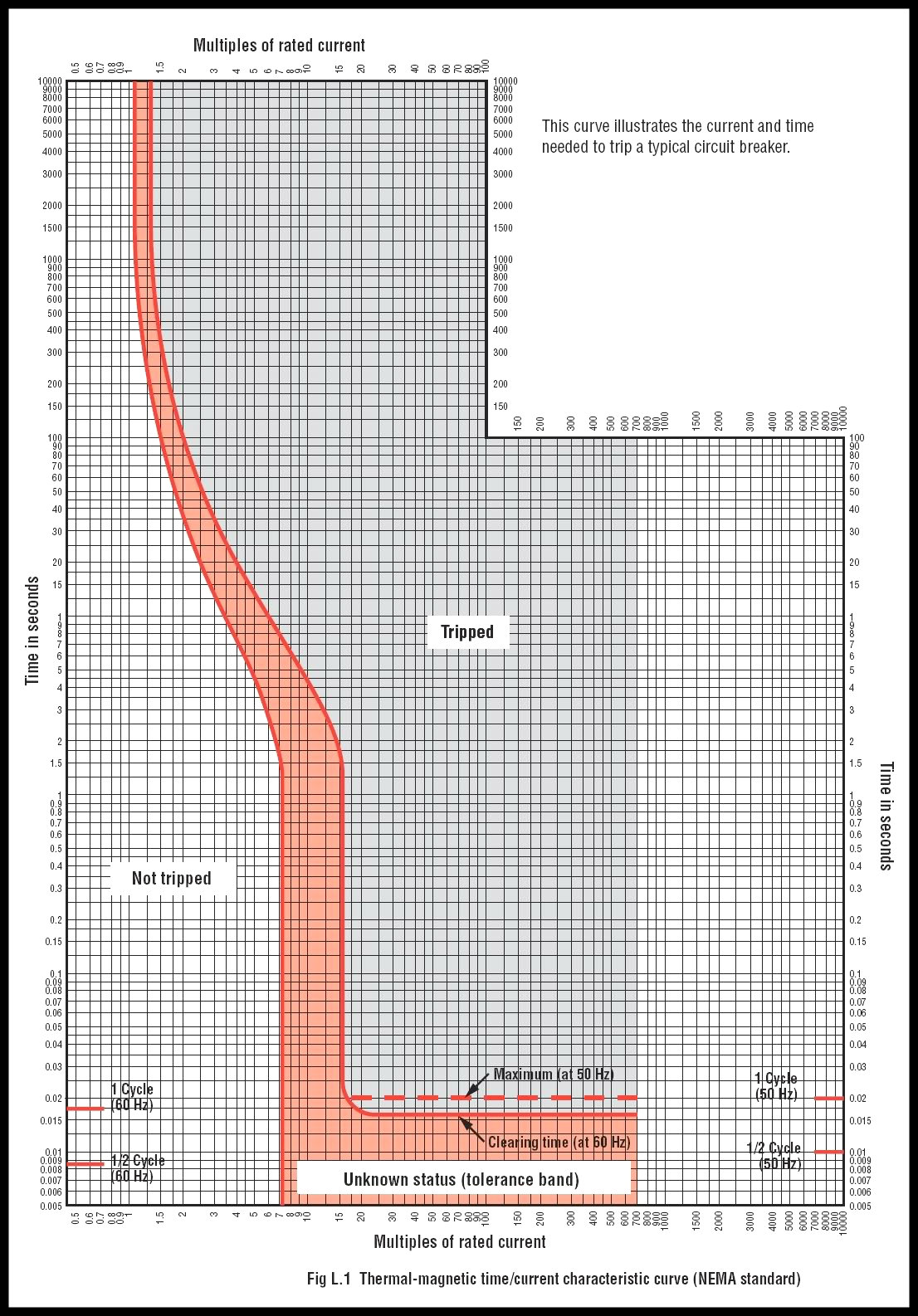
A thermal magnetic circuit breaker has an inverse time-current characteristic as shown in the graph. Apologies for the large image but I can't seem to resize it at the computer I'm using at the moment. If a breaker were overloaded at 134% of it's rating, it would trip in around 120 to 600 secs. (2 - 10 mins.) If the circuit was drawing 25 amps total and the wire was rated 20 amps, the breaker would be overloaded to 125% and the 20 amp breaker would trip somewhere between 200 seconds and an indeterminate amount of time.

The heaters should be wired to NEC requirements - period. Meaning #10 wire and breaker. #10 wire could be run to a junction box and split into a 20 amp run to each heater.

In Canada, they changed to code a number of years ago to allow branch circuit wire for heating circuits only to operate up to 100% of it's rating, but breakers must be sized at 125%. Doesn't seem right somehow, but that's what the code experts came up with. In the OP's scenario, this would mean 25 amp wire would be okay but there is no such thing so #10 it is.

aX9MD-ZA7HJIrcMix6SyC3AJpQ5Zx1j47PyYHBgqHaW5AR-evHCqrgGlDvXZKUQW2azy5LxXE5i7JecP-w6hvcZ0ay80WMy-BrE_Nr41YHpkWDMseciKcpmXbAaCnsiGAACHLhs
 
Last edited:

Speedy Petey

Well-known member
Joined
Apr 22, 2012
Messages
1,430
Location
NY State
The NEC requires heating loads to be limited to 80% of circuit capacity, period. it doesn't have to do if it is actually continuous or not, the mere fact that it is a heater load requires that it be treated as a continuous load.
OK, but aren't these plug-in space heaters?? Art 424 does not apply.
 
To avoid these ads, REGISTER NOW!
Top Bottom