I am installing a Rotary 9k 2 post lift. Says I need 4 inches concrete but my concrete is 3.5 inches. Guy helping me install is telling me that 3.5 will work just fine. Want to ask someone with experience. Dont want lifts tumbling down. Has 2 post with crossbar across top.


You are using an out of date browser. It may not display this or other websites correctly.
You should upgrade or use an alternative browser.
You should upgrade or use an alternative browser.
2 post lift Concrete Help
- Thread starter mlg567
- Start date
vhol5
Well-known member
I installed mine on a 3.5" slab. Lift my 8400 lb dooley and haven't noticed any loose bolts or other issues.
I think they specify 4" nominal, which is always 3.5" when poured...
I think they specify 4" nominal, which is always 3.5" when poured...
matt_i
Well-known member
In my opinion if you are worried, use epoxy anchors. Better strength to the concrete (on average, if prep is followed) and less chance of a bunch of anchors in a relatively small area fracturing between the holes due to the "wedge stress".
buntingmiester
Member
you will be much happier with a thickened footing under your posts. Just excavate enough soil to give youself an 8" deep footing at the minimum, figure a 2'x2' pad beneath your posts, then drop some #4 rebar, 6 pieces per pad and keep them 1" off the ground. Total cost in materail to do this is about $20 bucks!
wssix99
Well-known member
Says I need 4 inches concrete but my concrete is 3.5 inches. Guy helping me install is telling me that 3.5 will work just fine. Want to ask someone with experience. Dont want lifts tumbling down. Has 2 post with crossbar across top.
There are many reasons for this. With respect to falling down, the concrete thickness is much more critical than something like a 4 post lift.
Even though 3.5" is only 88% of the thickness of a 4" slab, in some failure modes, it is 75% of the strength. This is due to the way bolts hold and pressures distribute in the material. The lower half inch of concrete holds exponentially more than the half inch at the top.
So, the question would be: Do you feel safe using a lift that is (at best) 75% of what it should be. (There are other scenarios where it could be weaker.)
wssix99
Well-known member
Thanks alot I feel much better. I did epoxy the holes.
So, you already installed it?
In my opinion if you are worried, use epoxy anchors.
Not all epoxies are rated for this kind of tension stress. Some epoxy anchors rated for normal construction use could pull out when used in this application. Others won't - but the best thing would be to call the manufacturer to confirm the exact brand and type to use.
Better strength to the concrete (on average, if prep is followed) and less chance of a bunch of anchors in a relatively small area fracturing between the holes due to the "wedge stress".
In a situation where the concrete is too thin, using epoxy anchors won't do anything to make the situation stronger or more safe. The strength is most severely limited by the depth of the slab.
The strength comes from a cone shape, where the stresses act on the concrete:

The strength of the anchor is dependent on the surface area of that cone. As the depth decreases that surface area greatly decreases and there is a near exponential drop in strength.
The 2 post lift also exerts bending stresses on the concrete, which the depth counteracts. The full depth is also needed there and that mode could be more critical than the anchors.
Pouring the retrofit slabs as buntingmeister points out and Rotary recommends for this situation would be the most appropriate thing to do.
Last edited:
buntingmiester
Member
mlg567, if this was my project I would eliminate the anchor bolts entirely. Build a template of your bolt pattern and get some 1/2" anchor bolts, then embed them in your wet concrete, when the concrete is cured pull off the template, set your post , and torque down the nuts.Takes longer, but is much stronger, eliminates drilling costs as well was costly wedge type anchor systems, plus w/template it's gonna fit perfectly. Make one template and do one at a time, if you wish. Make your template long enough to span your excavated hole, and just fill concrete to the bottom of your template. Be sure you keep your concrete thick enough ( not runny ), with no air pockets ( vibrate/chugg)
buntingmiester
Member
mlg567, after I posted this I wondered about your experience at setting anchor bolts, so I thought I should add this comment, first the anchor bolts should have a 90* tail on the bottom to help prevent uplift (Lowes/Home Depot sell em), second, attach to template w/nuts & washers (coat w/grease). Also concerning the template materials, I would just use 1/2" plywood, and use a piece long enough to span both post, that way you eliminate a lot of measuring to find the exact placement of the second post. Best of luck whatever method you choose
rburke65
Well-known member
Wow.....you would get under a car on this lift, knowing that your foundation of the lift is less than the minimum recommended? Really? Sounds like more bleach in the gene pool ....
VWTim
Member
you will be much happier with a thickened footing under your posts. Just excavate enough soil to give youself an 8" deep footing at the minimum, figure a 2'x2' pad beneath your posts, then drop some #4 rebar, 6 pieces per pad and keep them 1" off the ground. Total cost in materail to do this is about $20 bucks!
If you're going to do this, make sure you run some rebar dowels into the nearby slab around the perimeter of the hole you cut. Otherwise the new "footing" your poured could move in relation to the slab.
Drill Sergeant Arc
Well-known member
you will be much happier with a thickened footing under your posts. Just excavate enough soil to give youself an 8" deep footing at the minimum, figure a 2'x2' pad beneath your posts, then drop some #4 rebar, 6 pieces per pad and keep them 1" off the ground. Total cost in materail to do this is about $20 bucks!
The 2 post lift also exerts bending stresses on the concrete, which the depth counteracts. The full depth is also needed there and that mode could be more critical than the anchors.
Pouring the retrofit slabs as buntingmeister points out and Rotary recommends for this situation would be the most appropriate thing to do.
Would either of you guys recommend epoxying rebar into the newly cut edge of the existing floor to resist the before mentioned "bending stresses on the concrete." It would seem to me this bending stress would now be most critically seen as a vertical stress on the existing slab's edge as the lift applies leverage on that new 2'x2' base that undoubtedly now extends under the older slab. Old floors have many unseen stress cracks and it would be unfortunate to have a small section "pop out" of the adjoining floor. I don't know about the rest of you folks but I seem to be always creeping up on the upper end of my safe operating limit of my lift. Two post lift columns are great pry bars when a large truck is pulling it down and to the side as the truck slips off a pad. Just saying.

Last edited:
wssix99
Well-known member
Would either of you guys recommend epoxying rebar into the newly cut edge of the existing floor to resist the before mentioned "bending stresses on the concrete." It would seem to me this bending stress would now be most critically seen as a vertical stress on the existing slab's edge as the lift applies leverage on that new 2'x2' base that undoubtedly now extends under the older slab. Old floors have many unseen stress cracks and it would be unfortunate to have a small section "pop out" of the adjoining floor. I don't know about the rest of you folks but I seem to be always creeping up on the upper end of my safe operating limit of my lift. Two post lift columns are great pry bars when a large truck is pulling it down and to the side as the truck slips off a pad. Just saying.
This is required for the reasons you mention. Mohawk has some really good instructions on this and the other lift manufacturers should give similar recommendations to either "pin" the slabs together (epoxy may not be needed) with rebar or "key" them by undercutting the old slab so the repair slab pours under the old.
Many people call these repair slabs "footings", which is not accurate in the same context as the footing of a wall or building. Mechanically, they behave differently. (We've had some folks post about older lifts that are different, but...) Modern lifts don't need footers due to the way they are designed - they spread the vertical loads out enough that a regular slab is just fine.
^ Calling these slab patches "repair slabs" is more accurate since they reinforce weak parts of the slab, restore a proper anchor embedment, and then pin/key in to the old slab to give the moment resistance that a properly poured monolithic slab would have.
Last edited:
VWTim
Member
Would either of you guys recommend epoxying rebar into the newly cut edge of the existing floor to resist the before mentioned "bending stresses on the concrete."
Those are the dowels I mentioned above. Definitely dowel any repair sections to the existing slab.
Drill Sergeant Arc
Well-known member
Those are the dowels I mentioned above. Definitely dowel any repair sections to the existing slab.
Sorry about that Tim, I'm an old guy and a slow at this. I had a head start and you still beat me by a mile in posting first.
I apologize for cross posting on your post.VWTim
Member
Sorry about that Tim, I'm an old guy and a slow at this. I had a head start and you still beat me by a mile in posting first.
No problem at all, just wanted to make sure people weren't confused by the term dowel for the rebar application you talked about.
Mr. Roboto
Well-known member
I was in the same boat. Take a look at my build thread if you want to see the process (link in sig, starts around page 13) I cut out footings and re-poured.
Last edited:
Aahz
Well-known member
Here is VSG (Rotary Lift, Forward Lift, Direct Lift and a few more) Latest Anchor Bulletin as well as their Anchor Reference Guide. If I can find the recommended pad replacement bulletin, I'll post it ASAP.
Attachments
lakeroadster
Well-known member
I am installing a Rotary 9k 2 post lift. Says I need 4 inches concrete but my concrete is 3.5 inches. Guy helping me install is telling me that 3.5 will work just fine. Want to ask someone with experience. Dont want lifts tumbling down. Has 2 post with crossbar across top.
Rotary specifies 4" minimum.
Here is a link: What are the Concrete Requirements for Rotary Lifts?
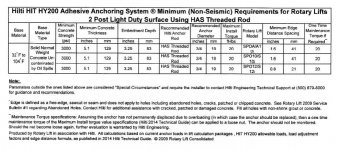
I used epoxy on my SPOA10. The data below I received from Rotary with their requirements: (5.1" concrete thickness when using epoxy).
Call them, it may be different for your lighter capacity lift.
Attachments
Last edited:
lakeroadster
Well-known member
I installed mine on a 3.5" slab. Lift my 8400 lb dooley and haven't noticed any loose bolts or other issues.
I think they specify 4" nominal, which is always 3.5" when poured...

This is an old contractors scam. 4" concrete means 4" concrete. I had a driveway done and inspected the sub-grade before the concrete was poured. I had them re-screed all the sub-base to ensure the thickness was 4".
Would you be ok with getting paid a nominal wag of $400, and only receiving $350?
bczygan
Well-known member
I installed mine on a 3.5" slab. Lift my 8400 lb dooley and haven't noticed any loose bolts or other issues.
I think they specify 4" nominal, which is always 3.5" when poured...
There is no such thing as nominal for concrete slabs. 4" is 4" minimum.
Bill
buntingmiester
Member
Well, if you are worried about the new foundation for the posts settling at a different rate than the existing slab, what I would recommend is connecting the two new pads with a poured tiebeam ( i.e.,a connecting footing 8"dx12"wxlenght between pads),and tie the rebar in the tiebeam to the rebar in the pads, make this a single pour..........best of luck,buntingmiester