I know each manufacturer has specific information for each model lift. But I haven’t and probably will not select a lift until well after construction is complete. Will be a 6” slab. Likely a 10k or 12k lift. Wondering if there is a general rule of thumb as to where to avoid placing control joints. I know the general area that I would like to place the lift. They don’t seem to very wildly. I think I would like to avoid any under the vehicle being lifted. Vehicle will be anything from a 2500 Suburban to a TVR Vixen. Any suggestions would be appreciated! Thanks.


You are using an out of date browser. It may not display this or other websites correctly.
You should upgrade or use an alternative browser.
You should upgrade or use an alternative browser.
2 post lift foot print?
- Thread starter no704
- Start date
You may want to pick out several lifts that you like, and call them for the requirements of the cement, both psi and thickness. I think all lift manufacturers don’t want the lift pads on a cement joint.
It’s really easy to dig a little deeper now, in the areas of the anchors, than do it after the cement is poured.
It’s a great feeling when you are standing under a 7000 lb. vehicle up on a lift, that you went way overboard on the cement and rebar requirements.
It’s really easy to dig a little deeper now, in the areas of the anchors, than do it after the cement is poured.
It’s a great feeling when you are standing under a 7000 lb. vehicle up on a lift, that you went way overboard on the cement and rebar requirements.
I suggest you find 3-4 lift mfrs and read through their requirements and find the most stringent requirements. Then you can vary lift placement and control joints while everything is still on paper.
Also review it and align with the concrete guy before hiring..........this way everybody understands the job requirements up front.
Also review it and align with the concrete guy before hiring..........this way everybody understands the job requirements up front.
There was no way for me to determine where my lift would end up, so I did 6" all the way through and demanded rebar (all they gonna do was driveway mesh).
Most lifts i was looking at wanted 5" slab, and I knew there would be some variability. On drilling the slab and placing my anchors, they grabbed at 4-5" depth (one side of one column anyway).
No control joints. As it turned out, I ended up with a hairline crack almost exactly halfway on the 20x38 slab. Lift now sits in the middle of one of the halves.
Most lifts i was looking at wanted 5" slab, and I knew there would be some variability. On drilling the slab and placing my anchors, they grabbed at 4-5" depth (one side of one column anyway).
No control joints. As it turned out, I ended up with a hairline crack almost exactly halfway on the 20x38 slab. Lift now sits in the middle of one of the halves.
70runner
Well-known member
Pin down the lift location before you pour. That way you can assure the proper placement of control joints as well as location of anchors such that they don't intersect with rebar. In addition, as mentioned above, reinforce the lift area with deeper concrete. In my case, with a new pour, adjusted the 5" slab design to include a 4' x 12', 12" deep tray centered on the lift location. With an additional rebar layer. I would also advise use of a modern epoxy anchor system vs the included mechanical anchors. I used the Hilti HY-200A V3 system.
Peace of mind (confidence in the lift support) when standing under 2-3 tons of vehicle can't be overstated.
Peace of mind (confidence in the lift support) when standing under 2-3 tons of vehicle can't be overstated.
36 x 28’. Im going to have the entire pad poured 6”. This is in Tempe AZ. Do I really even need joints cut? Will definitely have rebar. Going heavy on everything will most likely have other machine tools in the space. Also don’t know where or what yet.
AC-WC
Well-known member
carcruse
Well-known member
BendPak 12apx says this: Concrete specifications. The concrete must be steel reinforced, a minimum 6 in. (150 mm) thick, 3,000 PSI minimum compressive strength, and cured for a minimum of 28 days. Do not install the Lift on cracked or defective concrete. Anchor Bolts must be more than six inches from cracks and expansion joints in the concrete or from a wall.
CraigStu
Well-known member
Don't forget that some lifts have an extra wide version. You really need to nail the lift position asap. If you hit a piece of rebar drilling the 7th hole you get to move and redrill while crossing your fingers.
kaymccampbell
Well-known member
There are special drills for that problem.Don't forget that some lifts have an extra wide version. You really need to nail the lift position asap. If you hit a piece of rebar drilling the 7th hole you get to move and redrill while crossing your fingers.
Just remember it’s not the punch through force you have to be concerned with. The base plates are large enough to prevent that. It’s rotating force that will pull the anchors out of the concrete. I’ve installed 2 lifts in my shops and over design the slabs because my life or the life of a loved one is not worth 1500 bucks in rebar and concrete. #4 rebar 12” each way on a 6” slab of 5000psi concrete. 5000 has a lot of advantages. It burns in well and provides a very slick and durable finish, it is so dense water cannot permeate it.
Just my .02 but it like buying a helmet, is head worth 100 bucks or is it the $500 one a better deal?
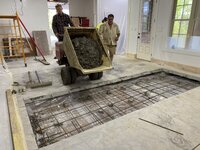
First 2 photos retrofit slab for new lift 12” thick by 4 wide and 12’ long. Next 2 as described above.
Just my .02 but it like buying a helmet, is head worth 100 bucks or is it the $500 one a better deal?
First 2 photos retrofit slab for new lift 12” thick by 4 wide and 12’ long. Next 2 as described above.
Attachments


Yes, but will still have 11’6”.Aren’t you limited on height?
I remembered that and it could be a limiting factor for the lift columns if you’re going with a hard lid.Yes, but will still have 11’6”.
Yea, i would prefer not to have a hump. But can probably place in between trusses.I remembered that and it could be a limiting factor for the lift columns if you’re going with a hard lid.
finn
Well-known member
The lack of engineering skills on this forum never ceases to amaze me.
Will 12” of concrete with rebar spaced at 12” work for a lift?
Certainly.
But is it any better than using what the manufacturer of the lift recommends, eg 6” of concrete?
In a word, no. An infinite lifetime is an infinite lifetime, no matter what. What some see as overbuilding is more aptly called wasting scarce resources, on this case, time and money.
Just my take on it.
Will 12” of concrete with rebar spaced at 12” work for a lift?
Certainly.
But is it any better than using what the manufacturer of the lift recommends, eg 6” of concrete?
In a word, no. An infinite lifetime is an infinite lifetime, no matter what. What some see as overbuilding is more aptly called wasting scarce resources, on this case, time and money.
Just my take on it.
Rusted Nut
Well-known member
Yes, but you create another problem of having your reinforcement cut. No substitute for proper planning.There are special drills for that problem.
Yes, but you create another problem of having your reinforcement cut. No substitute for proper planning.
When its in the concrete anyway and only a garage floor slab drilling through one piece of rebar isn't going to compromise the floor any more then drilling a whole new set of holes will. If you're hitting it every hole then you should probably stop what you're doing. But yeah planning on where you want a hoist up front does save some headaches.
kaymccampbell
Well-known member
It's not like it's tensioned cables.Yes, but you create another problem of having your reinforcement cut. No substitute for proper planning.
CraigStu
Well-known member
Kay, pls tell me more about that drill bit. My concern would be that trying to drill through steel you would end up making the hole in the concrete an oval.There are special drills for that problem.
ericm
Well-known member
I suggest you find 3-4 lift mfrs and read through their requirements and find the most stringent requirements. Then you can vary lift placement and control joints while everything is still on paper.
Also review it and align with the concrete guy before hiring..........this way everybody understands the job requirements up front.
Review it all with the concrete guy. And then mark the no control joint area on the wall or someplace where he can't miss it when he's laying them out after the pour. I reviewed it all with the concrete and gave him drawings, and he still put a joint a little too close than where I wanted. I'll have to move my lift about 6".
If I'd been there watching the whole time I would have caught it but I had to leave before the pour so I wasn't there for the control joints.
AC-WC
Well-known member
To help explain rusted nut and Kay....
This link shows the stress in the concrete when an anchor is 'pulled' an upside down cone is the stress in the concrete. Depending on where the rebar is cut with the bit will affect the 'cone' of the stress. Will it make a difference in the cone stress? I haven't seen any testing done to prove/disprove this. That's why rusted nut keeps saying planning is critical. I would not take a chance even if it is 'OK'
https://procesosindustriales.net/en...llout-force-design-calculator-per-aci-318-02/
What Kay is saying there's a Carbide tipped concrete drill bit that can cut through the steel rebar. Available in regular hammer drill and SDS style bits.
Steel tensioned concrete is typically used in suspended concrete like bridges or parking garages.
This link shows the stress in the concrete when an anchor is 'pulled' an upside down cone is the stress in the concrete. Depending on where the rebar is cut with the bit will affect the 'cone' of the stress. Will it make a difference in the cone stress? I haven't seen any testing done to prove/disprove this. That's why rusted nut keeps saying planning is critical. I would not take a chance even if it is 'OK'
https://procesosindustriales.net/en...llout-force-design-calculator-per-aci-318-02/
What Kay is saying there's a Carbide tipped concrete drill bit that can cut through the steel rebar. Available in regular hammer drill and SDS style bits.
Steel tensioned concrete is typically used in suspended concrete like bridges or parking garages.
kaymccampbell
Well-known member
When I hit rebar, I'd switch to a diamond or carbide core drill. It got me a nice smooth straight cut through the rebar. Then I'd switch back to the regular today hammer drill to finish off.Kay, pls tell me more about that drill bit. My concern would be that trying to drill through steel you would end up making the hole in the concrete an oval.
Assuming you're going to use epoxy anchoring vs wedge type anchors, a little oddly shaped hole wouldn't matter that much.
kaymccampbell
Well-known member
And in slab on grade with expansive or unsupportive soil. It allows for a thinner, more rigid slab, with less cracks.Steel tensioned concrete is typically used in suspended concrete like bridges or parking garages
Rusted Nut
Well-known member
Look up “rebar eater”; drill bits for coring through rebar. Still wouldn’t recommend cutting much rebar though.Kay, pls tell me more about that drill bit. My concern would be that trying to drill through steel you would end up making the hole in the concrete an oval.
Ilikeike
ALLIANCE MEMBER
Mohawk lifts has real good info on their site, for new construction and old.
Was helpful for my retrofit two post install .
Was helpful for my retrofit two post install .
CraigStu
Well-known member
Thanks Kay and Rusted. I won't be installing a lift but a little knowledge often has applications beyond the one being discussed at the moment.
sz0k30
Well-known member
The key words are "2 post lifts". The 2 posts will probably all be within a foot of each other widthwise. The basic footprints are all going to be within a few inches.
If you read Mohawks manual for a retrofit footing for their lifts is as I showed and described. I do also have a degree in architectural engineering and have been involve in the designed and construction of projects all over the globe. Sorry if my 30% safety factor seems wasteful but most all structural calculations I’ve used since the 1980’s include it.The lack of engineering skills on this forum never ceases to amaze me.
Will 12” of concrete with rebar spaced at 12” work for a lift?
Certainly.
But is it any better than using what the manufacturer of the lift recommends, eg 6” of concrete?
In a word, no. An infinite lifetime is an infinite lifetime, no matter what. What some see as overbuilding is more aptly called wasting scarce resources, on this case, time and money.
Just my take on it.