Ok im ready to pull the trigger on a 2 post open top floor plate bendpak, i have spoken to jeff (nice guy) and i just realized that i have expansion cuts between every garage door at 134ins, now the lift im looking at says its 145 ins. will this be a factor? my crete is 5in #4500 with fiber mesh ....no rebar. about 3 yrs old. the exp cut is about 1/2 deep heres a pic . honest answer here please .thks.


You are using an out of date browser. It may not display this or other websites correctly.
You should upgrade or use an alternative browser.
You should upgrade or use an alternative browser.
2 post lift install near crack??
- Thread starter mad57
- Start date
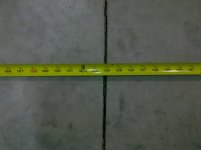
mslisaj
Well-known member
Jeff would really be the one to ask. He may pick up your post here and respond.
Good luck..........
Lisa
Good luck..........
Lisa
pattenp
Well-known member
I have a Challenger two post and the installation instructions say no anchors should be
installed within 8˝ of any crack, edge, or
expansion joint. I wouldn't think Bendpak would recommend anything less.
installed within 8˝ of any crack, edge, or
expansion joint. I wouldn't think Bendpak would recommend anything less.
Well this is what the engeneers at bendpak say:
If they straddle the expansion joints they will have 4.3” anchor edge distance from anchor to concrete edge.
Per Hilti, their KB 3 mechanical anchor needs only 2.75” to satisfy the critical edge distance.
Per Hilti the minimum edge distance for a 4” deep HIT-RE 500 Epoxy anchor (per page 270 of the Hilti manual) is 2”. At 4.3” edge distance they have a 90% strength factor.
If they optimize the anchor depth and straddle the expansion joints it looks like an epoxy anchor is a good fit.
If they straddle the expansion joints they will have 4.3” anchor edge distance from anchor to concrete edge.
Per Hilti, their KB 3 mechanical anchor needs only 2.75” to satisfy the critical edge distance.
Per Hilti the minimum edge distance for a 4” deep HIT-RE 500 Epoxy anchor (per page 270 of the Hilti manual) is 2”. At 4.3” edge distance they have a 90% strength factor.
If they optimize the anchor depth and straddle the expansion joints it looks like an epoxy anchor is a good fit.
I'm in the EXACT same boat, same measurements.... gotta cut and dig, and pour a pier.
I cant do it that concrete is solid an really hate the act of taking a blade to it. decisions why cant life in the garage just be simple

countrytech
Well-known member
I cant do it that concrete is solid an really hate the act of taking a blade to it. decisions why cant life in the garage just be simple
cause then it wouldn't be any fun
wssix99
Well-known member
That isn't an expansion joint. Its a control joint, so you may want to ask the question to BendPak again.
The only crack you'll get there is a shrinkage crack. (There may not even be a crack there at all right now.)
The only crack you'll get there is a shrinkage crack. (There may not even be a crack there at all right now.)
Chevy Gasser
Member
wssix99 has a good point, that is not really an expansion joint. Ask again. You would solid 4 1/2" under the score.
Prototyper
Well-known member
Just a thought...
How about having a metal fab shop with a CNC plasma table, cut out some steel plates, maybe 3/4" thick, that your lift bolts to, and in turn, spreads the anchors out over a larger area? You would need tapped holes for the lift to bolt to the plate, then a pattern of clearance holes for the concrete anchors. That way, you could tailor exactly where the anchors are placed.
How about having a metal fab shop with a CNC plasma table, cut out some steel plates, maybe 3/4" thick, that your lift bolts to, and in turn, spreads the anchors out over a larger area? You would need tapped holes for the lift to bolt to the plate, then a pattern of clearance holes for the concrete anchors. That way, you could tailor exactly where the anchors are placed.
Mac
Member
I just installed a BP XPR10-A a couple of weeks ago. My floor is 4 inch, rebared at 2' and fiber meshed. I had saw cuts done the day after the pour.
When I layed out my concrete I left 4'x4' areas at the 2 lift base points so I'd have 12" concrete with the rebar located just outboard of the lift base footprint. It just happened that a saw cut crossed exactly where the lift was going from side to side under both bases. Oh Oh!
I read every thread I could find about installing near/over cracks and expansion joints. I looked at others lifts being used in home or commercial shops before I did my install. Even from the distriutors, different answers all around. I chose to put my lift exactly where I had planned, saw cut be damned. I drilled for deeper anchors just in case the kit bolts didn't hold but I did use the provided anchors and they torqued to the required 90lb/ft without any problems.
Actually getting the posts squared and leveled was a bigger problem to me because they are a little warped from the heavy welds at the bases. I did the complete install by myself in 3 days and the instruction manual left something to be desired. Actually, the one that BP has on their webpage as a pdf had better picutres than the line drawing version that came with the lift.
Granted, its only been a couple of weeks but I have lifted a variety of vehicles including 3/4 ton 4x4 Suburban and a 1 ton 4x4 Dodge dually. I see NO problems at this point and don't really suspect I will.
When I layed out my concrete I left 4'x4' areas at the 2 lift base points so I'd have 12" concrete with the rebar located just outboard of the lift base footprint. It just happened that a saw cut crossed exactly where the lift was going from side to side under both bases. Oh Oh!
I read every thread I could find about installing near/over cracks and expansion joints. I looked at others lifts being used in home or commercial shops before I did my install. Even from the distriutors, different answers all around. I chose to put my lift exactly where I had planned, saw cut be damned. I drilled for deeper anchors just in case the kit bolts didn't hold but I did use the provided anchors and they torqued to the required 90lb/ft without any problems.
Actually getting the posts squared and leveled was a bigger problem to me because they are a little warped from the heavy welds at the bases. I did the complete install by myself in 3 days and the instruction manual left something to be desired. Actually, the one that BP has on their webpage as a pdf had better picutres than the line drawing version that came with the lift.
Granted, its only been a couple of weeks but I have lifted a variety of vehicles including 3/4 ton 4x4 Suburban and a 1 ton 4x4 Dodge dually. I see NO problems at this point and don't really suspect I will.
WNYflyer
Well-known member
- Vast majority of concrete slabs on ground are designed structurally as uncracked slabs. The main purpose of any reinforcing (along with joints) is to help control shrinkage cracking.
- Therefore ANY (shrinkage, control/construction joints, structural) cracks can be bad if located in the wrong spot relative to the location of the lift.
-Always contact the lift manufacturer's tech support and get the "real" concrete/foundation requirements. Preferably before you buy a lift. Most of the published concrete requirements on the websites are BS and don't tell you the whole story. And from reading some of the actual installation manuals some are very poor or don't even explain the "real" concrete requirements.
- The edge distance from the bolt to the crack maybe not be your only worry. Contact the tech support and send them a sketch of your layout of your lift relative to any cracks in the slab and ask them to comment on your slab and hopefully it works out for you.
- Therefore ANY (shrinkage, control/construction joints, structural) cracks can be bad if located in the wrong spot relative to the location of the lift.
-Always contact the lift manufacturer's tech support and get the "real" concrete/foundation requirements. Preferably before you buy a lift. Most of the published concrete requirements on the websites are BS and don't tell you the whole story. And from reading some of the actual installation manuals some are very poor or don't even explain the "real" concrete requirements.
- The edge distance from the bolt to the crack maybe not be your only worry. Contact the tech support and send them a sketch of your layout of your lift relative to any cracks in the slab and ask them to comment on your slab and hopefully it works out for you.
darkk
Well-known member
Buy a 4 poster and stop worrying...
Getting advise from the lift manufacturer will be biased. It is in their best interest to err on the safe side, so they will always suggest that you make things 10x as strong as it needs to be. Is this bad advise? Heck no. They don't want pics of their lift crashed to the floor spread throughout the internet because some numb nuts decided to install the lift in a floor that is too thin, lacks reinforcement, or is too close to a control line, etc. And any lift owner shouldn't want to see their lift crashed to the floor either.
I have the same condition in my shop that you do. Control joints are in the wrong place. I initially wanted to install a Mohawk lift. Their rep came out to my shop, measured the locations of the control joints and said "No way." A few months later I bought a used 9000 lb Rotary SPO9 asymmetric from the local GM dealer that folded. The footprint of the Rotary was about 8" narrower than the Mohawk, so I took a chance and installed it without making any changes to the floor. The closest fastener is about 6 inches from the control joint. That was 3 years ago, and it's working just fine so far. Was this a good decision? I don't know. If it never fails, it was a good decision. If it falls over with my car on it someday, it was a bad decision.
Would I recommend that you do the same thing? That is your choice to make, I'm just providing input from my experience to help you decide. However, I would suggest comparing other lifts to your BendPak that may have a different footprint, and may give you a better fit to your control joints.
Dale
I have the same condition in my shop that you do. Control joints are in the wrong place. I initially wanted to install a Mohawk lift. Their rep came out to my shop, measured the locations of the control joints and said "No way." A few months later I bought a used 9000 lb Rotary SPO9 asymmetric from the local GM dealer that folded. The footprint of the Rotary was about 8" narrower than the Mohawk, so I took a chance and installed it without making any changes to the floor. The closest fastener is about 6 inches from the control joint. That was 3 years ago, and it's working just fine so far. Was this a good decision? I don't know. If it never fails, it was a good decision. If it falls over with my car on it someday, it was a bad decision.
Would I recommend that you do the same thing? That is your choice to make, I'm just providing input from my experience to help you decide. However, I would suggest comparing other lifts to your BendPak that may have a different footprint, and may give you a better fit to your control joints.
Dale
WNYflyer
Well-known member
Getting advise from the lift manufacturer will be biased. It is in their best interest to err on the safe side, so they will always suggest that you make things 10x as strong as it needs to be. Is this bad advise? Heck no. They don't want pics of their lift crashed to the floor spread throughout the internet because some numb nuts decided to install the lift in a floor that is too thin, lacks reinforcement, or is too close to a control line, etc. And any lift owner shouldn't want to see their lift crashed to the floor either.
I have the same condition in my shop that you do. Control joints are in the wrong place. I initially wanted to install a Mohawk lift. Their rep came out to my shop, measured the locations of the control joints and said "No way." A few months later I bought a used 9000 lb Rotary SPO9 asymmetric from the local GM dealer that folded. The footprint of the Rotary was about 8" narrower than the Mohawk, so I took a chance and installed it without making any changes to the floor. The closest fastener is about 6 inches from the control joint. That was 3 years ago, and it's working just fine so far. Was this a good decision? I don't know. If it never fails, it was a good decision. If it falls over with my car on it someday, it was a bad decision.
Would I recommend that you do the same thing? That is your choice to make, I'm just providing input from my experience to help you decide. However, I would suggest comparing other lifts to your BendPak that may have a different footprint, and may give you a better fit to your control joints.
Dale
Not an expert on lifts but I am assuming the Rotary has the bar across the top tying the two post together such that they balance each other somewhat if loaded the same ? While the Mohawk has probably has no bar across the top or plate across the bottom?
If so then two different animals structurally I suspect thus probably big differences in concrete/slab requirements as well as post base plate sizes and anchor bolt spreads. Need to always make sure that people are comparing apples to apples as far as how each type of lift loads the base plate/concrete.
Not an expert on lifts but I am assuming the Rotary has the bar across the top tying the two post together such that they balance each other somewhat if loaded the same ? While the Mohawk has probably has no bar across the top or plate across the bottom?
If so then two different animals structurally I suspect thus probably big differences in concrete/slab requirements as well as post base plate sizes and anchor bolt spreads. Need to always make sure that people are comparing apples to apples as far as how each type of lift loads the base plate/concrete.
Yes, the SPO9 has the tie bar across the top, and you are correct, the Mohawk did not. Yes, they are structurally different. That went into my decision to buy the Rotary, since the Mohawk was going to require a re-do on my brand new floor.
With the tie bar, the load "balancing" is improved side-to-side over the Mohawk, but typically a vehicle will be somewhat balanced in that direction anyway. The Mohawk compensates for the lack of a tie bar by using significantly wider base plates. The actual concrete slab requirements by both manufacturers are actually pretty similar as to thickness, strength, and distance to the edge of the slab/crack, for lifts of similar capacity. There's probably an industry standard, or they copy each other's installation guidelines.
The real concern is balancing fore and aft, where a vehicle's weight can vary based on engine placement, and the load on the lift is also more variable depending on how well the vehicle is staged near the center of gravity before engaging the lift arms. The tie bar really has little effect there.
I would suspect there is a much higher probability of a 2-post lift failing by falling forwards or rearwards than sideways, and likely because of poor vehicle placement before lifting.