To avoid these ads, REGISTER NOW!

2' x 4' Troffers in 24" rafters

szenttehen

New member
Joined
Nov 22, 2013
Messages
3
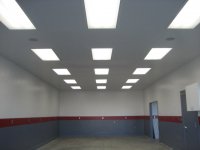
I would like to put fluorescent troffers in my garage ceiling. I like the troffers because they seem to create less glare than strip lights and they are out of the way on the 8.5' ceiling I have.

All 2' x 4' troffers need an opening of around 24" to be installed. My trusses are 24" apart on center which only leaves 22.5" for a light to be installed in between. Do they make troffers that fit between 24" trusses? I have seen 12" wide troffers, but they are only 2 lamp and I would like to use 4 lamp troffers.

Any ideas for fixtures that fit between trusses?
 
To avoid these ads, REGISTER NOW!

Wangstang

Well-known member
Joined
May 25, 2006
Messages
405
Location
Triangle Area, NC, USA
I would like to put fluorescent troffers in my garage ceiling. I like the troffers because they seem to create less glare than strip lights and they are out of the way on the 8.5' ceiling I have.

All 2' x 4' troffers need an opening of around 24" to be installed. My trusses are 24" apart on center which only leaves 22.5" for a light to be installed in between. Do they make troffers that fit between 24" trusses? I have seen 12" wide troffers, but they are only 2 lamp and I would like to use 4 lamp troffers.

Any ideas for fixtures that fit between trusses?

Interesting application. They tend to be designed from Drop ceilings. I'm curious to know if they are safe to have insulation directly on the back side of them?

These seem to be pretty common size options based on a google image search:
Troffer-Composite-1024x695.jpg


Wes

Edit to add a direct link to the CR14:
http://www.cree.com/lighting/products/indoor/troffers-international/cr14-220v-240v
 

Rocket79

Active member
Joined
Nov 13, 2013
Messages
30
Location
Kansas
Recessed fixtures must be UL "IC" rated for direct Insulation Contact. Most recessed troffers are not "IC" rated. "IC" fixtures are special fixtures.

However, I have seen the practice of covering non-IC lights done before. The top of the light doesn't really get that hot so I don't think it would be much of a problem, probably just shorten ballast life, and would not be built to code.

I imagine "IC" fixtures would probably have a zero clearance on the sides as well which might solve the truss issue.

Best bet, contact the specific light manufacturer. I've dealt with a few and most are very friendly and more than willing to help answer your questions and/or suggest other alternatives.
 

Rocket79

Active member
Joined
Nov 13, 2013
Messages
30
Location
Kansas
That question was asked by the second poster, not the original person.

I guess I was unaware that I was only allowed to offer help/advice/suggestions/opinions to one person per page. My mistake, thanks for correcting me.

But if you read my entire response, I did say the "IC" type fixtures might have a zero side tolerance, and might work for the available truss space. I was trying to help both, Sorry for confusing you.
 

2ManyProjects

Well-known member
Joined
Jul 18, 2013
Messages
757
I would like to put fluorescent troffers in my garage ceiling. I like the troffers because they seem to create less glare than strip lights and they are out of the way on the 8.5' ceiling I have.

Leaving aside the "Insulation Contact" issue (which IS valid, BTW), I would urge you to re-think that for other reasons.

One of the likely reasons you think the troffers "create less glare" is that, due to their recessed nature, you cannot see the tubes themselves, at least not from anywhere except more-or-less directly below them. But the down-side of this is, that also means they cannot distribute their light output to the sides anywhere near as effectively as either open-tube strip or (at least most) "wrap"-type fixtures can. And with only 8-1/2 feet of ceiling hight to work with, that is exactly the opposite of what you really need.

All 2' x 4' troffers need an opening of around 24" to be installed.

That's because they are generally designed for suspended ceilings, such as typically found in offices.

My trusses are 24" apart on center which only leaves 22.5" for a light to be installed in between. Do they make troffers that fit between 24" trusses?

Maybe. In fact, "probably", simply because odds are SOMEBODY out there makes pretty much anything which can be imagined. But I'd expect them to be somewhat difficult to find, and far more expensive than "normal" fixtures when you do.

I have seen 12" wide troffers, but they are only 2 lamp and I would like to use 4 lamp troffers.

Bad idea. Concentrating your light sources on a "four at a time" basis would be making a bad situation (i.e., your low ceiling) even worse.

Please understand this: Regardless of any other considerations, your "limiting factor" is your ceiling height. Your inter-fixture spacing will be determined almost solely by that dimension, at least if you wish to maintain reasonably even coverage at working height. Further, in order to ensure that reasonably even coverage, the spacing WILL be close enough that even single-tube fixtures are likely to be adequate, on an overall lumens/ft.^2 basis; and the common 4-foot twin-tube fixtures will surely provide MORE light than you really need. Going to four-tube fixtures (especially ones which limit their side-spread like troffers do) will NOT permit you to use fewer fixtures; it will only make the hot spots hotter, relative to the shadow areas.

Recessed fixtures must be UL "IC" rated for direct Insulation Contact.
If there is in fact insulation in the ceiling joists, which hasn't been mentioned.

Even if there isn't now, it's only prudent to assume that there will be, sooner or later (even if "later" is the next property owner). It's never a good idea to set up a "Gotcha!"


Ch3No2

Well-known member
Joined
Nov 27, 2009
Messages
356
Here is the way I did mine
 

Attachments

  • Garage 18.JPG
    Garage 18.JPG
    121.4 KB · Views: 109
  • Garage 32.JPG
    Garage 32.JPG
    72.9 KB · Views: 93
To avoid these ads, REGISTER NOW!

N0tt0N

Well-known member
Joined
Sep 26, 2013
Messages
229
Location
DC
szenttehen: Sorry for hijacking your fluorescent question but maybe the troffer mounting kit info helps...

Interesting application. They tend to be designed from Drop ceilings. I'm curious to know if they are safe to have insulation directly on the back side of them?

These seem to be pretty common size options based on a google image search:

Wes

Wes, I have been looking closely at the CR14 (1'x4') unit in your post and they have a kit for ceiling mounting the troffers so maybe others do as well. It looks like it creates a frame that then mates to the unit as if the ceiling was a drop ceiling. I especially like the high efficacy and CRI of the units. Been working through the complexity of the dimming options (0-10v w/GRC-TVI vs. LES w/Powerpack). Anyway, perhaps 2ManyProjects can read the dispersion charts (I can't seem to understand them) to see if the care Cree says they've put into the design plays out in reality.
 
Last edited:

2ManyProjects

Well-known member
Joined
Jul 18, 2013
Messages
757
Wes, I have been looking closely at the CR14 (1'x4') unit in your post and they have a kit for ceiling mounting the troffers so maybe others do as well. It looks like it creates a frame that then mates to the unit as if the ceiling was a drop ceiling. I especially like the high efficacy and CRI of the units.

You ought to, considering the cost (about $300-400 per fixture, even "at discount"). :yikes:

Been working through the complexity of the dimming options (0-10v w/GRC-TVI vs. LES w/Powerpack).

That's yet another issue. They require a DEDICATED control system if you want to have any dimming or automation capability. That both adds still more cost, and plays hob with any larger-scale lighting-control/automation system (such as Insteon) you might want to use. (Which is not to say that such a system COULDN'T be integrated; but it would be a much more complex and expensive proposition than with more traditional forms of lighting.)

Anyway, perhaps 2ManyProjects can read the dispersion charts (I can't seem to understand them) to see if the care Cree says they've put into the design plays out in reality.

I have little doubt that Cree has put some "serious" engineering into these products. But despite that, I don't think they're "quite ready for prime time", at least in a typical residential context. In a "serious" commercial environment where the considerable up-front costs can be more easily justified by a very heavy (possibly 24/7/365) usage pattern, they make somewhat more sense.

As for the photometrics, those polar diagrams on the spec sheets tell most of the story. I'm not sure what unit scale they're using for the radial axis (i.e., the numbers shown on the left-hand side of the graphs); but that hardly matters for purposes of the RELATIVE light distribution patterns. Obviously, all three models produce their greatest intensity on-axis (straight down). As you move to the sides, the light output falls off progressively. Not too surprisingly, the 2'x2' model CR22 does so nearly symmetrically, regardless of which (horizontal) axis we're moving along. By comparison, the CR24 and (especially) CR14 lose output much more rapidly in the "end-to-end" direction than the "side to side" direction. In all cases, the output holds up quite well at 15-degrees off-axis, and still pretty decently until about 30-degrees off-axis. But after that, it starts to fall off rapidly; by the time you're 45-degrees off-axis, you've lost at least a third (closer to half, in some cases) of the output.

 
OP
S

szenttehen

New member
Joined
Nov 22, 2013
Messages
3
Thank you for all your input!

In way of clarification I will be insulating the ceiling. I am aware that I will need to use IC rated troffers. More importantly it seems that I am facing a trade off between glare from exposed lamps vs uneven lighting with troffers. In a perfect world I would have all the ambient lighting in the garage would be indirect lighting. I find glare from direct lighting very distracting. I would then have direct lighting for task lighting.

However, it is a trade off between the expense, effort, and uneven light of troffers against cheap, easy, but glaring strip lights. A compromise might be wrapped fluorescents strip lights. I have heard though that wraps just get dirty and lead to low light when used in garages. Anyone had thoughts on using wraps to reduce glare?
 

2ManyProjects

Well-known member
Joined
Jul 18, 2013
Messages
757
However, it is a trade off between the expense, effort, and uneven light of troffers against cheap, easy, but glaring strip lights. A compromise might be wrapped fluorescents strip lights. I have heard though that wraps just get dirty and lead to low light when used in garages. Anyone had thoughts on using wraps to reduce glare?

It doesn't really matter what type fixtures you use (including both open-tube strips AND troffers); periodic cleaning WILL be required to maintain maximum efficiency and good appearance. If the fixtures are truly weather-tight/vapor-tight types, you probably won't need to clean the interiors as often; but still...

A decent wrap-type fixture will indeed help diffuse the light more effectively than an open-tube strip light; hence, you would likely find "glare" to be less of a problem. The "cost" in terms of light output is generally minimal, especially if the diffuser/wrap is basically a clear polycarbonate with a (typically diamond-pattern) embossed pattern. But even if you were to use a slightly less efficient diffuser (such as one made of milk-white plastic), so what? As I said before: Getting "enough" light is NOT going to be your problem. Getting even coverage with only 8-8.5 feet of mounting height to work with IS. By the time you place the fixtures closely enough to accomplish the latter, the former will take care of itself.


Wangstang

Well-known member
Joined
May 25, 2006
Messages
405
Location
Triangle Area, NC, USA
My email to CREE about the CR series Troffer LED light sytems:

I recently built a pole barn to do work on farm/heavy equipment and I plan to run power to the barn. Among other things that I am planning to power, I'd like to install lights. I would prefer to go with something like the CR24 troffer light fixtures in the 5000L 35K 110v format but I have some questions about how well those fixtures will work in my application.

1) I plan to insulate the ceiling with blow in or rolled out fiberglass insulation once the wiring is done. Are these fixtures rated/safe to use with insulation in direct contact with the exterior.

2) Can these fixtures be mounted in an unconditioned structure with no significant impact on their life span? I see that they are designed with a heat-sink that would be exposed when in use, but since this building will not have anything more than ceiling fans in it, I'm curious to know how well the fixtures will stand up to use.

3) Can the fixtures be mounted in a horizontal position, such as in a wall instead of a ceiling, without any negative impact? My ceilings are 14' tall and I've seen some interesting examples of improving light dispersion in a shop by putting a few fixtures in the walls in addition to the ceilings when you have high ceilings.

Response from CREE tech support:
1)The CR Series Troffers are not meant to be buried in insulation and per the installation instructions they must be at least 3in from the insulation.

http://www.cree.com/~/media/Files/C...s_LutronControls_InstallationInstructions.pdf

2) LEDs actually work better in colder temperatures to a certain point.

3) The fixtures were not designed to be mounted into a wall so we cannot recommend it.

Hope that helps.

Wes
 

N0tt0N

Well-known member
Joined
Sep 26, 2013
Messages
229
Location
DC
2ManyProjects and Wangstang: Thank you both for this very useful information.

Szenttehen: Good luck with your search!
 
OP
S

szenttehen

New member
Joined
Nov 22, 2013
Messages
3
@2ManyProjects
Got it. So then what is the recommended spacing for lights on a 8.5 foot ceiling?

@bczygan
Can you mount troffers directly to the ceiling? Or do you have to build a frame for each one? I don't think I am going to go the lay-in ceiling route.


Also, I have seen folks put outlets in the ceiling and then plug the lights into those, rather than hardwiring the lights. Is there an advantage to that approach?
 

2ManyProjects

Well-known member
Joined
Jul 18, 2013
Messages
757
@2ManyProjects
Got it. So then what is the recommended spacing for lights on a 8.5 foot ceiling?

There's no hard-and-fast rule; and much will depend on the specific layout/usage of the space. That said, the most "difficult" area in most garages is the parking bay immediately UNDER where the overhead door(s) sit(s) when it's open. In order to keep the lights from being blocked by the door, they need to be mounted off to the sides of the door, which usually means at least 9-10 feet apart for a single-bay door. With only an 8.5-foot ceiling, this will be something of a "stretch" to evenly cover the middle of the bay. But the "saving grace" here is, you usually don't really NEED to cover the middle of the bay, at least not at full intensity; after all, how often are you working on the middle of your car's roof?

@bczygan
Can you mount troffers directly to the ceiling? Or do you have to build a frame for each one? I don't think I am going to go the lay-in ceiling route.

Use surface-mount open-strip or (preferably) "wrap" type fixtures, and be done with it.

Also, I have seen folks put outlets in the ceiling and then plug the lights into those, rather than hardwiring the lights. Is there an advantage to that approach?

Actually, there is a rather large DISadvantage. Per the current NEC, any 120V electrical outlet in a garage MUST be GFCI protected, either by being a GFCI-type outlet, or by being fed from the "Load" side of one which lies "upstream" in the same circuit, or by having the whole circuit fed by a GFCI breaker in the panel. And yes, this even applies to ones mounted ten feet up on the ceiling. Regardless of the "how", this is problematic for lighting fixtures; as many fluorescent lights do not "play nicely" with GFCIs (and vice versa). You'll likely get lots of nuisance trips, if it works at all.

Plus, even ignoring this, using plug-in "shop lights" or similar near-inevitably leads to a messy rat's nest of power cords, extension cords, etc., snaked all over the ceiling. Yuck.

 
Last edited:
To avoid these ads, REGISTER NOW!
Top Bottom