To avoid these ads, REGISTER NOW!

20+ years old Harbor Freight digital caliper

visionguru

Well-known member
Joined
Jan 2, 2017
Messages
1,233
Location
Chicago
This has been my favorite tool for precision measuring, used quite a bit in the last 20+ years. $10 back in 2002.

Yesterday, I dug out my 20+ years old "Popular Mechanics" feeler gauge set, to check spark plug gaps. I was surprised by the accuracy of Harbor Freight digital caliper.
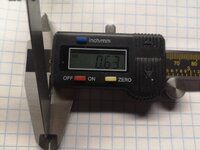
IMG_20251108_213901.jpg
0.025"=0.635mm
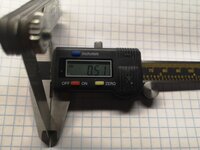
IMG_20251108_214118.jpg
0.020"=0.508mm
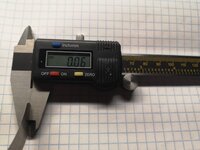
IMG_20251108_214227.jpg
0.0025"=0.064mm
IMG_20251108_214816.jpg
 
Last edited:
To avoid these ads, REGISTER NOW!

zendriver

Well-known member
Joined
Dec 10, 2014
Messages
29,770
Location
Indiana
I've hade one for years, used on occasion.

Been storing it the garage lately and the tiny battery has finally died.

Talk about inflation!, just checking, the price for a new tool, is nearly double what I paid. Just want to make sure it was not less than a new battery.:lol:
 

AC-WC

Well-known member
Joined
Jan 22, 2023
Messages
762
Location
NE, Indiana
I've had mine a little longer, gets calibrated at work for free. Did you know it also has a port to download data into software? Can't beat that for $10.
 

zendriver

Well-known member
Joined
Dec 10, 2014
Messages
29,770
Location
Indiana
I've had mine a little longer, gets calibrated at work for free. Did you know it also has a port to download data into software? Can't beat that for $10.
So, that's what that is ? :thumbup:

I was messing with it yesterday to get to the battery, popped that little cover off "WTF is this, USB port?" :headscrat :lol:
 

dscheidt

Well-known member
Joined
Apr 26, 2017
Messages
2,887
So, that's what that is ? :thumbup:

I was messing with it yesterday to get to the battery, popped that little cover off "WTF is this, USB port?" :headscrat :lol:
If it’s using the standard interface, it is very low voltage (1.5v, I think) serial data. So it requires some kind of interface to raise voltage.
 

Beerhippie

Well-known member
Joined
Oct 13, 2023
Messages
9,679
Location
Far NE Oregon
One, why not use that little button that says inch/mm instead of converting?

B) Which are more accurate: PM feeler gauges or two-decade-old HF digital calipers?
 

Aileron

Well-known member
Joined
Apr 15, 2019
Messages
460
Location
outside
I had one in the original wrapper in the garage cabinet. Opened it the other day and it was dead. The battery had leaked. Put the spare in and its dead also. Not sure if its saveable or not. Threw it to the side and used my dial Starret.
 

908Jim

Well-known member
Joined
Aug 1, 2013
Messages
555
I have had plenty of these as "beater" calipers for fabrication work when I want to keep the US, Swiss, and Japanese stuff nice and safe. They are ok for quick sanity checks on the floor but they have a lot more compliance than better calipers which can cause a lot of error if people don't have the feel for their calipers vs a standard. I've also had pairs that have errors at a random point of the scale. For example, 1.000" and 4.000" might read dead nuts on standards but 3.30 to 3.350 is several thou off because of a defect in the scale.

They're $10 calipers. Trust them accordingly.
 

AEAdam

Well-known member
Joined
May 27, 2023
Messages
2,730
Location
SE PA
This story is both good and bad. Good if you have enjoyed using this tool for the past 20yrs. Bad if you haven’t. I have tools I bought 20 or 30 yrs ago that I hate, but cannot replace because they have the audacity to continue working. Come to think of it, my wife probably feels that way about me!

Point is, be careful selecting tools or spouses. Both can stick around longer than you might expect.
 

darkzero

Well-known member
Joined
Oct 20, 2011
Messages
3,317
Location
SoCal
For the most part, the cheapies are accurate enough. Manufacturing quality will vary drastically.

Older HF ones were branded Cen-Tech & newer ones Pittsburgh. But depending on the supplier they weren't always banded on the actual caliper as such.

Despite the different supplies over the years, there are basically two types. Absolute models which are the battery eaters & non absolute. Absolute remembers their position at all times as long as there is enough juice in the battery. They don't actually turn off & due to their inefficiency that's why they eat batteries.

I used to buy them for $10 just for the case for my Mitus & gave away the calipers. But those $10 days are gone, the only HF one I ever kept is a non absolute model which I use at work. Since it doesn't remember it's position & actually turns off it doesn't eat batteries. Downside is that you have to remember to zero it everytime you turn it on. That's annoying but I rather deal with that than dead batteries. But that's only at work. Of course none of those issues with my Mitus.
 

AEAdam

Well-known member
Joined
May 27, 2023
Messages
2,730
Location
SE PA
When I learned about how inaccurate calipers were in general, I began testing those I had. What I determined was the difference in inaccuracy between models seemed to be roughly aligned to the inherent inaccuracy in my technique using them.

My premium models are nicer and more accurate than my cheapies. But the real world accuracy difference is less than we think.

Btw, I was measuring gage blocks and found exactly what @908Jim found. There were “inaccurate” spots or ranges on the scale. But in my case, I thought it the underlying cause was grit or burrs on the slide, not a magnetic tape error. I purchased my first set from LittleMachineShop.com. (recommend) I disassembled them and stoned all the interfacing parts. They are made of pretty hard steel so that wasn’t easy. I swear it helped, but not worth anyone else’s time.
 

RoninB4

Well-known member
Joined
Jul 22, 2020
Messages
3,491
Location
Under My House
They're $10 calipers. Trust them accordingly.
-Couldn't agree more with the above quote. The operative word here is "trust". The resolution may read down to .*** but the accuracy (last time I looked at one) only reads to +/- .001 and that's where trust comes in. Most folks here aren't reading to that level accuracy and those familiar with that level aren't going to be using a caliper for that anyway. Any caliper shouldn't be trusted to read that level of accuracy, wrong tool for the job.

-Since most folks here only really need an accuracy (resolution is different) of .** then these will probably do ok. As for the dead zones, I'd find that more than a little unsettling for important dimensions regardless of accuracy needed. I don't think I could work with something I couldn't trust but that's just me.
 

jayemm

Well-known member
Joined
Dec 18, 2018
Messages
1,512
Location
up high down low
-Couldn't agree more with the above quote. The operative word here is "trust". The resolution may read down to .*** but the accuracy (last time I looked at one) only reads to +/- .001 and that's where trust comes in. Most folks here aren't reading to that level accuracy and those familiar with that level aren't going to be using a caliper for that anyway. Any caliper shouldn't be trusted to read that level of accuracy, wrong tool for the job.

-Since most folks here only really need an accuracy (resolution is different) of .** then these will probably do ok. As for the dead zones, I'd find that more than a little unsettling for important dimensions regardless of accuracy needed. I don't think I could work with something I couldn't trust but that's just me.
I got what you're saying and luckily not having to need extreme precision, in trying to confirm accuracy on my "inexpensive" digital calipers, and lacking a set of gage blocks, have resorted to stacking 1-2-3 blocks in various configurations to hit the 1-2-3-4-5-6 marks and "assume" (there's that word) points in between are accurate.
 

RoninB4

Well-known member
Joined
Jul 22, 2020
Messages
3,491
Location
Under My House
I got what you're saying and luckily not having to need extreme precision,
-That's a big aspect and the correct way to consider it.
in trying to confirm accuracy on my "inexpensive" digital calipers, and lacking a set of gage blocks,
-Gauge blocks, regardless of what most people think, are not the last word for testing calipers. Gauge blocks are good for testing accuracy at set distances but they do NOT test how parallel the jaws are, particularly when the calipers have been dropped. Gauge blocks also do NOT test well for deflection at the beam when jaw pressure is applied. A gauge pin tested at several places on the jaw will reveal whether the jaws are parallel and how much pressure will cause deflection in jaw pressure.
have resorted to stacking 1-2-3 blocks in various configurations to hit the 1-2-3-4-5-6 marks and "assume" (there's that word) points in between are accurate.
-That would depend upon how accurate the 1-2-3 blocks are. A great many of those blocks that are sold commercially are oversize by anywhere from .0005-.003 on all sides. That's not sloppy manufacturing, it's purposely done to allow the buyer to accurately grind to size and perpendicular (square) to all sides. I purchased a set many years ago just because they were slightly oversized so I could grind them in. Some are supposedly to size but you have to know how much because when you start stacking them together you're adding the error of each one together in a stack. The phrase "tolerance stack" comes to mind. If most of your work is under 1" you could always get a precision ground steel dowel pin, they're almost throw away cheap in some machine shops. Most ground steel dowel pins are only about .0001-.00025 (yes tenths..) oversize. Either that or get a cheap used micrometer that has the "standard" rod. Those are used for setting the accuracy of the micrometer and are closer to size than almost anything you can buy cheaply. The standard rods are in 1" increments per each micrometer, cheaper than a set of gauge blocks (unless you need them anyway) and it won't matter if the mic is any good or not. Some sets of all the standard rods are even available on the used market but probably more expensive. Test your caliper with those. Hope this helps.

-For what you're doing I wouldn't be too concerned about it, you said you're not working to extreme precision. I'd be more concerned about checking for "dead zones" that another member commented on.
 

908Jim

Well-known member
Joined
Aug 1, 2013
Messages
555
-That's a big aspect and the correct way to consider it.

-Gauge blocks, regardless of what most people think, are not the last word for testing calipers. Gauge blocks are good for testing accuracy at set distances but they do NOT test how parallel the jaws are, particularly when the calipers have been dropped. Gauge blocks also do NOT test well for deflection at the beam when jaw pressure is applied. A gauge pin tested at several places on the jaw will reveal whether the jaws are parallel and how much pressure will cause deflection in jaw pressure.

-That would depend upon how accurate the 1-2-3 blocks are. A great many of those blocks that are sold commercially are oversize by anywhere from .0005-.003 on all sides. That's not sloppy manufacturing, it's purposely done to allow the buyer to accurately grind to size and perpendicular (square) to all sides. I purchased a set many years ago just because they were slightly oversized so I could grind them in. Some are supposedly to size but you have to know how much because when you start stacking them together you're adding the error of each one together in a stack. The phrase "tolerance stack" comes to mind. If most of your work is under 1" you could always get a precision ground steel dowel pin, they're almost throw away cheap in some machine shops. Most ground steel dowel pins are only about .0001-.00025 (yes tenths..) oversize. Either that or get a cheap used micrometer that has the "standard" rod. Those are used for setting the accuracy of the micrometer and are closer to size than almost anything you can buy cheaply. The standard rods are in 1" increments per each micrometer, cheaper than a set of gauge blocks (unless you need them anyway) and it won't matter if the mic is any good or not. Some sets of all the standard rods are even available on the used market but probably more expensive. Test your caliper with those. Hope this helps.

-For what you're doing I wouldn't be too concerned about it, you said you're not working to extreme precision. I'd be more concerned about checking for "dead zones" that another member commented on.

I'm not a machinist, just a hack, so take this for FWIW.

While I have micrometer standards in a handful of sizes I use to check my calipers I don't think it's necessary for most people in the garage. An ABEC rated (literally 1 or higher) ball bearing is a perfectly adequate standard for a sanity check calipers. A quick look shows that the OD tolerance for a ball bearing under 3.1" OD shows a worst case tolerance range of +.0000" to -.0005" with many sizes being even tighter, which is far more accurate than what you should ever be using a caliper for.
 

RoninB4

Well-known member
Joined
Jul 22, 2020
Messages
3,491
Location
Under My House
I'm not a machinist, just a hack, so take this for FWIW.
-You may not be a machinist but I certainly do NOT regard you as a hack. I don't recall a post of yours I disagreed with.(y)
While I have micrometer standards in a handful of sizes I use to check my calipers I don't think it's necessary for most people in the garage.
-Probably not needed is right, I was just offering a low cost suggestion for those feeling the need to test their budget calipers.
An ABEC rated (literally 1 or higher) ball bearing is a perfectly adequate standard for a sanity check calipers. A quick look shows that the OD tolerance for a ball bearing under 3.1" OD shows a worst case tolerance range of +.0000" to -.0005" with many sizes being even tighter, which is far more accurate than what you should ever be using a caliper for.
-Absolutely is much tighter. I only suggested a ground steel dowel pin because of availability and cost. A ball bearing would be more than good enough but I seldom find ball bearings larger than 2". Perhaps you have a source for used ball bearings up to 6"? o_O
 

ecotec

Well-known member
Joined
Oct 5, 2010
Messages
5,419
I still use mine all the time. I trust it just fine for what little I use it for at home. When I got it, I removed the lid of the case and set it into a drawer of a machinist box. It has stayed in pretty much perfect condition because of it being cared for.

I have a Mitutoyo right next to it, but I usually grab the Pittsburgh because it is more convenient. I would never rip the lid off of a case of a high dollar caliper.
 

Fixr

Well-known member
Joined
Dec 23, 2012
Messages
9,702
Location
SW VA
I've hade one for years, used on occasion.

Been storing it the garage lately and the tiny battery has finally died.

Talk about inflation!, just checking, the price for a new tool, is nearly double what I paid. Just want to make sure it was not less than a new battery.:lol:
I don't think HF has carried that one for well over a decade. They "replaced" it with something Pittsburgh branded that isn't half as good. It's gritchy and works when it wants to. But I'm pretty sure it was cheaper than the earlier model.
 
To avoid these ads, REGISTER NOW!

zendriver

Well-known member
Joined
Dec 10, 2014
Messages
29,770
Location
Indiana
I don't think HF has carried that one for well over a decade. They "replaced" it with something Pittsburgh branded that isn't half as good. It's gritchy and works when it wants to. But I'm pretty sure it was cheaper than the earlier model.

Are you basing your comments from actual use of the product? :dunno:

If by cheaper you mean price, I think I paid 10 bucks for it

As far as being less accurate that just seems absurd, given the nature of the modern tool world
 

AEAdam

Well-known member
Joined
May 27, 2023
Messages
2,730
Location
SE PA
Are you basing your comments from actual use of the product? :dunno:

If by cheaper you mean price, I think I paid 10 bucks for it
Reminder of how these tools work: you apply a force to open or close the jaws on the thing you are measuring. The jaws and frame flex under load, but do so consistently because their spring constant is consistent (k) F=kx

If the load you apply is different for every reading, and it will be, this WILL, not may, change your reading. When the mechanism is cheaply made, the friction you must over come to move the jaw varies throughout the range. That is typically the #1 source of inaccuracy in calipers.

Every machinist I know owns a pair of cheapies that they use in dirty environments to work to .0X” accuracy. Because dirt and grime have the exact same effect. I have several sets myself including plastic models for aircraft, so I don’t inadvertently scratch paint finishes.

I tried fixing cheapies, by sanding rough surfaces. But these are typically stainless and hard to hone. But it does help.

As far as being less accurate that just seems absurd, given the nature of the modern tool world
Yep, here we go. This is the conspiracy theory I wrote about here. What you are suggesting is that surely all the electronic reader heads for Mitutoyo, Tesa, Starrett, Fowler, and Pittsburgh all come from the same factory in China. Because they look similar, they are identical. You either believe that, or unintentionally suggested it. In this case, you would be right for maybe half of the brands I mentioned. And that’s the problem with rebranding.

We (US) did this. And now we can’t get that genie back in the bottle. Is a Lexus better than a Toyota Camry? Is an Audi Q5 a cheaper version of the Porsche Macan? We did this and premium brands will suffer. Why should I pay a premium for an Apple branded computer monitor when it uses a Samsung screen I can buy cheaper under a different brand name?

This is a subtext in SO many threads where we discuss tool brands.
 

zendriver

Well-known member
Joined
Dec 10, 2014
Messages
29,770
Location
Indiana
Reminder of how these tools work: you apply a force to open or close the jaws on the thing you are measuring. The jaws and frame flex under load, but do so consistently because their spring constant is consistent (k) F=kx

If the load you apply is different for every reading, and it will be, this WILL, not may, change your reading. When the mechanism is cheaply made, the friction you must over come to move the jaw varies throughout the range. That is typically the #1 source of inaccuracy in calipers.

Every machinist I know owns a pair of cheapies that they use in dirty environments to work to .0X” accuracy. Because dirt and grime have the exact same effect. I have several sets myself including plastic models for aircraft, so I don’t inadvertently scratch paint finishes.

I tried fixing cheapies, by sanding rough surfaces. But these are typically stainless and hard to hone. But it does help.


Yep, here we go. This is the conspiracy theory I wrote about here. What you are suggesting is that surely all the electronic reader heads for Mitutoyo, Tesa, Starrett, Fowler, and Pittsburgh all come from the same factory in China. Because they look similar, they are identical. You either believe that, or unintentionally suggested it. In this case, you would be right for maybe half of the brands I mentioned. And that’s the problem with rebranding.

We (US) did this. And now we can’t get that genie back in the bottle. Is a Lexus better than a Toyota Camry? Is an Audi Q5 a cheaper version of the Porsche Macan? We did this and premium brands will suffer. Why should I pay a premium for an Apple branded computer monitor when it uses a Samsung screen I can buy cheaper under a different brand name?

This is a subtext in SO many threads where we discuss tool brands.
I’m not suggesting anything.

Your point about machinists just using them in dirty environments just seems silly

They don’t need accuracy in those situations?
 

RoninB4

Well-known member
Joined
Jul 22, 2020
Messages
3,491
Location
Under My House
Your point about machinists just using them in dirty environments just seems silly
-There's nothing silly about it. If you've never worked in a machine shop then you have no idea what the environment can be. You also might have a different definition of what "dirty" is.
They don’t need accuracy in those situations?
-While I like reading many of your postings the above statement is patently absurd.
 

zendriver

Well-known member
Joined
Dec 10, 2014
Messages
29,770
Location
Indiana
-There's nothing silly about it. If you've never worked in a machine shop then you have no idea what the environment can be. You also might have a different definition of what "dirty" is.

-While I like reading many of your postings the above statement is patently absurd.
i have worked in a machine shop. We used the same measuring tools al of the time.

Besides, what did machinists do in dirty situations before Harbor Freight? Use some old 'beater" measuring tools? That sound's like a winner.

This just seems like the same tired parroting, anyway.

China, Taiwan, Malaysia etc, can build machines to make computer chips, make those computer chips, computer hard drives, 3d printers. laser **** and precision tooling to build a precise everything. But, when it comes to a set of digital calipers, its no-can-do, it's just impossible for them to make something that is consistently accurate.

IMO, it defies logic, but doesn't matter, since it's rhetoric we seem interested in.
 

Steve_P

Well-known member
Joined
Sep 15, 2010
Messages
5,182
i have worked in a machine shop. We used the same measuring tools al of the time.

Besides, what did machinists do in dirty situations before Harbor Freight? Use some old 'beater" measuring tools? That sound's like a winner.

This just seems like the same tired parroting, anyway.

China, Taiwan, Malaysia etc, can build machines to make computer chips, make those computer chips, computer hard drives, 3d printers. laser **** and precision tooling to build a precise everything. But, when it comes to a set of digital calipers, its no-can-do, it's just impossible for them to make something that is consistently accurate.

IMO, it defies logic, but doesn't matter, since it's rhetoric we seem interested in.

Haven't you heard from the GJ Cranky Boomer COO Commission (CBCC) that even Taiwan can't build a quality ratchet or drill press, even though they build the world's most advanced computer chips? :ROFLMAO: The reality is that these guys would rather eat glass than admit that China or Taiwan can make a quality vise or anvil, let alone even a drill press or dial caliper. Somehow China made the smart phone they are typing on but can't even make a quality anvil.
 

AEAdam

Well-known member
Joined
May 27, 2023
Messages
2,730
Location
SE PA
i have worked in a machine shop. We used the same measuring tools al of the time.

Besides, what did machinists do in dirty situations before Harbor Freight? Use some old 'beater" measuring tools? That sound's like a winner.
Yeah, they used easy to clean veniers instead of risking their dials for example. I don't have a grinder, but I want one. That's one machine you don't want your precision tools near. I like my fly cutter. I grind special bits for it and it can make a surface like a mirror on aluminum. That things makes a dust cloud of metal! My wife caught me once- standing there like a dummy in a cloud of metal dust with no PPE!

China, Taiwan, Malaysia etc, can build machines to make computer chips, make those computer chips, computer hard drives, 3d printers. laser **** and precision tooling to build a precise everything. But, when it comes to a set of digital calipers, its no-can-do, it's just impossible for them to make something that is consistently accurate.

IMO, it defies logic, but doesn't matter, since it's rhetoric we seem interested in.
You know the deal. They can absolutely build nice calipers. But not for an MSRP of $10 USD. Chinese workers get paid more than many in the US think. China is changing. To build and ship a set of digicals for what? $1? you have to cut corners. Or, in this case, NOT cut corners. My Chinese digital calipers have pretty ragged surfaces!
 
Last edited:

zendriver

Well-known member
Joined
Dec 10, 2014
Messages
29,770
Location
Indiana
You know the deal. They can absolutely build nice calipers. But not for an MSRP of $10 USD. Chinese workers get paid more than many in the US think. China is changing. To build and ship a set of digicals for what? $1? you have to cut corners.
Maybe they should charge more, then we'd deem them more accurate. lol

Without going too far into the political weeds, lets remember that the cost of something from China, might not be relative to it's manufacturing cost - at all. That whole manufacturing subsidy thing. One can buy a pretty nice plasma cutter for $150. ( I have one).

Can't find it now, but once spied a YouTube video showed a Chinese company machining the bodies for digital calipers. Looks like it spit one out about every second, so maybe labor cost is not really a big issue, if the factory is pretty automated. :dunno:
 

AEAdam

Well-known member
Joined
May 27, 2023
Messages
2,730
Location
SE PA
Maybe they should charge more, then we'd deem them more accurate. lol
I don't get the lol part but YES. If they chose to make better quality stuff, it would cost more and we'd probably like it more and they may well do that. Or they may make higher grades of digi-cals and HF just won't import them. People say igaging or Fowler bring in better quality chinese made stuff, but I don't see much difference between those and Pittsburgh. But I could be wrong.
Without going too far into the political weeds, lets remember that the cost of something from China, might not be relative to it's manufacturing cost - at all. That whole manufacturing subsidy thing. One can buy a pretty nice plasma cutter for $150. ( I have one).

Can't find it now, but once spied a YouTube video showed a Chinese company machining the bodies for digital calipers. Looks like it spit one out about every second, so maybe labor cost is not really a big issue, if the factory is pretty automated. :dunno:
Interesting. That's makes sense. The hand work sometimes adds the cost to things. But if its careful hand finishing, that can also add a lot of value to a product. I'm telling ya (yous), my US made Starrett 798 calipers are the bees knees. They are jewel-like. A lot of my Starrett stuff is like that. The finishes are just really nice.
 

zendriver

Well-known member
Joined
Dec 10, 2014
Messages
29,770
Location
Indiana
The lol was about our insistence on comparing quality to price.

If a brand-name LED flashlight is $75 then a no name $15 one must be a piece of ****. It doesn’t necessarily work that way, and has not for the last 30 years.

The calipers they sell are now $23 if that makes people feel better. My guess is they just removed the data port because no one probably uses it.

As far as accuracy, I think there’s endless YouTube comparison videos that has the Asian measuring tools hanging in there pretty well.

As the world turns, even Starrett has measuring tools. From China, but they charge more than $23 for calipers. I’m assuming they are accurate. :dunno:
 

AEAdam

Well-known member
Joined
May 27, 2023
Messages
2,730
Location
SE PA
The lol was about our insistence on comparing quality to price.

If a brand-name LED flashlight is $75 then a no name $15 one must be a piece of ****. It doesn’t necessarily work that way, and has not for the last 30 years.

The calipers they sell are now $23 if that makes people feel better. My guess is they just removed the data port because no one probably uses it.

As far as accuracy, I think there’s endless YouTube comparison videos that has the Asian measuring tools hanging in there pretty well.

As the world turns, even Starrett has measuring tools. From China, but they charge more than $23 for calipers. I’m assuming they are accurate. :dunno:
Hope this helps: If you are in a store that sells these, and you are allowed to open the box and mess with them, run the jaws the full length of the slide several times open and closed. If there’s something that feels like grit, any hint of resistance in one or more spots, don’t buy them. The slide ways on new digital calipers should feel perfect. This is important for their accuracy.

If you have old calipers and they are gritty, disassemble and clean them. Hose them down with wd-40 to float out any crud. Then wipe as much of that off as you can with a lint free cloth and resassemble. You don’t really want oil on your calipers.

If you have calipers and they have a rough spot, you can try smoothing it with your machinist’s hones. If you are unsuccessful or unacquainted with the good folks of Gesswein, put that set in the dirty coffee mug with your pencils and spare reading glasses, next to the bench or surface grinder.

I have had cheap digital calipers so sticky the the second decimal place was questionable (.0X”). Typically the Chinese made cheapies are pretty good, but the third decimal place (.00X”) will always be a bit of a guess. It’s less of a guess with good units. The fourth decimal place on all calipers is a joke. Mitutoyo says their calipers are good to +/- .0015. My guess is the cheapies are double that, which can be more than good enough for many users.

I think the chief complaint about the cheap calipers is their short battery life. I’ve done no testing, just an opinion, but I’ve observed the newer models with the larger CR2032 battery are night and day better. Whether they are true absolute reading or the battery just lasts longer because they have more juice I don’t know. If you have old ones you love including mitutoyos, with LR44 batteries, people say replacing them with SR44 batteries prolongs their lives.
 

pcrov

Well-known member
Joined
Feb 27, 2023
Messages
375
Location
Ontario, CA
I think the chief complaint about the cheap calipers is their short battery life. I’ve done no testing, just an opinion, but I’ve observed the newer models with the larger CR2032 battery are night and day better. Whether they are true absolute reading or the battery just lasts longer because they have more juice I don’t know. If you have old ones you love including mitutoyos, with LR44 batteries, people say replacing them with SR44 batteries prolongs their lives.
Like 99% of the time I thought my cheapie's LR44 was dying it turned out to be making bad contact. Wipe it off with little deoxit and it's going fine again for months.
 

zendriver

Well-known member
Joined
Dec 10, 2014
Messages
29,770
Location
Indiana
Hope this helps: If you are in a store that sells these, and you are allowed to open the box and mess with them, run the jaws the full length of the slide several times open and closed. If there’s something that feels like grit, any hint of resistance in one or more spots, don’t buy them. The slide ways on new digital calipers should feel perfect. This is important for their accuracy.

If you have old calipers and they are gritty, disassemble and clean them. Hose them down with wd-40 to float out any crud. Then wipe as much of that off as you can with a lint free cloth and resassemble. You don’t really want oil on your calipers.

If you have calipers and they have a rough spot, you can try smoothing it with your machinist’s hones. If you are unsuccessful or unacquainted with the good folks of Gesswein, put that set in the dirty coffee mug with your pencils and spare reading glasses, next to the bench or surface grinder.

I have had cheap digital calipers so sticky the the second decimal place was questionable (.0X”). Typically the Chinese made cheapies are pretty good, but the third decimal place (.00X”) will always be a bit of a guess. It’s less of a guess with good units. The fourth decimal place on all calipers is a joke. Mitutoyo says their calipers are good to +/- .0015. My guess is the cheapies are double that, which can be more than good enough for many users.

I think the chief complaint about the cheap calipers is their short battery life. I’ve done no testing, just an opinion, but I’ve observed the newer models with the larger CR2032 battery are night and day better. Whether they are true absolute reading or the battery just lasts longer because they have more juice I don’t know. If you have old ones you love including mitutoyos, with LR44 batteries, people say replacing them with SR44 batteries prolongs their lives.
Battery life for me :dunno: I don’t use them a lot and I think it’s the original battery that finally died.

It takes literally seconds to replace it so I wouldn’t think that that would be that big a deal.
 

dscheidt

Well-known member
Joined
Apr 26, 2017
Messages
2,887
Battery life for me :dunno: I don’t use them a lot and I think it’s the original battery that finally died.

It takes literally seconds to replace it so I wouldn’t think that that would be that big a deal.
Actually changing the battery isn't that big a deal. It's needing a battery of the right size, finding it, etc, that's the pain. And of course, it's dead when you need to make a quick measurement, so instead of a 10 second job, it's a 10 minute one. If you use it all the time, it's much less of a hassle, but it's still an annoyance. How much of annoyance depends a lot on you.

(The last time the battery in my mitutoyo was dead, the spare I keep in the case was also dead. I'm pretty sure they came out of the same pack, so they probably both died of old age, not use.)
 

zendriver

Well-known member
Joined
Dec 10, 2014
Messages
29,770
Location
Indiana
Actually changing the battery isn't that big a deal. It's needing a battery of the right size, finding it, etc, that's the pain. And of course, it's dead when you need to make a quick measurement, so instead of a 10 second job, it's a 10 minute one. If you use it all the time, it's much less of a hassle, but it's still an annoyance. How much of annoyance depends a lot on you.

(The last time the battery in my mitutoyo was dead, the spare I keep in the case was also dead. I'm pretty sure they came out of the same pack, so they probably both died of old age, not use.)
I think if I used it all of the time, I’d probably use something different. Abig battery would be s plus.

I don’t think any claimed these $20 tools are the best, just functional and reasonably accurate, for the money.
 

steve855

Well-known member
Joined
Dec 30, 2019
Messages
61
Location
PA
I had the same caliper as OP for many years and it served its purpose. I didn't count on it for +/- .001" but I think it was probably trustworthy to about +/- .003" if I had to guess. Finally died last year, the LCD display started going crazy and new battery didn't help.

I use a Mitutoyo digital caliper every day at work but I didn't need one for my own shop. I have a nice starrett model #1202 dial caliper and a starrett 0-1" micrometer if I need more accuracy than the HF caliper. The HF caliper was nice because I didn't feel bad using it a bit more roughly than something higher-end.

Went to HF to buy a replacement and discovered they don't have the exact model as my old (2003?) caliper anymore. What they did have is a caliper that adds a third function to inch/metric readings- fractional inches. I didn't notice this right away until I started cycling between inch/metric and realized every time would require another button push to get past the fraction setting.

I use both inch and metric functions frequently at work and in my home shop, and I knew immediately that the fraction thing was going to drive me crazy. So I returned that model and found another model that's inch/metric only. I don't like them quite as much as my old HF pair but they do what I need for $23 or whatever it was.

Old man rant- I don't need my caliper to tell me that .750" is 3/4" or .1875" is 3/16". If I don't know the fractional/decimal equivalent offhand, I have at least three conversion charts and 2 calculators in my workshop that can answer the question quickly. I'm assuming the fractional thing is supposed to be a convenience for woodworking or something similar. Probably very useful to someone, but it was a major irritation to me. /rant.
 

jayemm

Well-known member
Joined
Dec 18, 2018
Messages
1,512
Location
up high down low
I had the same caliper as OP for many years and it served its purpose. I didn't count on it for +/- .001" but I think it was probably trustworthy to about +/- .003" if I had to guess. Finally died last year, the LCD display started going crazy and new battery didn't help.

I use a Mitutoyo digital caliper every day at work but I didn't need one for my own shop. I have a nice starrett model #1202 dial caliper and a starrett 0-1" micrometer if I need more accuracy than the HF caliper. The HF caliper was nice because I didn't feel bad using it a bit more roughly than something higher-end.

Went to HF to buy a replacement and discovered they don't have the exact model as my old (2003?) caliper anymore. What they did have is a caliper that adds a third function to inch/metric readings- fractional inches. I didn't notice this right away until I started cycling between inch/metric and realized every time would require another button push to get past the fraction setting.

I use both inch and metric functions frequently at work and in my home shop, and I knew immediately that the fraction thing was going to drive me crazy. So I returned that model and found another model that's inch/metric only. I don't like them quite as much as my old HF pair but they do what I need for $23 or whatever it was.

Old man rant- I don't need my caliper to tell me that .750" is 3/4" or .1875" is 3/16". If I don't know the fractional/decimal equivalent offhand, I have at least three conversion charts and 2 calculators in my workshop that can answer the question quickly. I'm assuming the fractional thing is supposed to be a convenience for woodworking or something similar. Probably very useful to someone, but it was a major irritation to me. /rant.
I had a HF caliper for years with the fractional feature. It was handy for identifying fractional Allen wrenches that were too small or not labeled. And very few other things. But for things not an exact fraction it would read down to the 1/128" so you'd get **** like 23/128" or similar and then I'd have to jiggle the thumbwheel back and forth to see what made sense. I gave those calipers to a neighbor and the replacement set is only in/mm.
 

RTM

Well-known member
Joined
May 13, 2019
Messages
13,090
Location
SF Bay Area
Old man rant- I don't need my caliper to tell me that .750" is 3/4" or .1875" is 3/16". If I don't know the fractional/decimal equivalent offhand, I have at least three conversion charts and 2 calculators in my workshop that can answer the question quickly. I'm assuming the fractional thing is supposed to be a convenience for woodworking or something similar. Probably very useful to someone, but it was a major irritation to me. /rant
As I woodworker, I find the fractions annoying. If it would stop at 1/16, or even 1/32, it would be useful. But giving me 1/128 is just annoying. When trying to size a box full of unmarked Allen wrenches for example, throw in the +/- tolerances, could be metric, and even **** quality, I got nowhere fast.

I use my fractions occasionally when sizing vintage screws for repairs, but the same rules from above apply.
 
To avoid these ads, REGISTER NOW!
Top Bottom