
safariknut
Well-known member
Not your average "tool" and if it is inappropriate for this forum please remove it. While I was downtown yesterday picking up a couple of watch batteries I wandered into one of the four antique shops we have in the downtown area. I recently scored a nice S&K machinists' tool box here and wasn't disappointed this time either.
In the case was an old straight razor with a strop that housed a drawer for holding said razor. Not sure if it was original to the razor but it is old enough to be.
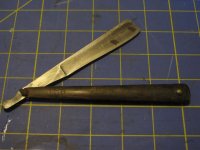
Early straight razors are fairly easy to spot by their shape:they are straight! Later razors started curving the handles slightly and the later they were made the more curve they had. Another way to tell early ones is by the length and thickness of the tail.The shorter(or the absence of)the tail the earlier they are. The tang stamp will also tell a lot but they are harder to decipher age by.
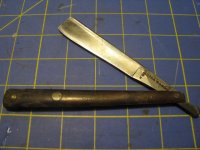
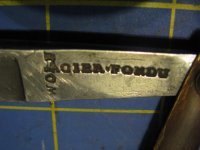
Anyway the handles of the razor were adorned with small circles arranged in patterns which was unusual to me. The tang stamp(WOLF-ACIER FONDU) which translates from the French as CAST STEEL can be deceptive as that stamping was often used on early English razors as well. The WOLF is supposed to have a crown above it and it was nearly completely worn off by repeated honing of the blade. The stamp is that of a cutler named John Shepherd of Holles Croft England who was in business from 1770 to 1795.
The strop consists of a hard wood handle attached to a thin metal box covered with a soft leather. Inside is a small drawer made of the same metal with a wood front and brass knob to open it.
The razor;other than being heavily sharpened is in decent shape except for the pile side handle which has a small piece missing around the pivot pin. The handles have no other cracks and have not been damaged by dermacid beetle larvae that so many horn pieces are subject to.
All in all a great example of an early English straight razor for under $20 US.
In the case was an old straight razor with a strop that housed a drawer for holding said razor. Not sure if it was original to the razor but it is old enough to be.
Early straight razors are fairly easy to spot by their shape:they are straight! Later razors started curving the handles slightly and the later they were made the more curve they had. Another way to tell early ones is by the length and thickness of the tail.The shorter(or the absence of)the tail the earlier they are. The tang stamp will also tell a lot but they are harder to decipher age by.
Anyway the handles of the razor were adorned with small circles arranged in patterns which was unusual to me. The tang stamp(WOLF-ACIER FONDU) which translates from the French as CAST STEEL can be deceptive as that stamping was often used on early English razors as well. The WOLF is supposed to have a crown above it and it was nearly completely worn off by repeated honing of the blade. The stamp is that of a cutler named John Shepherd of Holles Croft England who was in business from 1770 to 1795.
The strop consists of a hard wood handle attached to a thin metal box covered with a soft leather. Inside is a small drawer made of the same metal with a wood front and brass knob to open it.
The razor;other than being heavily sharpened is in decent shape except for the pile side handle which has a small piece missing around the pivot pin. The handles have no other cracks and have not been damaged by dermacid beetle larvae that so many horn pieces are subject to.
All in all a great example of an early English straight razor for under $20 US.
Attachments
-
 WolfAcierFonduRazor-w-Case&Strop-19.50 001.jpg53.1 KB · Views: 82
 -
 WolfAcierFonduRazor-w-Case&Strop-19.50 002.jpg57.1 KB · Views: 67
 -
 WolfAcierFonduRazor-w-Case&Strop-19.50 003.jpg44 KB · Views: 72
 -
 WolfAcierFonduRazor-w-Case&Strop-19.50 004.jpg49.2 KB · Views: 70
 -
 WolfAcierFonduRazor-w-Case&Strop-19.50 007.jpg76.9 KB · Views: 81