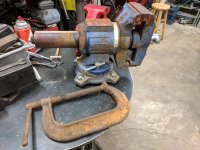
I'm about ready to go to a small party at a friend's house, so this will be my last post of the year. I want to wish everyone a Happy New Year and to thank everyone for all the good stuff we found, for the laughs, for the camaraderie, and for the sense of relentless devotion we all share. I also want to wish the best of luck to BlueBomber (not that he needs it - we are all in good hands), and everyone else in 2019.
As a token of my appreciation, I give you all my ode to pickers....
Rust Never Sleeps
We trudge from our trucks and cars like miners with flashlights huddling in front of a table waiting for the load to be unloaded from the back of the truck parked behind the table. The table forming a barrier between us and them. Pickers and vendors. We stand there in our boondockers, our shitkickers and our sneakers. We are grown men with collars turned up against the cold, our bags slung over the opposite shoulder, looking like irregulars in a ragtag army. We take our places, facing forward, a loose formation, which cannot help but bring to mind supplicants at the altar of some ancient god. Or a throng of marathoners poised at the starting line. It is the period before the vendors are ready to start when to be still is harder than anything, energy escaping in shifts and fidgets.
We breathe lightly, conserving energy. The air from our lungs making little puffs in the air above our heads. We do not talk much. Talk is for those who come later, holding cups of coffee and smoking cigars, when the sun is up. Talk is for old men and rookies. Talk is unnecessary. Talk is for jinxing. There is not much for anyone to say. Acknowledgment of our mutual consciousness of each other in the world is a given, its concordance immutable. Also the sense that we were all there for something rare enough that it felt sacrilegious to simply say it out loud. Or fear that it would go **** to say its name. At any rate, we are not there for talk. This mantra is not merely philosophical, but practical. We watch the progress of the unloading illuminated by the intermittent strafing of flashlight beams, trying to identify the objects by shape. If anybody recognizes anything, nobody is saying. Intelligence is meant to be expended in only one way, at offer time, and that is selfishly guarded. We reflect upon our collections, conducting an inventory in our heads. We are preoccupied with thoughts of the pawing through the haul ahead. We visualize the gleaming wrench, not the gaping hole on the tool board.
Or perhaps instead we are standing in a line in a driveway or around the bend on the sidewalk in front of an estate with a little piece of paper, grasped firmly between our thumb and index finger, with a little entry number on it. Hoping the number is low enough for the object of our desire, spotted in an advertisement written in code, written in another language, in the pixelated artificial light of the magic box. Long C. Baby Bullet. Vacuum-Grip.
And then we hear the magic words.
The making of a pile is quick, deft, but patient work, systematic and unglamorous. Not unlike the DNA analysis of zebra fish under a microscope. Too fast you may miss something. Too slow, you may miss something in the next pile to someone else who gets there first. The balance is fine. The balance is an art. There are limits. You have to choose what to focus on. You have to establish priorities. You have to learn what looks promising and what looks like junk. Fingers and eyes, trained for what the heart desires, operating in unison. We know our business, vying with each other for supremacy in our minds. There is no jostling. This is not a wrestling match. We compete, to be sure, but there are unwritten rules, expectations and traditions which reach back to men with bad teeth and hard scowls, such as ‘Never reach into a box someone already has their hand in.’ The conventions observed among pickers do not contain the competition, but channel it. They are flexible rules, liable to be shifted by resentments and disagreements. We are governed by the mood of the mass, which is as changeable as that of any mob, altered in an instance by a tiny glitch, such as the sudden appearance of a 1930’s era roller and top box from the back of the truck.
Perhaps we recognize each other as individuals, if not by name then by our predilections, the types of tools we collect. The greater the arcana, the more we marvel at each others fluency in it, but in the actual accomplishment of the collections we have built so long toward, we are forever faced with the scant effect of the calling we have been chosen to by the rest of the world’s utter indifference to it and to all our hard-earned expertise.
It is the hunt of course that takes us back to ourselves. In the service of single moments, of possibilities, of finds so fine or rare they merit a word reserved for reaching the end zone or stepping on home plate, most of us don’t understand that we are participants in something larger. A machinery greater than any of us. Some force outside of our field of vision, our google-fu, and our ken. The same force responsible for leaving an elusive pebbled hinge handle in a motley midget set in the dingy machine shop closed out by liquidators two days ago. We are just artifacts ourselves, proof that this activity exists, and that it is accomplished by men. We steely-eyed scroungers are just something that it happens to, like an arrowhead turned up in a cornfield by a plow, or a bolt from a drifting, disintegrating satellite, prying loose and falling, tearing through the roof of a house, recovered in the middle of a burn-marked bed spread a hundred years from now, to prove that we were here. We accept this perspective, because it ennobles what we do. It dignifies the fact that we are aging, nostalgic for a glorified mechanical juncture in our nation’s past, and slowly making ourselves broke through our devotion to preserving - nay, preventing – its antiquity.
This is no hobby. This is a religion. Life is picking. Picking is life.
And rust never sleeps.




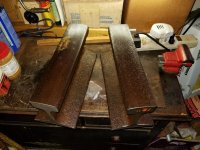

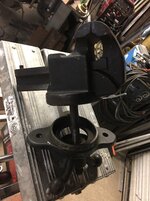


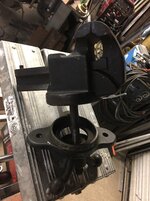

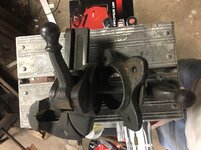






 and thankfully the dirt wasn't stuck on so I didn't have to be agressive with the scrubby sponge. However, I'm not sure where I'm going to put them as wall space is at an extremely high premium, I'm going to let them stew for a week before I decide what to do...