To avoid these ads, REGISTER NOW!

220 Help needed (pics inside)

sixball

Well-known member
Joined
Dec 4, 2009
Messages
149
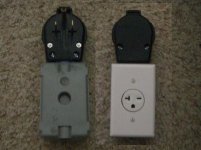
I just picked up a Dayton 3VU36 garage heater and am trying to hook it up. It says it's a 30 Amp 240 Volt plug which looks like this:

electrical008.jpg


I have a receptical in my garage thats 50 amp that takes a plug patern like this:

electrical001.jpg


So........ I need the heater 20 feet away from where the receptical is, so I bought a 25 foot 10/3 portable power cord and was going to wire it on one end to the plug in the second picture so I could plug that end into the wall. Then I was going to use these:

electrical003.jpg


One on the other end of the portable power cord and then cut the plug off the heater and attach the other to the heater cord. That way I would have an extension cord later down the line if need be, as well as being able to unplug the cord from the wall and take the heater somewhere else if needed.

Now the problems/questuions:

The plug I got to plug into the wall (2nd picture) says it's NEMA 10-50P but non-grounding. Is this going to work?

And the Turnlock conectors I got say 30 Amp, but 125V. I'm dealing with 220 from the wall, and the heater says 30 amp 240 Volt.

Any input on what to do, or if this will work would be great. I didn't see any bigger turnlocks at Menards.

Thanks for any help

Sixball
 
To avoid these ads, REGISTER NOW!

mrb

Well-known member
Joined
Dec 31, 2008
Messages
3,734
First: Dont use the 125v 30amp twistlock connectors with a 240v supply. Get the correct connectors (I have them if you have difficulty sourcing) the type is L6-30.

Second: You cannot supply a heater which requires a 30 amp circuit (nor a 30 amp extension cord) from a 50 amp circuit.

Third: The 10-50 dryer receptacle you have does not have a ground. It has two hots and a neutral. Dont use it in its current configuration to supply your heater. It is possible to replace it with a L6-30 receptacle which would involve changing some things around including replacing the breaker supplying it with a 30 amp, and making sure the box and receptacle are properly bonded. Dont attempt this unless you know what you are doing.
 

rodnok1

Well-known member
Joined
Jan 27, 2005
Messages
853
Location
NC
Listen to mrb, the circuit is designed to prevent 50 amp overloading. That cord and heater will catch on fire long before it will pop the breaker. Put a 30 amp breaker and new wiring in and save yourself alot of grief and a fire hazard.
 

mrb

Well-known member
Joined
Dec 31, 2008
Messages
3,734
Listen to mrb, the circuit is designed to prevent 50 amp overloading. That cord and heater will catch on fire long before it will pop the breaker. Put a 30 amp breaker and new wiring in and save yourself alot of grief and a fire hazard.


if its done right, he should be able to reuse the wiring supplying the 10-50 receptacle, just needs to supply it from a 30 amp breaker and get it grounded properly.
 

sberry

Banned
Joined
Jun 18, 2005
Messages
35,747
Location
Brethren, Michigan
I would toss the extension cord idea and run a circuit for it. But since this is a help forum lets start with what does the existing circuit that you want to plug in to go to? Is it a general use type thing? Does it go to a main service entrance panel or a sub fed type garage panel?
 
Last edited:

Rigmaster

Well-known member
Joined
Nov 17, 2008
Messages
1,061
Location
Elm Grove Farm, NC
Listen to mrb, the circuit is designed to prevent 50 amp overloading. That cord and heater will catch on fire long before it will pop the breaker.

I'll admit I'm far from being an electrical expert- but I don't think there's much truth in this statement.

If the heater shorted out somehow, bad enough to cause a fire, I'm pretty sure a 50a breaker would trip.

I'm not saying he should run the heater with a 50a breaker, just trying to clear up the facts here.


Can anyone confirm or dispute this?
 

mrb

Well-known member
Joined
Dec 31, 2008
Messages
3,734
I'll admit I'm far from being an electrical expert- but I don't think there's much truth in this statement.

If the heater shorted out somehow, bad enough to cause a fire, I'm pretty sure a 50a breaker would trip.

I'm not saying he should run the heater with a 50a breaker, just trying to clear up the facts here.


Can anyone confirm or dispute this?

im too tired to type the long answer this question requires, but the cliffs notes version is, there are possible failure modes of the heater which would not cause a 50 amp breaker to trip which could cause overheating of the 30 amp connectors, and 10 awg supply cord which in turn could cause a fire.

there is a reason for having everything on proper size wiring and breakers.
 
OP
S

sixball

Well-known member
Joined
Dec 4, 2009
Messages
149
I would toss the extension cord idea and run a circuit for it. But since this is a help forum lets start with what does the existing circuit that you want to plug in to go to? Is it a general use type thing? Does it go to a main service entrance panel or a sub fed type garage panel?

The 50 amp plug is not being used. It's just in the garage. It's a detached garage. The line for the plug exits the main box in the house, then it's burried underground and comes up the wall in the garage where the plug is. I have no idea what it was used for in the past, the house was built in the 60's.

I've got an electrician coming over this weekend to fix me up. The reason I was asking about this, and trying to do it myself was because there was a thread over on the heating/ac about using the dryer cords and wiring heaters. I don't want to get into the box and change things up (thats why I got the pro comming over) But the way I was wanting to do it wouldn't have required me to. But now I know thats not the right way.

And on the extension cord idea: This heater is a portable unit. Even though I am mounting it from the celing, it can be used as a portable unit. I didn't want to limit myself to having it available in just one place, and I also wanted the option to be able to use it (extension cord) for my big welder if I needed to weld 25 feet away from an outlet at some point.

I appreciate the help and advice, I'll see what the electrician suggests when he is on-site and sees what I've got and what I'm trying to acomplish.

Thanks to all. Looks like I'll get it done and done safe
 

MrMark

Well-known member
Joined
Jan 25, 2010
Messages
4,626
Location
Southern Cal.
im too tired to type the long answer this question requires, but the cliffs notes version is, there are possible failure modes of the heater which would not cause a 50 amp breaker to trip which could cause overheating of the 30 amp connectors, and 10 awg supply cord which in turn could cause a fire.

there is a reason for having everything on proper size wiring and breakers.

Let's forget about the extension cord for a minute. Are you saying that if this person just had a proper grounded plug, say a 50 amp plug and proper gauge wire, say 8 in conduit or 6romex, that he would have to use a 30 amp breaker to protect the heater? I thought the breaker was to protect the wire, not the device. That device should not be depending on a circuit breaker for protection, no?

What I'm asking is are you saying that this heater has no internal overload protection and it needs to rely on the branch circuit breaker?

By this logic I could not put 6 gauge wire and a 50 amp breaker to supply my electric range.
 

mrb

Well-known member
Joined
Dec 31, 2008
Messages
3,734
Let's forget about the extension cord for a minute. Are you saying that if this person just had a proper grounded plug, say a 50 amp plug and proper gauge wire, say 8 in conduit or 6romex, that he would have to use a 30 amp breaker to protect the heater? I thought the breaker was to protect the wire, not the device. That device should not be depending on a circuit breaker for protection, no?

What I'm asking is are you saying that this heater has no internal overload protection and it needs to rely on the branch circuit breaker?

By this logic I could not put 6 gauge wire and a 50 amp breaker to supply my electric range.

the breaker is to protect everything downstream of it. If the heater calls for a 30 amp circuit, then you put it on a 30 amp circuit not a 50 amp circuit. The line cord on the heater is 10ga. You cant plug a 10ga cord into a 50 amp circuit (with welders being the exception depending on duty cycle).

As far as your electric range, that all depends on what your range calls for...
 

sberry

Banned
Joined
Jun 18, 2005
Messages
35,747
Location
Brethren, Michigan
The heater could run continuous and has no need for "surge protection" the way a welder or motor may. Like a water heater, needs the right wire and breaker. There are some issues with this install, obviously its likely not a legal feed to this garage, probably has multiple circuits. I would want a pro vs a handyman type or maintenance type electrician, some of those guys know, some of them don't. In theory if a guy has a license in his pocket he should be able to sort this out.
 

MrMark

Well-known member
Joined
Jan 25, 2010
Messages
4,626
Location
Southern Cal.
the breaker is to protect everything downstream of it. If the heater calls for a 30 amp circuit, then you put it on a 30 amp circuit not a 50 amp circuit. The line cord on the heater is 10ga. You cant plug a 10ga cord into a 50 amp circuit (with welders being the exception depending on duty cycle).

As far as your electric range, that all depends on what your range calls for...

So the device is not required and doesn't have any internal protection?

Then why are you allowed to plug devices with 16 gauge cords into a 20 or 15 amp recepticle? Almost everything you plug into a plug has wiring and connections rated for a fraction of the circuit rating. Cords have different rules and are not required to have the same ampacity as the branch circuit wiring. Why is this heater any different?

Are you sure you are correct on this. It does not sound right to me.

I have a hard time believing that a branch circuit breakers job is to protect the device as well as the wiring.
 

mrb

Well-known member
Joined
Dec 31, 2008
Messages
3,734
So the device is not required and doesn't have any internal protection?

Then why are you allowed to plug devices with 16 gauge cords into a 20 or 15 amp recepticle? Almost everything you plug into a plug has wiring and connections rated for a fraction of the circuit rating. Cords have different rules and are not required to have the same ampacity as the branch circuit wiring. Why is this heater any different?

Are you sure you are correct on this. It does not sound right to me.

I have a hard time believing that a branch circuit breakers job is to protect the device as well as the wiring.

once you get over a 20 amp circuit the rules change.

I am 100% sure I am correct on this. There are several different reasons you cant put it on a 50 a circuit. Look through your code book until you find them.
 

mrb

Well-known member
Joined
Dec 31, 2008
Messages
3,734
without getting into the more technical details, here is the simplest reason you cant do it. The heater comes with a 30 amp plug installed. You cannot replace this plug with a 50 amp plug. You cannot install a 30 amp receptacle on a 50 amp circuit. So there is no way to plug the heater in.
 

MrMark

Well-known member
Joined
Jan 25, 2010
Messages
4,626
Location
Southern Cal.
without getting into the more technical details, here is the simplest reason you cant do it. The heater comes with a 30 amp plug installed. You cannot replace this plug with a 50 amp plug. You cannot install a 30 amp receptacle on a 50 amp circuit. So there is no way to plug the heater in.

Why, because it will violate the UL listing to cut the cord and replace the plug?

I will look in the code book, if you have a cite it will be helpful, if not that's fine. I appreciate learning about this.
 

sberry

Banned
Joined
Jun 18, 2005
Messages
35,747
Location
Brethren, Michigan
Then why are you allowed to plug devices with 16 gage cords into a 20 or 15 amp receptacle? Almost everything you plug into a plug has wiring and connections rated for a fraction of the circuit rating. Cords have different rules and are not required to have the same ampacity as the branch circuit wiring. Why is this heater any different?
I haven't read the manual for that specific heater but as I recall from here there is a listing in the book that specifically limits breaker size. Although it is a known load it is likely to do with the short circuit rating of some internal parts or wiring. Someone more familiar with NEMA would likely be able to clear this.
As for other light wiring on common circuits the load is limited by the appliance, socket type or fixture and the cords and most internal components need to be heavy enough to carry a fault to trip a breaker (short circuit), I believe 18 on 20 if I recall. This is one reason codes are fussy about recept spacing in houses, they don't want a ton of cords with the potential to be overloaded. One reason you often see a mini breaker on power strips. I haven't seen many burnt cords but my bet is that a 16 with 2 heaters dumped on it would trip a 20 before it caught on fire? Especially if it happened fast enough. Most hi current loads like saws are run short duration, circ saw that uses 15 might not have the power as it would on a 14 or better but the run time is short.
 

Dan0myte

Well-known member
Joined
Nov 18, 2009
Messages
92
Location
Regina, Saskatchewan
I'm by no means an electrician, but from my understanding the breaker serves two purposes:

1. Protect against shorts
2. Protect against overheating the wire and outlet

A 20A breaker requires 12 gauge wire and 20A rated outlets because 14 gauge wire and 15A outlets can be damaged, or worst case start on fire, from the additional current provided and heat created from electrical resistance.

The device will only draw a certain amount of current by design. If it's rated for 20 Amps it will only draw 20 Amps... ever. If the device fails and shorts, it will draw FAR more than 20 amps. If you plug a device that draws 20 amps into a 50 amp outlet and it shorts, it will still trip the 50A breaker. It's not like a direct short from positive to neutral will only increase the draw on the circuit by 5 or 10 amps.

Like I said I'm no professional and this is just me rambling. If the code book states specifically that the breaker for a device must be within a certain range of the device I would like to see it cited. I appreciate the knowledge.
 
Last edited:

Aceman

Well-known member
Joined
Jan 28, 2007
Messages
2,513
Location
Eastern Oregon
If the heater manufacturer wanted to give you the option to install it on a 30 or 50 amp circuit they wouldn't have installed a cord and cord end for a 30 amp circuit.

Look through the literature, it may give you a maximum circuit breaker rating. If the electrician you hire suggests anything other than changing the recep and breaker to a 30 amp, I'd personally wonder if he was qualified.
 
To avoid these ads, REGISTER NOW!

MrMark

Well-known member
Joined
Jan 25, 2010
Messages
4,626
Location
Southern Cal.
If the heater manufacturer wanted to give you the option to install it on a 30 or 50 amp circuit they wouldn't have installed a cord and cord end for a 30 amp circuit.

Look through the literature, it may give you a maximum circuit breaker rating. If the electrician you hire suggests anything other than changing the recep and breaker to a 30 amp, I'd personally wonder if he was qualified.

That doesn't address the issue of whether a 30 amp breaker must be installed. All it shows is that the manufacturer designed the device to run on 30 amps. I have yet to hear a convincing argument as to why a 50 amp breaker, heavier wire and a 50 amp plug is not permissible, other than changing the plug would be against the UL listing.

I have not heard any sound reasoning why a heater has no internal design protection and must rely on a branch circuit breaker for overload protection.

There may be a code section that addresses this, but I have not seen a cite yet. I have not searched either.
 

MrMark

Well-known member
Joined
Jan 25, 2010
Messages
4,626
Location
Southern Cal.
Thank you for taking the time to look that up, mrb.

Here's what 422.11 "Overcurrent Protection" states:

"(A) BRANCH-CIRCUIT OVERCURRENT PROTECTION. Branch circuits shall be protected in accordance with 240.4 (THESE ARE THE NORMAL RULES).
If a protective device rating is marked on an appliance, the branch-circuit overcurrent device rating shall not exceed the protective device rating marked on the appliance."

Do we know if this device has such a marking?

This device might come under 422.11 (E) "Single Non-motor-Operated Appliance"
In which case, if the overcurrent protection wasn't marked on the heater and if the heater is rated at over 13.3 amps, then the overcurrent protection would be 150 percent of the appliance rated current.

This is section E(3)
 
Last edited:

mrb

Well-known member
Joined
Dec 31, 2008
Messages
3,734
I havent seen the nameplate for that heater, but it probably does call out the OCP size.

If 422.11(e)3 did come in to play, that would be ~35a not 50.

There is still the issue of the 30 amp plug.

Can the OP post a picture of the heater's nameplate?
 

MrMark

Well-known member
Joined
Jan 25, 2010
Messages
4,626
Location
Southern Cal.
150 percent of 30 amp (rated current) is 45. Next size up under 422.11(E)(3) is 50 amp.

There is still the issue of the 30 amp plug.

Does this thing have a blower on it too?
 

mrb

Well-known member
Joined
Dec 31, 2008
Messages
3,734
150 percent of 30 amp (rated current) is 45. Next size up under 422.11(E)(3) is 50 amp.

There is still the issue of the 30 amp plug.

Does this thing have a blower on it too?

the rated current of that heater is 23.3 amps @ 240v

if the rated current was 30 amps, then it would come with a 6-50P plug, since thats the next size up from the 6-30
 

MrMark

Well-known member
Joined
Jan 25, 2010
Messages
4,626
Location
Southern Cal.
OK, I guess you have the rated current googled. I thought the OP said it was 30 amps.

This would get us to around 35 for the overcurrent protection as you stated. Then we get to go to next std size breaker at 40 amps. So...... a 40 amp protected circuit can use a 6-50 plug, because there is no 40 amp plug!

I'm sure you are right that this thing has an overcurrent protection placard on it.
 

mrb

Well-known member
Joined
Dec 31, 2008
Messages
3,734
OK, I guess you have the rated current googled. I thought the OP said it was 30 amps.

This would get us to around 35 for the overcurrent protection as you stated. Then we get to go to next std size breaker at 40 amps. So...... a 40 amp protected circuit can use a 6-50 plug, because there is no 40 amp plug!

I'm sure you are right that this thing has an overcurrent protection placard on it.


I got the specs from Grainger's website. Unfortunately they dont have the manual online. Bottom line is the heater is made for a 30 amp circuit as evidenced by its load, and the attachment plug that is installed on it.
 
OP
S

sixball

Well-known member
Joined
Dec 4, 2009
Messages
149
Bit of an Update: The electrician came over today and took a look at my situation, seems that the line coming out of the hose to supply the garage to where I wanted the heater is 12 guage off a double 20 breaker. So....... It's not gona work out for me. I'm not going to bury another line, so now I have a brand new Dayton heater for sale ! I'm gona put it over in the classafied section if interested.

Thanks for all the help, and information that came with the thread


Sixball
 

mrb

Well-known member
Joined
Dec 31, 2008
Messages
3,734
what about that 50 amp dryer receptacle? Is this a detached garage with a 20a MWBC supplying it?
 
OP
S

sixball

Well-known member
Joined
Dec 4, 2009
Messages
149
The outlet is there. I asked the electrician about it, he said it's there, but to be used with caution because of the draw that would be crated if I was running lights/heater/tools. He said just the heater and afew lights alone would trip to 20 amp breaker in the house.

I would have to go with a 30 amp breaker in the house (he said the way everything was, it would be ilegal to go with anything biger than 20) then I would have to run 10 guage off that to the garage. And with deckwork and concrete, that would be a major pain.
 

JBurgess

Well-known member
Joined
Mar 1, 2008
Messages
372
Location
Arizona
150 percent of 30 amp (rated current) is 45. Next size up under 422.11(E)(3) is 50 amp.

There is still the issue of the 30 amp plug.

Does this thing have a blower on it too?

MrMark, did you look at 240.6? 45 amp is a standard size. Just for knoweldge base:)

240.6 Standard Ampere Ratings.
(A) Fuses and Fixed-Trip Circuit Breakers. The standard
ampere ratings for fuses and inverse time circuit
breakers shall be considered 15, 20, 25, 30, 35, 40, 45, 50,
60, 70, 80, 90, 100, 110, 125, 150, 175, 200, 225, 250, 300,
350, 400, 450, 500, 600, 700, 800, 1000, 1200, 1600, 2000,
2500, 3000, 4000, 5000, and 6000 amperes. Additional
standard ampere ratings for fuses shall be 1, 3, 6, 10, and
601. The use of fuses and inverse time circuit breakers with
nonstandard ampere ratings shall be permitted.
 

mrb

Well-known member
Joined
Dec 31, 2008
Messages
3,734
The outlet is there. I asked the electrician about it, he said it's there, but to be used with caution because of the draw that would be crated if I was running lights/heater/tools. He said just the heater and afew lights alone would trip to 20 amp breaker in the house.

I would have to go with a 30 amp breaker in the house (he said the way everything was, it would be ilegal to go with anything biger than 20) then I would have to run 10 guage off that to the garage. And with deckwork and concrete, that would be a major pain.

is the garage detached?
 

MrMark

Well-known member
Joined
Jan 25, 2010
Messages
4,626
Location
Southern Cal.
MrMark, did you look at 240.6? 45 amp is a standard size. Just for knoweldge base:)

240.6 Standard Ampere Ratings.
(A) Fuses and Fixed-Trip Circuit Breakers. The standard
ampere ratings for fuses and inverse time circuit
breakers shall be considered 15, 20, 25, 30, 35, 40, 45, 50,
60, 70, 80, 90, 100, 110, 125, 150, 175, 200, 225, 250, 300,
350, 400, 450, 500, 600, 700, 800, 1000, 1200, 1600, 2000,
2500, 3000, 4000, 5000, and 6000 amperes. Additional
standard ampere ratings for fuses shall be 1, 3, 6, 10, and
601. The use of fuses and inverse time circuit breakers with
nonstandard ampere ratings shall be permitted.

No, I didn't know that. I thought I had looked at this and didn't remember seeing 35 or 45 in there. Thanks for the info!
 
OP
S

sixball

Well-known member
Joined
Dec 4, 2009
Messages
149
is the garage detached?


Yes the garage is detached. The electrician id'd the line that exits the house box and enters the garage. At the house there is a double 20 with 12 guage line running to the garage. At the garage there is a panel with about 4 glass fuses and two of the old type cylinder fuses. Then right below that is the dryer type outlet.

I don't know what the outlet was used for originaly, I've never had anything plugged into it.
 

Git

Well-known member
Joined
May 18, 2008
Messages
6,894
Location
S Cal
In my garage I have a circuit for my Millermatic 180 welder. It is a 230v circuit and it is being protected by a double pole 20 amp breaker.

I also have an old Delta 13" wood planer that is also 230v and the plug for it looks very similar to the plug for your heater. My solution was to make an "adapter box" from common parts found at Lowe's - basically a new plug and a plastic work box with a piece of pvc electrical conduit connecting the two

I can either plug the adapter box into the wall outlet for the welder or the 50' extension cord that I have for it
 

Attachments

  • Adapter.jpg
    Adapter.jpg
    50.1 KB · Views: 12
OP
S

sixball

Well-known member
Joined
Dec 4, 2009
Messages
149
I think what my problem is, is the 12 guage wire that is running from my house to my garage. I had everything to convert my plug ends and the electrician said we could work with it, but then when he took the cover off the box and found the 12 guage where 10 guage should be that kinda ended the "project"
 

MrMark

Well-known member
Joined
Jan 25, 2010
Messages
4,626
Location
Southern Cal.
He means you could replace the 12 gauge wire if you had conduit.

Maybe you do. Do you know if you have conduit or is your feed direct burial?
 
To avoid these ads, REGISTER NOW!
Top Bottom