To avoid these ads, REGISTER NOW!

220 outlet not grounded at box?

DanielVetpath

Well-known member
Joined
Sep 14, 2011
Messages
89
Hi guys:

An electrician ran a 50 amp 220 circuit for my welder (Hobart 230) ending with a 6-50 three wire plug. I decided to run a second similar circuit to run my Dynasty 210 so I can have them both plugged in at the time. I opened the surface mount metal 4 x 4 x 2 box of the original outlet to see how it was wired and was surprised to see that there was no ground to the box (he used two black wires going to the breaker poles and one white going to the neutral/ground bar (this is the main breaker panel).

Question: Why is the outlet not grounded to the metal box? Is this safe?

Thanks, Daniel
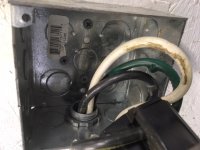
 

Attachments

  • IMG_2856.JPG
    IMG_2856.JPG
    100.6 KB · Views: 95
  • IMG_2855.JPG
    IMG_2855.JPG
    97.9 KB · Views: 64
To avoid these ads, REGISTER NOW!

pattenp

Well-known member
Joined
Jun 4, 2008
Messages
10,175
Location
Virginia - USA
The box needs to be grounded. And white is a wrong color for the ground, needs to be bare copper or green insulated. Are not to re-identify the white as green.
 

sberry

Banned
Joined
Jun 18, 2005
Messages
35,747
Location
Brethren, Michigan
In an ideal world the wire would be green or bare and a jumper to the box but this recept has a bonded yoke, if all the screws are tight then it is grounded.
He didn't leave you with a compliant install but the equipment you plug in to it is grounded.
 
Last edited:

lakelandcat

Well-known member
Joined
Sep 25, 2017
Messages
7,327
Some of the more experienced electricians can explain deeper but if your neutral(white)is bonded to ground in your panel box you should be fine.
 

pattenp

Well-known member
Joined
Jun 4, 2008
Messages
10,175
Location
Virginia - USA
I didn't answer the safe question, yes it's technically safe as long as the outlet is self grounding.
 
Last edited:

sberry

Banned
Joined
Jun 18, 2005
Messages
35,747
Location
Brethren, Michigan
Some of the more experienced electricians can explain deeper but if your neutral(white)is bonded to ground in your panel box you should be fine.

It's kind of reverse for this purpose. Neutral at service main IS ground, the ground wires are bonded TO it. It needs a low impedance pathway back to the transformer that the circuit originated from to trip the breaker in the event of a fault. The ground rods don't do this and it will work without them.
 

lakeroadster

Well-known member
Joined
Jan 19, 2015
Messages
5,166
Location
Central Colorado
The box needs to be grounded. And white is a wrong color for the ground, needs to be bare copper or green insulated. Are not to re-identify the white as green.

Is it not acceptable, by code, to wrap green electrical tape around the white wire at the outlet and at the panel?
 
Last edited:
OP
D

DanielVetpath

Well-known member
Joined
Sep 14, 2011
Messages
89
Ok - so, If I were to install a second similar outlet, I would use two black (to the breaker poles) and a green to the neutral/ground bar with a pigtail from the green to the box? Thanks for the help, guys
 
To avoid these ads, REGISTER NOW!

lakelandcat

Well-known member
Joined
Sep 25, 2017
Messages
7,327
It's kind of reverse for this purpose. Neutral at service main IS ground, the ground wires are bonded TO it. It needs a low impedance pathway back to the transformer that the circuit originated from to trip the breaker in the event of a fault. The ground rods don't do this and it will work without them.

OK I understand that transformer is grounded, meter should have a rod, plumbing, or slab rebar ground which should supply a low impedance path back. If the outlet is not screwed in tight and you have catastrophic failure, that would make human a lower impedance ground? I understand there is a difference between ground and grounded. Trying to understand. Mike
 

mm08822

Well-known member
Joined
Jan 13, 2012
Messages
6,008
Location
NJ
Hi guys:

An electrician ran a 50 amp 220 circuit for my welder (Hobart 230) ending with a 6-50 three wire plug. I decided to run a second similar circuit to run my Dynasty 210 so I can have them both plugged in at the time. I opened the surface mount metal 4 x 4 x 2 box of the original outlet to see how it was wired and was surprised to see that there was no ground to the box (he used two black wires going to the breaker poles and one white going to the neutral/ground bar (this is the main breaker panel).

Question: Why is the outlet not grounded to the metal box? Is this safe?

Thanks, Daniel

So are you saying the black wire with the green tape is going to the X or Y terminal and the white is going to the gnd terminal on the recept?? If so, remove the green tape and place on white wire at recept and panel locations.

Where these pics of the same box? At the same time? I ask b/c one pic shows conduit coming in thru bottom and the other shows a surface mount box w/o any penetrations on the sides???

Looks like conduit feeding the box in first pic.
Since conduit, box is grounded through conduit (assuming continuous back to panel enclosure).
Receptacle yoke is attached to metal cover which is attached to surface mounted box. This is considered an acceptable means of grounding.

2 blacks should have been used connected to X and Y on recpt going to the 2P cb. Since the recept grd is bonded thru the yoke back to the box, it would be considered grounded. A better practice would be to at least put a jumper from recept grd terminal back to the box. Even better, a green wire could have been connected to grd on recept and at neutral bar in panel.
 

mm08822

Well-known member
Joined
Jan 13, 2012
Messages
6,008
Location
NJ
OK I understand that transformer is grounded, meter should have a rod, plumbing, or slab rebar ground which should supply a low impedance path back. If the outlet is not screwed in tight and you have catastrophic failure, that would make human a lower impedance ground? I understand there is a difference between ground and grounded. Trying to understand. Mike


This why the jumper to the box or a wire back to the panel is best.

The purpose of running a ground wire (or metallic conduit) with branch circuit conductors is to provide a low resistance fault path back to the panel to allow the fault current to get high enough to trip the cb to clear the fault. If this intentional fault path did not exist, anyone touching energized parts and completing the circuit to any other grounded object would complete the circuit and get zapped - severely or minimally depending on conditions. Concrete can conduct current due to its moisture content.

Although grd rods, etc. may provide a path of variable resistance back to the panel, it is not intended for clearing branch circuit faults.
It is intended to eliminate static buildup created from wind and provide an intentional controlled point of discharge for lightning strikes instead of seeking the entire building wiring for discharge paths.

Ground/grounding/grounded terms are used interchangeably and most times not being correct to do so. Terms like bonded, equipment grounding conductor and grounding electrode conductor are more precise for the different purposes intended - but a mouthful to speak.

See Wylie's sticky. There is a post in there explaining this.
 
Last edited:
OP
D

DanielVetpath

Well-known member
Joined
Sep 14, 2011
Messages
89
MM08822:

Yes - both pictures are the same; the conduit enters the box from the side/bottom, but is cut off in my photo.

Yes - the black wire with green tape goes to the 2p cb. The white wire goes to the ground/neutral bar. I can move the green tape to the white wire.

Does the ground wire jumper from receptacle to the metal box need to be 6 ga also? If so, can I use some kind of crimped on metal terminal to mount it to the screw post on the box?

Thanks again, Daniel
 

PhysicsDude

Well-known member
Joined
Jan 28, 2013
Messages
805
Location
Dallas, TX
Aren't virtually all 240v+ 20A+ receptacles self-grounding?

I think to be totally code compliant the ground should be bonded to the box, but I think realistically the ground lug on the receptacle is already bonded to the box cover and box.
 

sberry

Banned
Joined
Jun 18, 2005
Messages
35,747
Location
Brethren, Michigan
A jumper only needs 10 here. There are a couple code violations here but nothing to make this circuit a danger, not to lose sleep worrying over it.
 

mm08822

Well-known member
Joined
Jan 13, 2012
Messages
6,008
Location
NJ
MM08822:

Yes - both pictures are the same; the conduit enters the box from the side/bottom, but is cut off in my photo.

Yes - the black wire with green tape goes to the 2p cb. The white wire goes to the ground/neutral bar. I can move the green tape to the white wire.

Does the ground wire jumper from receptacle to the metal box need to be 6 ga also? If so, can I use some kind of crimped on metal terminal to mount it to the screw post on the box?

Thanks again, Daniel

The ground wire could have been #10. Since you already have the #6, I would determine if you could put a pass-thru lug in the box and strip 2" off the "white" insulation (soon to be taped green) at the mid point of the wire length within the box and pick up the connection to the box. Placement will be the biggest PIA, b/c recept has to go back in.

If not possible, connect the conductor to the box and add a 8" #10 jumper from the same point to the recept grd terminal. Do not put 2 wires under a terminal on the recept.

Aren't virtually all 240v+ 20A+ receptacles self-grounding?

I think to be totally code compliant the ground should be bonded to the box, but I think realistically the ground lug on the receptacle is already bonded to the box cover and box.

Ground wires need to provide continuity to the circuit independent of any devices installed. Even through this ground wire is redundant b/c of the conduit, the preferred method is to connect directly to box and then from there pick up the device. IOW's, pretend the conduit is non-metallic or a cable.
 

Norcal

Well-known member
Joined
Mar 16, 2008
Messages
13,767
The NEC does not permit remarking 6 AWG & smaller conductors with green tape ,if insulated they must be green colored.
 

lakelandcat

Well-known member
Joined
Sep 25, 2017
Messages
7,327
This why the jumper to the box or a wire back to the panel is best.

The purpose of running a ground wire (or metallic conduit) with branch circuit conductors is to provide a low resistance fault path back to the panel to allow the fault current to get high enough to trip the cb to clear the fault. If this intentional fault path did not exist, anyone touching energized parts and completing the circuit to any other grounded object would complete the circuit and get zapped - severely or minimally depending on conditions. Concrete can conduct current due to its moisture content.

Although grd rods, etc. may provide a path of variable resistance back to the panel, it is not intended for clearing branch circuit faults.
It is intended to eliminate static buildup created from wind and provide an intentional controlled point of discharge for lightning strikes instead of seeking the entire building wiring for discharge paths.

Ground/grounding/grounded terms are used interchangeably and most times not being correct to do so. Terms like bonded, equipment grounding conductor and grounding electrode conductor are more precise for the different purposes intended - but a mouthful to speak.

See Wylie's sticky. There is a post in there explaining this.

Got it, thanks, I try to be politically correct. I did not know that ground rods eliminate static buildup. I do realize that earth is not a good ground where I am, or should I say earth is better ground in some places. I understand bonding to ground ac, which may be different than grounding your 12v alternator dc. But when you start talking about neutral as a reverse low empedance pathway back to the transformer, I got confused, maybe it's just a senior moment:eyecrazy: sometimes I like them.
 
Last edited:
To avoid these ads, REGISTER NOW!
Top Bottom