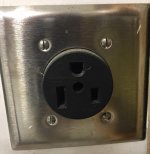
I am wanting to install an air conditioner in my garage and believe I would need one that that would require 220v. I do have a 220 outlet in the garage on the opposite side wall that is a 50 amp outlet used for my welder. I was wondering if I could make an extension cord to plug into the outlet and run it to an air conditioner about 20 feet away. The outlet looks like a standard 110v except it is much larger. Can this be done and if so what would you suggest as far as what would be needed?

You are using an out of date browser. It may not display this or other websites correctly.
You should upgrade or use an alternative browser.
You should upgrade or use an alternative browser.
220v extension cord
- Thread starter tc_rain
- Start date
Kilroy
Well-known member
50 amp is probably way too much for the A/C unit... You might have to wire in some sort of breaker.
20' is probably pushing it no matter what kind of material you use. I made an extension cord out of 3/3/5 romex for a temporary piece of equipment I had set up, but it was only about 12' and it still got uncomfortably warm and eventually failed entirely.
Given that it's for an AC unit, what you're basically going to be dealing with is the instant on load and then a relatively light load as the machines running... There will also be the lesser, fan on and off bumps too...
So if you went up to say 2/2/2/4 and ignored the ground wire, you might be able to make something work for a while, but it's not something I'd want to leave for a long time and I'd never leave it running without me looking at it.
Basically... That's all a theoretical, bench-rodding kind of discussion... What it comes down to is, don't do it.
20' is probably pushing it no matter what kind of material you use. I made an extension cord out of 3/3/5 romex for a temporary piece of equipment I had set up, but it was only about 12' and it still got uncomfortably warm and eventually failed entirely.
Given that it's for an AC unit, what you're basically going to be dealing with is the instant on load and then a relatively light load as the machines running... There will also be the lesser, fan on and off bumps too...
So if you went up to say 2/2/2/4 and ignored the ground wire, you might be able to make something work for a while, but it's not something I'd want to leave for a long time and I'd never leave it running without me looking at it.
Basically... That's all a theoretical, bench-rodding kind of discussion... What it comes down to is, don't do it.
Last edited:
Jkcolo22
Well-known member
That’s a NEMA 5-50 plug. You need to first check the size of the breaker in your panel and the wire gauge feeding that outlet/breaker. That plug is commonly used on welders that only require a 240v 30amp breaker, even though that plug is associated with 240v 50amp. Then you need to ensure your AC unit is compatible with the existing voltage/wiring. It’s easy to make a 240v extension cord from SJOW cable and ends from your local big box store, but will be pointless if the breaker can’t support the load. Don’t even think about changing the breaker to a bigger breaker unless you are certain the wire in the wall will support the amps. Breakers must be sized with compatible wire. It would be ironic if you burnt down your shop with an AC unit.
Sent from my iPhone using Tapatalk
Sent from my iPhone using Tapatalk
Jkcolo22
Well-known member
50 amp is probably way too much for the A/C unit... You might have to wire in some sort of breaker.
20' is probably pushing it no matter what kind of material you use. I made an extension cord out of 3/3/5 romex for a temporary piece of equipment I had set up, but it was only about 12' and it still got uncomfortably warm and eventually failed entirely.
Given that it's for an AC unit, what you're basically going to be dealing with is the instant on load and then a relatively light load as the machines running... There will also be the lesser, fan on and off bumps too...
So if you went up to say 2/2/2/4 and ignored the ground wire, you might be able to make something work for a while, but it's not something I'd want to leave for a long time and I'd never leave it running without me looking at it.
Basically... That's all a theoretical, bench-rodding kind of discussion... What it comes down to is, don't do it.
Oversized breaker isn’t a problem. You can put 30 amps on a 50 amp breaker all day. Breakers merely protect the wire from overheating.
Edit to change undersized breaker to oversized breaker (undersized breaker IS a problem as it should do its job and trip).
Sent from my iPhone using Tapatalk
Last edited:
Kilroy
Well-known member
Undersized breaker isn’t a problem. You can put 30 amps on a 50 amp breaker all day. Breakers merely protect the wire from overheating.
Sent from my iPhone using Tapatalk
And the AC unit from burning up...
I mean... I'm assuming this is some sort of small AC unit and not a large like 14 seer whole house thing. Those run on a couple breakers and the one for the heater might be 50 amp/240V. But for smaller A/C units, you want to make sure the breaker is sized for the device, and then wire accordingly for distance.
Last edited:
PugetDude
ALLIANCE MEMBER
I have a 50' extension cord for my welder, #8 SJOOW cord with NEMA 6-50 ends from Agent Orange.
Use it all the time on a 30 amp 330V Breaker.
Use it all the time on a 30 amp 330V Breaker.
Air conditioners are listed for a minimum and maximum ampere rating and I would assume that your going to get a window shaker those are 30 amperes max.,and that receptacle is 50A, plus a extension cord should not be used in place fixed in place equipment install a proper circuit for it. BTW, 110 and 220 volts are pre WW II voltages. Install a circuit that the manufacturer has specified and you will be good to go.
nadogail
Well-known member
An extension cord is very doable. I have a 8AWG extension cord in my workshop/garage for both my welder and my table saw.
I have used it to run either of those tools from my Home Brewed Generator set.
ROMEX or NM cable is not suitable for an extension cord.
I have used it to run either of those tools from my Home Brewed Generator set.
ROMEX or NM cable is not suitable for an extension cord.
Jkcolo22
Well-known member
ROMEX or NM cable is not suitable for an extension cord.
Yes. Don’t do this. Terrible laziness (or being cheap) that can end badly.
Sent from my iPhone using Tapatalk
TTA89
Well-known member
Just buy a cord off ebay. I have one and it's way nicer than anything I could build.
https://www.ebay.com/itm/25ft-8-3-A...136746?hash=item2827c866aa:g:ogwAAOSwnDpaE149
View media item 105304
https://www.ebay.com/itm/25ft-8-3-A...136746?hash=item2827c866aa:g:ogwAAOSwnDpaE149
View media item 105304
Last edited:
sberry
Banned
The problem isn't a cord really but that's a poor way to wire a fixxed appliance. As Norcal pointed out its not code compliant. Most likely the breaker is too big for the appliance. In a specialized circuit the breaker isn't there to protect the wire from overheating but to protect against short circuit. It's an off on switch.
If an air conditioning doesn't come with a plug then there is a good chance it can be connected to 30 but you got to look at the instruction. If it comes plug then the circuit matches that. Lots of modern welders now can run on a 30 circuit. Lots of 50A welder circuits wired 10 wire. If connecting equipment other than welders a guy should verify but,,, nothing I know except welders come with that, only rated 3 hp anyway.
Lots of equipment relies on the premise circuit breaker for short circuit protection. While it won't overheat the circuit wire or the cord the internals of the equipment are not designed to be connected to 50A.
If an air conditioning doesn't come with a plug then there is a good chance it can be connected to 30 but you got to look at the instruction. If it comes plug then the circuit matches that. Lots of modern welders now can run on a 30 circuit. Lots of 50A welder circuits wired 10 wire. If connecting equipment other than welders a guy should verify but,,, nothing I know except welders come with that, only rated 3 hp anyway.
Lots of equipment relies on the premise circuit breaker for short circuit protection. While it won't overheat the circuit wire or the cord the internals of the equipment are not designed to be connected to 50A.
wyliesdiesels
Well-known member
I am wanting to install an air conditioner in my garage and believe I would need one that that would require 220v. I do have a 220 outlet in the garage on the opposite side wall that is a 50 amp outlet used for my welder. I was wondering if I could make an extension cord to plug into the outlet and run it to an air conditioner about 20 feet away. The outlet looks like a standard 110v except it is much larger. Can this be done and if so what would you suggest as far as what would be needed?
220v doesnt exist
No do not use that 50a outlet for the air conditioner.
Do not use an extension cord either. You may have voltage drop issues....
you need to use the circuit size specified by the manufacturer.
What size air conditioner are you getting? what make and model?
The largest window units (2 ton no heat) are usually 20a 240v.
The outlet you have is a nema 6-50r and you need a 6-20r.
50 amp is probably way too much for the A/C unit... You might have to wire in some sort of breaker.
20' is probably pushing it no matter what kind of material you use. I made an extension cord out of 3/3/5 romex for a temporary piece of equipment I had set up, but it was only about 12' and it still got uncomfortably warm and eventually failed entirely.
what the hell were you running on it for it to get warm? #3 NM-b is good for 85a and i doubt it would get warm with even 100a load.
Given that it's for an AC unit, what you're basically going to be dealing with is the instant on load and then a relatively light load as the machines running... There will also be the lesser, fan on and off bumps too...
So if you went up to say 2/2/2/4 and ignored the ground wire, you might be able to make something work for a while, but it's not something I'd want to leave for a long time and I'd never leave it running without me looking at it.
Basically... That's all a theoretical, bench-rodding kind of discussion... What it comes down to is, don't do it.
#2 cu or al? that is WAY overkill for a 20a 240v load. talk about a waste of money


this circuit could be wired with #12 NM-b on a double pole breaker most likely.
BUT i digress, this is garage journal. Sure why not oversize the wire by 5 gauges....

That’s a NEMA 6-50 receptacle. You need to first check the size of the breaker in your panel and the wire gauge feeding that outlet/breaker. That plug is commonly used on welders that only require a 240v 30amp breaker, even though that plug is associated with 240v 50amp. Then you need to ensure your AC unit is compatible with the existing voltage/wiring. It’s easy to make a 240v extension cord from SJOW cable and ends from your local big box store, but will be pointless if the breaker can’t support the load. Don’t even think about changing the breaker to a bigger breaker unless you are certain the wire in the wall will support the amps. Breakers must be sized with compatible wire. It would be ironic if you burnt down your shop with an AC unit.
Sent from my iPhone using Tapatalk
fixed it for you. its 240v (6-**) not 120v (5-**) and its a receptacle NOT a plug.
And the AC unit from burning up...
I mean... I'm assuming this is some sort of small AC unit and not a large like 14 seer whole house thing. Those run on a couple breakers and the one for the heater might be 50 amp/240V. But for smaller A/C units, you want to make sure the breaker is sized for the device, and then wire accordingly for distance.
NO! the A/C unit should have integral overload protection. All my window units do....
Last edited:
sberry
Banned
The internal protection also provides the thermal protection for the incoming circuit wire.
Think of this being similar to a common power strip,, similar in theory for this discussion. Got a 14 cord, a 15 end and connects to a 20A circuit. The 20A is for short circuit and the little breaker on the Strip protects the 14 wire for thermal from multiple outlets. The 20 leaves some overhead for shared circuits and start loads.
Think of this being similar to a common power strip,, similar in theory for this discussion. Got a 14 cord, a 15 end and connects to a 20A circuit. The 20A is for short circuit and the little breaker on the Strip protects the 14 wire for thermal from multiple outlets. The 20 leaves some overhead for shared circuits and start loads.
Last edited:
sberry
Banned
Some of the posts make it sound like any cord will overheat which isn't really accurate. Too small of a cord, cords thru doors, walked on, undercarpets, have 3 ways added to too few circuits. Not likely to overheat a welder cord.
555
Well-known member
Here's my questions?
1. How big is your garage
2. Is it insulated
3. Do you have any 120v receptacles near where you want to put an AC? I'm assuming a window, but you may intend to cut a hole in the wall.
The reason I'm asking is I have a good quality 120v window AC in my garage plugged into a 20 amp 120V recptacle. My garage is 30 x 40 and this same AC has been there 19 years with no problems. My garage is insulated but certainly has air gaps. It was 97 degrees with 67% humidity this afternnon and it had no problems keeping the garage comfortably cool.
1. How big is your garage
2. Is it insulated
3. Do you have any 120v receptacles near where you want to put an AC? I'm assuming a window, but you may intend to cut a hole in the wall.
The reason I'm asking is I have a good quality 120v window AC in my garage plugged into a 20 amp 120V recptacle. My garage is 30 x 40 and this same AC has been there 19 years with no problems. My garage is insulated but certainly has air gaps. It was 97 degrees with 67% humidity this afternnon and it had no problems keeping the garage comfortably cool.
Kilroy
Well-known member
Penny wise, pound foolish... At the end of the day, the amount of money you're saving making or buying an extension cord for the AC unit to run off that particular circuit, rather than just paying an electrician to run a dedicated line, probably isn't going to be enough to pay for the hastle of having the cord hanging around or not really knowing if it's done right.
sberry
Banned
That is probably pretty good logic.
TuxThePenguin
Well-known member
Kilroy said:So if you went up to say 2/2/2/4 and ignored the ground wire, you might be able to make something work for a while, but it's not something I'd want to leave for a long time and I'd never leave it running without me looking at it.
Wires have no idea if they are used as an extension cord or whether they are installed in a wall. Unlike the post earlier that seems to imply that wires hate being used as extension cords and that they'll commit suicide by melting whenever they are used as such.
You can literally use an extension cord for anything. Absolutely anything. As long as the wire is large enough (given the conditions) and any connectors/plugs you use can handle the rated current and they aren't exposed to any elements that they aren't designed to be exposed to.
The post saying you need to use 2 gauge wire is so stupid it is literally insulting. (Yes, I know it was a little more specific than my summary there, but every sentence in that post was absolutely ridiculous.)
Extension cords are rarely advisable, and not always legal, but it is usually "possible" to use them with reasonable amounts of safety. Telling someone that an extension cord with significantly oversized wire is still going to somehow melt (for literally no good reason) is highly counterproductive as it makes people question the advice they're given which then causes some people to start ignoring ALL advice they are given, even the good advice.
That said, wire is not that expensive. Breakers aren't even that bad (if $50 is expensive to someone, they really ought to be not doing a project in the first place). I don't understand why running a proper wire is an issue. But if this is a case of "the electrician will install the correct wire next week" and you have the APPROPRIATELY SIZED extension cord available, then go ahead.
Extension cords are not the bogey man. You have to be an absolute ***** to cause a problem with them.
To many people this post I've made is all obvious stuff, and it should be, but then you get these people who truly do think extension cords are the bogey man.
Last edited:
Wires have no idea if they are used as an extension cord or whether they are installed in a wall. Unlike the post earlier that seems to imply that wires hate being used as extension cords and that they'll commit suicide by melting whenever they are used as such.
You can literally use an extension cord for anything. Absolutely anything. As long as the wire is large enough (given the conditions) and any connectors/plugs you use can handle the rated current and they aren't exposed to any elements that they aren't designed to be exposed to.
The post saying you need to use 2 gauge wire is so stupid it is literally insulting. (Yes, I know it was a little more specific than my summary there, but every sentence in that post was absolutely ridiculous.)
Extension cords are rarely advisable, and not always legal, but it is usually "possible" to use them with reasonable amounts of safety. Telling someone that an extension cord with significantly oversized wire is still going to somehow melt (for literally no good reason) is highly counterproductive as it makes people question the advice they're given which then causes some people to start ignoring ALL advice they are given, even the good advice.
That said, wire is not that expensive. Breakers aren't even that bad (if $50 is expensive to someone, they really ought to be not doing a project in the first place). I don't understand why running a proper wire is an issue. But if this is a case of "the electrician will install the correct wire next week" and you have the APPROPRIATELY SIZED extension cord available, then go ahead.
Extension cords are not the bogey man. You have to be an absolute ***** to cause a problem with them.
To many people this post I've made is all obvious stuff, and it should be, but then you get these people who truly do think extension cords are the bogey man.
The problem is that there plenty of absolute morons out there, extension cords are intended for temporary use, need to use your welder in front of your shop/garage? That is what extension cords are for, not to string across the building because someone is too cheap to have a receptacle where it is needed.
sberry
Banned
Yes, I did one recently where it was discussed with the owner was determined he was going to use a big ole cord across the shop. He did pay me after I put the second outlet in where it was going to be used.
TuxThePenguin
Well-known member
The problem is that there plenty of absolute morons out there, extension cords are intended for temporary use, need to use your welder in front of your shop/garage? That is what extension cords are for, not to string across the building because someone is too cheap to have a receptacle where it is needed.
I generally agree with you. My point wasn't "use extension cords for everything! Who needs electricians!" but rather to dispute a specific reply.
I should have quoted the post I was replying to. I've edited that in. Kilroy literally told OP that even 2 gauge wire wouldn't really be enough here, which is absurdly wrong. When people give advice that bad, the question asker will often "tune out" and will be worse off for it. I know when I ask a question and somebody starts talking some stupid ****, I definitely tune out.
And when I say extension cords aren't the bogey man, by bogey man I am referring to the idea that extension cords are ALWAYS bad. I am not stating the opposite to be true (that they are always good), just that they're fine to use within reason.
Powering a 240v AC could be within reason if the wire used is reasonable, the connectors used are reasonable, the wire is not in danger of being damaged, and all the other reasonable precautions are covered. Even still, a proper wire should be run for long-term use.
But telling OP that not even 2 gauge wire would do this job is just... well, if I were an admin I would outright delete that post. Nobody deserves to have to read that. I think bad advice is dangerous even when the bad advice is advising against something. People are remarkably good at detecting bad advice even if they don't know the correct answer. Someone's going to read what Kilroy wrote and it will screw them up.
Last edited:
Lassen Forge
Well-known member
You do know that because the BREAKER is rated for 50 amps that it's not like a high pressure pump where whatever you plug into it is stuffed with all 50 amps whether it can use it or not, right? That's like saying if you plug a desk lamp into a circuit with a 20 amp breaker, it will push all 20 amps into a 0.1 or 0.2 amp device and make it take it, bursting the lamp into flames...
Or worse, your computer - Is your hard drive and power supply smouldering because it's plugged into a socket on a 20 amp circuit? Think not...
Electricity just doesn't WORK like that. Jeez...
I would say the appropiate plug on one side, 6 ga (in case you use it for something that actually pulls 50 amps like your welder) cabling, and the correct outlet in a box on the other. We did this for welders, plasma cutters, and even a drill press over the years.
Just make sure it's wired correctly. Screw that up, and THAT WILL cause you problems!!!
Or worse, your computer - Is your hard drive and power supply smouldering because it's plugged into a socket on a 20 amp circuit? Think not...
Electricity just doesn't WORK like that. Jeez...
I would say the appropiate plug on one side, 6 ga (in case you use it for something that actually pulls 50 amps like your welder) cabling, and the correct outlet in a box on the other. We did this for welders, plasma cutters, and even a drill press over the years.
Just make sure it's wired correctly. Screw that up, and THAT WILL cause you problems!!!
sberry
Banned
You do know that because the BREAKER is rated for 50 amps that it's not like a high pressure pump where whatever you plug into it is stuffed with all 50 amps whether it can use it or not, right? That's like saying if you plug a desk lamp into a circuit with a 20 amp breaker, it will push all 20 amps into a 0.1 or 0.2 amp device and make it take it, bursting the lamp into flames...
While that is true it doesnt draw more than is needed the equipment is not rated to be plugged to hi amp breakers. The computer is rated to be plugged in to a 20,,, not a 30. All the listed stuff is designed that way, designed to be hooked to a current limited circuit. Not all of it requires the capacity its simply allowed to be connected to it. The little welders being one example. Only need 30, can be plugged in to 50. Some motor circuits can be shared, some shop equipment can go on general 30A but they require the right cord, need to be designed for it even though they pull only 10A etc.Or worse, your computer - Is your hard drive and power supply smouldering because it's plugged into a socket on a 20 amp circuit? Think not...
TuxThePenguin
Well-known member
While that is true it doesnt draw more than is needed the equipment is not rated to be plugged to hi amp breakers. The computer is rated to be plugged in to a 20,,, not a 30. All the listed stuff is designed that way, designed to be hooked to a current limited circuit. Not all of it requires the capacity its simply allowed to be connected to it. The little welders being one example. Only need 30, can be plugged in to 50. Some motor circuits can be shared, some shop equipment can go on general 30A but they require the right cord, need to be designed for it even though they pull only 10A etc.
Equipment is to protect itself. The breakers are only for the wire. Equipment should have its own fuse, breaker, PTC or whatever. Computers don't pull anywhere near 15A. You still put them on a 15A or 20A circuit. My computer has a Ryzen 3900x and Radeon 5700XT and it's not going to reach more than ~5A from the wall. I could put it on a 10A breaker if I had a Siemens panel. But I don't have to do that either way because the load protects itself.
As an electronics guy, I'm surprised that code would apparently allow differently rated loads for motors... That's insane. Breakers are your protection when someone pierces a million-inch-long nail into the wire you ran. If your wire is undersized for a general load, that's not good. A pierced, shorted wire should trip a breaker, not cause a fire because your wire was only sized for an occasional load. I don't like it one bit.
Always use wire rated for the load AND the breaker. If code allows otherwise, I'd ignore that allowance, personally.
Last edited:
sberry
Banned
Not quite accurate. The breaker may not be for the wire at all for thermal.Equipment is to protect itself. The breakers are only for the wire.
The code wasnt written by guys didnt have anything better to do and is very specific and constantly amazes me how intricate and complete it is.
Lots,,, most of the worlds connected equipment is designed to use the breaker for some protection from short circuit. Some has additional protection, some not, when its not often the wire is sized specifically for the circuit it goes on. Even with half the current at 240 over 120 a lead may be upsized due to the circuit its on. Look at a common electric range, a buzzer welder etc. All thermal by the calculated load and the rest of it short circuit protected by breaker. Mostly,,, the only real loads protected thermal are building wires with multiple outlets, general circuits.
My pressure washer, 30 circuit at 240. All the internals the same as the 120V units cept all the controls in 14 wire vs 16 for a 120 on a 20A breaker. Only additional is some thermal ahead of the blower motor leads.
Last edited:
sberry
Banned
Most of the worlds wire is not protected for thermal by a breaker. Service entrance usually is, general use circuits with multiple outlets is. Most other outlet above 20 is calculated, the outlet is to insure it is sufficient for that current. Simply says,,, you can plug 30 here, says its current limited to 30.
sberry
Banned
This is why I am not a fan of tampering with some equipment that has been carefully designed at the factory. Joe puts a hour meter on a comp, puts some lights or switches or other **** not rated for the circuit breaker without sizing and adding additional protection.
TuxThePenguin
Well-known member
I mean, if a load doesn't protect itself then whose fault is it when it fails? Would you buy equipment from a manufacturer that did not reasonably protect its circuits? I won't even buy Weller soldering irons now after EEVBlog outed them for not installing fuses on the primary side of the transformer of the power supply of whichever unit he was looking at a couple years ago. I'd rather have a fuse and not an expensive fusible link that happens to also be a transformer (in this example).
If a dedicated circuit has a device as a load which is intended specifically to use on a dedicated circuit, what I said really wasn't intended to apply to that situation, aside from my comment that if the code allows the wiring to be undersized for motor loads (I don't actually know what it says about that), I would still run the normal wire size and not an undersize one.
I don't think we're in disagreement, at least not too badly
If a dedicated circuit has a device as a load which is intended specifically to use on a dedicated circuit, what I said really wasn't intended to apply to that situation, aside from my comment that if the code allows the wiring to be undersized for motor loads (I don't actually know what it says about that), I would still run the normal wire size and not an undersize one.
I don't think we're in disagreement, at least not too badly
Last edited:
sberry
Banned
The code doesnt allow undersized wire for motors, got to be 125% of its fla. There certainly can be cases of individual items causing or having problems but the listing is intended to insure compliance.
They do by design. That IS the protection. A common lamp or light fixture is protected in this fashion. Has 16 wire, enough for short circuit on a 20 breaker and has a base that limits the lamp or the load that can be installed. Actually the wire is larger than it needs to serve the load but has to be sized legal to be on a 20.Would you buy equipment from a manufacturer that did not reasonably protect its circuits?
Last edited:
wyliesdiesels
Well-known member
Equipment is to protect itself. The breakers are only for the wire. Equipment should have its own fuse, breaker, PTC or whatever. Computers don't pull anywhere near 15A. You still put them on a 15A or 20A circuit. My computer has a Ryzen 3900x and Radeon 5700XT and it's not going to reach more than ~5A from the wall. I could put it on a 10A breaker if I had a Siemens panel. But I don't have to do that either way because the load protects itself.
As an electronics guy, I'm surprised that code would apparently allow differently rated loads for motors... That's insane. Breakers are your protection when someone pierces a million-inch-long nail into the wire you ran. If your wire is undersized for a general load, that's not good. A pierced, shorted wire should trip a breaker, not cause a fire because your wire was only sized for an occasional load. I don't like it one bit.
Always use wire rated for the load AND the breaker. If code allows otherwise, I'd ignore that allowance, personally.
you need to have a better understanding of how breakers work.
There are two trip functions in a regular NON GFCI or AFCI breaker- thermal and magnetic. The thermal function trips the breaker when the current running through the breaker is ***% over the breakers rating. The overload trip curve for a breaker varies by brand and model but can be looked up
the second function in a breaker is the magnetic portion. This is for tripping when there is a line to line or line to ground fault which cause fault current 100s of magnitude higher than the breaker rating. some breakers it can be thousands of amps for split seconds.
your pierced wire scenario would trip the magnetic portion of the breaker NOT the thermal portion. So your comment about the wire being undersized and catching fire during a line to line or ground fault before the breaker trips is totally incorrect.
Please do some research on how breakers function and react to different kinds of faults....
wyliesdiesels
Well-known member
I mean, if a load doesn't protect itself then whose fault is it when it fails? Would you buy equipment from a manufacturer that did not reasonably protect its circuits? I won't even buy Weller soldering irons now after EEVBlog outed them for not installing fuses on the primary side of the transformer of the power supply of whichever unit he was looking at a couple years ago. I'd rather have a fuse and not an expensive fusible link that happens to also be a transformer (in this example).
If a dedicated circuit has a device as a load which is intended specifically to use on a dedicated circuit, what I said really wasn't intended to apply to that situation, aside from my comment that if the code allows the wiring to be undersized for motor loads (I don't actually know what it says about that), I would still run the normal wire size and not an undersize one.
I don't think we're in disagreement, at least not too badly
your comment shows you need to study a bit more on motor circuits.
the wiring is NOT undersized. You are basing that off the breaker rating but this is incorrect. This is because the breaker's job is NOT sized to protect the wire OR motor from overload. This is the job of the integral thermal overload protection INSIDE the motor (red reset button) OR the overload relay in the motor starter. In this case, the breaker is only there to protect against line and ground faults which i explained in my previous comment.
sberry
Banned
I forget the math and don't know it that well, most of it is over my head anyway and am a simple installer. A fault on a 200 service can go astronomically high, thousands of amps depending on what it's connected to.
Wow, it's so long since I read any of that can't remember a single thing about it. It's not shat I ever use.
Wow, it's so long since I read any of that can't remember a single thing about it. It's not shat I ever use.
Last edited:
Bretny
Well-known member
Is it s fixed appliance if it's a window unit? What about through the wall?The problem isn't a cord really but that's a poor way to wire a fixxed appliance. As Norcal pointed out its not code compliant. Most likely the breaker is too big for the appliance. In a specialized circuit the breaker isn't there to protect the wire from overheating but to protect against short circuit. It's an off on switch.
If an air conditioning doesn't come with a plug then there is a good chance it can be connected to 30 but you got to look at the instruction. If it comes plug then the circuit matches that. Lots of modern welders now can run on a 30 circuit. Lots of 50A welder circuits wired 10 wire. If connecting equipment other than welders a guy should verify but,,, nothing I know except welders come with that, only rated 3 hp anyway.
Lots of equipment relies on the premise circuit breaker for short circuit protection. While it won't overheat the circuit wire or the cord the internals of the equipment are not designed to be connected to 50A.
sberry
Banned
If its cord and plug I dont think its fixxed. I would tend to believe a unit designed for thru the wall is fixxed. All the rules kind of run together for me anymore, its been a long time since I really study and never did learn all that well fwiw. There woukld be some consideration as to whether it was more than 50% of the circuit also.
Most of my babble was generalization in nature anyway and I knd of poke at stuff that tends to be routinely misunderstood. The original was about connecting the AC to a welder outlet and the answer is,,, a somewhat maybe depending on the unit and the breaker to the outlet. 50 is probably no, 30 maybe.
The unit will run fine, would run connected to 100 but its not rated to be hooked to them. The cord to it, some of the internals depend on the breaker for part of the protection.
Most of my babble was generalization in nature anyway and I knd of poke at stuff that tends to be routinely misunderstood. The original was about connecting the AC to a welder outlet and the answer is,,, a somewhat maybe depending on the unit and the breaker to the outlet. 50 is probably no, 30 maybe.
The unit will run fine, would run connected to 100 but its not rated to be hooked to them. The cord to it, some of the internals depend on the breaker for part of the protection.
Last edited:
dave*99
Well-known member
Equipment is to protect itself. The breakers are only for the wire. Equipment should have its own fuse, breaker, PTC or whatever. Computers don't pull anywhere near 15A. You still put them on a 15A or 20A circuit. My computer has a Ryzen 3900x and Radeon 5700XT and it's not going to reach more than ~5A from the wall. I could put it on a 10A breaker if I had a Siemens panel. But I don't have to do that either way because the load protects itself.
As an electronics guy, I'm surprised that code would apparently allow differently rated loads for motors... That's insane. Breakers are your protection when someone pierces a million-inch-long nail into the wire you ran. If your wire is undersized for a general load, that's not good. A pierced, shorted wire should trip a breaker, not cause a fire because your wire was only sized for an occasional load. I don't like it one bit.
Always use wire rated for the load AND the breaker. If code allows otherwise, I'd ignore that allowance, personally.
If your computer acted like a motor, it would draw many times its 5A run current at startup. This would happen for a very short period and then settle to the 5A run current. The code has been dealing with electric motors since long before you computer was designed.
Study the differences between resistive and inductive loads to learn more.
sberry
Banned
Difference between thermal as short.