To avoid these ads, REGISTER NOW!

220V outlet question

Boyd Who

Well-known member
Joined
Oct 15, 2007
Messages
1,080
Location
Manitoba
I'm in the planning stages for the electrical in my 20 x 22 shop build. I know where I want the 110V outlets, but I'm wondering about the 220V ones.
I'm thinking of placing one outlet in each of the 4 corners of the shop. Will this be overkill? Their main use will be for a future welder, compressor, and possibly a plasma cutter. I definitely want one outlet near the OH door so I can run a welder outside in I need to.
What does the collective GJ membership think?
 
To avoid these ads, REGISTER NOW!

oleguy

Well-known member
Joined
Nov 22, 2009
Messages
273
220 at oh door is good.the rest should be where you will have good access.
 

sammm

Well-known member
Joined
Jun 7, 2010
Messages
609
Location
North Carolina
My plan is to have 2 of them in a 16x24 build. 1 dedicated for a compressor, and the other for whatever else. I guess it all depends on how many you think you'd be using at the same time.

I like the 50' extension idea Professur. :thumbup:
 
OP
B

Boyd Who

Well-known member
Joined
Oct 15, 2007
Messages
1,080
Location
Manitoba
Hmmmm...I like the idea of just having one (or possibly one at each end) and using an extension. That would certainly cut down on running wire for 4!
Thanks!
 

84scrambler

Well-known member
Joined
Nov 2, 2008
Messages
185
Location
Livermore Ca.
I have one dedicated for the air compressor which is by the front of the door so if I needed to I can use it for my welder. The only other one is in the back which is being used for the welder with an extension cord. So far all I have ever really used for the welder is the one in the back and it has done fine in my two car garage.
 

HemiRambler

Well-known member
Joined
Apr 20, 2010
Messages
270
Location
Cleveland, Ohio
I have 1 in my old garage - hate it!!! Sometimes OVERKILL is a good thing - THIS is one of those times - stick with your original plan!!
 

crowldawg

Well-known member
Joined
Jul 5, 2007
Messages
92
Location
orient ny
Same as above .I have one dedicated for the air compressor by front door .Welding is then done outside. I chose to wire my stationary table saw with 110 .If not The outlet is close enough if I go to 220 some day
 

sgrammel

Well-known member
Joined
Oct 27, 2009
Messages
1,344
Location
The 'couv
Why the corners? Seems to make more sense to put them in the middle of each wall. Its gotta be pretty cheap to put them in now...rather than later...The more the merrier!
 

dan76

Well-known member
Joined
Jul 14, 2009
Messages
230
I like your original plan. Besides if you go with a plasma cutter, you'll need two outlets....one for the PC and one for the compressor.

I don't like 240 volt extension cords.....
 

travisd

Well-known member
Joined
Feb 2, 2006
Messages
155
Location
Westminster, MD
Since there's uncertainly about what wiring you'd actually need, have you considered just running some empty conduit (well, empty with a pull string) to a few locations? This way you can pull in what you need when the device actually becomes known.
 

nate379

Banned
Joined
Feb 2, 2009
Messages
7,279
Location
Palmer, AK
Why?

My welder is on 100ft of cord. Handy to roll out in the driveway or backyard.

I like your original plan. Besides if you go with a plasma cutter, you'll need two outlets....one for the PC and one for the compressor.

I don't like 240 volt extension cords.....
 

1969

Well-known member
Joined
Jan 8, 2010
Messages
1,412
Location
East Coast
Compressors of any size are usually hard-wired, aren't they ? Just the smaller ones use a cord, I think. Something to think about, running conduit....good advise.
 
To avoid these ads, REGISTER NOW!

larry_g

Well-known member
Joined
Apr 28, 2007
Messages
16,866
Location
oregon
I have to ask if you plan to put in 220v outlets what size wire do you plan to run and what you plan to fuse it at? Most 220v pieces of equipment have specific requirements for power and fusing.

lg
no neat sig line
 

ddrewyor

Well-known member
Joined
Dec 23, 2007
Messages
250
My garage is 30 x 40 and I have 4, 50amp outlets in the garage. The back and side walls each have one in the center and the front wall with the garage door has one off to the side. Most of my equipment is on carts or rolling stands and I wheel them to wherever I need them and just plug them in. If you use extension cords watch for a large voltage drop (checked at full load). That is the killer of many a motor.

Dave
________
BUY EASY VAPE VAPORIZER
 
Last edited:

nate379

Banned
Joined
Feb 2, 2009
Messages
7,279
Location
Palmer, AK
That is true. Many years ago my Dad was working on a fence so he just ran about 1000ft of 6/3 cord out to the fence with his old Lincoln buzz box. Didn't work all that great, but got the job done.

He got the cord for 0.05/ft, and wouldn't sell me 100ft of it when I needed some :mad::spit:


BTW isn't it 240v in Canada, or do they really use 220v?
 

Norcal

Well-known member
Joined
Mar 16, 2008
Messages
13,752
That is true. Many years ago my Dad was working on a fence so he just ran about 1000ft of 6/3 cord out to the fence with his old Lincoln buzz box. Didn't work all that great, but got the job done.

He got the cord for 0.05/ft, and wouldn't sell me 100ft of it when I needed some :mad::spit:


BTW isn't it 240v in Canada, or do they really use 220v?


It's 240V in Canada, just like in the US.
 
OP
B

Boyd Who

Well-known member
Joined
Oct 15, 2007
Messages
1,080
Location
Manitoba
Thanks for all the replies! I decided to go with two 240V outlets, one at each end of the shop. Got the outlets mounted today, just need to run the wire and get the sub-panel hooked up.
 

Dan0myte

Well-known member
Joined
Nov 18, 2009
Messages
92
Location
Regina, Saskatchewan
BTW isn't it 240v in Canada, or do they really use 220v?

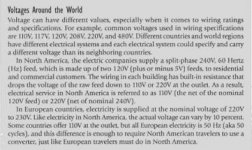
240V is nominal output from the transformer on your power pole. Depending on wire losses and distances, most homes see 220V or 230V at the actual outlet. That's why electrical outlets and wiring are rated for 240V because they might see that as a maximum value, while electrical appliances are usually rated at 220V to show what you will most likely get as output when you use it.

It's the same all over North America.
 

mrb

Well-known member
Joined
Dec 31, 2008
Messages
3,734
240V is nominal output from the transformer on your power pole. Depending on wire losses and distances, most homes see 220V or 230V at the actual outlet. That's why electrical outlets and wiring are rated for 240V because they might see that as a maximum value, while electrical appliances are usually rated at 220V to show what you will most likely get as output when you use it.

It's the same all over North America.


outlets arent rated at 240v. All nema devices are rated at 125v and 250v. 120/240v is the standard for north america, if you are getting 220v at your outlet and your utility's system voltage is 240, you have a problem.
 

nate379

Banned
Joined
Feb 2, 2009
Messages
7,279
Location
Palmer, AK
I agree. I have lived in 8-9 different houses in about as many years and ALL where right around 120v/240v... plus or minus 2-3 volts.

Now when a heavy load is put on that line, maybe it does drop to 110v, but that would be like saying your 60psi water is really 30psi when every faucet in the house is on.
 

Dan0myte

Well-known member
Joined
Nov 18, 2009
Messages
92
Location
Regina, Saskatchewan
http://www.faqs.org/faqs/electrical-wiring/part1/section-14.html

FAQS.org said:
One thing where things might get a bit confusing is the
different numbers people bandy about for the voltage of
a circuit. One person might talk about 110V, another 117V
or another 120V. These are all, in fact, exactly the same
thing... In North America the utility companies are required
to supply a split-phase 240 volt (+-5%) feed to your house.
This works out as two 120V +- 5% legs. Additionally, since there
are resistive voltage drops in the house wiring, it's not
unreasonable to find 120V has dropped to 110V or 240V has dropped
to 220V by the time the power reaches a wall outlet. Especially
at the end of an extension cord or long circuit run. For a number
of reasons, some historical, some simple personal orneryness,
different people choose to call them by slightly different numbers.
This FAQ has chosen to be consistent with calling them "110V" and
"220V", except when actually saying what the measured voltage will
be. Confusing? A bit. Just ignore it.
 

buicfrank

Member
Joined
Oct 25, 2009
Messages
11
Location
new castle, pa
After reading this forum I'm still confused. Sorry. My question would be: Can a 20ft extension cord be run across my garage? This cord would be made of the same wire as the cord from the compressor to the 220 plug. I want to move my compressor but not the plug. Thanks Frank
 

babzog

Well-known member
Joined
Apr 20, 2009
Messages
2,117
Location
Eastern Ontario, Canada
I've got a 220v 60A outlet between the doors for the welder. Also have a long ext. cord to reach places. I have other 220V 15A outlets along one side and the back (three total) for 220V machines (currently just a table saw, but want to get a planer, jointer, etc).
 

38Chevy454

Well-known member
Joined
Dec 26, 2006
Messages
4,036
Location
Cincinnati, OH
On my 26 x 48 I put only two 240v outlets, one 30 amp and one 50 amp; each on it's own breaker. Being that large gage wire is expensive, I kept them fairly close to the breaker box. The 50 amp circuit has 45 ft of cable from the breaker and was nearly $100 just for that length.
 
To avoid these ads, REGISTER NOW!
Top Bottom