To avoid these ads, REGISTER NOW!

220v switch to cut out one tool and run another?

Bessy

Well-known member
Joined
Dec 18, 2012
Messages
995
Location
Ontario, Canada
I have been given a free 220v iVAC switch for dust collection in my woodshop. Unfortunately my current dust collector is of the 120v 1.5hp variety. My current plan is to have my DC and Compressor relocated into a shed outside of the shop to cut down on the noise and just better utilize the interior space for projects. This got me thinking, if I were to find a 220v dust collection system in the future, I would consider upgrading.

For the future shed, I have only run one wire so far to eventually feed 220v to the compressor. My current plan was to simply tap into one of the existing 120v circuits in the shop to run the DC, but since I don't have the capacity nor do I forsee the need to run both the compressor and the DC at the same time, I'd be curious if there is a solution out there that would enable me to have an "either-or" switch to feed 220v power to either the compressor (say if the switch was flipped to the right) OR, flipping the switch to the left, cutting the power to the compressor to instead feed the DC, with the middle between the two being the "off" position for both?

Does such a circuit/switch exist in the 220/240v range??? I know the simple solution is to just buy a 120v DC auto switch and trade off or sell the 220v switch, but I like to overcomplicate things, at least in my head, especially when it involves not needing to buy something new that I don't have (ignoring of course the obvious need for the switch).

Thoughts from the brain trust?
 
To avoid these ads, REGISTER NOW!

The Cobbler

Super Moderator
Staff member
Joined
Oct 24, 2013
Messages
25,999
Location
Niagara Region, Ontario, Canada
you could do a low voltage control to 2 contactors in the shed . the low voltage control switch would be a double throw, on on switch so either one or the other 240 volt circuit would be energized . an on/off/on switch would allow both circuits to be off.
 

dave*99

Well-known member
Joined
May 5, 2009
Messages
4,289
Location
Coastal NJ
I have been given a free 220v iVAC switch for dust collection in my woodshop. Unfortunately my current dust collector is of the 120v 1.5hp variety. My current plan is to have my DC and Compressor relocated into a shed outside of the shop to cut down on the noise and just better utilize the interior space for projects. This got me thinking, if I were to find a 220v dust collection system in the future, I would consider upgrading.

For the future shed, I have only run one wire so far to eventually feed 220v to the compressor. My current plan was to simply tap into one of the existing 120v circuits in the shop to run the DC, but since I don't have the capacity nor do I forsee the need to run both the compressor and the DC at the same time, I'd be curious if there is a solution out there that would enable me to have an "either-or" switch to feed 220v power to either the compressor (say if the switch was flipped to the right) OR, flipping the switch to the left, cutting the power to the compressor to instead feed the DC, with the middle between the two being the "off" position for both?

Does such a circuit/switch exist in the 220/240v range??? I know the simple solution is to just buy a 120v DC auto switch and trade off or sell the 220v switch, but I like to overcomplicate things, at least in my head, especially when it involves not needing to buy something new that I don't have (ignoring of course the obvious need for the switch).

Thoughts from the brain trust?
A simple sketch showing what's in the shed, vs what's in the garage, and whatever cabling or conduit is available between the two will go a long way toward getting useful answers.
 

cannuck

Well-known member
Joined
Nov 30, 2021
Messages
4,662
Location
Rural SK
Suggest you wire to provide 240 to one circuit or the other, with your relay default (NC) to keep DC circuit alive until the compressor switch circuit calls for the compressor to run. Essentially wire the compressor control cicuit power supply to the incoming line (probably one side of a 240) and switch the outbound (NO) to power compressor socket while dumping the NC side the will feed the full 240 to DC circuit - where for the time being you will use only one side of the hot pair plus neutral back to panel to power a 120 socket (that you will change to 240 later using both hot wires).
 
OP
B

Bessy

Well-known member
Joined
Dec 18, 2012
Messages
995
Location
Ontario, Canada
The shed's not built yet. I'm still in the imagination and future-proofing phase here in the event that I determine a need for a higher capacity dust collector (I have a line on one, I just haven't pulled the trigger because I don't have the space for it right now). I'm mainly curious whether this is conceptually possible in the first place. I know it's possible to do with two separate switches, one for the DC and one for the compressor, but my thought process is that since I won't need to fill the compressor at the same time I'm using the DC, it would be nice to cut the power to one while turning on the other in a single motion, to prevent any situation where both would inadvertently be turned on at the same time. See the second photo for an illustration of what I'm envisioning, basically an "A"-on_All-Off_"B"-on situation.

As far as electrical is concerned, we have 100a capacity to the house and a single 40a circuit feeding the shop right now. The panel in the shop feeds a couple of 15a circuits (four, I think) and two 220v circuits, one for the compressor and one for the welding plug at the front of the garage. The welding circuit is used for welding, and for powering the 3hp spindle moulder, using a welding extension cord. So far, I just make sure to confirm that the compressor is turned off before I fire up the welder or the shaper. With the compressor in another room though, that's where I get concerned about making sure it's very clear that it's turned off and it won't fire up while I have something else running.

This past fall because we were insulating the ceiling, I ran an additional 10ga wire through the attic from the panel (not yet connected) to back where the corner of the shed will go. When it comes time to build said shed, I'll pop a hole in the top plate and bring that wire down into the wall cavity on both ends. The 10ga will feed the compressor which will be located in the front right corner of the shed. In my anticipation that I may need to increase my dust collection capacity, I have been toying with the idea of stepping up to a 3hp dust collector which will require 220v power.

The simplest *interim* solution, which really only requires me to buy a new iVAC 120v switch, is to tap off of that back wall and add a circuit in the shed for the dust collector that I have now. Because the back wall will have my miter station I'm not worried about the capacity of that 15a leg. Any of the tools on the wall will use the Fein HEPA vac for dust management, and I've confirmed that the miter saws and the Fein can be run at the same time on the same circuit. With the equipment I have right now, I can run my 1.5hp dust collector off of that back wall, and then power the rest of the tools off any of the other circuits in the shop. So far, I have not popped a breaker in any tool/DC combination.

I've been meaning to update my build thread with some of this information as well, but the first photo is the best layout that I've come up with so far for my major tools that would allow me to have a single bay open for parking and other work, while keeping all of the major dust producing tools connected to a central dust collection trunk (not yet drawn up). On that trunk, I'll run a 120v and a 220v outlet so that I don't have extension cords all over the floor. Again the idea there is that as a one-man shop, I won't in any likelihood have any situation where I'll be running any of my large tools simultaneously.

I will admit, I haven't yet modelled up the wide drum sander but I do expect it to occupy the corner between the outfeed and the smaller miter saw, and I'll just have to run an auxiliary hose to the main trunk for that tool. Once our cabinets are done, I'm not entirely sure I'll keep the wide drum sander anyway. It's a 120v tool, so it can be run off any side of the shop. I'm not entirely sure that I'll keep that sander once we get done with cabinet building in the house, as it's a bit bigger footprint than I think I want to keep for an occasional use tool.
 

Attachments

  • 2026 02 15 - Shop Top View - Proposed.png
    2026 02 15 - Shop Top View - Proposed.png
    408.9 KB · Views: 4
  • Switch Idea.png
    Switch Idea.png
    25.2 KB · Views: 5
OP
B

Bessy

Well-known member
Joined
Dec 18, 2012
Messages
995
Location
Ontario, Canada
Suggest you wire to provide 240 to one circuit or the other, with your relay default (NC) to keep DC circuit alive until the compressor switch circuit calls for the compressor to run. Essentially wire the compressor control cicuit power supply to the incoming line (probably one side of a 240) and switch the outbound (NO) to power compressor socket while dumping the NC side the will feed the full 240 to DC circuit - where for the time being you will use only one side of the hot pair plus neutral back to panel to power a 120 socket (that you will change to 240 later using both hot wires).
I think I get the broad idea of what you're saying, but is there any way to make this a little bit clearer for the layman in me?
 

dscheidt

Well-known member
Joined
Apr 26, 2017
Messages
2,909
For the future shed, I have only run one wire so far to eventually feed 220v to the compressor.
In general, you are only allowed a single circuit running to a detached structure. You probably need to plan for a sub panel on the shed.
 
To avoid these ads, REGISTER NOW!
OP
B

Bessy

Well-known member
Joined
Dec 18, 2012
Messages
995
Location
Ontario, Canada
The shed will be attached to the existing garage structure, just only accessible from outside.

I'm only relocating the existing end of the wire from 3' from the panel to 25' from the panel. The question is "is there a switch that I can turn to the left to turn on one tool, turn to the right to turn on the other tool, or keep centered to leave both unpowered?" effectively creating a "T". I'm pretty confident that I've seen it in low voltage (6 or 12v) system, just not in a high voltage scenario.
 

theoldwizard1

Well-known member
Joined
Feb 22, 2011
Messages
43,321
Location
SE MI
I'd be curious if there is a solution out there that would enable me to have an "either-or" switch to feed 220v power to either the compressor (say if the switch was flipped to the right) OR, flipping the switch to the left, cutting the power to the compressor to instead feed the DC,
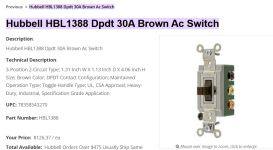
That type of switch is called a Double Pole, Double Throw (DPDT) switch. Leviton makes them (#1282, #1286, #1288, 15A, 20A, 30A). I'm not sure if they are motor rated OR if code allows such a configuration.

For 120V applications, you want a Single Pole, Double Throw (SPDT) switch
 

cannuck

Well-known member
Joined
Nov 30, 2021
Messages
4,662
Location
Rural SK
I think I get the broad idea of what you're saying, but is there any way to make this a little bit clearer for the layman in me?
You have a single 240 volt supply coming to location, so it is one leg at 120 and 0 degrees and the other sine wave on second "hot" leg 180 out of phase, making your 240 V difference from hot to hot legs. You will also run a neutral and a ground back to box. At the end of that wire you can have either 240 single phase (that is actually 2 phases shifted from 120 apart to 180) to you feed that into a relay that has 120 actuating coil and a set of contacts that are NC (normally closed when pull in control voltage not supplied) and another side of the relay NO (normally open until control power sent to pull in coils. You can connect the 2 "hot" leads (essential +120 and -120 to get 240 V) to the "inbound" terminal of a double pole, double throw relay so it when no power to pull in coils power goes from the in terminals to the NC terminals connected to your dust collection receptacle that for now will use a neutral (straight from panel) and only one of the "hot" legs to get a 120 supply, just capping off the second "hot" lead with a wire nut until you want to have a 240 volt dust system. As long as no power is sent to the pull in (activation) coils your dust collector is live.
Back at those "incoming" terminals take a hot leg connection and tap off power to your compressor pressure switch (assuming mechanical). Connect the NO (normally open) terminals to the compressor 240V motor. The 120 you took from the "input" terminals to the switch don't do anything when the compressor is up to pressure. You can throw a manual on/off switch in that wire to allow you to disable the compressor. When the compressor falls below setpoint pressure, its pressure switch closes and takes the control power you provided from one of the "input" terminals from the compressor switch to the relay pull in (activation) coils that change the NO terminals to live to run the compressor motor and drops the NC coils to no voltage shutting off the dust collector while the compressor runs. When it gets to its setpoint, will drop the power to pull in, thus shut off compressor motor and return power to the NC terminals bringing the dust circuit back in.

I should mention: a DPDT relay could be anything rated up to 600V and most likelly to have 3 terminals - just use 2. What is critical is getting one with 120V control (pull in coil) rating - that is common as dirt and it is rated at high enough amps for the largest load (compressor no doubt). Give me a break if I don't use the right sparky terms, since I am a strictly mechanical guy. I actually DO have some hands on with electrical devices, but usually in the hundreds of thousands of volts or tens of thousands amps.
 
Last edited:
OP
B

Bessy

Well-known member
Joined
Dec 18, 2012
Messages
995
Location
Ontario, Canada
Which 240V iVac model do you have? Some models can only run a 120V shop vac/DC and others can run a 240V DC.


1771195124399.png
#RS24020NA is the one I have right now. Looks like the proper 120v version is about $100 shipped, so I know it's doable in a pinch with the system I have. I've been meaning to reach out to the iVAC customer support and see what they say, but I'm pretty confident that this unit from what I've read is exclusively 240v.
 

dave*99

Well-known member
Joined
May 5, 2009
Messages
4,289
Location
Coastal NJ
Compressor is 5hp so that might be a bit much. Dust collector, if I upgrade will be between 2-5hp.
What type of controls are on the compressor? Is there a contactor? Post photos.

If there is a contactor you can lock it out by interrupting the coil power in the contactor.
 
Last edited:
To avoid these ads, REGISTER NOW!
Top Bottom