To avoid these ads, REGISTER NOW!

220V to Shop - Voltage Drop

billrigsby

Well-known member
Joined
Mar 17, 2017
Messages
58
I have a 220V run from the house to the shop (#2 AL direct bury).
Last night when locking up none of the lights worked (several 8' fluorescents).

This AM I checked voltage, 120 on one leg and 65 on the other.
I have 120 on each leg of the breaker at the main panel.

I am pretty sure I know the answer, an underground problem?
All of a sudden this year there has been several dirt mounds,
moles, voles, whatever, are these digger animals know for such damage?

The worst thing is no 220V so no welding or compressor!


Thoughts?
Bill
 
To avoid these ads, REGISTER NOW!

Shiftless

Well-known member
Joined
Mar 9, 2014
Messages
14,551
Location
East Bay SFO
Looks like you better get ready for a lot of digging.

We have lots of gophers in my neighborhood. Besides chewing on roots and killing plants, one of them ate through a buried low voltage landscape lighting cable (14ga). After digging up the run, I ran PVC conduit to protect the new wire. Crazy.
 

PCustoms

Well-known member
Joined
Jul 23, 2011
Messages
23,022
Location
VT
You're probably right, as direct bury does fail from rocks and critters, but first check the obvious/easy.

Kill power at main panel. Are lugs on breaker tight?

Check the sub panel, are lugs tight?
 
Last edited:

mm08822

Well-known member
Joined
Jan 13, 2012
Messages
5,957
Location
NJ
This is why one doesnt go the direct burial route… if the wire fails, its a lot easier pulling out the old and pulling in the new vs digging a new trench or trying to find the bad spot…
This is when that few hundred $$ spent on conduit ain't so bad!! Critters (or rocks) might have never found the conductors if in conduit.
 
OP
B

billrigsby

Well-known member
Joined
Mar 17, 2017
Messages
58
Just talking to the neighbor they had a similar problem with their hot tub, and it was in conduit albeit plastic, he said a critter went through everything.

I'm thinking abandon in place and go ariel, not sure how to go about finding the bad spot without making swiss cheese of the property.

I know when this was put in close to 10 years ago it was properly bedded so the chances of it being a rock are pretty slim I think it's got to be the new found critters I see digging all over the place.
 

Stuart in MN

Well-known member
Joined
Sep 8, 2005
Messages
23,128
Location
Minneapolis
In areas where there are gophers or other burrowing critters it can sometimes be a good idea to oversize the conduit, so it's more difficult for them to open their jaws wide enough to get a good bite on it.
 

wyliesdiesels

Well-known member
Joined
Aug 14, 2012
Messages
20,022
Location
Modesto, CA
considering it is aluminum, I would start by tightening the lugs and make sure the proper paste was used. If that doesn't work then the low side is probably leaking to ground. Ask the POCO if they have equipment that may locate the leak. Example of a leak detector company https://www.simplyleakdetection.biz/services/electrical-ground-fault-locating/
if one is gonna tighten the lugs they need to remove the wire, cut off the smashed part, and start over. also, no-alox is not required by most manufacturers...

but i highly doubt the issue is loose lugs

also most PoCos do not touch wire on the load side of a service so good luck with that
 

Innovate1

Well-known member
Joined
Jul 28, 2014
Messages
4,289
Location
Illinois near St. Louis, Missouri
Sounds like it is probably not loose lugs but still worth checking - it's quick and easy. As for finding a break - that's difficult and are buried splices allowed? I'm thinking no but perhaps with the right splice device. I was going to suggest TDR to find the break but wondering if it's a complete break. May not work unless the break is complete. What's the hot to hot voltage at the garage? Should be 240 but guessing it's less than 120 and the 65V you are measuring is leakage from the other hot wire. If so TDR will send a low voltage pulse down the wire and measure the time for it to reflect from the open end and give you distance. But unless you can splice it doesn't really matter where the break is - the whole wire has to be replaced.
 

mike93lx

ALLIANCE MEMBER
Joined
Dec 9, 2013
Messages
37,589
Location
Richmond, VA
considering it is aluminum, I would start by tightening the lugs and make sure the proper paste was used. If that doesn't work then the low side is probably leaking to ground. Ask the POCO if they have equipment that may locate the leak. Example of a leak detector company https://www.simplyleakdetection.biz/services/electrical-ground-fault-locating/
If the lugs need torquing, pull the wire restrip and the secure it.

Paste is not universally required. All depends on what the wire manufacturer calls for

Edit...missed wylie's response
 

dave*99

Well-known member
Joined
May 5, 2009
Messages
4,268
Location
Coastal NJ
Here are some things to consider.

You measured 65V (to neutral I assume?) at the shop on one leg.
You can do some diagnosis and possibly find the break.
What happens if you turn off all the breakers in the shop? Line to line, line to neutral, line to ground?

Let's say there is a partial or full break in one leg out in the yard. If a critter chewed direct bury cable, it will still be touching soil. That leg will have 120V on it from the house side. It will conduct voltage to the soil. Connect a voltmeter to ground at the house using a long cord. Measure the voltage at the soil surface along the buried cable run. Map it out. You should see an increase in voltage as you approach the break. And it will fall off after you pass the break ----- assuming all the loads are off in the shop.
 

wyliesdiesels

Well-known member
Joined
Aug 14, 2012
Messages
20,022
Location
Modesto, CA
Chewing through a wire at that voltage wouldn't the little **** be fried?
depends on the resistance of the soil. if there isnt low enough resistance then the circuit is not complete and it would be merely like a bird sitting on a bare power line
 
To avoid these ads, REGISTER NOW!

wyliesdiesels

Well-known member
Joined
Aug 14, 2012
Messages
20,022
Location
Modesto, CA
I would think that below ground most places would have enough moisture and conduction to give them a good shock. And if so they would stop chewing before they caused an open circuit. Maybe not...
not always the case. in a similar incident, we had a rodent chew service call at a car dealership. the little booger chewed through multiple conductors on a 70v speaker system including right at the transformer and both conductors. @ 70v shouldve been hit with voltage but the little **** didnt get fried.

we repaired it all and a week later he came back and did it again.... pest control was having a real hard time getting rid of them
 

b-boy

Well-known member
Joined
Oct 2, 2013
Messages
2,155
Location
Buffalo NY
I had squirrels in my crawlspace. They ate the covering off of one 12g wire run down to bare copper. I didn't find a body nearby, so I guess it didn't kill him.
 
OP
B

billrigsby

Well-known member
Joined
Mar 17, 2017
Messages
58
Just to update;

Everything is tight, and was.
No the local utility will do nothing once it's past their meter.
Maybe 8 years ago when I was working alongside them at a sister company so to speak I may have gotten someone to do a little something on the side.
At this point everyone I know is retired or moved on.
Still going to probably pursue the aerial route.
If next weekend is not so hectic I'm going to try to isolate which leg is bad.
And I may have a temporary fix seeing as how everything was grounded with ground rods I have a green ground wire that was never used on both ends I may use it as primary for temporary purposes.
There was no way I was going to untwist 120 ft I just left it in place at the time.
 

wyliesdiesels

Well-known member
Joined
Aug 14, 2012
Messages
20,022
Location
Modesto, CA
Just to update;

Everything is tight, and was.
No the local utility will do nothing once it's past their meter.
Maybe 8 years ago when I was working alongside them at a sister company so to speak I may have gotten someone to do a little something on the side.
At this point everyone I know is retired or moved on.
Still going to probably pursue the aerial route.
If next weekend is not so hectic I'm going to try to isolate which leg is bad.
And I may have a temporary fix seeing as how everything was grounded with ground rods I have a green ground wire that was never used on both ends I may use it as primary for temporary purposes.
There was no way I was going to untwist 120 ft I just left it in place at the time.
What do you mean you have a ground wire that was unused?

The grounding electrodes do not take the place of an EGC. You need both. Sounds like someone didnt know what they were doing

That green ground wire should be hooked up to the ground bar in your subpanel and the neutral bar in the main. Also, the neutral bar in your sub needs to be isolated. The ground rods should connect to the ground bar. Any grounds on the neutral bar need to be moved over to the ground bar.
 
OP
B

billrigsby

Well-known member
Joined
Mar 17, 2017
Messages
58
What do you mean you have a ground wire that was unused?

The grounding electrodes do not take the place of an EGC. You need both. Sounds like someone didnt know what they were doing

That green ground wire should be hooked up to the ground bar in your subpanel and the neutral bar in the main. Also, the neutral bar in your sub needs to be isolated. The ground rods should connect to the ground bar. Any grounds on the neutral bar need to be moved over to the ground bar.

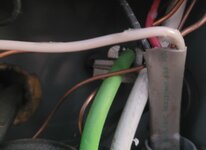
Okay let me rephrase that I have a ground wire that I could disconnect and use as a hot but I guess that is a No-No, it is currently connected to the ground system in the boxes and the ground rod. Sorry not so good of a picture.
20230710_204839.jpg

I'll just live with 120 volts until I can get it all figured out.
 

Zeke

Well-known member
Joined
Aug 13, 2009
Messages
17,176
Location
Long Beach CA, the sewer by the sea.
Find someone with an underground fault locator. It no big deal to find the bad spot and repair it.
Assuming it's a break that is leaking at a small point when it's possible a long area is leaking. I'll bet that a new feed needs to be run. Seeing as this has been done before, then there might not be any obstacles unless the previous trench was backfilled with rocks. I'd kill the service and follow the old trench line as much as possible. Might take less than a hour.

I didn't see it mentioned anywhere how long a run this is. If a 100 feet or so the money spent on burying new cable or conduit is not a bank breaker.
 

Jim greengo

Well-known member
Joined
Sep 3, 2018
Messages
7,415
Location
Behind my house
I have a 220V run from the house to the shop (#2 AL direct bury).
Last night when locking up none of the lights worked (several 8' fluorescents).

This AM I checked voltage, 120 on one leg and 65 on the other.
I have 120 on each leg of the breaker at the main panel.

I am pretty sure I know the answer, an underground problem?
All of a sudden this year there has been several dirt mounds,
moles, voles, whatever, are these digger animals know for such damage?

The worst thing is no 220V so no welding or compressor!


Thoughts?
Bill
That's why I prefer to bury things in conduit.
 

Wrench97

Well-known member
Joined
Jun 23, 2018
Messages
12,118
Location
Southeastern Pa
Just talking to the neighbor they had a similar problem with their hot tub, and it was in conduit albeit plastic, he said a critter went through everything.

I'm thinking abandon in place and go ariel, not sure how to go about finding the bad spot without making swiss cheese of the property.

I know when this was put in close to 10 years ago it was properly bedded so the chances of it being a rock are pretty slim I think it's got to be the new found critters I see digging all over the place.
Sniff around for the fried gopher aroma? :lol:
 

Bert_

Well-known member
Joined
Dec 24, 2016
Messages
9,745
Location
NW Iowa
Assuming it's a break that is leaking at a small point when it's possible a long area is leaking. I'll bet that a new feed needs to be run. Seeing as this has been done before, then there might not be any obstacles unless the previous trench was backfilled with rocks. I'd kill the service and follow the old trench line as much as possible. Might take less than a hour.

I didn't see it mentioned anywhere how long a run this is. If a 100 feet or so the money spent on burying new cable or conduit is not a bank breaker.
I've never had a break at more than one place unless someone hit it while digging. If there was bad backfill it's possible that it end up with more bad spots in time
 

dave*99

Well-known member
Joined
May 5, 2009
Messages
4,268
Location
Coastal NJ
Keep in mind there is likely a safety issue in play. If there is contact between a live conductor and earth somewhere in your yard, it can create a shock hazard. Faulted underground cables are know to create this type of hazard.


Zeke

Well-known member
Joined
Aug 13, 2009
Messages
17,176
Location
Long Beach CA, the sewer by the sea.
I've never had a break at more than one place unless someone hit it while digging. If there was bad backfill it's possible that it end up with more bad spots in time
I was suggesting a traveling corrosion problem. I suppose if 1 foot of cable is bad then 2 splices might fix it. I was thinking it wasn't going to be just a cut where the ends still meet. Might be though, and it's arcing underground. But if that were the case, the wire back into the sheath is going to be bad. Back to 2 splices?
 

Bert_

Well-known member
Joined
Dec 24, 2016
Messages
9,745
Location
NW Iowa
I was suggesting a traveling corrosion problem. I suppose if 1 foot of cable is bad then 2 splices might fix it. I was thinking it wasn't going to be just a cut where the ends still meet. Might be though, and it's arcing underground. But if that were the case, the wire back into the sheath is going to be bad. Back to 2 splices?
You will always need 2 splices. Usually cut 6" and you are back to good wire. Even a cable that has been bad for 6 months has been this way for me
 

FredWanaker

Well-known member
Joined
Mar 27, 2021
Messages
1,470
Location
NorCal
I wasn't thinking that the POCO would do the finding, I was thinking they might know companies in the area that had the equipment to do that.
 

dave*99

Well-known member
Joined
May 5, 2009
Messages
4,268
Location
Coastal NJ
If there is a fault in the cable underground there is usually a few volts measurable at the surface. This is seen in stray and contact voltage cases by utilities frequently.
Use a long lead to connect a voltmeter to ground at the main service panel. Connect the other lead to a screwdriver. Probe the soil along the surface above the cable run. When you find the peak, turn off the power and dig. No specialized equipment needed.
 
OP
B

billrigsby

Well-known member
Joined
Mar 17, 2017
Messages
58
Yeah dont disconnect that. Its part of the ground fault system…

Nothing in the shop is GFCI equipped,

All of this is bringing up a question in my head, not to start another discussion or definitely not an argument but....

The power pole with the transformer on it has a copper plate on the base and a copper wire running up to the transformer which is the ground, from the triansformer triplex runs from the transformer to the meter, two hots and a neutral.

That meter in the main panel is then grounded similarly with about a 6 ft ground rod pounded into the ground. That is in fact how my entire house is grounded, built in 95 for what it's worth.

So now not to stir up controversy, just for my knowledge what is the difference between running two hots and a neutral from the main panel to a sub panel on the shop, via a circuit breaker, which also has a 6-ft ground rod pounded into the ground.

Obviously not an electrician and I don't want to be one!

It is nice to not go a day without learning something though.
 
To avoid these ads, REGISTER NOW!
Top Bottom