To avoid these ads, REGISTER NOW!

220v wiring help

volaredon

Well-known member
Joined
Oct 7, 2012
Messages
1,640
Location
IL
I have 2, 220v circuits in my detached garage.
I have a compressor a welder and a 2 post lift that run off of 220. I have the lift tied into the welder breaker as I am never using both simultaneously but often the compressor is running while I'm putting something up on the lift.
Anyway I have gotten into a little home powdercoating. I bought a $40 used kitchen oven/ range from CL for my powdercoating. It's a 3 wire setup and I use it off the cord I use for the welder when I need it on the opposite side of the garage from where my 220 plugs are at. Same prong configuration at the plug.
I found a different oven I want to use instead. It's a double, built in style oven with temp controls and timers for both top and bottom compartments. (I don't care about the timers working or not as long as the temp controls do)
I'll get into why I'm going to a different style of oven later. (Has mostly to do with getting older and not having to bend down so much to load and unload the oven, and getting the "drops" trying to be quick about working near a red hot heating coil)

Anyway this double oven is a 4 wire.
Not a 3. I have red. Black white and green coming out of the oven.
I know that conventionally red and black are hot white is neutral and green is ground. All the wiring in the walls is run in galvanized EMT.
Can I eliminate one of the 4 wires and wire this oven to a 3 wire plug at least to plug it in and verify it works before I get rid of the stove/range combo?
I don't think brand matters for purpose of discussion but it is an old ancient Tappan double oven. If I had to guess I'd say late 60s to early/mid 70s vintage.
I'm wondering if it's 4 wire because the temp controls running off of 110 maybe and not 220?
Can I wire in a 3 wire plug (even if temporary to test this "new" oven) mainly because I have it here and don't have a 4 wire on hand? The wall plugs in the garage are set up for 4 wire but this cord I have is only 3.
The (at least for now) "test plug" I have is a new take off pigtail with black white and green.
(Hey the Eastwood store had a whole box of these at $5 ea haha Soni had to buy 2 for "someday"... I think they came off of /or for/ the welders they sell)

The other reason for the change is that the stove/oven combo, only the bottom heating element works. The top one never has.
When I'm hanging small parts off the oven racks that's not an issue. But when I do something closer to filling the oven and have parts on top rack and bottom rack the parts on the top rack run 50* colder than what's in the bottom rack and I'm not so sure about the powder curing as well on that top rack at the colder temp as the parts on the bottom can/ do

I most recently did the hub portion of a couple of 3/4 ton truck rotors in that one and that's when I discovered the temp difference within. I knew the top element was "out" before curing the rotors but it was the first job I did with that "loading configuration".
 
To avoid these ads, REGISTER NOW!

Snapped-off

Well-known member
Joined
Feb 22, 2012
Messages
4,857
Location
Indiana
New oven is 4 wire because they have unbonded the neutral and ground at the appliance.

Why don't you just buy a 4w appliance whip, if your receptacles are already 4w. It's a little confusing what the 3w test plug is necessary for.
 

dave*99

Well-known member
Joined
May 5, 2009
Messages
4,351
Location
Coastal NJ
Let’s not forget the difference between a welder receptacle for 240V with L-L-G. And an oven 120/240 receptacle with L-L-N and no ground. Both use 3 wires and serve different purposes.

Which type of receptacle do you have? Sounds like L-L-G. So that’s not 120/240 as your oven requires.

Today’s requirements for the oven are 120/240 with L-L-N-G.
 

75gmck25

Well-known member
Joined
Jul 21, 2014
Messages
1,345
Location
Alexandria, VA
Considering the age of your "new" oven, you need to use the model number to track down its installation docs and find out if it can be converted from using a 4 wire cord to a 3 wire cord.

The 3 wire cord was common back in the 60s and 70's, but gradually most appliances have gone over to using a 4 wire cord (which usually also allows the appliance to use both 120 and 240 volts) . The conversion from 4 wire to 3 wire cord is easy if the manufacturer allows for it and provides directions. If not, it may be difficult/impossible to simply change the cord.
 

dave*99

Well-known member
Joined
May 5, 2009
Messages
4,351
Location
Coastal NJ
Post a photo of the terminal block in the oven. It should be easy to find the N-G bond.

But keep in mind your welder receptacle probably lacks a neutral wire. Be sure to check. What type receptacle is installed? 10-30? 6-30?
 

Cruzan80

Well-known member
Joined
Jul 22, 2015
Messages
4,457
Location
Denver, CO
Future-proofing:
Keep in mind as well, for future use, items that only use Hot/Hot/Ground could be adapted to a 4wire plug.

Wire the receptacle with the appropriate four wires (Hot/Hot/Neutral/Ground), and install the appropriate rated four prong plug (14 series is 125/250, your choice of locking or not, match amps to breaker/wiring). For any item that only uses Hot/Hot/Ground, simply leave the neutral prong disconnected on the plug side (you could still use the existing 3-wire cordage to the machine).

Not an electrician, the following is my best guess/conjecture. Please confirm
To answer the question you asked originally:
I understand you want to test with what is there, but I dont know if the third wire (on older Neutral/grounded bond 3-wire ovens) would react badly to a modern Hot/Hot/Ground setup, especially if the neutral and ground are not bonded in the panel (if a detached building subpanel for example). Would hate for you to damage something, when swapping the receptacle and grabbing a plug would prevent it (you said the EMT drop was 4-wire, correct?).
 
Last edited:

Snapped-off

Well-known member
Joined
Feb 22, 2012
Messages
4,857
Location
Indiana
Let’s not forget the difference between a welder receptacle for 240V with L-L-G. And an oven 120/240 receptacle with L-L-N and no ground. Both use 3 wires and serve different purposes.

Which type of receptacle do you have? Sounds like L-L-G. So that’s not 120/240 as your oven requires.

Today’s requirements for the oven are 120/240 with L-L-N-G.

...

But keep in mind your welder receptacle probably lacks a neutral wire. Be sure to check. What type receptacle is installed? 10-30? 6-30?
According to OP, the receptacles are 4 wire. I guess he just wants to use his 3 wire test cord instead of getting a new one.
The wall plugs in the garage are set up for 4 wire but this cord I have is only 3.
 
OP
V

volaredon

Well-known member
Joined
Oct 7, 2012
Messages
1,640
Location
IL
New oven is 4 wire because they have unbonded the neutral and ground at the appliance.

Why don't you just buy a 4w appliance whip, if your receptacles are already 4w. It's a little confusing what the 3w test plug is necessary for.
Just wanted to use what I have on hand is all
 
OP
V

volaredon

Well-known member
Joined
Oct 7, 2012
Messages
1,640
Location
IL
Considering the age of your "new" oven, you need to use the model number to track down its installation docs and find out if it can be converted from using a 4 wire cord to a 3 wire cord.

The 3 wire cord was common back in the 60s and 70's, but gradually most appliances have gone over to using a 4 wire cord (which usually also allows the appliance to use both 120 and 240 volts) . The conversion from 4 wire to 3 wire cord is easy if the manufacturer allows for it and provides directions. If not, it may be difficult/impossible to simply change the cord.
There is some kind of paper affixed to the side of the oven but I can't see it without either cutting the side of the Wood cabinet out or pulling the oven out of it... Not saying that would be the diagram or not just that that's all I got that might be. I don't see any model or serial number on the machine anywhere yet.
 
OP
V

volaredon

Well-known member
Joined
Oct 7, 2012
Messages
1,640
Location
IL
I did wind up going and buying a 4 pin outlet for my cord end and a 4 prong plug. . I haven't put them in yet
 
To avoid these ads, REGISTER NOW!

wyliesdiesels

Well-known member
Joined
Aug 14, 2012
Messages
20,230
Location
Modesto, CA
The 3 wire cord was common back in the 60s and 70's, but gradually most appliances have gone over to using a 4 wire cord (which usually also allows the appliance to use both 120 and 240 volts)

a 3-wire cord also allows the appliance to use both 120 and 240. the difference between 3-wire and 4-wire is the ground wire NOT the neutral wire. and it doesnt sound like the OP has a neutral since he stated he has 2 240v circuits. so 3-wire and 4-wire is inconsequential. neither will work as there is no neutral.
 

wyliesdiesels

Well-known member
Joined
Aug 14, 2012
Messages
20,230
Location
Modesto, CA
What exactly does that have to do with three vs four wire plugs and receptacles? Especially since he said the receptacles already have four wires run to them?

its a very important detail as originally the only info given by the OP is that they have 2 240v circuits in the garage. these cannot run a 120/240v appliance...
 

Cruzan80

Well-known member
Joined
Jul 22, 2015
Messages
4,457
Location
Denver, CO
wrong for the OPs situation. neutral return current should never be ran on a ground wire. The OP needs a neutral for 120v.
I was saying the opposite of what you replied. If there is a 4-wire receptacle (assuming it was tied in all the way back to the panel correctly) meaning Hot/Hot/Neutral/Ground, and the machine only needs Hot/Hot/Ground, he could use a 4-prong plug and not connect anything to the neutral pin.

In this case, no return current would run along the ground wire, as the machine wouldn't utilize a neutral in the first place. I was talking about AFTER he had a 4-prong receptacle in place (correctly), and wanted to plug in 3-prong equipment. He could just swap the plug.

The OP also stated he has 2 240v circuits which means no neutral.

Overall, the OP could have a 2x 240 circuits in the garage, and have run 4-wire from the breaker panel to the receptacle (only using 3 of the 4 to the receptacle, and not connecting the neutral). Therefore, he could swap out to a 120/240 repectacle and still be code compliant. Seems like a reach to immediately jump to "He cant", simply based on what he said to start only. He said later "4 wires to the box".

I agree, if there are only three wires from the breaker to the receptacle, he can't tie neutral/ground together safely. But that doesnt sound like what is happening, based off everything that the OP has said.
 

wyliesdiesels

Well-known member
Joined
Aug 14, 2012
Messages
20,230
Location
Modesto, CA
Seems like a reach to immediately jump to "He cant",

I can only respond to what the OP has given us.

simply based on what he said to start only. He said later "4 wires to the box".

where did he state this? i went thru the entire thread and did not see one comment where the OP said he had 4-wire to the receptacles. he only said he had 4-wire receptacles. someone can install 4-wire receptacles on a 3-wire circuit. he also said in the OP he had 2x 240v circuits which means no neutral
 
OP
V

volaredon

Well-known member
Joined
Oct 7, 2012
Messages
1,640
Location
IL
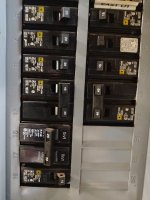
How does 2,220v circuits automatically mean "no neutral". I have (2) seperate 40a double pole breakers, one wired to each plug. One for the compressor and the other one I plug the welder to. Its been a while since I had the cover off of the breaker box so I can't remember details. I think the 20a 220 might actually be for my 2 post lift. I thought I had wired it to one of the 40s... I've run the MiG and the compressor simultaneously many times without having a problem.
 

Attachments

  • IMG_20260824_162933144.jpg
    IMG_20260824_162933144.jpg
    1 MB · Views: 0
  • IMG_20260824_162954190.jpg
    IMG_20260824_162954190.jpg
    561.9 KB · Views: 0
To avoid these ads, REGISTER NOW!
Top Bottom