To avoid these ads, REGISTER NOW!

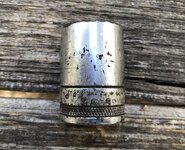
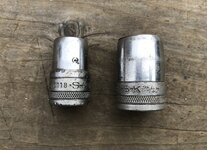
25/32?

tyyost

Well-known member
Joined
Jan 14, 2009
Messages
803
Location
Tunkhannock, PA
I just dumpster dived an old Craftsman Box and was going through it. Most of the contents were moderately Rusty’s but it had some Billings DBE wrenches, some Shaw DOE wrenches, a few SK sockets, and some other odds and ends along with a bunch of swarf.

When cleaning up the wrenches I noticed several 3/4 and 25/32 combo wrenches and at least 2 of the sockets were 25/32. I can’t recall ever needing that size for a bolt, but most of the stuff I have worked on was from the 70’s on. Since they are married to 3/4 in the wrenches I can see them in the overflow box, but the sockets?

Where/when was this a size that mattered? I saw a previous post on the old standard for a heavy 7/16 bolt, but anyone ever use one?
 
To avoid these ads, REGISTER NOW!

Marsim

Well-known member
Joined
Feb 9, 2022
Messages
496
As thehorse13 said, older cars used them. A few other /32 sizes as well. I use those odd ball sizes occasionally to removed stripped bolt heads.
 

Dave455

Well-known member
Joined
Mar 19, 2013
Messages
5,803
Location
Sussex, England
Well, I’m not a huge expert on older U.S. threads, but I believe the previous post was correct - 25/32 was the size for 7/16 heavy pattern nuts from the old U.S.S. (United States Standard) coarse threads. Seldom found now, as most “American” bolt heads are now Unified, which doesn’t use 25/32.

I have both sockets and wrenches in 25/32, used by my Grandfather for working on U.S. vehicles during, and after, the war. I don’t think I’ve ever used this size myself, but you never know…!

I have a feeling that this size might be used in the aerospace industry, maybe for something proprietary. I’ve seen (relatively new) sets that include it.
 

Private Lugnutz

Well-known member
Joined
Mar 30, 2012
Messages
30,526
Location
The Authentic Jersey Shore
Just to qualify and elaborate, this doesn't just pertain to 25/32". ALL U.S.S. nuts and bolt heads were wider in A.F. diameter than their S.A.E. counterparts of the same size bolt. It comes up here so often I put it in the Sticky, post #5.

Bell housings on transmission and gear box and brake assemblies on WWII era Willys MB Jeeps were 7/16 U.S.S. (with a 25/32" head), if you want another example.
 

Junkdrawer Dog

Well-known member
Joined
Jan 14, 2019
Messages
1,460
Location
LV NV
My Dad's old toolbox had 25/32" wrenches. He wrenched a bit in the late 40s and early 50s before changing jobs.
 

Ricky Joe

Well-known member
Joined
Sep 15, 2013
Messages
2,452
Location
Roanoke, Va.
And now the garagejournal effect /32 wrench run on eBay
Not necessary. I have a hundred of them, free for the asking. The only socket set I have that has all of the /32” sizes is a 1930s Duro set. I have a 23/32” Wright socket and a 27/32” s shaped wrench, forget what is on the other side and who made it, but I think Herbrand. 19/32” and 25/32” are common sizes. 21/32” is a common Ford engine bearing size. I have recently been in an accident and got my back broken in two places. I can’t make it to the garage easily so can’t get pictures.
 

Jim C.

Well-known member
Joined
Jan 8, 2010
Messages
2,598
There’s a 25/32” nut that shows up on old Delta woodworking machines frequently.

Jim C.
 

MShaw

Well-known member
Joined
Mar 2, 2015
Messages
1,013
Location
York, Pa.
I remember using a 19/32 wrench to remove the cast iron tanks from a radiator on an Austin Western road grader. I did that in the early 1960s and the grader was old then.
 

Ed in Virginia

Well-known member
Joined
Jul 30, 2022
Messages
205
Location
Montpelier, VA
I just dumpster dived an old Craftsman Box and was going through it. Most of the contents were moderately Rusty’s but it had some Billings DBE wrenches, some Shaw DOE wrenches, a few SK sockets, and some other odds and ends along with a bunch of swarf.

When cleaning up the wrenches I noticed several 3/4 and 25/32 combo wrenches and at least 2 of the sockets were 25/32. I can’t recall ever needing that size for a bolt, but most of the stuff I have worked on was from the 70’s on. Since they are married to 3/4 in the wrenches I can see them in the overflow box, but the sockets?

Where/when was this a size that mattered? I saw a previous post on the old standard for a heavy 7/16 bolt, but anyone ever use one?
Ford Model T tool kits had many x/32 sockets and wrenches. This is a ratchet and socket set from the Model T era and most of the sockets were sized in /32's - 19, 21, 23,,,
 

Attachments

  • Model T Ratchet-Socket Set - Syracuse Wrench Co..png
    Model T Ratchet-Socket Set - Syracuse Wrench Co..png
    1.8 MB · Views: 24

Private Lugnutz

Well-known member
Joined
Mar 30, 2012
Messages
30,526
Location
The Authentic Jersey Shore
That is a related but potentially confusing matter, Ed. Early pressed steel sockets were intentionally oversized to account for the quality of the hardware and the pressed steel socket manufacturing at the time, they went from 5/16 to 1-9/32 in /32nd increments, and with that range and those increments many of them would also fit all the various fastener standards of the day, including the coarser U.S.S., the A.L.A.M., Hex Cap Screw, and the finer American Standard bolt that would emerge as S.A.E.

Here's the Sticky entry on page 5
/32nds
- Antique pressed steel socket wrenches in /32nds sizes are typically oversized to accommodate crude hardware manufacturing standards.
- Vintage wrenches in /32nds sizes are not. They are not metric equivalents or made for tamper-proof fasteners, either, to name a few of the most common misconceptions. Most correspond to U.S.S. nuts and bolts, which had heads that were exactly 1/16” or 1/8” wider in Across-the-Flats O.D. than S.A.E. nuts and bolts of the same thread size. Wrenches in /32nds sizes were made from the advent of U.S.S. nuts and bolts in the 1800’s right through the 1950’s. Some are to accommodate non-standard mfgr's specs.
 

Ed in Virginia

Well-known member
Joined
Jul 30, 2022
Messages
205
Location
Montpelier, VA
That is a related but potentially confusing matter, Ed. Early pressed steel sockets were intentionally oversized to account for the quality of the hardware and the pressed steel socket manufacturing at the time, they went from 5/16 to 1-9/32 in /32nd increments, and with that range and those increments many of them would also fit all the various fastener standards of the day, including the coarser U.S.S., the A.L.A.M., Hex Cap Screw, and the finer American Standard bolt that would emerge as S.A.E.

Here's the Sticky entry on page 5
What is potentially confusing about it? The post that started this thread specifically mentioned /32 sockets: "When cleaning up the wrenches I noticed several 3/4 and 25/32 combo wrenches and at least 2 of the sockets were 25/32. I can’t recall ever needing that size for a bolt, but most of the stuff I have worked on was from the 70’s on. Since they are married to 3/4 in the wrenches I can see them in the overflow box, but the sockets?" My response seems pertinent to this post in that regard, does it not?
 

Private Lugnutz

Well-known member
Joined
Mar 30, 2012
Messages
30,526
Location
The Authentic Jersey Shore
I thought I explained why in my reply. The OP finding vintage 40's and 50's hot-forged combination wrenches with 25/32" openings (milled explicitly in that size opening to accommodate 7/16 U.S.S. bolts) is not the same reason why pressed steel sockets were all made in /32nd inch increments from 10/32" to 1-9/32" decades earlier. I was just trying to clarify the difference. But I won't press the point further.
 

leg17

Well-known member
Joined
Aug 11, 2011
Messages
1,371
Location
Kentucky
What is potentially confusing about it? ..... My response seems pertinent to this post in that regard, does it not?
This post, like so many, offers some an opportunity to add additional related info in order to avoid multiple posts.
No need for separate posts about 31/32, 19/32, etc.
A good way to pick up some information.

WRENCH SIZES
31/32" is the old U.S.S. standard for 9/16" bolt/nut.
25/32" is the old U.S.S. standard for 7/16" bolt/nut.
19/32" is the old U.S.S. standard for 5/16" bolt/nut.
11/32" is the old standard for #8 hex screw. This size still common in electrical work.

Other size sockets were offered by many toolmakers for various unique automobile applications. The 1937 Herbrand catalog is very helpful concerning these sizes.

21/32” socket was designated for Ford Model A and B connecting rods and for V8-60 mains.
23/32” socket was designated for 1933-34 Chevrolet front main bearings.
29/32” socket was designated for Chrysler Corp shackle bolts.
 

Private Lugnutz

Well-known member
Joined
Mar 30, 2012
Messages
30,526
Location
The Authentic Jersey Shore
19/32"is very close to 15mm.
While that's true, and a few other sizes are also 'close' to a few metric sizes, that was not the intent of any of the /32nd sizes, the difference has resulted in many curses or some rounded off nuts, and the seeming equivalence is just an artifact of the influx of foreign cars, an overlap in a couple generations of mechanics as imperial sizing and standards faded out, and hunches. As a side-note, and somewhat to the contrary, BHM believed in the 'closeness' enough to make dual-marked versions of their DOE wrenches, milled for imperial sizes, for export markets as early as the 1930s.
This post, like so many, offers some an opportunity to add additional related info in order to avoid multiple posts.
:thumbup:

I tried to be more summarily succinct in the Sticky, to keep its length down, but I just had a light bulb moment. I will add a link to it to this post or one of the others you have made in similar replies.
 
Last edited:
To avoid these ads, REGISTER NOW!

vavet

Well-known member
Joined
Mar 6, 2012
Messages
5,321
Location
Ashland, VA
I can't add to the knowledge base, but just another sighting - I have at least one Craftsman double open end wrench with one side being 25/32 that was handed down by my dad. He was a simulator technician in the USAF 1966-70 and then went to work for Delta Airlines doing the same thing in 1970. My belief is that this tool would've been acquired during his time with Delta.

He might've acquired it because it was needed for automotive work during that time, but most of his tools were for simulators.
 

Ricky Joe

Well-known member
Joined
Sep 15, 2013
Messages
2,452
Location
Roanoke, Va.
I can't add to the knowledge base, but just another sighting - I have at least one Craftsman double open end wrench with one side being 25/32 that was handed down by my dad. He was a simulator technician in the USAF 1966-70 and then went to work for Delta Airlines doing the same thing in 1970. My belief is that this tool would've been acquired during his time with Delta.

He might've acquired it because it was needed for automotive work during that time, but most of his tools were for simulators.
Just because we have a tool doesn’t mean we have ever needed or used it.
 

DOUGD

Well-known member
Joined
Mar 15, 2011
Messages
171
If you ever need to change a main landing gear brake assembly on a Boeing 727 you will need a 25/32 12 point socket or wrench. Not sure if I used that size any where else.
 

MarkH

Well-known member
Joined
Dec 19, 2005
Messages
1,353
Location
Kansas
I usually see them in the old sets at auctions. There is usually the 19/32 and 25/32 in the set. We do keep one of the old sets with 32's in the main shop. We do have some old stuff that someone goes the tools do not fit. Go look in the old Waterloo box and select a 32nd sized between what did not fit. The kids usually give a funny look followed by it worked. Old box for old stuff we still routinely use.
 

genog

Well-known member
Joined
Sep 4, 2021
Messages
2,001
Location
Silicon Valley
This thread sure helped make sense of my wonderment concerning the 32's
19/32, 21/32, et al

How about 53/64?
Here's an old Duro that I found recently.
duro4.jpgduro3.jpg
 

Private Lugnutz

Well-known member
Joined
Mar 30, 2012
Messages
30,526
Location
The Authentic Jersey Shore
How about 53/64?
Here's an old Duro that I found recently.
That and similar odd sizes are not related to different hardware standards. They are usually for spark plugs or some other special application. Yours shows up from time to time on the Duro-Indestro thread. According to the 1939 and 1940 catalogs, it was for 1933 to 1936 Chevy spark plugs. If you go to post# 1281 in the DI thread I posted links to other examples in that thread for the last time one was posted.
 

d42jeep

Well-known member
Joined
Oct 22, 2014
Messages
16,526
Location
Northern California
This thread sure helped make sense of my wonderment concerning the 32's
19/32, 21/32, et al

How about 53/64?
Here's an old Duro that I found recently.
duro4.jpgduro3.jpg
Here is a Western Auto relative. It will prove useful if I ever need to change the plugs on my imaginary ‘33 to ‘36 Chevy.
-Don7BFDFC55-3197-4D35-9942-9133F03F49F2.jpegB14FA527-348C-4137-8ABF-7373B8A30E41.jpeg
 
Last edited:

genog

Well-known member
Joined
Sep 4, 2021
Messages
2,001
Location
Silicon Valley
Does anyone know the application for 53/64?

That was the point of my post and pic above.
It wasn't meant to be a Show and Tell
 

Draftpick1

Well-known member
Joined
Mar 22, 2018
Messages
326
You can still buy these and others USA made Proto 25/32 J5225, 19/32 J5219, 17/32 J5217 Proto only had these in 12 point.
 

Leviton

Well-known member
Joined
Feb 25, 2019
Messages
901
Location
Oregon
Here is a Western Auto relative. It will prove useful if I ever need to change the plugs on my imaginary ‘33 to ‘36 Chevy.
-Don
You know how this works. You get the tool cheap at a garage sale and then you need to buy its accessory/missing-piece at many times the price of the cheap tool. You have to buy the Chevy.
 
To avoid these ads, REGISTER NOW!
Top Bottom