

You are using an out of date browser. It may not display this or other websites correctly.
You should upgrade or use an alternative browser.
You should upgrade or use an alternative browser.
3/4" ratchets with 72t or more
- Thread starter ecotec
- Start date
gdocktor3
Well-known member
IMO, as ratchets get bigger the tooth count should get smaller. Due to the large amounts of torque applied to a 3/4" ratchet, a smaller tooth count gear provides more surface contact between gear and pawl. I just checked Snap On and their 3/4" ratchet heads are only 32 tooth. With that said, I have the 3/4" SK round head ratchet that is 72t and it is a beast, but every time I use it in really high torque applications, I picture the gears stripping out and myself go flying. In my head, I always picture these fine tooth ratchets blowing apart much like the small motorized cars I had as a kid. You roll them backwards then let them go. Well, if you rolled them back to far, too many times, the gears eventually stripped out and often the guts would come pouring out.
Either way, you can find the SK on eBay all the time for around $50 and repair kits are still available, usually for free. I doubt you'll find many/any for the Bonney.
Either way, you can find the SK on eBay all the time for around $50 and repair kits are still available, usually for free. I doubt you'll find many/any for the Bonney.
Empty Pockets
Well-known member
IMO, as ratchets get bigger the tooth count should get smaller. Due to the large amounts of torque applied to a 3/4" ratchet, a smaller tooth count gear provides more surface contact between gear and pawl. I just checked Snap On and their 3/4" ratchet heads are only 32 tooth. With that said, I have the 3/4" SK round head ratchet that is 72t and it is a beast, but every time I use it in really high torque applications, I picture the gears stripping out and myself go flying. In my head, I always picture these fine tooth ratchets blowing apart much like the small motorized cars I had as a kid. You roll them backwards then let them go. Well, if you rolled them back to far, too many times, the gears eventually stripped out and often the guts would come pouring out.
Either way, you can find the SK on eBay all the time for around $50 and repair kits are still available, usually for free. I doubt you'll find many/any for the Bonney.
I couldn't have said it better
Loscaldazar
Well-known member
- Joined
- Feb 23, 2013
- Messages
- 2,385
IMO, as ratchets get bigger the tooth count should get smaller. Due to the large amounts of torque applied to a 3/4" ratchet, a smaller tooth count gear provides more surface contact between gear and pawl. I just checked Snap On and their 3/4" ratchet heads are only 32 tooth. With that said, I have the 3/4" SK round head ratchet that is 72t and it is a beast, but every time I use it in really high torque applications, I picture the gears stripping out and myself go flying. In my head, I always picture these fine tooth ratchets blowing apart much like the small motorized cars I had as a kid. You roll them backwards then let them go. Well, if you rolled them back to far, too many times, the gears eventually stripped out and often the guts would come pouring out.
Either way, you can find the SK on eBay all the time for around $50 and repair kits are still available, usually for free. I doubt you'll find many/any for the Bonney.
I couldn't have said it better
This is the same argument that people use for why fine tooth ratchets in 1/4, 3/8, and 1/2 are weaker, when in reality, they aren't. It's all about the surface area contact, and low tooth count ratchets generally only have 1, or at most, 2 large teeth engaged, where as fine tooth ratchets generally have more smaller teeth engaged and overall a larger surface contact area, as well as they spread that load out across more area on the gear mechanism (not all the force on one tooth that sticks out from the pawl quite a ways).
The reason most 3/4 and 1" ratchets aren't fine tooth is because they are generally low volume (and only are worth updating every once in a long while financially) as well as you jut don't need a small swing arc with a large ratchet. If you're using something that large, you probably have lots of room to swing the ratchet, so for that reason, I wouldn't be concerned about finding a fine tooth 3/4 drive ratchet.
toolenthusiast
Well-known member
- Joined
- Jan 21, 2017
- Messages
- 723
The SK 72t design has 17 teeth in contact at a time. That's strong. It's like velcro. It's well-established that fine-tooth ratchets are incredibly strong, and there's no reason that the design can't scale up.
Gear/pawl interface is only one facet of ratchet design. The alloy used, the heat treating process, and the precision of the ratchet parts are frequently ignored.
Gear/pawl interface is only one facet of ratchet design. The alloy used, the heat treating process, and the precision of the ratchet parts are frequently ignored.
toolenthusiast
Well-known member
- Joined
- Jan 21, 2017
- Messages
- 723
This is the same argument that people use for why fine tooth ratchets in 1/4, 3/8, and 1/2 are weaker, when in reality, they aren't. It's all about the surface area contact, and low tooth count ratchets generally only have 1, or at most, 2 large teeth engaged, where as fine tooth ratchets generally have more smaller teeth engaged and overall a larger surface contact area, as well as they spread that load out across more area on the gear mechanism (not all the force on one tooth that sticks out from the pawl quite a ways).
Exactly! What's good for the goose is good for the gander. No one would ever say "A small knife needs to be sharp but a large knife shouldn't".
It's well-established that fine-tooth ratchets are incredibly strong, and there's no reason that the design can't scale up.
"Incredibly strong"--as in the sense of being as strong as the square drive-- is only something that has come to pass recently.
Ign
Well-known member
If you truly can get more engagement and/or engagement more equally distributed with more, finer teeth, then it's the same as axles: assuming axle shaft diameter is equal (and of course equal metallurgy) the axle with a higher spline count is stronger.
crane operator
Well-known member
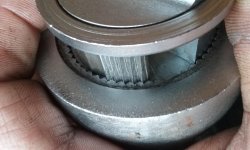
I purchased a wright 1" drive set, with a bad ratchet. The replacement pawl kits are 45 tooth, as are the new ratchets (same part #'s). The old ratchets were 60 tooth. I got a good look at what the differences were, when wright sent me a 45 to try to fix my ratchet.
There are no more teeth on the pawl of the 60 tooth than the 45, they are just of a different size. Both have 5 teeth.
So your higher tooth count doesn't get you more engagement teeth, they just have less engagement area. The teeth are shorter. But you have less turn to the next tooth, with a higher tooth count.
I think the newer wright with less teeth- will be stronger
View attachment 628919
There are no more teeth on the pawl of the 60 tooth than the 45, they are just of a different size. Both have 5 teeth.
So your higher tooth count doesn't get you more engagement teeth, they just have less engagement area. The teeth are shorter. But you have less turn to the next tooth, with a higher tooth count.
I think the newer wright with less teeth- will be stronger
View attachment 628919
crane operator
Well-known member
This is the same argument that people use for why fine tooth ratchets in 1/4, 3/8, and 1/2 are weaker, when in reality, they aren't. It's all about the surface area contact, and low tooth count ratchets generally only have 1, or at most, 2 large teeth engaged, where as fine tooth ratchets generally have more smaller teeth engaged.
Not at all true- all the teeth on the pawl are engaged at the same time.
Pictures of the 60 tooth and 45 tooth

dnschmidt
Well-known member
This is a case of less is more. Gdocktor3 has got this right. If you're using a 3/4" ratchet you mean business and the stronger the better. Fine teeth are not the answer to this particular question.
WWheeler
Well-known member
Never in my life have I felt the need for a fine tooth 3/4 or 1" ratchet and I use both daily.
Less teeth on a gear means the teeth are cut deeper = much more contact area per tooth = that much less chance that it can slip. It really doesn't matter how many teeth are engaged if they are all hanging by a thread's depth of engagement. Finer teeth equal a shallower engagement on each tooth and more of a chance to slip and strip.
Less teeth on a gear means the teeth are cut deeper = much more contact area per tooth = that much less chance that it can slip. It really doesn't matter how many teeth are engaged if they are all hanging by a thread's depth of engagement. Finer teeth equal a shallower engagement on each tooth and more of a chance to slip and strip.
Loscaldazar
Well-known member
- Joined
- Feb 23, 2013
- Messages
- 2,385
I purchased a wright 1" drive set, with a bad ratchet. The replacement pawl kits are 45 tooth, as are the new ratchets (same part #'s). The old ratchets were 60 tooth. I got a good look at what the differences were, when wright sent me a 45 to try to fix my ratchet.
There are no more teeth on the pawl of the 60 tooth than the 45, they are just of a different size. Both have 5 teeth.
So your higher tooth count doesn't get you more engagement teeth, they just have less engagement area. The teeth are shorter. But you have less turn to the next tooth, with a higher tooth count.
I think the newer wright with less teeth- will be stronger
View attachment 628919
Not at all true- all the teeth on the pawl are engaged at the same time.
Pictures of the 60 tooth and 45 tooth
I think you missed the part where I said generally. Finding one exception does not make my statements "not at all true."
Snap On Dual 80s (around 7 teeth engaged, maybe it was 9) are stronger than the older 36T ratchets (2 teeth), the Armstrong/Matco 88T ratchets are stronger than the 36T craftsman ratchets. Gearwrench 84T ratchets are 190% of ASME torque, 120XPs are 180% (or around there). Dual 80s are around 200%. The Snap On pawls for the 80T mechanisms are also a little bit deeper than the 36T pawls. Surface area is dramatically more on the dual 80T than the 36T. Same goes for Armstrong/Matco/GW/Craftsman/Husky/Crescent fine tooth ratchets, and Mac/Proto's new 90T ratchet compared to their older 24T.
Additionally, roundheads do tend to have more teeth engaged at one time than do spearheads of the same tooth counts. The SK round heads have more teeth engaged relative to their tooth count than do most other pear head ratchets of the same tooth count (3 vs 2 or 1). The higher tooth count (and discontinued) SK Tuff 1 ratchets had 17 teeth on the pawl engaged on a 72T ratchet vs 3 on the lower tooth SK ratchets.
It isn't some conspiracy by ratchet manufacturers that they are advertising fine tooth ratchets as significantly stronger than low tooth count ratchets.
I don't think a fine tooth 3/4 drive+ ratchet is necessary because you generally have so much room to swing it. I usually use a 3/4 drive breaker bar (effectively a "4 tooth ratchet," slightly more with a 12 point socket). A fine tooth 3/4 drive ratchet (like the Facom or SK) will be plenty strong. There just aren't many options since 3/4 drive ratchet rarely get updated (as they are not worth the investment that 1/4, 3/8, or 1/2 ratchets bring in).
Never in my life have I felt the need for a fine tooth 3/4 or 1" ratchet and I use both daily.
Less teeth on a gear means the teeth are cut deeper = much more contact area per tooth = that much less chance that it can slip. It really doesn't matter how many teeth are engaged if they are all hanging by a thread's depth of engagement. Finer teeth equal a shallower engagement on each tooth and more of a chance to slip and strip.
It absolutely does matter how many teeth are engaged. The load gets spread out between the teeth. The more teeth, the more the load is spread out.
Your analysis only works out if you are comparing it on a tooth to tooth basis, not as an entire system. 2 Teeth that hold 90 ft-lbs each are not going to produce as strong of a ratchet as 7 teeth (or 17!) that hold 30-ft-lbs each. Apply 200 ft-lbs to that system, and one will hold (the fine tooth), not the low tooth ratchet. You have to consider this as an entire system, not as individual pieces.
Last edited:
crane operator
Well-known member
I think you missed the part where I said generally. Finding one exception does not make my statements "not at all true."
Snap On Dual 80s (around 7 teeth engaged, maybe it was 9) are stronger than the older 36T ratchets (2 teeth), the Armstrong/Matco 88T ratchets are stronger than the 36T craftsman ratchets. Gearwrench 84T ratchets are 190% of ASME torque, 120XPs are 180% (or around there). Dual 80s are around 200%. The Snap On pawls for the 80T mechanisms are also a little bit deeper than the 36T pawls. Surface area is dramatically more on the dual 80T than the 36T. Same goes for Armstrong/Matco/GW/Craftsman/Husky/Crescent fine tooth ratchets, and Mac/Proto's new 90T ratchet compared to their older 24T.
Additionally, roundheads do tend to have more teeth engaged at one time than do spearheads of the same tooth counts. The SK round heads have more teeth engaged relative to their tooth count than do most other pear head ratchets of the same tooth count (3 vs 2 or 1). The higher tooth count (and discontinued) SK Tuff 1 ratchets had 17 teeth on the pawl engaged on a 72T ratchet vs 3 on the lower tooth SK ratchets.
It isn't some conspiracy by ratchet manufacturers that they are advertising fine tooth ratchets as significantly stronger than low tooth count ratchets.
I don't think a fine tooth 3/4 drive+ ratchet is necessary because you generally have so much room to swing it. I usually use a 3/4 drive breaker bar (effectively a "4 tooth ratchet," slightly more with a 12 point socket). A fine tooth 3/4 drive ratchet (like the Facom or SK) will be plenty strong. There just aren't many options since 3/4 drive ratchet rarely get updated (as they are not worth the investment that 1/4, 3/8, or 1/2 ratchets bring in).
Sorry to add to the confusion- I honestly wasn't thinking of pear head type ratchets, because of my recent go around with my wright, and my s-k style 3/4" drive.
You are totally right- on that style you would have much more engagement with the higher tooth counts, with the pawl style they have.
Thanks for putting me right

WittHay
Well-known member
I always thought the low tooth count pear heads were stronger than the round design.
I use a Mac 3/4" 30 tooth ratchet. The Snap-on and Gray are both 32 tooth.
Not sure why you need a fine tooth 3/4" ratchet.
I use a Mac 3/4" 30 tooth ratchet. The Snap-on and Gray are both 32 tooth.
Not sure why you need a fine tooth 3/4" ratchet.
Sam'sAutoParts
Well-known member
I have an SK and love it, only thing is I wish it had a longer handle.
Firebrick43
Well-known member
My 32 tooth 1974 snap on was used by my dad for years in maintaining cat equipment and now by me maintaining cnc machine that make cat equipment. It has the 42" handle on it. Snap ons have different length replaceable handles unlike many. Now my dad is a big guy. When I was a teenager he had some 50 semi trailers used for storage. To change bud wheels I would use a handyman Jack (aka farmer killer) to support a long extension as he bounce on a 7' pipe slipped over the handle. The handle would flex in quite an arc and never did take a bend. He had fried every brand before finally dropping the coin on a snap on. Sk while nice ratchets(generally my favorite especially the tuff 1's) would always bend the handle if a pipe and a really rusted bolt was encountered.
Also snap ons dual 80 24" 1/2 drive ratchets make all of the 24" 3/4 ratchets obsolete. Every mech at work has a flex head/comfort handle version and while no one uses pipes I have seen 300lb guys hanging from them and have seen not one failure of the two dozen in the plant. It's pretty rare for me to use "big Bertha" as everyone calls her but sometime she's needed. My wright 24" 3/4 hasn't been used in years.
Also snap ons dual 80 24" 1/2 drive ratchets make all of the 24" 3/4 ratchets obsolete. Every mech at work has a flex head/comfort handle version and while no one uses pipes I have seen 300lb guys hanging from them and have seen not one failure of the two dozen in the plant. It's pretty rare for me to use "big Bertha" as everyone calls her but sometime she's needed. My wright 24" 3/4 hasn't been used in years.
I have a New Britain / Mac Z4R 24" 3/4" drive ratchet from the early 70s that is 44 teeth.
Just for the gee whiz the New Britain / Kilness ratchets were designed so that the square would always shear off before any other damage. Therefore they were always rebuildable with no damage to the frame from the failure.
Just for the gee whiz the New Britain / Kilness ratchets were designed so that the square would always shear off before any other damage. Therefore they were always rebuildable with no damage to the frame from the failure.
gdocktor3
Well-known member
I have a New Britain / Mac Z4R 24" 3/4" drive ratchet from the early 70s that is 44 teeth.
Just for the gee whiz the New Britain / Kilness ratchets were designed so that the square would always shear off before any other damage. Therefore they were always rebuildable with no damage to the frame from the failure.
Are rebuild kits still available from Mac?
dnschmidt
Well-known member
Typically 3/4" ratchets are 20" long. My 1/2" breaker bars are 24" long. TOPTUL does make a 72 tooth 3/4" ratchet with a plastic handle that's 20" long it's part number CHWM2451. It's a beautiful ratchet but my reason for never importing it is that anybody doing anything with 3/4" drive is going to be putting a cheater bar on a 20" ratchet and that's not going to work with a plastic handle. Why make 20" long 3/4" drive ratchets. This makes no sense to me.
WittHay
Well-known member
Snap-on once made a L78 1 1/2" 16 tooth ratchet 42" long.The handle diameter was 1 3/8"
Definitely not fine-toothed but you probably put a 10 foot pipe on it.
Definitely not fine-toothed but you probably put a 10 foot pipe on it.
WWheeler
Well-known member
[...] Snap On Dual 80s (around 7 teeth engaged, maybe it was 9) are stronger than the older 36T ratchets (2 teeth) [...]
Where did you learn this? I gave it a cursory google and came up empty.
I seem to recall when Snap On was still selling the 936 line and the Dual 80 at the same time they were marketing the Dual 80 for the 4 (and a half) degree ratcheting arc and their 936 line as their "High strength ratchet" line. I don't ever recall seeing Snap On claim that their Dual 80 was actually stronger than their 936 ratchets. I have several of both and I really do not believe this is the case. If I'm mistaken please do show me. After all, I am from Missouri.

Last edited:
thesilverone
Well-known member
i have a 1 tooth 3/4 dr ratchet
**** on that
**** on that
Loscaldazar
Well-known member
- Joined
- Feb 23, 2013
- Messages
- 2,385
Where did you learn this? I gave it a cursory google and came up empty.
I seem to recall when Snap On was still selling the 936 line and the Dual 80 at the same time they were marketing the Dual 80 for the 4 (and a half) degree ratcheting arc and their 936 line as their "High strength ratchet" line. I don't ever recall seeing Snap On claim that their Dual 80 was actually stronger than their 936 ratchets. I have several of both and I really do not believe this is the case. If I'm mistaken please do show me. After all, I am from Missouri.
Snap On advertised the 936 series as "high strength" as soon as they released them- years before the dual 80s were released. The 936 series were called high strength because they were higher strength than the previous generation ratchets (830 series I believe they were), not because they were stronger than the Dual 80s.
A quick email with Snap On will confirm that the dual 80s are stronger than the older 936 series. But a few of the phrases Snap On uses to describe the Dual 80 ratchets
"Shop our selection of professional Snap-on Dual 80 Technology ratchet wrenches - the smoothest, strongest ratchets"
or
"Dual pawls and an 80 tooth gear provide this Snap-on classic with more power in less lateral space."
Do a search for the following too....
How do 936 series fail under high torque?
Answer: Either the teeth on the gear or pawls. Indicates the teeth are the weak point on the 936 series.
How do dual 80 ratchets fail under high torque?
Answer: They twist the drive end off. Indicates the drive end, not the teeth are the weak point. The gear mechanism is strong enough that these will twist the drive tang off.
Further thoughts:
How many ratchets would twist the drive end off before modern fine tooth ratchets?
Practically none. Historically, the gear or pawl teeth have always been the weak point on any ratchet. That is not the case with modern ratchets where you are now starting to twist the drive end off the ratchet more than you are damaging the teeth. Shearing the drive tang off a ratchet is literally only something that has a thing for the past 10-15 years.
Why were older coarse tooth ratchets never offered in extra long configurations? If those older ratchets were stronger, why did they not have extra long ratchets? Why are they not offered today in extra long configurations?
Ratchets have only recently become strong enough to do this like, say, a 24" handle on a 1/2" drive ratchet mechanism. Anything 24" long used to be reserved for 3/4 drive territory. Hell, anything 18" used to be either a 3/4 drive ratchet or a 1/2 drive breaker bar (no ratcheting mechanism). There simply never was a 1/2 drive ratchet strong enough to stand up to daily use on a 24" bar, or a 3/8 drive ratchet with a 18" handle! (1/4" drive with a 10-11" handle???)
If the 936 series were stronger, why would Snap On discontinue them? Why not sell every tech a fine tooth ratchet for tight areas and a coarse tooth ratchet for more strength? Twice the sales for the same market....Why sink more costs into warrantying a newer inferior product? Why come out with a product that is worse than the outgoing model? Why anger techs with a product that will break more often? Why lie and say the dual 80s are the strongest if the previous generation ratchets were stronger?
Ask the Snap On dealers who are on here (or look up what the ones formerly on this forum said) about which ratchets they have to fix more often. They all say they replace the 936 gears way more often then they do the Dual80s.
But, quite frankly, the only proof I really need is pictures like the one below. Any ratchet that shear off the drive tang and ratchet like new is a clear indication that the teeth are not the weak point (which is where most ratchets fail). Ratchets are getting stronger- not weaker.
http://www.garagejournal.com/forum/showpost.php?p=1304363&postcount=15
Last edited:
WittHay
Well-known member
100% agree that 1/4" to 1/2" ratchets have improved a lot in the last 10 years.
I am still not convinced in 3/4" and up sizes that you can make a high strength fine tooth ratchet. Its like in bolt sizes the larger the bolt the less threads you have. You need a certain amount of metal between threads or in a ratchet between gears to be strong.
Snap on 3/4" ratchet has 32 teeth, Snap-on 1 1/2" ratchet has 16 teeth
I think most 1" 1000 ft.lb. torque wrenches are 24 to 30 tooth pear heads
I am still not convinced in 3/4" and up sizes that you can make a high strength fine tooth ratchet. Its like in bolt sizes the larger the bolt the less threads you have. You need a certain amount of metal between threads or in a ratchet between gears to be strong.
Snap on 3/4" ratchet has 32 teeth, Snap-on 1 1/2" ratchet has 16 teeth
I think most 1" 1000 ft.lb. torque wrenches are 24 to 30 tooth pear heads
Last edited:
WWheeler
Well-known member
[...]
How do 936 series fail under high torque?
Answer: Either the teeth on the gear or pawls. Indicates the teeth are the weak point on the 936 series.
How do dual 80 ratchets fail under high torque?
Answer: They twist the drive end off. Indicates the drive end, not the teeth are the weak point. The gear mechanism is strong enough that these will twist the drive tang off.
[...]
Couldn't be bothered to read any further. I've repaired two dual 80s with stripped gears. One I bought that way for dirt cheap and one I broke myself. Never have I been able to break a 936. I do not believe for a second the dual 80s are stronger.
BIG BACCHUS
Well-known member
I have an SK and love it, only thing is I wish it had a longer handle.
They make pipes for that.

Firebrick43
Well-known member
They make pipes for that.
I have seen a lot of 3/4" sk with bent handles. Nice ratchets but I wouldn't stick a pipe on one.
bobcatdan
Well-known member
I think you are spitting hairs on which tooth count is stronger in a 3/4" ratchet. You would need hell of a pipe on one to do so and you will most likely bend the handle long before the guts give out.
shockwave
Well-known member
I have been looking at facom and beta both offer nice fine tooth 3/4 ratchets
On a cheaper note look at nos kd tools 3/4 as a coarse tooth is quite strong and 3/4 is usually more geared towards strength vs fine tooth
On a cheaper note look at nos kd tools 3/4 as a coarse tooth is quite strong and 3/4 is usually more geared towards strength vs fine tooth
davethorik
Well-known member
They make pipes for that.
They make the Wright 6425 for that.
I do not believe for a second the dual 80s are stronger.
FYI - there was published tests on this
and dual-80 is the champ
But back to 3/4 drive...

Loscaldazar
Well-known member
- Joined
- Feb 23, 2013
- Messages
- 2,385
FYI - there was published tests on this
and dual-80 is the champ
But back to 3/4 drive...
Those were in a Japanese magazine, weren't they? Or am I thinking about a different test?
Also, here's a screen shot from the Snap On customer service asking directly about the 936 vs Dual 80s. Rep fired back that the dual 80s were stronger.
To be honest, I thought this debate was over years ago....
And... a 72 Tooth bonney ratchet for the OP if interested
http://www.ebay.com/itm/like/152164029597?lpid=82&chn=ps&ul_noapp=true
Or a 60 Tooth Stahlwille
https://www.amazon.com/dp/B00C13BRXS/?tag=atomicindus08-20
Or 72T Crescent
https://www.amazon.com/dp/B00EXX8RNM/?tag=atomicindus08-20
Attachments

Last edited: