To avoid these ads, REGISTER NOW!

3 phase heating elements

Bigrhamr

Well-known member
Joined
Apr 16, 2009
Messages
293
Location
North Idaho
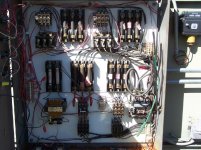
Here is a couple pics of an oven I'm looking at for powder coating. As you can see it's currently wired for high voltage (440,460,480v) three phase. In my new building I have 208 three phase so it would need to be reconnected for the low voltage option. Should anything else need to be changed other than changing the connections at the transformer per the diagram? Also do I have it right thinking that the amp draw will roughly double at the lower voltage?
 

Attachments

  • Transformer closeup.jpg
    Transformer closeup.jpg
    124.2 KB · Views: 46
  • Oven electrical.jpg
    Oven electrical.jpg
    138.4 KB · Views: 44
To avoid these ads, REGISTER NOW!

A_Pmech

Well-known member
Joined
May 8, 2007
Messages
8,002
Location
IL
The transformer pictured is the control transformer. It will have to be switched to the lower voltage, yes. The transformer operates the various controls and relays within the cabinet.

In addition, the heating elements will probably have to be re-wired from series to parallel or series-parallel operation, depending on the number of voltage choices.

I would contact the manufacturer and ask for assistance before proceeding. They should be able to provide you with hook-up diagrams for the various supported voltages.
 

Aceman

Well-known member
Joined
Jan 28, 2007
Messages
2,513
Location
Eastern Oregon
It won't heat very well. Here's an example:

Look at your water heater, it's pretty much a fixed resistance. It'll show 240v delivers 4500 watts, but hooked up 208v it'll be down around 3500 watts or so. Now do the math from 480-->208, you're not going to like the result.
 
OP
B

Bigrhamr

Well-known member
Joined
Apr 16, 2009
Messages
293
Location
North Idaho
It won't heat very well. Here's an example:

Look at your water heater, it's pretty much a fixed resistance. It'll show 240v delivers 4500 watts, but hooked up 208v it'll be down around 3500 watts or so. Now do the math from 480-->208, you're not going to like the result.

Thanks for the replys. I thought the purpose of the transformer was to convert the different input voltages to the voltage required by the loads?
 

A_Pmech

Well-known member
Joined
May 8, 2007
Messages
8,002
Location
IL
The transformer is for control voltage only. The 120V power it supplies operates the coils in the contactors, panel lights, etc. The control transformer only supplies roughly 150 watts of power at 120V.

The heating elements on most multi-voltage ovens are wired in series for 440V, doubling their resistance. By re-wiring the heating elements in parallel, you effectively half the resistance. Thus, the oven will then produce just as much heat at 220V as it did at 440V. The oven likely has provisions to do this in the form of terminal blocks, shorting bars, etc.

The control may or may not have provisions to wire the unit for 208V. They may simply allow the 220V connection to suffice, with a slightly lower maximum operating temperature being the only consequence.

NOTE: I have seen dual-voltage machines where the main service wires within the control were too small to support the lower voltage connections. Remember that with power being constant and voltage dropping by half, current must double. I would be certain to contact the manufacturer before proceeding. Even then, double-check the incoming wire sizes to be safe.
 
Last edited:
OP
B

Bigrhamr

Well-known member
Joined
Apr 16, 2009
Messages
293
Location
North Idaho
Okay, that's making more sense to me. I'm working on contacting the manufacturer but don't know for sure if they're still in business. I wonder if I should consider providing a transformer to feed it high voltage, will start reading what I can find on that.
 
To avoid these ads, REGISTER NOW!

A_Pmech

Well-known member
Joined
May 8, 2007
Messages
8,002
Location
IL
Getting a boost transformer was going to be my next suggestion.

:thumbup:

Okay, that's making more sense to me. I'm working on contacting the manufacturer but don't know for sure if they're still in business. I wonder if I should consider providing a transformer to feed it high voltage, will start reading what I can find on that.
 

Tscott

Well-known member
Joined
Oct 17, 2006
Messages
1,484
Location
Keystone Heights, FL.
I am not sure what type of oven it is, but I used to work on commercial cooking equipment, and I know of at least one instance where the manufacturer produced a dual voltage oven that used different heating elements for each voltage. This replaced the need to rewire the elements into parallel. You just replaced the elements and re-tapped the transformer if there was one. If you cannot get the manufacturer on the phone, I would be leery of buying the unit without at least finding if you can get parts.

Good Luck,

Tom
 

jwith68

Well-known member
Joined
Jan 10, 2006
Messages
1,639
Location
EC Missouri
Guys, refer to Ohm's law here:

http://www.the12volt.com/ohm/ohmslaw.asp

Upper left hand corner of the pie chart, Watts=Volts^2/Ohms. So if you cut the voltage in 1/2, the power will drop to 1/4. Or, to look at it another way, to keep the power constant while doubling voltage, the resistance must be multiplied by 4.

Need to keep this in mind when looking at rewiring for different voltages.
 

A_Pmech

Well-known member
Joined
May 8, 2007
Messages
8,002
Location
IL
LOL! Ooooooooops!

You're right, I forgot my PIE's and EIR's back there and violated Ohm's law.

However, what I was really trying to illustrate was the principle of multi-voltage connection of heating elements, which still applies.

Thanks for catching that.

:beer:

Guys, refer to Ohm's law here:

http://www.the12volt.com/ohm/ohmslaw.asp

Upper left hand corner of the pie chart, Watts=Volts^2/Ohms. So if you cut the voltage in 1/2, the power will drop to 1/4. Or, to look at it another way, to keep the power constant while doubling voltage, the resistance must be multiplied by 4.

Need to keep this in mind when looking at rewiring for different voltages.
 
Last edited:

jwith68

Well-known member
Joined
Jan 10, 2006
Messages
1,639
Location
EC Missouri
LOL! Ooooooooops!

You're right, I forgot my PIE's and EIR's back there and violated Ohm's law.

However, what I was really trying to illustrate was the principle of multi-voltage connection of heating elements, which still applies.

Thanks for catching that.

:beer:

Yes, the principle multi-voltage connection definitely still applies. I just wanted to point out the "squared" relationship there - especially important if rewiring from a lower to a higher voltage.
 
To avoid these ads, REGISTER NOW!
Top Bottom