To avoid these ads, REGISTER NOW!

3 phase machines

woody 73

Well-known member
Joined
Apr 14, 2009
Messages
11,540
Location
The Great State Up North
Hi,

I would like some advice:

As time goes on I have had to pass over some truly fantastic deals on very old machines (due to being 3-phase).

I have had several electricians in the past tell me to stay away and not even bother with them.

Deep down I feel that somehow this advice is just wrong.

In the back of my mind I do not want to just let this issue die; more to the point I over heard some people talking about a phase master (is this a simple device that an electrician could install)?

I would only want to run one machine at a time and it would be for woodworking (no large horsepower say 10 at the most).

Should I just let this issue die once and for all or should I look into a phase master? Thanks for any light that you can shed on this subject.
 
To avoid these ads, REGISTER NOW!

OccupantRJ

Well-known member
Joined
May 15, 2009
Messages
10,959
Location
Eastern North Carolina
Do a google search on Phase converter. There are 2 basic types. One is a static converter, done with capacitors and relays, the other is a rotary converter, done using another 3 phase motor as a third leg generator, Once you understand the principle, not hard to build. I have a commercial static unit, a homebuilt unit, and a 5 hp rotary for my machines. Rotary gives the best power, Another method is to use a VFD. Go to rec.crafts.metalworking on Google groups, do a search, and you will find all the info you can absorb. You will have to wade through the political BS, but that place is a storehouse of mechanical and technical knowledge. I am giving you a general web link to get you started.

http://www.metalwebnews.com/howto/ph-conv/ph-conv.html

RJ
 

rodm1

Well-known member
Joined
Feb 17, 2008
Messages
2,270
A Phase Inverter (VFD) is what you need.
 
Last edited:
OP
W

woody 73

Well-known member
Joined
Apr 14, 2009
Messages
11,540
Location
The Great State Up North
First let me say thank you very much for your help.

If I am hearing you correctly then (A) I should not give up on 3-phase.
(B) I would feel better about buying a -
commercial product.
(C) I would like to stick with Rotary -
since I hear good things about it.

Now is it possible to find someone that has the knowledge in order to make it work? I say this lightly because already three Electricians have turned me down. Again thank you...
 

pete379

Well-known member
Joined
Dec 4, 2009
Messages
471
2nd the vfd. got one on a mill, one on a lathe, they are neat !!
 

A_Pmech

Well-known member
Joined
May 8, 2007
Messages
8,002
Location
IL
I've built a 10HP RPC and I'm planning a 60-100HP RPC. I have also used VFD's for some projects.

VFD's work great for small machines (under 5hp) which do not have dedicated control circuitry. In other words, simply a motor and a motor starter.

RPC's work better for large machines, multiple machines, or when the control requires three-phase.

RPC's are not hard to build. Look at the Fitch William's design on Practical Machinist.
 

t. jones

Well-known member
Joined
Dec 18, 2008
Messages
152
Location
Cambridge On. Canada
I'm three up on you Woody! I bought a sander first for scrap price then I wanted a saw and couldn't pass up on a milling machine at the same auction. I'm sure you'll get it figured out I know I have to :)
Thanx Trevor
 

LoneGunman

Well-known member
Joined
Mar 27, 2007
Messages
2,081
Location
The Gunshine state
Well I am an electrician, it's obvious the other electricians you talked to were probably residential electricians, they are giving you bad advice. No way should you stay away from 3 phase machines, single phase machines command a premium , much better deals are to be had in the 3 phase market. Everyone already covered the VFD or phase converters.
 

Torque1st

MEMBER EMERITUS
Joined
Sep 14, 2008
Messages
5,668
Location
KC Metro, Kansas
Look at that link I posted above. You can make your own RPC or you can buy them already assembled. The manufactured RPC units come with instructions any good electrician could follow.

I bought a 7.5HP 3phase metal lathe which will be running on a 5HP RPC with an additional 10HP idler for a total of 15HP for the RPC system.
 

Falcon67

Well-known member
Joined
Jun 11, 2009
Messages
18,371
Location
Merkel, TX
G0519_running.jpg

G0519_VFD.jpg


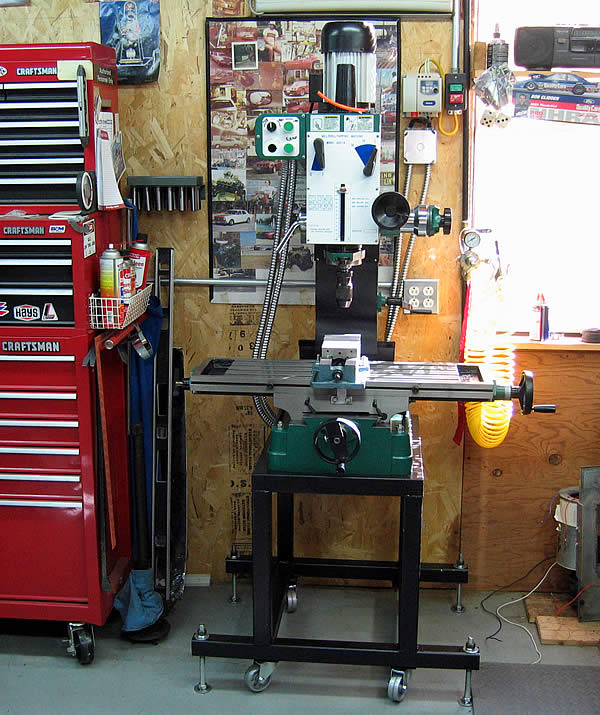
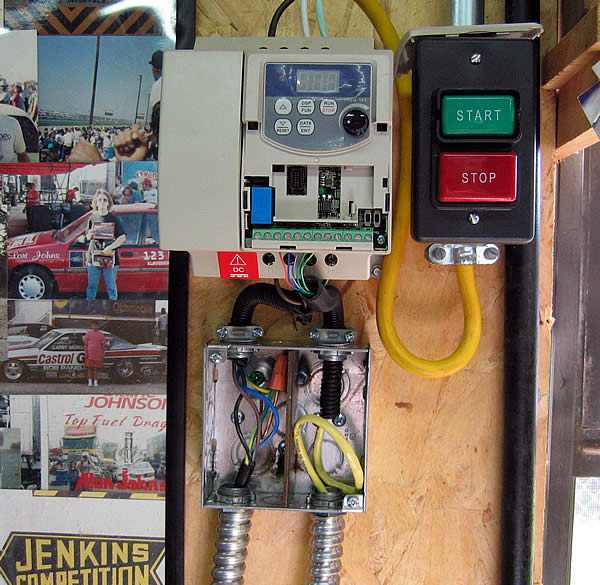
G0519 Grizzly - 1 HP 3 phase running on a 2HP VFD fed by a 220V 20A single phase circuit. The VFD was right at $170. I like the VFD much better than I'd like a rotary. The VFD gives you startup and spin down contol, emergency stop time adjust, etc. I programmed this one for 5 second spin up, 2 second stop, .5 second E-stop. Reverse, etc are also setup through the remote inputs using the stock mill controls.

If I had the time and cash, I convert just about every machine in the shop to a 3 phase.
 
Last edited:

fordcragar

Well-known member
Joined
Sep 6, 2007
Messages
712
Location
Yakima Wa.
About ten years ago I bought my first 3-phase machine. I wrestled with the idea about a rotary phase converter and then decided on a VFD. In some ways, I wish that I had gone with the rotary phase converter, but in others I'm glad that I went with the VFD. If I had used the rotary phase converter, it would have been cheaper; I've spent a lot more on VFD's.

I have a couple of large nibblers, each with their own VFD and my power hammer has one. I might even convert my ATW lathe back to 3-phase and run a VFD on it; it would give me a little more speed control.

With a VFD, you can use a potentiometer and get a variable speed with it. I set up my nibblers with a foot pedal potentiometer and it works like a sewing machine.
 

hidollartoys

Well-known member
Joined
Jul 15, 2008
Messages
594
Location
K. C. Metro area
This is just my opinion. I believe that the reason for purchasing 3 phase machines is because of 1. there availability and 2. their low initial cost. The availability is continuing to deminish, albiet not at an extremely fast rate, because there are just not the number of industrial users there once was. Except for the equipment that requires rebuilding, the costs dont seem to be extraordinarily lower than there used single phase counterparts. GOOD used equipment, single phase and 3 phase, is getting harder to get. Competition for these machines is rising due to the DIY market and the small business users. Rebuilding of 3 phase machines is a viable option if it is a simple clean-up and adjust. If any hard parts are needed they could be impossible to locate (age) or expensive at best.

Now if you are lucky to find the equipment of choice at a price that you just cant refuse, you will be confronted with the prospect of providing power for operation. The suggestions for using VFDs and RPCs are very viable and are utilized at all user levels. You might want to check out unique3phase.com for another alternative. All these power converter choices have use and cost limitations.

The real question should be: How much is this going to cost me, IN TOTAL, to purchase, move, repair, install (wire) and OPERATE. Most of the replys so far are for machines of 5 hp or less. I would caution that over 5 hp is the point where cost to install and operate start to escalate beyond what seems reasonable, especially in a DIY environment. Hard start applications, continous demand, computer controlled (CNC) equipment and instantanious reverse are especially critical applications that require special consideration. It is my opinion (as stated earlier) that used 3 phase equipment is just like single phase equipment, it is usually always a compromise. If you do dilligent home work, choose the RIGHT power converter and do all the work yourself you COULD end up with a COST EFFECTIVE ALTERNATIVE to more expensive and power limited single phase equipment.
 
Last edited:

APEowner

Well-known member
Joined
Oct 2, 2009
Messages
4,164
Location
Sunny, New Mexico
I have an American Rotary 5HP rotary converter that I use to power my milling machine that I'm very happy with. The instructions that came with it were very clear and anyone who's comfortable with residential wiring should be able to install one. I installed a separate 3 phase load center powered buy the converter so if I ad more equipment I only need to run power from another breaker. The cost of the converter was about what it would have cost to re-power the mill and I now have the capability to power other machines (although I'll only be able to run one at a time).
 

Falcon67

Well-known member
Joined
Jun 11, 2009
Messages
18,371
Location
Merkel, TX
Falcon67, does the vfd allow you to go instant reverse, as in power tapping?

I don't think it'll do instant - depends on the load and the VFD. If the VFD has enough overhead, you should be able to program reverse down close to .5 second or less. You would likely need to add a braking resistor to get the quick direction change without the drive faulting. This mill came set up for "tapping" with the stock controls but I'd personally rather just get a decent tapping head.

PS - VFD will also let you do speed changes without torque loss, within reason. I've run mine down to 40hz (about 80 RPM) and up to around 100hz (about 2500 RPM) and it's a pretty cool feature.

This is the VFD I'm using : TECO JNEV-202-H1
 
Last edited:
To avoid these ads, REGISTER NOW!

OldCarGuy

Well-known member
Joined
Nov 29, 2005
Messages
1,984
Location
Ohio
Like others have mentioned. There is no need to shy away from three phase power. And if you're planning on having more than one three phase operated machine, I'd recommend a RPC. You can run a number of motors off a single RFC. As long as the total draw doesn't exceed the RFC's nameplate amperage. I have over 20 motors ranging from 1/ 4 to 7 1/ 2 Hp running on in my garage shop. And have run many at the same time.

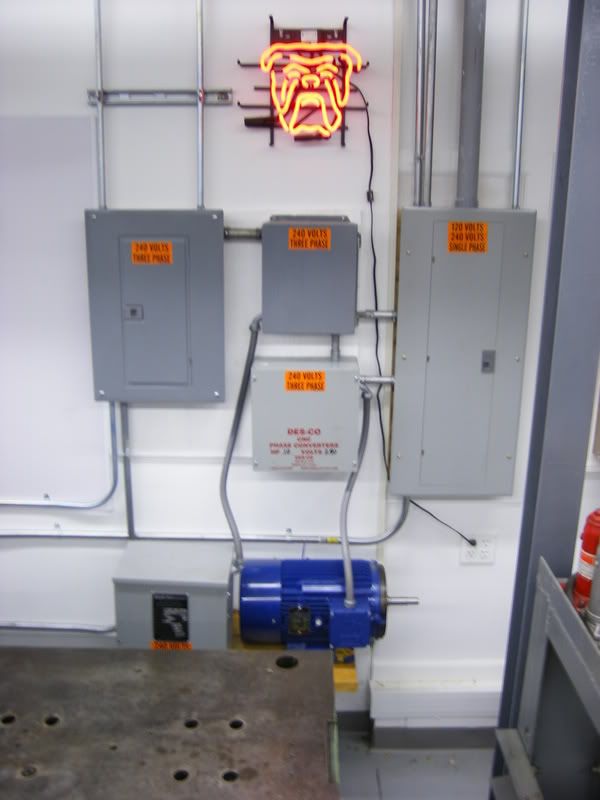
I have two rotary phase converters in my garage. One is a pre-packaged 5 HP CNC style manufactured by GWM. The other is a DesCO Electrical Industry 10 HP. I have them setup to run either one or both in tandem for maximum output. Each converter has its’ own relay so that it will not be back fed when only running a single converter. From this relay cabinet the power is distributed to a three-phase load center with breakers for all my equipment. The three-phase output is 240 Volts and works great for all my machines, except for my 2D Kearney Trecker Rotary Head Mill. That I have a 3KW dry type three-phase transformer that boosts the power to 480Volts.

Watch out what type of idler motor is used. A TEFC verses an open framed idler motor is not as important. Particularly in a clean working environment. But from my experience, make sure the idler is 1750 PRM rather than a 3400. The higher RPM motor is louder. However, from what I understand, some applications the higher RPM unit performs better.

GWM is now. http://www.gwm4-3phase.com/products.html
DesCo.. http://www.deselectric.com/price1

DSCF0592-1.jpg
 

fordcragar

Well-known member
Joined
Sep 6, 2007
Messages
712
Location
Yakima Wa.
...................................................................
PS - VFD will also let you do speed changes without torque loss, within reason. I've run mine down to 40hz (about 80 RPM) and up to around 100hz (about 2500 RPM) and it's a pretty cool feature.

....................................................

I heard that you shouldn't run less than 30hz, you run the risk of overheating the motor. This would also depend on how long you are doing it as well. They were designed to be run at 60hz, anything else is a compromise.
 

krooser

Well-known member
Joined
Jun 3, 2005
Messages
2,377
Location
Waupaca, Wisconsin
I have a 3-phase mill, drill press and belt sander. Been saving (right!) for a rotary convertor but I think I'm going to buy a static convertor from a local dealer. 1 1/2 HP for $140.00... I'm tired of waiting... always spend the $$$ on something else.

They've been using a phase convertor for years at their shop on their ironworker, band saw, grinders, etc without any problems. I know about the HP loss but I think I can deal with it.
 

bimmer1980

Well-known member
Joined
Feb 5, 2009
Messages
2,103
Location
York, PA
definitely go for the 3-ph equipment.....

On some items it doesn't make sense, but if you can get an older (i.e. solid, cast iron, good bearings, power feeds, etc) machine for a great price, you can reap a lot of benefits.

Your biggest cost is going to be in procuring a phase converter.

keep this in mind: a VFD will only give you 2/3's of the power available. THis is because the VFD momentarily powers the third leg to start it, and then runs the motor on the other two.

The rotary phase converter will give you the full power of the machine motor. For example, the amperage of the RPC will be at 30 amps per line (2 lines), while the machine will operate at 20amps per line (3 lines) (minus line losses and efficiencies).

I bought a 3-ph milling machine that I will eventually be purchasing a RPC. Conversely, it probably doesn't makse sense to purchase a 3-phase drill press--those are readily available in 1-ph and do not require a 3-phase motor. one of the key benefits to a 3-phase motor is the nearly instant "on". immediate torque.
 
OP
W

woody 73

Well-known member
Joined
Apr 14, 2009
Messages
11,540
Location
The Great State Up North
Thanks again for all the replies it's a lot of food for thought. I did learn several good things namely that I shoul not give up on 3-phase,avoid the residential electricians,look for an enclosed type motor(lots of sawdust),look for full horsepower (woodworking machines run best at high horsepower)and learn more about 3-phase.
 

the spyder

Well-known member
Joined
Jan 1, 2007
Messages
589
Location
Oregon
I have a 3-phase mill, drill press and belt sander. Been saving (right!) for a rotary convertor but I think I'm going to buy a static convertor from a local dealer. 1 1/2 HP for $140.00... I'm tired of waiting... always spend the $$$ on something else.

They've been using a phase convertor for years at their shop on their ironworker, band saw, grinders, etc without any problems. I know about the HP loss but I think I can deal with it.

Don't waste your money!
Before I understood 3 phase, a friend wanted a 1.5hp paint booth fan wired in his shop. This was no problem until I found out I only had a 220v outlet in the paint booth. We bought a static, capacitor style PC, from a reputable manufacture for $150. Installed it, tossed the switch, and HUMMMMMM. The motor would not start. Even unloaded. A quick flick of the wrist on the blades got the unit going. This was unacceptable, as the fan was ceiling mounted. I ended up running a wire from the other side of the building (several hundered feet) where we had 3 phase and wiring up the fan. Works great now.

You have several machines, just check craigslist/local junk yards. 5hp motors can be had for $50 + $150 in parts to build a nice converter. Its only a little bit more and requires some simple research. You will thank yourself later.

I am putting in a 10hp unit myself, I got the motor for free.
 

Burl

Well-known member
Joined
Sep 21, 2007
Messages
790
Location
Where Mountaineers are free
Is it easier to change the motor, or use a converter, or is this possible ( to change the motor). I've passed up a few nice compressors because they were 3 phase.
 

Falcon67

Well-known member
Joined
Jun 11, 2009
Messages
18,371
Location
Merkel, TX
Is it easier to change the motor, or use a converter, or is this possible ( to change the motor). I've passed up a few nice compressors because they were 3 phase.

Depends - on my Grizzly mill, I could have bought a sister mill with more features and swapped in the same motor that's on my mill. The VDF was $170 with free shipping, a new 3 phase replacement motor from Griz was $220 plus about $50 shipping. If you can find a used or repaired motor, you can come out cheaper. 3 phase motors are more efficient than singles, so there's something in that.
 

hidollartoys

Well-known member
Joined
Jul 15, 2008
Messages
594
Location
K. C. Metro area
Is it easier to change the motor, or use a converter, or is this possible ( to change the motor). I've passed up a few nice compressors because they were 3 phase.

Motor change-outs are possible if you can locate a replacement that has the same frame style (mounting configuration). Sometimes the 3 phase mounting can not be duplicated in a single phase frame. Additionally, single phase motors are physically larger that equivalent 3 phase motors. This can be a problem if the motor in question is located "inside" the machine. If the machine utilizes "spindle mount" tooling, motor shaft size(dia, keyway, etc) is critical. The other issue is the 3 phase efficiency vs single phase. Simply put a single phase motor will not produce the same motor efficiencies(torque) as there 3 phase equivalents. Some derating of the machine output will be realized. Machines with multiple motors are also a challange if you are considering VFDs or RPCs.

As for compressors, a motor change will reduce the ultimate cfm out put. VFDs and RPCs will also be limited based on compressor motor size. Compressor applications are considered "hard start/high demand" applications and require significantly larger conversion equipment that most other applications. Total installed cost should be evaluated when considering 3 phase compressors. If you require a large volumn of air it may be more cost effective the use two single phase compressors in tandem.

As I stated earlier in the thread, each individual application should be considered for the best, most cost effective approach. There is not ons single best answer for these questions.
 

1Garageman

Well-known member
Joined
May 12, 2009
Messages
4,417
Location
Columbus, Ohio
Depends - on my Grizzly mill, I could have bought a sister mill with more features and swapped in the same motor that's on my mill. The VDF was $170 with free shipping, a new 3 phase replacement motor from Griz was $220 plus about $50 shipping. If you can find a used or repaired motor, you can come out cheaper. 3 phase motors are more efficient than singles, so there's something in that.


I was reading on this webpage about 3 phase motors. And it explains pretty well why a 3 phase moter IS BETTER:thumbup:. Thought you guys might be interested in it also.
http://www.3phasepower.org/3phasemotors.htm

Here is an out-take from the link that I thought was good.
3 Phase Power Is More Efficient Than Single Phase

Three phase electricity powers large industrial loads more efficiently than single-phase electricity. When single-phase electricity is needed, It is available between any two phases of a three-phase system, or in some systems , between one of the phases and ground. By the use of three conductors a 3 phase system can provide 173% more power than the two conductors of a single-phase system. Three-phase power allows heavy duty industrial equipment to operate more smoothly and efficiently. 3 phase power can be transmitted over long distances with smaller conductor size.
 
Last edited:

76cb750

New member
Joined
Mar 16, 2008
Messages
3
I have been wondering about this as well. I just bought a 3 phase metal lathe and wondered about the difference between the RPC and the Static ones. I havent heard anyone talk about the noise of a RPC. I have only been around a couple but they were LOUD! You know that really annoying fingernails across the chalkboard kind of thing. You guys that have them experience this problem?
 

A_Pmech

Well-known member
Joined
May 8, 2007
Messages
8,002
Location
IL
Depends on what you define as loud.

I can't even hear it over the whine of the Pacemaker.

:)


I have been wondering about this as well. I just bought a 3 phase metal lathe and wondered about the difference between the RPC and the Static ones. I havent heard anyone talk about the noise of a RPC. I have only been around a couple but they were LOUD! You know that really annoying fingernails across the chalkboard kind of thing. You guys that have them experience this problem?
 

930dreamer

Super Moderator
Staff member
Joined
Oct 7, 2009
Messages
22,940
Location
Amarillo,TX and Stinnett,TX
This is a RPC I built for nothing. I use a pony motor to spin the 10hp 3 phase (idler)motor (low start up amps) to speed, then apply 240v 1 phase and it starts the compressor. I will hard wire everything later.


t. jones

Well-known member
Joined
Dec 18, 2008
Messages
152
Location
Cambridge On. Canada
I am offically " THREE PHASED" . Because I needed 575 voltage I had to buy a transformer first, wire it backwards to step up instead of down, a couple of switches, bunch of wire, 7.5 horse motor, 1/2 horse 115 v kicker motor to zing it up, bought it all used at a Mennonite farm auction. Thanks for the words of advice and encouragement I've received here, I'm making sawdust today, chips tomorrow. Thanx Trevor
 

Torque1st

MEMBER EMERITUS
Joined
Sep 14, 2008
Messages
5,668
Location
KC Metro, Kansas
I have been wondering about this as well. I just bought a 3 phase metal lathe and wondered about the difference between the RPC and the Static ones. I havent heard anyone talk about the noise of a RPC. I have only been around a couple but they were LOUD! You know that really annoying fingernails across the chalkboard kind of thing. You guys that have them experience this problem?
Sounds like bad bearings or on some motors, -fan noise. The units that use 3600RPM motors will be louder.
 

Steve from Socal

Well-known member
Joined
Jan 27, 2009
Messages
3,491
Location
Hutchinson Ks.
Somebody mentioned that a VFD will only deliver 2/3 rated power; this is not true, some VFD's will only handle about 2/3 the rated capacity IF the inverter is powered by single phase. A static phase converter will only deliver about 66% of the name plate power because of the loss of one phase. A VFD Variable Frequency Drive AKA Inverter can be used as a phase converter with three full phases and there are many up to around 7.5 HP that are single phase input. The big problem with inverters as noted is they need to be dedicated to a single motor.

I have used static conversion, rotary and swapped motors in machines. In hind sight I would have just cut right to a rotary if I had it to do over. I changed the motor in my K & T milling machine 5HP; to a single phase motor, I don't have much more than the cost of capacitors and relays of a rotary in the swap. That said; when I got my band saw and bought more capacitors and relays it was everything but the idler motor sitting there. I used the motor out of my mill as the idler and if i run across a suitable idler I may repower my mill back to the original motor.

I had two 4 head CNC routers that used inverters to drive the spindle heads and, while this was 15 years ago, they only lasted a few years before they needed some work. These were 400Hz and they were often at max speed. I don't have anything against inverters but, as others have said, having a rotary with a 5-7.5 HP idler gives you a lot of flexibility with little down side. Make a self starter and only turn it on when you are ready to use a machine. They do consume some power when idling.

Steve
 
To avoid these ads, REGISTER NOW!
Top Bottom