To avoid these ads, REGISTER NOW!

3-Phase Question

rvr6000

Well-known member
Joined
Oct 3, 2010
Messages
1,072
Location
St. Paul, MN
I've always kinda struggled in the understanding of this but I think I'm starting to figure it out. Last week there were some power issues at our fire station. The power company came out and basically said we lost a phase.

So first question....If I understand it right, in the US, a phase is basically just your standard 120 volt service line as are the second and third except the frequency of all three are offset by 120 degrees which provide a "smoother" delivery of AC power. But it's also 360 volts which allows you to run the big stuff like the rooftop hvac and our big scba air compressor?

Here's where I get kinda confused....with one or two phases out (I forget how many they said) there were some lights and outlets that still worked. Am I correct in thinking these were just the circuits that are wired to that operable phase?

Also....I'm trying to picture the breaker panel. I know there are a few breakers with three switches tied together.....obviously those are supplying 3 phase power to an appliance of some kind, no?

Thanks in advance....always found this stuff interesting....just trying to understand the stuff beyond 120volts a little better.

Edit -

Forgot my other question.....so what makes a phase go out anyway? These lines to the station are all underground. The power company had to replace a phase that went bad a couple years ago to. The power company ended up replacing and boring a whole new line from the station to the powerline across the street.
 
Last edited:
To avoid these ads, REGISTER NOW!

ddawg16

Well-known member
Joined
Jul 11, 2008
Messages
21,005
Location
S. California
You are almost correct......here is a link that gives some good info on it.

http://en.wikipedia.org/wiki/Three-phase_electric_power

Common causes for a phase to go out...

Line fuse.

Transformer.

Bad connection.

And your voltage is most likely 480...not 360.

Something else of note...

You could hook up 3 different step down transformers to each phase and have 3 different 120Vac supplies. But each one would be 120 deg out of phase with the other ones.
 

Gooch

Well-known member
Joined
May 30, 2009
Messages
676
Location
Petersberg, IA
You are almost correct......here is a link that gives some good info on it.

http://en.wikipedia.org/wiki/Three-phase_electric_power

Common causes for a phase to go out...

Line fuse.

Transformer.

Bad connection.

And your voltage is most likely 480...not 360.

Something else of note...

You could hook up 3 different step down transformers to each phase and have 3 different 120Vac supplies. But each one would be 120 deg out of phase with the other ones.

IF he has 120v single phase, his 3 phase voltage is probably 208(maybe 240 if it's an open delta) you can't just assume 3 phases + 120v per phase=360v.

since all the voltage is 120 degrees out of phase from each other, you need to add the voltages vectorially, which is why you have 208(or 240) between phases.
 

nehog

Well-known member
Joined
Jan 2, 2010
Messages
7,935
Location
Jaffrey, NH
There is no such thing as 360 volt three phase. You have wye wired three phase, typically 120/208 (or, rarely, 240/416) or delta three phase which is single (specified) voltage.

There is also something called high-leg delta configuration which will give 120/240 volt power. Not very common.

There is 277/440 which is the same ratio as 120/208.

Most three phase is wye wired, as that gives two voltages (a high and a low) by default, but wye does require four wires (it has neutral) where as delta wired has three wires and no neutral.

Why is three phase great? Well, first thee phase is a 'moving' voltage, so motors start (and run) without any additional circuitry (such as capacitors), and motors are a bit more efficient on three phase. Generally except for large motors (>5 to 10 HP) a single phase motor can be built that is as efficient as the three phase version.

The image shows why you have 120 volts, but not 240 with a three phase wye configuration. So many people have problems visualizing where the other volts go!
 

Attachments

  • Three Phase Voltages - wye.jpg
    Three Phase Voltages - wye.jpg
    34.6 KB · Views: 84
Last edited:

ClassAct

New member
Joined
Jul 28, 2011
Messages
2
In more basic terms, the actual power generators produce 3-phase power because the machinery is in effect a large rotating motor. Customers that require a large electrical services are usually running lots of motors and the 3-phase power will operate those motors most efficiently. The phases are in effect "rotating" already so the motors do not require start and run capacitors to provide torque. 3-phase is also the most efficient way to deliver a large service. Only one phase of the 3 is required to run standard 120 volt equipment, but the loads should be distributed evenly over all 3 phases.
 

gatchel

Well-known member
Joined
Dec 12, 2009
Messages
672
Location
West of King of Prussia, PA
There is no such thing as 360 volt three phase. You have wye wired three phase, typically 120/208 (or, rarely, 240/416) or delta three phase which is single (specified) voltage.

There is also something called high-leg delta configuration which will give 120/240 volt power. Not very common.

There is 277/440 which is the same ratio as 120/208.

Most three phase is wye wired, as that gives two voltages (a high and a low) by default, but wye does require four wires (it has neutral) where as delta wired has three wires and no neutral.

Why is three phase great? Well, first thee phase is a 'moving' voltage, so motors start (and run) without any additional circuitry (such as capacitors), and motors are a bit more efficient on three phase. Generally except for large motors (>5 to 10 HP) a single phase motor can be built that is as efficient as the three phase version.

The image shows why you have 120 volts, but not 240 with a three phase wye configuration. So many people have problems visualizing where the other volts go!

I have always wondered how you got 208 from 3 phase and never really could remember to look it up. That image is perfect. Thank you!
 

Milton Shaw

Well-known member
Joined
Feb 11, 2011
Messages
4,835
In a 3 phase breaker box every set of three breakers has all three phases. If they are hooked together they go to one motor/load if not hooked together it goes to 3 different 120 volt circuits. You can tell if you have 3 phase by looking at the power pole outside your business. Does it have one transformer or three transformers. If it has three transformers you have three phase. Most residential homes have single phase 240 volt service. Most appliances are made for 240 volt service. Most heating appliances heat very slowly on 2 phases of a three phase circuit as the 208 volt drops the wattage output of the heater by a big percentage. For instance a stove, the oven heats on 240 and beeps ready in 7-8 minutes on three phase that time grows to 20 -30 minutes. Some of the high end pro model stoves have an extra element that can be wired in to correct for this and keep oven preheat times to reasonable times. One other advantage of 3phase is motor rotation direction, switch any two leads and the motor runs the other way, not so simple on single phase motors. (Equipment must be checked to see if its running the right direction when installed in three phase installations)
 
Last edited:

theoldwizard1

Well-known member
Joined
Feb 22, 2011
Messages
43,100
Location
SE MI
the 3-phase power will operate those motors most efficiently.
Another way to think of it, a single phase motor is "coasting" part of the time. (Think of pedaling a bicycle. There is sometime when you are not pushing down on either pedal with maximum force.) The other 2 phase "fill in" the coasting time.

In theory 5 phase would be better, but not enough better to cover the costs
 

mrb

Well-known member
Joined
Dec 31, 2008
Messages
3,734
In a 3 phase breaker box every set of three breakers has all three phases. If they are hooked together they go to one motor/load if not hooked together it goes to 3 different 120 volt circuits. You can tell if you have 3 phase by looking at the power pole outside your business. Does it have one transformer or three transformers. If it has three transformers you have three phase. Most residential homes have single phase 240 volt service. Most appliances are made for 240 volt service. Most heating appliances heat very slowly on 2 phases of a three phase circuit as the 208 volt drops the wattage output of the heater by a big percentage. For instance a stove, the oven heats on 240 and beeps ready in 7-8 minutes on three phase that time grows to 20 -30 minutes. Some of the high end pro model stoves have an extra element that can be wired in to correct for this and keep oven preheat times to reasonable times. One other advantage of 3phase is motor rotation direction, switch any two leads and the motor runs the other way, not so simple on single phase motors. (Equipment must be checked to see if its running the right direction when installed in three phase installations)

you may also have 3 phase with 2 transformers. its called open delta and is pretty common in alot of areas.
 

79firebird

Well-known member
Joined
Aug 19, 2008
Messages
385
Location
Victoria bc
mrb You are correct. Across from my work thats what the guy has suplying his busness. hes running a 25 and a 15hp compressor as well as outher stuff and never had a prob. Hes running 208 tho. A shop down the road is running 3 transformers but there all 480 But they also run 3 40 hp compressors
 

mrb

Well-known member
Joined
Dec 31, 2008
Messages
3,734
you cant get 208 from open delta. its 240V 3ph delta sometimes with a center tap neutral on one of the transformers to supply 120v loads from 2 of the 3 phases (this latter type of service is referred to as 'high leg')
 
OP
R

rvr6000

Well-known member
Joined
Oct 3, 2010
Messages
1,072
Location
St. Paul, MN
Wow....good info. Thanks everyone. Might come up with a few more questions but this definately filled in some gaps. "theoldwizard" that analogy makes perfect sense to me. Thanks everyone.
 
To avoid these ads, REGISTER NOW!
OP
R

rvr6000

Well-known member
Joined
Oct 3, 2010
Messages
1,072
Location
St. Paul, MN
So would I be correct that these phases are all still cycling at 60Hz each?

In general residential and commercial power supply are there any circumstances where they aren't at 60Hz?
 

Stuart in MN

Well-known member
Joined
Sep 8, 2005
Messages
23,009
Location
Minneapolis
So would I be correct that these phases are all still cycling at 60Hz each?

Yes, at least in the US - some countries use 50hz. There is a slight variation allowed in the frequency; I don't remember what it is offhand but it's very small, maybe a couple per cent.
 

Griff93

Well-known member
Joined
Jul 25, 2009
Messages
1,121
Location
Huntsville, AL
Yes they are cycling at 60Hz generally. Some machinist like to use variable frequency drives which vary the Hz input to an induction motor to vary the speed.
 

Norcal

Well-known member
Joined
Mar 16, 2008
Messages
13,752
So would I be correct that these phases are all still cycling at 60Hz each?

In general residential and commercial power supply are there any circumstances where they aren't at 60Hz?

Aircraft & old main frame computers run 400Hz, so places that repair aircraft components could have 208/120V 400Hz, former employer had a 100 HP motor gen set for that very purpose.
 
OP
R

rvr6000

Well-known member
Joined
Oct 3, 2010
Messages
1,072
Location
St. Paul, MN
Okay....I think I'm finally getting a handle on this. I guess I was always under the impression that 3-phase basically just meant 3 hot wires coming in from the pole or whatever (that's why I thought it was 360 volts as I mentioned before) when in fact it is three hot wires but it's all in the delivery via the transmission system (transformers, etc).

So if I had three hot wires coming into my house from the pole I would indeed have 360 volts but not three-phase. I think I understand the calculation as well why 3-phase gets you more than the 360volts.

Thanks again everyone for your help in making me understand this. Good thing I'm a lot better with airplanes.
 

ishiboo

Well-known member
Joined
Oct 27, 2010
Messages
9,481
Location
Oshkosh, WI
Okay....I think I'm finally getting a handle on this. I guess I was always under the impression that 3-phase basically just meant 3 hot wires coming in from the pole or whatever (that's why I thought it was 360 volts as I mentioned before) when in fact it is three hot wires but it's all in the delivery via the transmission system (transformers, etc).

So if I had three hot wires coming into my house from the pole I would indeed have 360 volts but not three-phase. I think I understand the calculation as well why 3-phase gets you more than the 360volts.

Thanks again everyone for your help in making me understand this. Good thing I'm a lot better with airplanes.

The second paragraph doesn't make sense, and you're still missing a bit. 120v + 120v, if on the same phase, is still 120v. Voltage is potential - the difference between the two legs, as all current flows in a loop. If there are two 120VAC legs, on the same waveform, and neutral, you still have 120VAC between both hots combined and the neutral. Between the two, +120v and +120v, you have 0 volts.

Single phase are two 120v legs, offset 180 degrees. So when one is at +120V, the other is at -120V. (The 120v leg actually goes from -170 to +170 volts, 120 is the RMS value - another lesson altogether.) Between one "hot" and ground, you get 120v because 120-0=120. Between the two hots, you get 120 minus -120 = 240.

Since there are 360 degrees, and single phase legs are 180 degrees apart, you can't have a third leg at 180 degrees - you'd be right back at the first phase. So 3-phase phases are only 360/3 = 120 DEGREES apart. There is no chance to add all 3 to produce 360 Volts. (Starting to get confusing as our degree and voltage numbers are the same.)

Now, these are all "standard" voltages for distribution simplicity. With a transformer, you could generate any voltage from any other voltage. So your single phase 120V could produce 360V, or 36,000V, or anything else.
 
OP
R

rvr6000

Well-known member
Joined
Oct 3, 2010
Messages
1,072
Location
St. Paul, MN
Damn.....I thought I was getting close. hahaha.....it is starting to sink in though. Thanks ishiboo and everyone else too.
 
OP
R

rvr6000

Well-known member
Joined
Oct 3, 2010
Messages
1,072
Location
St. Paul, MN
Single phase are two 120v legs, offset 180 degrees. So when one is at +120V, the other is at -120V. (The 120v leg actually goes from -170 to +170 volts, 120 is the RMS value - another lesson altogether.) Between one "hot" and ground, you get 120v because 120-0=120. Between the two hots, you get 120 minus -120 = 240.

This is basically what the service from the pole into my house is, correct?
 

snowmaneu1

Well-known member
Joined
Oct 15, 2024
Messages
70
There is no such thing as 360 volt three phase. You have wye wired three phase, typically 120/208 (or, rarely, 240/416) or delta three phase which is single (specified) voltage.

There is also something called high-leg delta configuration which will give 120/240 volt power. Not very common.

There is 277/440 which is the same ratio as 120/208.

Most three phase is wye wired, as that gives two voltages (a high and a low) by default, but wye does require four wires (it has neutral) where as delta wired has three wires and no neutral.

Why is three phase great? Well, first thee phase is a 'moving' voltage, so motors start (and run) without any additional circuitry (such as capacitors), and motors are a bit more efficient on three phase. Generally except for large motors (>5 to 10 HP) a single phase motor can be built that is as efficient as the three phase version.

The image shows why you have 120 volts, but not 240 with a three phase wye configuration. So many people have problems visualizing where the other volts go!
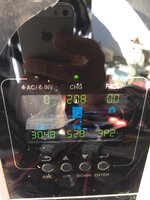
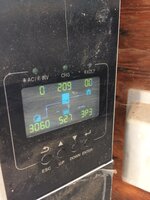
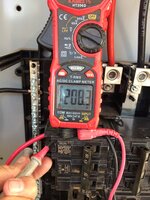
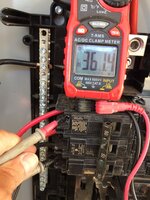
I have 360 v being produced line to line 3 phase .. line to neutral is 208. This is being produced by three Growatt 5000US solar spf inverters set up for three phase. Problem is the well pump is 3 phase 240v line to line.
Any help would be appreciated
 

Attachments

  • C53A0B51-1264-458C-A0F7-5817FEEFE8A1.jpeg
    C53A0B51-1264-458C-A0F7-5817FEEFE8A1.jpeg
    760.4 KB · Views: 21
  • 815C9EFC-0261-48E9-B60E-8EC5DF7BDDF0.jpeg
    815C9EFC-0261-48E9-B60E-8EC5DF7BDDF0.jpeg
    481.5 KB · Views: 9
  • A1CA47DB-94D1-4463-95AC-7DDD585551DF.jpeg
    A1CA47DB-94D1-4463-95AC-7DDD585551DF.jpeg
    653.2 KB · Views: 10
  • FBD454A7-80CD-444C-A586-5600E4FF5B63.jpeg
    FBD454A7-80CD-444C-A586-5600E4FF5B63.jpeg
    694.4 KB · Views: 10
  • D7B5C244-688A-451A-B704-D8299D998738.jpeg
    D7B5C244-688A-451A-B704-D8299D998738.jpeg
    666.7 KB · Views: 10
  • CB3C7241-27EB-4449-B8C8-962CEE681F94.jpeg
    CB3C7241-27EB-4449-B8C8-962CEE681F94.jpeg
    723.3 KB · Views: 10
  • FE8E1454-B2FE-4BA4-B955-49389968F7BD.jpeg
    FE8E1454-B2FE-4BA4-B955-49389968F7BD.jpeg
    571.2 KB · Views: 9
  • EB49DA47-5CDF-4C8F-927D-085A1E3F4C1C.jpeg
    EB49DA47-5CDF-4C8F-927D-085A1E3F4C1C.jpeg
    715.1 KB · Views: 9
  • 2B478D1F-6316-4D68-A77A-1F12A68399B6.jpeg
    2B478D1F-6316-4D68-A77A-1F12A68399B6.jpeg
    644.7 KB · Views: 8
  • BC45677F-3CE5-4DDF-85A6-6E125EA96425.jpeg
    BC45677F-3CE5-4DDF-85A6-6E125EA96425.jpeg
    645.1 KB · Views: 21
To avoid these ads, REGISTER NOW!
Top Bottom