To avoid these ads, REGISTER NOW!

3 vs 4 wires for detached structure w/grounding rods

ching0n

Well-known member
Joined
Jul 21, 2016
Messages
1,496
I did a detached garage w/the help from the forum (thanks) not long ago and was thinking of doing a similar deal for another structure at my folks (run a feeder for a 240v & 120 sub).

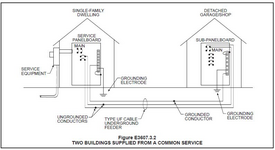
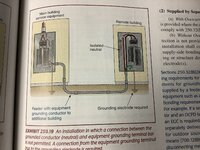
I couldn't help but think that running a ground from the home to the detached structure and then also using grounding rods was redundant. I get the rods are there for lighting strike so understand their use but can't quite get why the need for the ground from the main. The pictures below may explain it better.

IOW, would it not be possible to run hot, hot, neutral, no ground and then only ground at the rod as 2nd picture shows? If such setup is allowed by code, would the neutral & ground be bonded at the sub as if the sub was being fed by the utility, wouldn't that make the neutral also redundant?

The structure is a climate controlled storage unit of sorts so the requirements aren't a whole lot, was thinking 10gauge or even 12gauge if running 240v there but thought why even bother running a ground If I gotta bury rods too?

1736209405888.png
1736209417982.png
 
To avoid these ads, REGISTER NOW!

sparky 1971

Well-known member
Joined
Oct 9, 2018
Messages
8,090
Location
Central Iowa
I did a detached garage w/the help from the forum (thanks) not long ago and was thinking of doing a similar deal for another structure at my folks (run a feeder for a 240v & 120 sub).

I couldn't help but think that running a ground from the home to the detached structure and then also using grounding rods was redundant. I get the rods are there for lighting strike so understand their use but can't quite get why the need for the ground from the main. The pictures below may explain it better.
The ground rods are for lightning and, unless the conditions are perfect, won't do squat for a short circuit or ground fault. The ground back to the panel is what will carry the fault current, causing the breaker to trip.
IOW, would it not be possible to run hot, hot, neutral, no ground and then only ground at the rod as 2nd picture shows? If such setup is allowed by code, would the neutral & ground be bonded at the sub as if the sub was being fed by the utility, wouldn't that make the neutral also redundant?
Pre 2008 NEC, that was the norm. Now, the neutral is isolated from the ground so that neutral current won't be carried by the ground.
The structure is a climate controlled storage unit of sorts so the requirements aren't a whole lot, was thinking 10gauge or even 12gauge if running 240v there but thought why even bother running a ground If I gotta bury rods too
You could take a couple of circuits out there, not use a panel and avoid the ground rods, but that's absurd. If the work is being done, might as well spend a few extra bucks and do it better.
 

theoldwizard1

Well-known member
Joined
Feb 22, 2011
Messages
43,452
Location
SE MI
Electrical FAQ

4-wire-subpanel-detached-jpg.4205
 
OP
C

ching0n

Well-known member
Joined
Jul 21, 2016
Messages
1,496
The ground rods are for lightning and, unless the conditions are perfect, won't do squat for a short circuit or ground fault. The ground back to the panel is what will carry the fault current, causing the breaker to trip.
Well, the structure would have its own sub w/breakers. If there's no ground connecting main to sub but the sub is grounded to earth, are you saying it won't do anything for short circuit or ground fault? I guess I'm not seeing how it's any different than how the main panel is wired (grounded to earth).

I'm fairly certain code requires a ground from main panel to sub panel. I did for my detached garage, was pretty sure it was because of code.
I did as well but thinking back at it I'm wondering "why?"

Code rules allowing 3 wire feeds to a outbuilding was removed many NEC editions ago, a 4 wire feed is the only option.
Got it. Do you know why the change? It's only 100' of copper (maybe 15-20$), I'm not opposed to spending, moreso trying to rationalize the expense if it's not being wastefully redundant.
 

mike93lx

ALLIANCE MEMBER
Joined
Dec 9, 2013
Messages
38,340
Location
Richmond, VA
Got it. Do you know why the change? It's only 100' of copper (maybe 15-20$), I'm not opposed to spending, moreso trying to rationalize the expense if it's not being wastefully redundant.
Because it eliminated current flowing on the equipment grounding conductor
 

wyliesdiesels

Well-known member
Joined
Aug 14, 2012
Messages
20,138
Location
Modesto, CA
I did a detached garage w/the help from the forum (thanks) not long ago and was thinking of doing a similar deal for another structure at my folks (run a feeder for a 240v & 120 sub).

I couldn't help but think that running a ground from the home to the detached structure and then also using grounding rods was redundant. I get the rods are there for lighting strike so understand their use but can't quite get why the need for the ground from the main. The pictures below may explain it better.
they are not redundant. You need to research what the purpose of each is for. a grounding electrode and the earth does not provide a low impedance fault current pathway to allow breakers to trip and clear objectionable fault current on pathways that should not be energized

for your reading pleasure, you can check the electrical FAQs where i explain all of it.

IOW, would it not be possible to run hot, hot, neutral, no ground and then only ground at the rod as 2nd picture shows? If such setup is allowed by code, would the neutral & ground be bonded at the sub as if the sub was being fed by the utility, wouldn't that make the neutral also redundant?
you cannot bond the neutral at the subpanel. this creates all kinds of issues and if your detached building has metallic pathways, youve now created an alternate neutral return pathway

The structure is a climate controlled storage unit of sorts so the requirements aren't a whole lot, was thinking 10gauge or even 12gauge if running 240v there but thought why even bother running a ground If I gotta bury rods too?
because you dont know the difference and purpose of each
 

sparky 1971

Well-known member
Joined
Oct 9, 2018
Messages
8,090
Location
Central Iowa
Well, the structure would have its own sub w/breakers. If there's no ground connecting main to sub but the sub is grounded to earth, are you saying it won't do anything for short circuit or ground fault? I guess I'm not seeing how it's any different than how the main panel is wired (grounded to earth).
That's exactly what I'm saying.
 

wyliesdiesels

Well-known member
Joined
Aug 14, 2012
Messages
20,138
Location
Modesto, CA
Well, the structure would have its own sub w/breakers. If there's no ground connecting main to sub but the sub is grounded to earth, are you saying it won't do anything for short circuit or ground fault? I guess I'm not seeing how it's any different than how the main panel is wired (grounded to earth).
no it wont. the earth is a poor conductor of electricity. this has been proven and the reason why code requires 4-wires.
I did as well but thinking back at it I'm wondering "why?"

Got it. Do you know why the change? It's only 100' of copper (maybe 15-20$), I'm not opposed to spending, moreso trying to rationalize the expense if it's not being wastefully redundant.
because having the neutral bonded in more than one place creates the potential for shock from neutral return current which has happened. you dont want the neutral to go bad and then have an alternate pathway back to the transformer.

whatever you do dont bond a neutral in a sub
 
OP
C

ching0n

Well-known member
Joined
Jul 21, 2016
Messages
1,496
no it wont. the earth is a poor conductor of electricity. this has been proven and the reason why code requires 4-wires.

because having the neutral bonded in more than one place creates the potential for shock from neutral return current which has happened. you dont want the neutral to go bad and then have an alternate pathway back to the transformer.

whatever you do dont bond a neutral in a sub
Per your FAQ, you mention parallel metallic lines. Both structures share water piping (copper) and was planning on grounding the detached to it (plus a spare rod), unless I'm misreading the FAQ, this isn't a good idea since the main is also likely ground there?
 

Norcal

Well-known member
Joined
Mar 16, 2008
Messages
13,774
Per your FAQ, you mention parallel metallic lines. Both structures share water piping (copper) and was planning on grounding the detached to it (plus a spare rod), unless I'm misreading the FAQ, this isn't a good idea since the main, is also likely ground there?
It was only permitted to use a 3 wire feed if there were no other conductive paths, so no metallic water, gas, lines.
 

Chuckster in NJ

Well-known member
Joined
Jan 26, 2010
Messages
2,348
Location
Hunterdon County NJ
Per your FAQ, you mention parallel metallic lines. Both structures share water piping (copper) and was planning on grounding the detached to it (plus a spare rod), unless I'm misreading the FAQ, this isn't a good idea since the main is also likely ground there?
You asked the question and got answers on how to do it………. Listen to the voice of experience.

FOUR WIRE is the answer.
 

ipgenie

Well-known member
Joined
Jan 29, 2020
Messages
562
Location
Idaho
We built in 2001. Meter is on the shop and feeds the house with a 3-wire which was the norm before the NEC change. Our power is 6 feet down direct buried in the same 2' wide trench as water and gas and comes up through the middle of the garage floor into the wall with the sub.
If I ever have to replace or do any major work on the house panel, I'll have to abandon the existing 3-wire and find some way to trench and route a new 4-wire run between buildings in order to bring it up to current code (a new ground can't be run separately from the other conductors). That would be a royal pain and expensive so hopefully we won't have that situation.

Run the 4 wires and do it right. You don't want to have to re-do it later if you ever have it inspected. Even better would be to run it in conduit (maybe you are) because then you can more easily replace/upgrade the wires if it's ever needed/wanted.
 
OP
C

ching0n

Well-known member
Joined
Jul 21, 2016
Messages
1,496
You asked the question and got answers on how to do it………. Listen to the voice of experience.

FOUR WIRE is the answer.
The how to do it was acknowledged & settled on post 7, we moved on to why it's done that way and now we're in the what's with this other part of the code segment (pipes as grounds).
 

Chuckster in NJ

Well-known member
Joined
Jan 26, 2010
Messages
2,348
Location
Hunterdon County NJ
The how to do it was acknowledged & settled on post 7, we moved on to why it's done that way and now we're in the what's with this other part of the code segment (pipes as grounds).
OK…….. How long is the conduit run and what size wires will you be running? Any bends? Running conduit all the way back to main panel or are you transitioning to jacketed cable inside the house.
 
OP
C

ching0n

Well-known member
Joined
Jul 21, 2016
Messages
1,496
OK…….. How long is the conduit run and what size wires will you be running? Any bends? Running conduit all the way back to main panel or are you transitioning to jacketed cable inside the house.
Not sure of the relevance but it's about 100 feet, 3 elbows total, both panels are outside so no jacketed cables inside. Right now I'm thinking 10 or 12 AWG THHN inside of 3/4 18" underground in case we want to go bigger later (doubtful).

FWIW: I had this 'logical doubt' about 3v4, found similar queries online and got confirmation here of how one's now disallowed by code which settled the "why not do it this way".
 

billconner

Well-known member
Joined
Jul 20, 2021
Messages
6,986
Location
Thousand Islands NYS
Everyone says 4 wire and ground rod but fwiw I went with three in rigid conduit properly bonded and a ufer ground. I preferred the expense of the rigid and 6" deep in less time versus something else and digging deeper and taking longer.
 
To avoid these ads, REGISTER NOW!

dave*99

Well-known member
Joined
May 5, 2009
Messages
4,305
Location
Coastal NJ
Everyone says 4 wire and ground rod but fwiw I went with three in rigid conduit properly bonded and a ufer ground. I preferred the expense of the rigid and 6" deep in less time versus something else and digging deeper and taking longer.
Regarding 4 wire in PVC conduit with a ground rod in a detached building VS 3 wires in a bonded rigid conduit with a Ufer ground:
They are electrically equivalent and mechanically different. You may know that, but I'll post this for others to avoid any confusion.

And for an interesting read on the origin of the Ufer ground:

In 1942, Herbert G. Ufer was a consultant working for the U.S. Army. Ufer was given the task of finding a lower cost and more practical alternative to traditional copper rod grounds for these dry locations. Ufer discovered that concrete had better conductivity than most types of soil. Ufer then developed a grounding scheme based on encasing the grounding conductors in concrete. This method proved to be very effective, and was implemented throughout the Arizona test site.

After the war, Ufer continued to test his grounding method, and his results were published in a paper presented at the IEEE Western Appliance Technical Conference in 1963.[1][2] The use of concrete enclosed grounding conductors was added to the U.S. National Electrical Code (NEC) in 1968. It was not required to be used if a water pipe or other grounding electrode was present. In 1978, the NEC allowed 1/2 inch rebar to be used as a grounding electrode [NEC 250.52(A)(3)]. The NEC refers to this type of ground as a "Concrete Encased Electrode" (CEE) instead of using the name Ufer ground.
 

wyliesdiesels

Well-known member
Joined
Aug 14, 2012
Messages
20,138
Location
Modesto, CA
Per your FAQ, you mention parallel metallic lines. Both structures share water piping (copper) and was planning on grounding the detached to it (plus a spare rod), unless I'm misreading the FAQ, this isn't a good idea since the main is also likely ground there?
thats even more reason why there should be 4-wire feeder as the water lines need to be bonded to prevent becoming energized. if the neutral was bonded in the sub because you ran 3-wire and if the plumbing was bonded like it should be to the ground terminal (neutral terminal in the case of a 3-wire feeder) then the plumbing would become a parallel return pathway for neutral current creating a shock potential for anyone that comes into contact with it

definitely not good.

as far as your comment about misreading the FAQ, the only misunderstanding is that when you bond the water line with a bonded neutral in a subpanel you have created a parallel pathway like i explained above.
 
OP
C

ching0n

Well-known member
Joined
Jul 21, 2016
Messages
1,496
Everyone says 4 wire and ground rod but fwiw I went with three in rigid conduit properly bonded and a ufer ground. I preferred the expense of the rigid and 6" deep in less time versus something else and digging deeper and taking longer.
I had considered metal conduit to only dig a 6" trench. If I follow this logic per poster after this comment, the metal conduit becomes the 'ground' wire (allowed by code?)? I don't know if galvanized would last longer than a copper wire underground (location dependent) or if you're running something other than galvanized conduit (aluminum, pvc covered gas pipe?).
 
Last edited:
OP
C

ching0n

Well-known member
Joined
Jul 21, 2016
Messages
1,496
thats even more reason why there should be 4-wire feeder as the water lines need to be bonded to prevent becoming energized. if the neutral was bonded in the sub because you ran 3-wire and if the plumbing was bonded like it should be to the ground terminal (neutral terminal in the case of a 3-wire feeder) then the plumbing would become a parallel return pathway for neutral current creating a shock potential for anyone that comes into contact with it

definitely not good.

as far as your comment about misreading the FAQ, the only misunderstanding is that when you bond the water line with a bonded neutral in a subpanel you have created a parallel pathway like i explained above.
Thanks, it's been educational. I'll read up on the purpose of each as you suggested but I think I get the 'drift' that mostly my thinking was faulty in thinking neutral to ground was somehow equivalent to neutral to transformer (I'm guessing this is the low impedance path that allows for breaker trips)?
 

wyliesdiesels

Well-known member
Joined
Aug 14, 2012
Messages
20,138
Location
Modesto, CA
Everyone says 4 wire and ground rod but fwiw I went with three in rigid conduit properly bonded and a ufer ground. I preferred the expense of the rigid and 6" deep in less time versus something else and digging deeper and taking longer.
umm thats still considered "4-wire" only the rigid conduit is providing the EGC pathway as long as its properly bonded on both ends and complete end to end vs a physical 4th conductor.
 

Chuckster in NJ

Well-known member
Joined
Jan 26, 2010
Messages
2,348
Location
Hunterdon County NJ
A metallic conduit is a recognized grounding conductor by the NEC.
Very True!……. Keep in mind that you may need to use grounding lock nuts and or grounding bushings.
You can never "over do" grounding because it is the most important thing on an electrical system. When I worked is an oil refinery we always pulled in a properly sized ground wire when using rigid conduit.

IMHO running a PVC conduit along with a ground wire is the "best way to go"
 

wyliesdiesels

Well-known member
Joined
Aug 14, 2012
Messages
20,138
Location
Modesto, CA
Thanks, it's been educational. I'll read up on the purpose of each as you suggested but I think I get the 'drift' that mostly my thinking was faulty in thinking neutral to ground was somehow equivalent to neutral to transformer (I'm guessing this is the low impedance path that allows for breaker trips)?
the neutral to the transformer has nothing to do with neutrals and grounds between panels.... the bonded neutral in the main service panel is what facilitates breakers to trip upon ground fault.

the low impedance fault current pathway is the EGC/ground between panels and on branch circuits that allows the fault current to reach the bonded neutral in the main. the neutral to the transformer has nothing to do with it
 
OP
C

ching0n

Well-known member
Joined
Jul 21, 2016
Messages
1,496
the neutral to the transformer has nothing to do with neutrals and grounds between panels.... the bonded neutral in the main service panel is what facilitates breakers to trip upon ground fault.

the low impedance fault current pathway is the EGC/ground between panels and on branch circuits that allows the fault current to reach the bonded neutral in the main. the neutral to the transformer has nothing to do with it
Ok, let me back up again (for educational purposes). If we consider a house, no detached structure, it feeds from the mains via 3 wires & a ground to earth right, or am I missing something?

So in the 3 wire detached scenario, it would be 3 wires & a ground to earth (as if the main structure was the utility). I get that in the sub you'd probably have to run the neutral to ground as you would in a house (which I understand is disallowed now since any neutral feeding from the main can't be bonded).

In the above scenarios, what makes one structure functionally different than the other (for breaker tripping purposes)? And for safety, if I'm reading you correctly it creates a hazard that a lineman would be cognizant of coming from a house but a homeowner would not be in the detached?
 

billconner

Well-known member
Joined
Jul 20, 2021
Messages
6,986
Location
Thousand Islands NYS
I had considered metal conduit to only dig a 6" trench. If I follow this logic per poster after this comment, the metal conduit becomes the 'ground' wire (allowed by code?)? I don't know if galvanized would last longer than a copper wire underground (location dependent) or if you're running something other than galvanized conduit (aluminum, pvc covered gas pipe?).
I think it will last many decades. I've seen galvanized pipe over 100 years - but no doubt someone will claim today's is not like it was 100 years ago. In any case, I was happy with 3 no. 2 copper in a 1" rigid pipe just 6" underground. I'm sure it will outlast me, but that's not hard as I reach 73 next week. I don't know how long you'll be there but I'd guess either method will last and only the digging will be different.
 

dave*99

Well-known member
Joined
May 5, 2009
Messages
4,305
Location
Coastal NJ
Ok, let me back up again (for educational purposes). If we consider a house, no detached structure, it feeds from the mains via 3 wires & a ground to earth right, or am I missing something?

So in the 3 wire detached scenario, it would be 3 wires & a ground to earth (as if the main structure was the utility). I get that in the sub you'd probably have to run the neutral to ground as you would in a house (which I understand is disallowed now since any neutral feeding from the main can't be bonded).

In the above scenarios, what makes one structure functionally different than the other (for breaker tripping purposes)? And for safety, if I'm reading you correctly it creates a hazard that a lineman would be cognizant of coming from a house but a homeowner would not be in the detached?

The utility brings 3 wires to your house. Two phase conductors and a neutral. They all carry your load current. At your service panel you tie the utility neutral to the earth with an earth rod. From your panel outward, all circuits leave with one or two phase conductors and a neutral and a ground. Yes I know the neutral and ground are tied together in your panel.

BUT from that point forward, your neutral in your house carries LOAD current and your ground does not.
If a phase conductor in your house accidentally touched a grounded junction box, a large FAULT current flows and trips your breaker.
Without the ground conductor, the box gets energized and you can get a shock.

Since the neutral has LOAD current and wire has resistance, there will be some voltage on the neutral equal to the voltage drop across that neutral. But the boxes and appliances are grounded (to an earth rod) and they stay at the same potential as the earth around your house.

A sub panel needs to respect this scheme. It's just like another appliance. Neutral and ground are on separate wires. Neutral voltage can rise up a bit above earth potential, but the ground wire stays at earth potential. So in a sub panel we do not connect neutral and ground together as is done in the main panel. If we did, the neutral and ground between the main and sub would SHARE LOAD current. They would both rise above earth potential dependent on load.
 

wyliesdiesels

Well-known member
Joined
Aug 14, 2012
Messages
20,138
Location
Modesto, CA
Ok, let me back up again (for educational purposes). If we consider a house, no detached structure, it feeds from the mains via 3 wires & a ground to earth right, or am I missing something?

So in the 3 wire detached scenario, it would be 3 wires & a ground to earth (as if the main structure was the utility). I get that in the sub you'd probably have to run the neutral to ground as you would in a house (which I understand is disallowed now since any neutral feeding from the main can't be bonded).
no you do no run the neutral to a ground bar in a subpanel. nor does the neutral connect to the GES- grounding electrode system, in the detached., on a 4-wire system.
In the above scenarios, what makes one structure functionally different than the other (for breaker tripping purposes)? And for safety, if I'm reading you correctly it creates a hazard that a lineman would be cognizant of coming from a house but a homeowner would not be in the detached?
the difference is you dont want neutral current flowing on bonded objects. this can happen at any time and especially when the neutral develops a bad connection. I have seen this happen. so in order to keep the neutral current ONLY flowing on the neutral in the feeder and not other pathways (such as water lines, gas lines, air lines, phone lines, cable lines, internet lines, ethernet lines) between the buildings, the neutral needs to be isolated in the subpanel and a separate ground wire needs to be ran.

this has nothing to do with breakers being able to trip as they can do so on a 3-wire feeder with bonded neutral.

the issue with the bonded neutral in the subpanel in a detached structure is the potential for shock hazard and not to lineman but people using the building.

you cannot compare this to the 3-wire feed to the main service panel since that is on the line side of the meter.
 

mm08822

Well-known member
Joined
Jan 13, 2012
Messages
6,141
Location
NJ
Ok, let me back up again (for educational purposes). If we consider a house, no detached structure, it feeds from the mains via 3 wires & a ground to earth right, or am I missing something? Yes, but the "ground to earth" you mention is a grounding electrode conductor, not a neutral nor an equipment grounding conductor (neutral). It's purpose is NOT to be part of normal circuit operation or used during a circuit malfunction.

So in the 3 wire detached scenario, it would be 3 wires & a ground to earth (as if the main structure was the utility). I get that in the sub you'd probably have to run the neutral to ground as you would in a house (which I understand is disallowed now since any neutral feeding from the main can't be bonded). See point 2 below.

In the above scenarios, what makes one structure functionally different than the other (for breaker tripping purposes)? And for safety, if I'm reading you correctly it creates a hazard that a lineman would be cognizant of coming from a house but a homeowner would not be in the detached? Nothing to do with a lineman.
Much confusion comes from the names of equipment grounding conductor (EGC) used as a low resistance return path for fault current to trip the cb that the damaged circuit is part of VS. grounding electrodes( e.g. - ground rods) and grounding electrode conductors (GEC) that are used to (hopefully) dissipate static electrical charge built up on a building due to wind, moisture and passing clouds VS. that of a grounded conductor (neutral) used purposely and identified as the return path for normal circuit operation.

In this second named usage, the ground rods hopefully dissipate the static charge on the structure to the earth possibly collected through the multiple paths created by equipment ground wires from anything conductive they are attached to and brought back to the ground bar from the branch circuits and then out to the rods via the grounding electrode conductor. Moisture on the structure, humidity and other conductive objects with some random path to earth can also help drain off any excess charge. I use the word hopefully as resistance between the soil and the ground rods varies by location and soil moisture content. Not every EGC touches something "charged".

The variable soil resistance is usually not sufficient to provide a low enough fault path the trip the cb of a branch circuit experiencing a ground fault (hot - EGC). If the branch cb did not trip, then the cb for the feeder is next in line to trip. The conductivity of the soil between the 2 buildings is unpredictable but generally too low to trip the cb quickly or at all. This is why the EGC is run between the 2 buildings to ensure a low resistance path allowing high fault current to be created to cause the upstream cb to immediately trip.

Point 2
In the house where the main panel is and in this example, the first place of overcurrent protection, the neutral (grounded conductor) is bonded to the equipment enclosure and only here. Multiple bonding points between grounded surfaces and neutral wires are not permitted as it creates multiple paths for neutral current to split between the neutral and the paralleled ground wire. Someone opening equipment grounding conductors in this paralleled path can get shocked. (In this example, the EGC is carrying current potentially all the time and not just for the instant of a fault.)
These parallel paths can be created by other paths between buildings via interconnected water pipes, drain pies, air lines, etc. The expectation of the 4th wire (EGC) run with the feeder will be such a low resistance compared to other paths. So isolating the neutral wires (currents) from the EGC, eliminates any unintended conductive paths. This also further accomplished with isolated neutral bars from ground bars in sub-panels.
 
OP
C

ching0n

Well-known member
Joined
Jul 21, 2016
Messages
1,496
Much confusion comes from the names of equipment grounding conductor (EGC) used as a low resistance return path for fault current to trip the cb that the damaged circuit is part of VS. grounding electrodes( e.g. - ground rods) and grounding electrode conductors (GEC) that are used to (hopefully) dissipate static electrical charge built up on a building due to wind, moisture and passing clouds VS. that of a grounded conductor (neutral) used purposely and identified as the return path for normal circuit operation.

In this second named usage, the ground rods hopefully dissipate the static charge on the structure to the earth possibly collected through the multiple paths created by equipment ground wires from anything conductive they are attached to and brought back to the ground bar from the branch circuits and then out to the rods via the grounding electrode conductor. Moisture on the structure, humidity and other conductive objects with some random path to earth can also help drain off any excess charge. I use the word hopefully as resistance between the soil and the ground rods varies by location and soil moisture content. Not every EGC touches something "charged".

The variable soil resistance is usually not sufficient to provide a low enough fault path the trip the cb of a branch circuit experiencing a ground fault (hot - EGC). If the branch cb did not trip, then the cb for the feeder is next in line to trip. The conductivity of the soil between the 2 buildings is unpredictable but generally too low to trip the cb quickly or at all. This is why the EGC is run between the 2 buildings to ensure a low resistance path allowing high fault current to be created to cause the upstream cb to immediately trip.

Point 2
In the house where the main panel is and in this example, the first place of overcurrent protection, the neutral (grounded conductor) is bonded to the equipment enclosure and only here. Multiple bonding points between grounded surfaces and neutral wires are not permitted as it creates multiple paths for neutral current to split between the neutral and the paralleled ground wire. Someone opening equipment grounding conductors in this paralleled path can get shocked. (In this example, the EGC is carrying current potentially all the time and not just for the instant of a fault.)
These parallel paths can be created by other paths between buildings via interconnected water pipes, drain pies, air lines, etc. The expectation of the 4th wire (EGC) run with the feeder will be such a low resistance compared to other paths. So isolating the neutral wires (currents) from the EGC, eliminates any unintended conductive paths. This also further accomplished with isolated neutral bars from ground bars in sub-panels.
let me rephrase the doubt I still have. I understand that bonding neutral in a sub is a no-no and I would never do it because it's not up to code, but hypothetically, let's assume there's a 3 wire bonded sub w/proper grounded rods. Is there an analogous danger to a lineman upward from a house main as there is to a home owner upward from a 3-wire bonded sub? By bonded I mean to its own earth ground, not the main property's.
 

mm08822

Well-known member
Joined
Jan 13, 2012
Messages
6,141
Location
NJ
let me rephrase the doubt I still have. I understand that bonding neutral in a sub is a no-no and I would never do it because it's not up to code, but hypothetically, let's assume there's a 3 wire bonded sub w/proper grounded rods. Is there an analogous danger to a lineman upward from a house main as there is to a home owner upward from a 3-wire bonded sub? By bonded I mean to its own earth ground, not the main property's.
Nothing for the lineman. For anyone working in the house or detached garage yes. More likely, for anyone working on any of the metallic connections/systems in between the 2 buildings.
 
OP
C

ching0n

Well-known member
Joined
Jul 21, 2016
Messages
1,496
Nothing for the lineman. For anyone working in the house or detached garage yes. More likely, for anyone working on any of the metallic connections/systems in between the 2 buildings.
In the lineman question, I don't mean due to the sub in the property (imagine just a normal house w/o a sub), just your run of the mill wiring system of a main house which this sub scenario attempts to replicate "main as a utility comp".
 

u2slow

Well-known member
Joined
Nov 20, 2011
Messages
3,625
Location
BC
let me rephrase the doubt I still have. I understand that bonding neutral in a sub is a no-no and I would never do it because it's not up to code, but hypothetically, let's assume there's a 3 wire bonded sub w/proper grounded rods.

I ran into another problem with one of these recently. Neutral messenger and a hot had melted/burned together. Breaker did not open because of insufficient current draw. The remaining hot conductor measured 240V to ground. No more 120v at the other end. Not a good situation.

In Canada - current Code now - we use 4-wire to outbuildings, and extra ground rods are not required. Supplemental ground rods may be added - typical for when the outbuildings house livestock.
 
OP
C

ching0n

Well-known member
Joined
Jul 21, 2016
Messages
1,496
I ran into another problem with one of these recently. Neutral messenger and a hot had melted/burned together. Breaker did not open because of insufficient current draw. The remaining hot conductor measured 240V to ground. No more 120v at the other end. Not a good situation.

In Canada - current Code now - we use 4-wire to outbuildings, and extra ground rods are not required. Supplemental ground rods may be added - typical for when the outbuildings house livestock.
aren't the rods there for lighting? Or the chances aren't deemed sufficient to warrant code revision?
 

u2slow

Well-known member
Joined
Nov 20, 2011
Messages
3,625
Location
BC
aren't the rods there for lighting? Or the chances aren't deemed sufficient to warrant code revision?

What requires (and doesn't require) lightning protection is outside the scope of CEC.

When an authority specifically requires lightning protection, the applicable standard for reference is CAN / CCSA-B72-M8.
 

wyliesdiesels

Well-known member
Joined
Aug 14, 2012
Messages
20,138
Location
Modesto, CA
In the lineman question, I don't mean due to the sub in the property (imagine just a normal house w/o a sub), just your run of the mill wiring system of a main house which this sub scenario attempts to replicate "main as a utility comp".
Nothing on the house wiring affects a lineman other than a backfeeding generator which is a topic for another discussion. Line work is not part of the equation here so i have no clue why you keep bringing it up
 
To avoid these ads, REGISTER NOW!
Top Bottom