To avoid these ads, REGISTER NOW!

3-way switch with a twist

Cheeky81

Well-known member
Joined
Oct 28, 2009
Messages
175
So recently I moved into a new house and I'm trying to figure out some of the electrical wiring done by the electrician/plumber that was in charge of the electrical installation.

So far, with the things discovered, I'm really feeling lucky I don't have water coming out of the wall sockets.

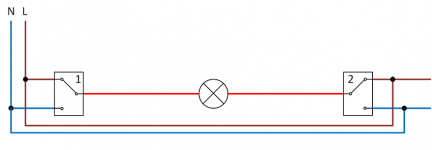
This is one of the latest discoveries... I have a 3 way switch on each side of stairs... One on the bottom, one on the top. I wanted to connect an additional switch for another light on the hallway, which would be separate from the 3 way circuit.

I did a quick sketch of the wiring I found... Traveler legs on the 3 phase switch are connected to phase and neutral on both sides and the light fixture is between both commons. :wtf:

So is this guy a genius or should I never let him touch another wire... I'm definitely on the latter side...

attachment.php
 

Attachments

  • 3WaySwitch.png
    3WaySwitch.png
    9.8 KB · Views: 662
To avoid these ads, REGISTER NOW!

nadogail

Well-known member
Joined
Jan 23, 2009
Messages
31,928
Location
Coronado, CA
IMHO, the diagram I am looking at probably would not work. If that is really an accurate depiction of how the circuit is wired it won't work properly.

You wrote about "the traveler legs on three phase switches" if that isn't a typo, please find a good book on basic electrical wiring.

If what you want to do is add an additional control point for a lighting circuit with two three way switches you need to add a double pole double throw (DPDT) (4 way) switch to reverse, or flop, the travelers. There is no real limit to the number of DPDT switches you can add.
 
Last edited:

Alchymist

Well-known member
Joined
Mar 1, 2009
Messages
4,423
Location
Central PA
Found a light circuit similar to that when we updated the electric in our newly purchased 1890's house. Not only wired similarly, but it was the stairway light (top of the stairs). One switch at the top of the stairs, other in the kitchen two rooms away.
 

wyliesdiesels

Well-known member
Joined
Aug 14, 2012
Messages
19,994
Location
Modesto, CA
I find it hard to believe that someone wired it that way. Your use of "3-phase switch" has me questioning some things here.

But if that is a true representation of how its wired, then its completely wrong.

Can you take some pics of both switch boxes showing wires coming into the box as well as wires on the switch terminals and post them here.
 

Bert_

Well-known member
Joined
Dec 24, 2016
Messages
9,707
Location
NW Iowa
It does work and it was common about 80-100 years ago. I have one in my own house.

It has not been an acceptable way to wire a three way switch for a long time. Hopefully this isn't a newer house.
 

Terry D

Well-known member
Joined
Mar 25, 2015
Messages
2,202
Location
St. Louis, MO.
That is the craziest thing that I have ever seen, and to make it more crazy, it for sure looks like it would work.
 

Terry D

Well-known member
Joined
Mar 25, 2015
Messages
2,202
Location
St. Louis, MO.
IMHO, the diagram I am looking at probably would not work. If that is really an accurate depiction of how the circuit is wired it won't work properly.

You wrote about "the traveler legs on three phase switches" if that isn't a typo, please find a good book on basic electrical wiring.

If what you want to do is add an additional control point for a lighting circuit with two three way switches you need to add a double pole double throw (DPDT) (4 way) switch to reverse, or flop, the travelers. There is no real limit to the number of DPDT switches you can add.

A DPDT switch and a 4-way are not the same thing. DPDT has 6 terminals and 4-way has 4. DPDT is like (2) 3-ways built together. They operate totally different
 
Last edited:

Alchymist

Well-known member
Joined
Mar 1, 2009
Messages
4,423
Location
Central PA
A DPDT switch and a 4-way are not the same thing. DPDT has 6 terminals and 4-way has 4. DPDT is like (2) 3-ways built together. They operate totally different

A "4 way" circuit uses a DPDT between two "three way" switches.
So yes, a "4 way" is a DPDT.
 

rlitman

Well-known member
Joined
Oct 18, 2010
Messages
24,591
Location
Long Island
That is the craziest thing that I have ever seen, and to make it more crazy, it for sure looks like it would work.


No, as drawn, that circuit will go boom and trip the breaker in two out of four possible switch configurations.
 

Terry D

Well-known member
Joined
Mar 25, 2015
Messages
2,202
Location
St. Louis, MO.
No, as drawn, that circuit will go boom and trip the breaker in two out of four possible switch configurations.

Look at it again, the state it is in now, you have just the neutral potential at each side of the lamp. Flip switch #1, now you have the hot and neutral at the lamp, lamp lights. Flip switch #2, now you have the hot potential at each side of the lamp, lamp goes out. The hot and neutral never come in contact in the switch.
 

Alchymist

Well-known member
Joined
Mar 1, 2009
Messages
4,423
Location
Central PA

Maybe this will help: the switch in the center is a DPDT switch. Follow the A & B wires through the switch - one position in red and the other position in black - in one position the two wires go straight through, in the other position it switches, thus allowing light on or off according to the other two switches.

I think the confusion is that the 4 way switches for lighting may come pre-wired for the cross wires.

Edit - the bottom red "A" in the left of the diagram should be a" B".
 

Attachments

  • 4Wayswitch.jpg
    4Wayswitch.jpg
    30.8 KB · Views: 76
Last edited:

rlitman

Well-known member
Joined
Oct 18, 2010
Messages
24,591
Location
Long Island
Look at it again, the state it is in now, you have just the neutral potential at each side of the lamp. Flip switch #1, now you have the hot and neutral at the lamp, lamp lights. Flip switch #2, now you have the hot potential at each side of the lamp, lamp goes out. The hot and neutral never come in contact in the switch.


Oh, that’s a lamp... I didn’t read that symbol as anything, as it isn’t.
 

Terry D

Well-known member
Joined
Mar 25, 2015
Messages
2,202
Location
St. Louis, MO.
Maybe this will help: the switch in the center is a DPDT switch. Follow the A & B wires through the switch - one position in red and the other position in black - in one position the two wires go straight through, in the other position it switches, thus allowing light on or off according to the other two switches.

I think the confusion is that the 4 way switches for lighting may come pre-wired for the cross wires.

Edit - the bottom red "A" in the left of the diagram should be a" B".

Well, I guess if you would add jumpers on the DPDT switch, it would work. But I have never seen switch like this used in a lighting circuit that has a 4-way in it. My comment was that a DPDT and a 4-way switch are not the same switch, and I will still stand behind that.
 
OP
C

Cheeky81

Well-known member
Joined
Oct 28, 2009
Messages
175
The circuit actually works. I really didn't pay much attention to it until now, because I wanted to add an independent switch to the box #2 for the light on the hallway and had to get hot and neutral from somewhere...

Circle with the cross is a lightbulb... those funny Europeans use it like that :dunno:

The benefit of it is that the guy that wired it saved himself one wire in the conduit from box 1 to box 2, however I'a bit reluctant with the state of having hot wire on both sides of the bulb when it is off.
 

mm08822

Well-known member
Joined
Jan 13, 2012
Messages
5,875
Location
NJ
The benefit of it is that the guy that wired it saved himself one wire in the conduit from box 1 to box 2, however I'a bit reluctant with the state of having hot wire on both sides of the bulb when it is off.

If it is wired with conduit it is an easy fix. The travelers between the S3's need to be independent of any other circuit conductors.

Sketch the exact conduit routing between each box.
 

teamextreme

Well-known member
Joined
Aug 10, 2013
Messages
867
Location
Lakewood, CO
I first looked at this and thought it wouldn't work, but then realized, I'll be damned it would work, but holy **** what a terrible way to wire it. Assuming the fixture has a black wire and a white wire feeding it, you wouldn't know what voltage was on either wire. Could be hot on both, neutral on both, hot on one, neutral on the other, or vice versa. Yikes. Probably was used in knob and tube days, but pretty sure that's a code violation today since the white wire would be hot at times and you're switching the neutral in some configurations.
 

mm08822

Well-known member
Joined
Jan 13, 2012
Messages
5,875
Location
NJ
A 4way switch is not the same as a DPDT switch.

A DPDT switch has 6 terminals and 3 fixed toggle positions. 2 of the terminals are commons.

A 4way has only 2 fixed positions. Those 2 positions would make it single throw (ST).
The 4way crosses the path of the travelers and has no commons.
 

JeepJohn62

Well-known member
Joined
Feb 25, 2019
Messages
157
Location
Alaska
The neutral doesn't tie thru the switch. 3 way and 4 way switches for houses are not like dpdt switches for normal electronic applications. There is a schematic diagram somewhere if you look.

You would not want the possibility of connecting a hot to a neutral. The neutral are tied common to the fixtures. Only the hot is switched.

Sent from my SM-A102U using The Garage Journal mobile app
 
To avoid these ads, REGISTER NOW!

JeepJohn62

Well-known member
Joined
Feb 25, 2019
Messages
157
Location
Alaska
Find a house electrical circuit book at Home Depot or Lowes. They typically have a brief electrical guide for house circuits with color diagrams.

Note that a 3 way switch has no connotations with 3 phase power as suggested in the original post.

Residential is all single phase essentially with a center tap neutral allowing a 120v tap.

Best wishes

Sent from my SM-A102U using The Garage Journal mobile app
 

Terry D

Well-known member
Joined
Mar 25, 2015
Messages
2,202
Location
St. Louis, MO.
Another crazy thing about the drawing in the first post, you could add a 4-way switch in between the two 3-ways to flip flop the not and neutral, and it would also work. But any loads down stream would also have the hot and neutral reversing. I personally have never came across anything like this, buy by what others have posted here, this does exist.
 

AntonLargiader

Well-known member
Joined
Nov 20, 2016
Messages
1,372
Location
Charlottesville, VA
I remember reading about that circuit here a year or so ago. The reason it was used is that it puts a constant hot and neutral at the distant switch location with only three wires, which isn't the case with more conventional 3-way wiring which gives you two travelers and a hot or neutral.
 
OP
C

Cheeky81

Well-known member
Joined
Oct 28, 2009
Messages
175
I had a brainfart about three phase switches... It was really meant to be 3 way switches. :)

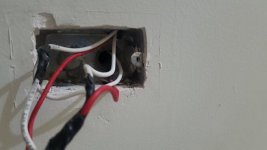
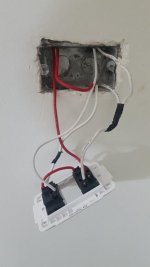
Here are some picture of the actual wiring... :shocking:

This is the first box (1). Hot and neutral are coming from the box on another side of the wall (red and white). The conduit on the top right side is going to the second box (2)
attachment.php


attachment.php


In the second box, bottom right are the wires coming from box 1, top left is going to the light fixture controlled by both 3 way switches, top left is another independent light on the hallway.

attachment.php


Wire colors are all wrong, there is no ground wire anywhere...

The big question here is... should I keep it as it is and just forget this even exists or rip all the cables out and do a proper connection?

I'm afraid what else I might discover if I go the latter route.
 

Attachments

  • Box1_1.jpg
    Box1_1.jpg
    18.8 KB · Views: 200
  • Box1_2.jpg
    Box1_2.jpg
    18.7 KB · Views: 198
  • Box2_1.jpg
    Box2_1.jpg
    18.5 KB · Views: 204

AntonLargiader

Well-known member
Joined
Nov 20, 2016
Messages
1,372
Location
Charlottesville, VA
If the actual workmanship looks OK and you don't want to dig into it, I would just leave it and make sure it's grounded. If the boxes are connected by conduit then it probably is. Is there even a provision for grounding those switches? What are they?

Looking at it, the only workmanship issue that comes to mind is the integrity of those taped connections. You could wire-nut them instead if there's enough space, or just check them, re-tape and leave them be.

EDIT: if you just leave it, you will have to remember that the fixture could be hot when it's off. But this could be the case anywhere in that same building, right? So just remember to use a tester for any work that you do.
 
Last edited:

teamextreme

Well-known member
Joined
Aug 10, 2013
Messages
867
Location
Lakewood, CO
I'm going to go out on a limb and say your electrician is waaaay beyond retirement age. Those splices with the electrical tape are something they did back in the 40's and 50's before they invented wire nuts. This guy needs to retire. Either that or he was trained by his grandpa.
If it's in conduit, as it looks to be, I would rip all that out and fix it properly.
 

dogdog

Well-known member
Joined
Nov 15, 2011
Messages
12,711
maybe the country OP is in have a different electrical code...

the circuit does work, probably not with safety practice in mind.... you will just have to keep in mind the two wires to the light bulb have no dedicated hot or neutral... means both wires can be hot or neutral dependents on the state of those switches... at one of the state... both wires can be live... even if the light bulb seemingly off... probably the most dangerous state...

Me.. I would fix it... or it would just annoy me for a while.
 

MBfreak

MEMBER EMERITUS
Joined
Dec 10, 2010
Messages
2,301
Location
Linkoping , Sweden
Schematic wise it will work, but is not acceptable wrt the rating of the three way switches used for house wiring , in Sweden .
Having phase and neutral on the NO and NC terminals can easily lead to a arcover when the switch is flipped, especially so if you have anything else than an incandescent lamp load. Fluorscent lighting ( cos fi appr 0,7) will probably cause a flash over phase to neutral at least 1/3 of the number of flips.
It was common and accepted practice in Sweden until fluoroscent tubes came , and also the rating of the switches were cheaped down. A typical 3 way switch here today has just the smallest insulation distances that will work and pass IEC and the minimum amount of metal.

Ola
 

wyliesdiesels

Well-known member
Joined
Aug 14, 2012
Messages
19,994
Location
Modesto, CA
Suprised no one has asked what country the OP is in.

The white conductors are a violation. since these are pulled through conduit they cannot be permanently marked black.

I would rip it out and start over. Or make him clme back and do it right
 

Alchymist

Well-known member
Joined
Mar 1, 2009
Messages
4,423
Location
Central PA
A 4way switch is not the same as a DPDT switch.

A DPDT switch has 6 terminals and 3 fixed toggle positions. 2 of the terminals are commons.

A 4way has only 2 fixed positions. Those 2 positions would make it single throw (ST).
The 4way crosses the path of the travelers and has no commons.

The 4way is a DPDT. A DPDT does not have 3 positions unless it is a variation with a center off postion, called a DPDT/center off. Call a 4 way whatever you want, it is still a DPDT. If you put a switch in a box, but you partially wire it inside the box, and only bring out 4 of the 6 terminals, it still is a DPDT.
 

Bert_

Well-known member
Joined
Dec 24, 2016
Messages
9,707
Location
NW Iowa
Looking close at those pictures I don't there is any conduit. It really looks like thhn or maybe tw wire just flying in though an open knockout. If that's the case then the whole thing is one big hack job after another.
 

Terry D

Well-known member
Joined
Mar 25, 2015
Messages
2,202
Location
St. Louis, MO.
The 4way is a DPDT. A DPDT does not have 3 positions unless it is a variation with a center off postion, called a DPDT/center off. Call a 4 way whatever you want, it is still a DPDT. If you put a switch in a box, but you partially wire it inside the box, and only bring out 4 of the 6 terminals, it still is a DPDT.
Ok, just for the sake of conversation, let's say we have a DPDT switch and we want to control two different 240 volt fans. When the switch is in the up position, fan #1 will run, when the switch is in the down position, fan #2 will run, and yes, alot of DPDT switches have a center off position. So in that position, either of the fans will not be running. So if what your saying is that a DPDT and a 4-way switch are the same, then please describe how to wire a 4-way switch to do the same thing


Sent from my SM-G960U using The Garage Journal mobile app
 

Alchymist

Well-known member
Joined
Mar 1, 2009
Messages
4,423
Location
Central PA
Ok, just for the sake of conversation, let's say we have a DPDT switch and we want to control two different 240 volt fans. When the switch is in the up position, fan #1 will run, when the switch is in the down position, fan #2 will run, and yes, alot of DPDT switches have a center off position. So in that position, either of the fans will not be running. So if what your saying is that a DPDT and a 4-way switch are the same, then please describe how to wire a 4-way switch to do the same thing


Sent from my SM-G960U using The Garage Journal mobile app

".......then please describe how to wire a 4-way switch to do the same thing.."

I did, in post #12.
 

Bert_

Well-known member
Joined
Dec 24, 2016
Messages
9,707
Location
NW Iowa
A 4 way switch is by definition a dpdt. But a dpdt is not necessarily a 4-way switch.
 

Alchymist

Well-known member
Joined
Mar 1, 2009
Messages
4,423
Location
Central PA
A Short Essay On Three and Four Way Switches

Lighting circuits are specified as single, three way or four way circuits. Confusingly, while the single circuit uses one switch, a three way circuit uses two, and a four way circuit uses three. The explanation is quite simple. A single circuit uses but one switch, which is quite logical. But a 3 way circuit uses only two, and a four way circuit uses ... yes, 3 switches.

The terms “three way” and “four way” originally referred to the number of settings that the circuit switches could assume, and over time became the colloquial name for the individual types instead of referring the more deterministic notation of the number of “poles and throws”. We can start with the three way circuit, and label our switches as S1 and S2. These two switches can be set one of three ways, as shown in the following table:

S1 S2
ON ON
OFF OFF
ON OFF

You then might ask well, what about OFF ON? The answer to that is – ON and OFF are just mirror images of OFF and ON. In other words, S1 on one side of a room being on and S2 ON the other side of the room being OFF are just a mirror image of S1 being OFF and S2 being ON.

Thus the switches needed for this circuit were different from the one used in a single switch circuit, and the term “3 way” became common usage for a SPDT switch, as compared to a SPST used in the single switch circuit. Note that both types of switch have but two positions, with the SPST switch position being labeled “ON’ and “OFF”, and the SPDT has no label, as there is no “on” and “OFF” as such. The SPDT connects a common terminal to one or the other of two additional terminals, depending on switch position.

Now we come to the “4 way” circuit. A 4 way circuit uses 3 switches, but of two different types. Two of the 3 way switches are used in conjunction with a DPDT switch to allow turning the circuit ON or OFF from three locations. This time our table has three switches and we arrive at the name “4 way” as follows:


S1 S2 S3
ON ON ON
OFF ON ON
OFF OFF ON
OFF OFF OFF

One might then say but the next line in the table should be
ON OFF OFF . True, but that line is a mirror image of line 3. In fact the table could be extended for another two lines, but they would be mirror images just as shown in the previous two switch table. Thus, there are 4 possible switch positions, which leads to the DPDT being called a 4 way switch. It does get confusing until you remember that a four way circuit consists of one “4 way” switch” and two “3 way” switches. Which brings us to the conclusion that a single switch (ie. SPST), should, by these notions, be called a “2 way” switch.
 

JeepJohn62

Well-known member
Joined
Feb 25, 2019
Messages
157
Location
Alaska
A "4-way" (intermediate) switch is a purpose built double pole, double throw (DPDT) switch, internally wired in manufacture to reverse the connections between the input and output and having only four external terminals. This switch has two pairs of "traveler" terminals that it connects either straight through, or crossed over (transposed, or swapped).

Above text From Wikipedia.


It is a modified dpdt that performs a "cross" function. This swaps the traveler power wire and allows multiple control locations.

Sent from my SM-A102U using The Garage Journal mobile app
 

JeepJohn62

Well-known member
Joined
Feb 25, 2019
Messages
157
Location
Alaska
So recently I moved into a new house and I'm trying to figure out some of the electrical wiring done by the electrician/plumber that was in charge of the electrical installation.

So far, with the things discovered, I'm really feeling lucky I don't have water coming out of the wall sockets.

This is one of the latest discoveries... I have a 3 way switch on each side of stairs... One on the bottom, one on the top. I wanted to connect an additional switch for another light on the hallway, which would be separate from the 3 way circuit.

I did a quick sketch of the wiring I found... Traveler legs on the 3 phase switch are connected to phase and neutral on both sides and the light fixture is between both commons. :wtf:

So is this guy a genius or should I never let him touch another wire... I'm definitely on the latter side...
attachment.php
I suspect that none of the white wires are in fact a neutral. They are marked black indicating a hot traveler switched wire.

The actual neutral is probably terminated at the load. Only the hot wires and traveler returns are connected at the switch.

John

Sent from my SM-A102U using The Garage Journal mobile app
 
To avoid these ads, REGISTER NOW!
Top Bottom