To avoid these ads, REGISTER NOW!

3-wire 240V conversion - ground to water pipe?

Duemeister

Member
Joined
Aug 9, 2023
Messages
9
Location
Tampa, FL
Hi folks. I have a different twist on an old maneuver - converting an unused 240 connection to 120. The 10 gauge wiring is black-red-white no green ground. I have a small subpanel with a couple of 120 breakers to step it down. But I think I need a ground wire to make it legit to U.S. code. However, there is a copper pipe within reach of my new subpanel. It even has a ground strap already on it (see in the background of the picture).

Can I make my ground connection to the copper pipe so I don't have to pull a new 4-conductor wire?IMG_0842.jpeg
 
To avoid these ads, REGISTER NOW!
OP
D

Duemeister

Member
Joined
Aug 9, 2023
Messages
9
Location
Tampa, FL
I was afraid you would say that. :) This is a fixer-upper house. So I don't know where that ground strap goes. Dammit. I guess I'll have to pull a 4-conductor line. Seriously miserable in this situation. The work space in the attic is miserable.
Thanks for keeping me out of trouble!
 

PCustoms

Well-known member
Joined
Jul 23, 2011
Messages
22,417
Location
VT
I was afraid you would say that. :) This is a fixer-upper house. So I don't know where that ground strap goes. Dammit. I guess I'll have to pull a 4-conductor line. Seriously miserable in this situation. The work space in the attic is miserable.

Thanks for keeping me out of trouble!

Any chance the ground wire just got snipped off at the jacket?
 

75gmck25

Well-known member
Joined
Jul 21, 2014
Messages
1,318
Location
Alexandria, VA
You do have three wires that could be used for hot, neutral and ground, but they are not the correct color.

I know you can remark a white wire to show it as hot, but I'm not sure you are allowed to mark a red wire to show it serves as ground. It would be electrically okay, but probably not code compliant, and would confuse any electrician that ran across it in the future.

I also recommend checking inside the wire jacket to make sure there isn't a ground wire hiding in there.
 
OP
D

Duemeister

Member
Joined
Aug 9, 2023
Messages
9
Location
Tampa, FL
Any chance the ground wire just got snipped off at the jacket?
Good question. I thought it was a four-conductor when I was rerouting it because it is a thick cable. After I trimmed it and stripped it back I was surprised to only find the red-black-white in the picture.
 

PCustoms

Well-known member
Joined
Jul 23, 2011
Messages
22,417
Location
VT
Good question. I thought it was a four-conductor when I was rerouting it because it is a thick cable. After I trimmed it and stripped it back I was surprised to only find the red-black-white in the picture.
Well if you stripped it you would have seen the ground
 

Crazyjake8493

Well-known member
Joined
Sep 26, 2014
Messages
3,952
Location
Upstate NY
The work space in the attic is miserable.
Get yourself a battery fan. I keep a Klein in my truck that gets used a lot. Has a clamp, keyhole, and magnets to mount it. I also use a Milwaukee M18 that will run forever with one of the big batteries in it.
 

Ry24000

Active member
Joined
Apr 26, 2024
Messages
28
Location
CarWA
your looking for 120 volt. check that cable to see if the grounding conductor is in there.(for whatever reason some installers liked to snip them off) If not use the red conductor as the equipment ground, wrap some green tape on it at both ends, land it on the proper ground terminal and viola you have your 120 volts. Please don't remove the red insulation. waist of time. if you do strip it completely be careful of where it is routed.
 

mike93lx

ALLIANCE MEMBER
Joined
Dec 9, 2013
Messages
37,427
Location
Richmond, VA
your looking for 120 volt. check that cable to see if the grounding conductor is in there.(for whatever reason some installers liked to snip them off) If not use the red conductor as the equipment ground, wrap some green tape on it at both ends, land it on the proper ground terminal and viola you have your 120 volts. Please don't remove the red insulation. waist of time. if you do strip it completely be careful of where it is routed.
Finding the roll of green tape and wrapping it will take longer than stripping the insulation. But six one, half dozen of the other

Not sure why any extra care would be needed in this case. An EGC in NM is always bare anyway
 

Ry24000

Active member
Joined
Apr 26, 2024
Messages
28
Location
CarWA
Finding the roll of green tape and wrapping it will take longer than stripping the insulation. But six one, half dozen of the other

Not sure why any extra care would be needed in this case. An EGC in NM is always bare anyway
Typical homeowners and stripping wire Hmmmmm......................
Yeah your right green tape would require a trip to the hardware store.
Just giving the guy options from a guy with 32 years of electrical experience.
 
OP
D

Duemeister

Member
Joined
Aug 9, 2023
Messages
9
Location
Tampa, FL
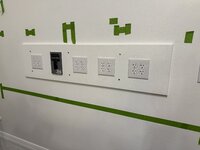
Mission accomplished folks. Thanks for all the great advice. I played it safe and just used the 3-wire for a plain old 120V sub panel and gave up on the 120/240V original idea.s (Did I say it right this time Norcal?) I bought some 4-strand 10-3 to run a new line but couldn't get it past the already crammed raceway to the attic. Florida also makes us run everything in a potentially damp condition (which is almost everywhere) on a GFCI, so I have that installed in the main box for the entire bench circuit. I really didn't need the sub panel complexity but I already had the hole cut for it and the box, so I left it. A little redundant but it might come in handy later. Now we'll see how the IKEA cabinets hold up.IMG_0855.jpegIMG_0870.jpeg
 
To avoid these ads, REGISTER NOW!
OP
D

Duemeister

Member
Joined
Aug 9, 2023
Messages
9
Location
Tampa, FL
Electricians - help me understand this. Some of you are saying that I couldn't have had a 240V connection running to an outdoor range. It must have been 120/240v. I think that is also known as "split phase" because one wire is a phase of 120 and another wire has another phase of 120 and when you add them together you get your 240. And, because they are running out of phase from each other, they inherently ground each other making a return neutral unnecessary. So a three-wire connection is sufficient. Is that what you are saying? OR, was my old three-wire configuration really a 240v connection as I originally stated, specifically because it only had three wires in the first place. The breaker was very clearly a labeled 30 amp and was a double-wide breaker. The black and red wires connected to the breaker and the white wire went to the neutral/ground bus bar in the main box. No fourth wire. The appliance on the other end was a 30-year old Jennaire outdoor downdraft grill/stove. It was hardwired to those three wires, not plugged in like an electric dryer.

So - was that a 120/240v connection or a 240v connection?
 

larry4406

Well-known member
Joined
Jan 27, 2006
Messages
19,076
Location
Northern Virginia
My original 240V electric range was wired with 3-wire conductor (black, red, white). Inside the oven at the cord junction box, there is a copper ground bar jumper that connected the oven frame to the white conductor. This is old school.

When we rewired, the wire was upgraded to 4-wire (black, red, white, ground). Had we kept that range, it would have been changed to a 4-prong plug and the ground jumper removed.
 

Norcal

Well-known member
Joined
Mar 16, 2008
Messages
13,752
Electricians - help me understand this. Some of you are saying that I couldn't have had a 240V connection running to an outdoor range. It must have been 120/240v. I think that is also known as "split phase" because one wire is a phase of 120 and another wire has another phase of 120 and when you add them together you get your 240. And, because they are running out of phase from each other, they inherently ground each other making a return neutral unnecessary. So a three-wire connection is sufficient. Is that what you are saying? OR, was my old three-wire configuration really a 240v connection as I originally stated, specifically because it only had three wires in the first place. The breaker was very clearly a labeled 30 amp and was a double-wide breaker. The black and red wires connected to the breaker and the white wire went to the neutral/ground bus bar in the main box. No fourth wire. The appliance on the other end was a 30-year old Jennaire outdoor downdraft grill/stove. It was hardwired to those three wires, not plugged in like an electric dryer.

So - was that a 120/240v connection or a 240v connection?
Prior to the adoption of the 1996 NEC it was permitted to ground the frames of clothes dryers, & cooking equipment, to the neutral, there was no grounding conductor. Those appliances used 120 volt components so a neutral is required.
 

dave*99

Well-known member
Joined
May 5, 2009
Messages
4,255
Location
Coastal NJ
Electricians - help me understand this. Some of you are saying that I couldn't have had a 240V connection running to an outdoor range. It must have been 120/240v. I think that is also known as "split phase" because one wire is a phase of 120 and another wire has another phase of 120 and when you add them together you get your 240. And, because they are running out of phase from each other, they inherently ground each other making a return neutral unnecessary. So a three-wire connection is sufficient. Is that what you are saying? OR, was my old three-wire configuration really a 240v connection as I originally stated, specifically because it only had three wires in the first place. The breaker was very clearly a labeled 30 amp and was a double-wide breaker. The black and red wires connected to the breaker and the white wire went to the neutral/ground bus bar in the main box. No fourth wire. The appliance on the other end was a 30-year old Jennaire outdoor downdraft grill/stove. It was hardwired to those three wires, not plugged in like an electric dryer.

So - was that a 120/240v connection or a 240v connection?
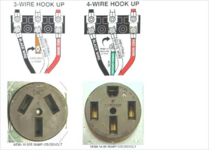
You had a 3 wire 120/240 connection. And no ground wire. Likely your appliance had the white (neutral) connected to the chassis. Today, we need to use 4 wires for a 120/240 appliance. Ground wire connects to chassis of the appliance. White (neutral) connects to the controls/clock/motor/light - whatever needs 120 inside the appliance.

Here is an example of a 50A system in 3 and 4 wire configurations.

1749394532370.png
 
OP
D

Duemeister

Member
Joined
Aug 9, 2023
Messages
9
Location
Tampa, FL
Prior to the adoption of the 1996 NEC it was permitted to ground the frames of clothes dryers, & cooking equipment, to the neutral, there was no grounding conductor. Those appliances used 120 volt components so a neutral is required.
Thanks Norcal. That makes sense. The house was built in 1992 and I'm sure that old stove was part of the original build.
 

Model A Fan

Well-known member
Joined
Dec 1, 2011
Messages
1,211
Location
NW Washington
Typical homeowners and stripping wire Hmmmmm......................
Yeah your right green tape would require a trip to the hardware store.
Just giving the guy options from a guy with 32 years of electrical experience.
He's already got the green tape. Just look at the photos! 😅😅🤣🤣
 

Glemon

Well-known member
Joined
Aug 29, 2020
Messages
2,159
Location
NE
Not an electrician, but regarding marking a red wire green and any confusion about the wire's identity. I think I would be much happier thinking a wire was hot and finding out it was a ground, than thinking it was a ground and finding out it was hot.

Also, if I am a red wire that identifies as green I think that is ok now...I will see myself out...
 

PCustoms

Well-known member
Joined
Jul 23, 2011
Messages
22,417
Location
VT
So what is this mystery 3 wire NM material that doesn't have a ground?

"Is 10/3 without ground" available?
 

wyliesdiesels

Well-known member
Joined
Aug 14, 2012
Messages
19,994
Location
Modesto, CA
I'm a little out of it today, but what application has 2 hots and neutral?
try reading previous posts... 3-wire stove and dryer receptacles prior to 1996 code cycle... look at nema 10-30 and 10-50 receptacles for dryers and stoves respectively... 120/240 no grnd...
 

wyliesdiesels

Well-known member
Joined
Aug 14, 2012
Messages
19,994
Location
Modesto, CA
Range, dryer, hot tub, Jacuzzi tub, sauna, floor heat, emergency power receptacle.
I could be wrong about the floor heat though.
Ive only seen 3-wire no grnd NM used on the first 2, never the others.... you wouldnt use it on 240v floor heat either. wrong application... and all of those required a grounding conductor.... as said above by norcal
 
To avoid these ads, REGISTER NOW!
Top Bottom