To avoid these ads, REGISTER NOW!

30 x 36 pole barn

Sp180

Member
Joined
Jul 29, 2013
Messages
15
Location
Nowthen, MN
My first post! Been a recent stalker here but need a more specific answers then I am reading.

here goes.

1. Running 240 from house panel to pole barn panel. 100 A for 250'. What type of wire do I need to run? A brand would be nice and type.

2. Can I drill holes to pass wires through my 6x6 pole barn beams? or is there a better way to run wires to each receptical?

3. I think I have most everything figured out except those last two items. Trying to find pictures on this site for how wires are run though the walls.

Thanks for any suggestions or assistance.

Mark
 
To avoid these ads, REGISTER NOW!

Flexia

Well-known member
Joined
Mar 8, 2013
Messages
215
Location
Akron/Canton Ohio
If it's a pole barn you can leave the drill put away and just run the wires behind the 6x6 on top of the perling.

Sent from my SCH-I605 using Tapatalk 4 Beta
 

wyliesdiesels

Well-known member
Joined
Aug 14, 2012
Messages
20,020
Location
Modesto, CA
At that distance due to voltage drop, u would need to go with 2/0 AL such as MHF or use 1/0 CU. CU wire will eat a whole in your pocket especially at that length, though....

Will this be a one man shop and if so, what if any high draw equipment will be used(elec heat or WH, AC, compressor, welder, etc.)?
 
Last edited:

pattenp

Well-known member
Joined
Jun 4, 2008
Messages
10,175
Location
Virginia - USA
Why would you need to drop to a 90A breaker on #2/0 AL. Are you thinking #2?

At that distance due to voltage drop, u would need to go with 2/0 AL such as MHF and drop the breaker down to 90a or use 1/0 CU and u can stick with the 100a breaker. CU wire will eat a whole in your pocket especially at that length!

Will this be a one man shop and if so, what if any high draw equipment will be used(elec heat or WH, AC, compressor, welder, etc.)?
 

Highbeam

Well-known member
Joined
Feb 15, 2011
Messages
2,292
Location
Mt Rainier foothills, WA
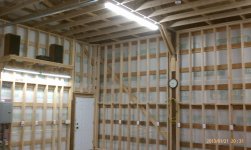
I just wired my pole barn and passed inspection last week. 15 circuits.

I ran the wires behind the poles in the 1.5" space made by the girts. I did NOT want to drill holes in the poles.
 

Attachments

  • IMAG0548.jpg
    IMAG0548.jpg
    95.6 KB · Views: 209

mrgm

Well-known member
Joined
Dec 13, 2010
Messages
199
Location
TX
100 amp will do. 1/0 copper for service in 1-1/2" conduit. PLEASE do not use aluminum wire. if you can not run your wire thru back of wood, then I would recommend in conduit on surface, makes things look nice. you can route your regular wire thru it.
 

wyliesdiesels

Well-known member
Joined
Aug 14, 2012
Messages
20,020
Location
Modesto, CA
100 amp will do. 1/0 copper for service in 1-1/2" conduit.

PLEASE do not use aluminum wire. if you can not run your wire thru back of wood, then I would recommend in conduit on surface, makes things look nice. you can route your regular wire thru it.

1 1/2" conduit? :eyecrazy: Your crazy! Thats gonna be fun to pull!

And whats wrong with al wire? The AL wire of today is not the same AL wire from back in the 70's
 
Last edited:

mrgm

Well-known member
Joined
Dec 13, 2010
Messages
199
Location
TX
nope, not crazy.

may not be the same, but still has the same problems. especially underground and at main connection. running a generator and compressor on AL service is not recommended. skip it. Hell, his local code may not even allow it.
 

pattenp

Well-known member
Joined
Jun 4, 2008
Messages
10,175
Location
Virginia - USA
Not recommended by whom? Your nay saying of AL feeders and service is not warranted if properly installed.

nope, not crazy.

may not be the same, but still has the same problems. especially underground and at main connection. running a generator and compressor on AL service is not recommended. skip it. Hell, his local code may not even allow it.
 

Highbeam

Well-known member
Joined
Feb 15, 2011
Messages
2,292
Location
Mt Rainier foothills, WA
So are the powerlines in the street copper too? How about the drop from the street to my meter? If aluminum is no good then why are nearly all homes fed with it?
 
To avoid these ads, REGISTER NOW!

mrgm

Well-known member
Joined
Dec 13, 2010
Messages
199
Location
TX
You can not compare ACSR with what they sell at Lowes or your local vender
The big problem with aluminum for this applications is surface oxidation when exposed to air. Yes the conductors are covered for the most part, but where the connections are made at panels and/or service connections they are exposed. this oxidation will increase resistance at the connections, which will build heat and can start a fire. And yes you can apply that anti-oxidant paste to the cable and connections, but after about 5 years or so, that stuff will chunk off or may not get total coverage even if you see total coverage. The oxidation that is built up anywhere on that wire (in pin hole, crack where ever) can cause a progressively hotter spot over time with more build up and can melt the surrounding wire and or attached fixture.
The expansion and contraction of the AL wire which may be termed as "cold creep" is a big problem. This is where the wire expands when warm or hot, and contracts when cooled, thru these cycles, loose connections can develop and will spark.
Aluminum wire just requires more maintenance and then copper. This stuff becomes brittle overtime especially when your zapping your welder\ compressor thru that size conductor. Spending the extra on the copper will give you piece of mind that sh!it wont go south one day.

We have worked on 100's of building where we have seen arcing and burned casings most of these building were not even 10 years old. A lot of telephone companies and Data Center retrofits have had us remove the old (and new) Al service and replace with Cu. They can not justify cost for safety and reliability. In some areas they would not get total coverage from there insurance companies because of the Al (yes, they had copper thru out building minus the entrance and main panel). We do design work from California to Massachusetts, Texas to Canada. Aluminum is not a preferred wire anywhere we go, we see it as half assin it. that is just our opinion.

well this got long...glad I did not go into detail :p

the only disadvantage to copper is cost.

my 2cents- now I'm broke.
 

joe_padavano

Well-known member
Joined
Feb 26, 2011
Messages
1,788
Location
Northern VA
The big problem with aluminum for this applications is surface oxidation when exposed to air.

Which is why you use this.

8c427b15-302c-4182-b074-3fac4fd559fb_300.jpg
 

pattenp

Well-known member
Joined
Jun 4, 2008
Messages
10,175
Location
Virginia - USA
The aluminum wire produced today does not suffer "Cold Creep" as the aluminum wire of the 60's. As I said before, if properly installed it will be fine to use for a feeder. If there was an issue I know for sure the people who watch over us that make up the NEC would have forbidden the use of aluminum wire for services and feeders..
 

2ManyProjects

Well-known member
Joined
Jul 18, 2013
Messages
757
If there was an issue I know for sure the people who watch over us that make up the NEC would have forbidden the use of aluminum wire for services and feeders..

While I certainly admire your faith in bureaucracy, I can't honestly say that I share it.


wyliesdiesels

Well-known member
Joined
Aug 14, 2012
Messages
20,020
Location
Modesto, CA
So are the powerlines in the street copper too? How about the drop from the street to my meter? If aluminum is no good then why are nearly all homes fed with it?

No cu. PoCos use ACSR, which is uncomparable to aluminum building wire. But yes most service drops and underground service feeders ARE aluminum!

You can not compare ACSR with what they sell at Lowes or your local vender
The big problem with aluminum for this applications is surface oxidation when exposed to air. Yes the conductors are covered for the most part, but where the connections are made at panels and/or service connections they are exposed. this oxidation will increase resistance at the connections, which will build heat and can start a fire. And yes you can apply that anti-oxidant paste to the cable and connections, but after about 5 years or so, that stuff will chunk off or may not get total coverage even if you see total coverage. The oxidation that is built up anywhere on that wire (in pin hole, crack where ever) can cause a progressively hotter spot over time with more build up and can melt the surrounding wire and or attached fixture.
The expansion and contraction of the AL wire which may be termed as "cold creep" is a big problem. This is where the wire expands when warm or hot, and contracts when cooled, thru these cycles, loose connections can develop and will spark.
Aluminum wire just requires more maintenance and then copper. This stuff becomes brittle overtime especially when your zapping your welder\ compressor thru that size conductor. Spending the extra on the copper will give you piece of mind that sh!it wont go south one day.

We have worked on 100's of building where we have seen arcing and burned casings most of these building were not even 10 years old. A lot of telephone companies and Data Center retrofits have had us remove the old (and new) Al service and replace with Cu. They can not justify cost for safety and reliability. In some areas they would not get total coverage from there insurance companies because of the Al (yes, they had copper thru out building minus the entrance and main panel). We do design work from California to Massachusetts, Texas to Canada. Aluminum is not a preferred wire anywhere we go, we see it as half assin it. that is just our opinion.

well this got long...glad I did not go into detail :p

the only disadvantage to copper is cost.

my 2cents- now I'm broke.

I bet all those installations of aluminum wire were done wrong. Ive seen countless installs of aluminum feeders, ranging in age from 10-30 yrs with NO problems and no signs of a problem. As has been said, the aluminum wire of today is A LOT different and A LOT better than the aluminum wire from the 60s!

http://www.southwire.com/commercial/ALBuildingWire30YrsOfReliability.htm

http://www.southwire.com/commercial/todaysAluminum.htm
 

hanly2

Well-known member
Joined
Feb 19, 2012
Messages
153
I just wired my pole barn and passed inspection last week. 15 circuits.

I ran the wires behind the poles in the 1.5" space made by the girts. I did NOT want to drill holes in the poles.
Thats so nice, what is the white stuff behind the purlins? Around the whole building?
 

UpstateNY

Well-known member
Joined
Jan 2, 2012
Messages
662
I just wired my pole barn and passed inspection last week. 15 circuits.

I ran the wires behind the poles in the 1.5" space made by the girts. I did NOT want to drill holes in the poles.

I see the wires, but how did you attach them to the back of the poles asuming the outside wall was already installed ?
 

CNGsaves

Well-known member
Joined
Sep 26, 2012
Messages
13,233
Location
KS and OK
Now would be good time to Update OP Profile on GJ with COUNTRY and STATE.

Electrical codes / methods vary by country, and even by state.

Pole barn in Tasmania will likely be wired much differently than one in NY !! :D
 

Charles (in GA)

Well-known member
Joined
Jan 11, 2006
Messages
12,489
Location
50 mi south of Atlanta
You can but it's against NEC requirements. 2011 NEC 300.18. There is also a chance of the glue damaging the wire insulation.

The other issue is that the conduit needs to be "pullable" (if there is such a term) and assembling one section at a time doesn't "prove" this. Metal, plastic, doesn't matter, the conduit has to be a complete assembly before you pull the wires in it.

Aluminum? If it were so bad, we would see a lot of problems and hear about it in the news, etc. Probably 95% of the houses built in the past 30 years are supplied by aluminum service entrance cables and wires. Properly done, with an anti-corrosive paste, and properly torquing connections, it will be many years before any issues might appear, if at all.

Charles

Charles
 
To avoid these ads, REGISTER NOW!
Top Bottom