To avoid these ads, REGISTER NOW!

36x72 insulation ?

etbjr

Active member
Joined
Jan 10, 2009
Messages
27
Location
Northeast KY
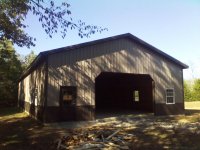
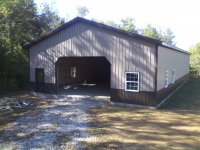
Hi all, first time posting, but long time reader. I've had a 36x72 building built and would like to get some recommendations on the insulation part of the process. The building is built as follows:

36x72x12 stick built using 2x6's 16"oc.
4/12 pitch trusses 24"oc.
Metal siding and metal roof.

Walls are constructed from outside to in as follows: Metal siding, house wrap, 2x6 girt boards horizontally and 2x6 studs.
Roof constructed from outside to in as follows: Metal roof, synthetic underlayment, 5/8" osb, 2x4 purlins on 24" and 4/12 trusses on 24"
BARN 1.jpg

BARN 3.jpg

Below is a photo of what it looks like from the inside on the wall and into the attic area. No finish work has been done, just waiting on the insulation.

BARN 2.jpg

I was first thinking on just install R19 fiberglass batts in the walls, but as you can see that would leave around an 1.5" space behind the fiberglass batt, which I've read and been told is not good. So I then thought about using a thicker batt, say R30 which is 9.5" thick and compressing it a little to fit the cavity. This would lower the R value to about R25 or so but would kinda get rid of the air space that the girt boards are creating.
Next would be to spray foam it. I've contacted 4 locally spray foam contractors and 3 out of the 4 recommend 3.5"-4" of open cell on the walls, the other said 1" of closed cell followed by R19 fiberglass batts.

3.5"-4" of open cell is ranging $3050 to $3650 giving me an R of 13.65-15.6
1" of closed cell is $2675 of R6 then the cost of the R19 batts.

I'm weighting heavily on the open cell at 3.5"-4", but not sure if that's the way to go??

I'm in KY>
 
Last edited:
To avoid these ads, REGISTER NOW!

walrus

Well-known member
Joined
Nov 12, 2008
Messages
11,679
Location
Maine
In Maine I'd go with the closed cell and batts. The closed cell makes the stud bay air tight so the fiberglass works correctly. The closed cell also adds rigidity to the building.

Sent from my SM-G950U using Tapatalk
 

Jackfre

Well-known member
Joined
Dec 26, 2010
Messages
4,411
Location
N CA
Well, it is all going to be covered up and you only get one shot at it. If you have the resources I'd suggest the max foam and batts as well. It will make it much easier to condition the space.
 
OP
E

etbjr

Active member
Joined
Jan 10, 2009
Messages
27
Location
Northeast KY
The main concern I have with the open cell is the possibility of water vapor moving through the foam and condensating on the exterior metal in the winter. The local foam guys say that won't be an issue though. They're stating where open cell is an air barrier at the correct thickness I shouldn't get any vapor transfer from air flow, that if there is any it'll dry to the outside. I'm in climate zone 4, so we have mixed heating and cooling so a vapor barrier on the warm side usually is not recommended. When I first started looking at spray foam I was all for closed cell till I was told the price and then recommend it was better in our climate to do open cell and that's recommend by 3 installers that spray both open and closed. Just don't want to put something in I'll have problems with??

I have already installed insulation baffles in every truss bay in the attic area, some of them you can see in the pics above, so I'll be using a blow in insulation in the attic at R38. There is vented soffits all around the eaves and ridge vent in the top.
 

yeldogt

Well-known member
Joined
Jan 2, 2012
Messages
18,184
I don't understand the logic of these -- no underlayment building -- when the goal is a fully insulated, finished building. Is not the preferred insulation with a typical pole barn the fully encapsulated product?

I actually don't see a problem with using typical insulation (batts) and the 1.5 inch gap -- typical insulation is often installed with spaces between the insulation and the roof and wall sheathing ... Is the metal siding waterproof (from rain). It's going to dry to the outside ... wet insulation is caused by transferred humidity into the wall and leaking siding -- control both and no wet insulation.

Remember -- lots of old houses are insulated with blown in .. and have no vapor barrier (or house wrap) ... and no moisture issues with the insulation.

I'm a real fan of closed cell foam -- anything new .... I do foam and batt or full foam. The closed cell eliminates air intrusion and any moisture migration worries .. I was quite impressed with my 2" foam and batts on a larger addition to my NJ place about 10 years ago. The batts IMO were really not necessary -- I noticed no difference when they installed the batts -- it was a week of almost 100 degree days. Needed the batts for R code.

I'm not sure how much you gain from only foaming the walls -- I'm sure something ... are you going to VB the ceiling? Doing a flash of the whole building in foam would be the ticket -- no vents.

Have the foam installers had any concerns with the foam pushing out the house wrap -- I have never felt wise to directly foam the back side of the metal -- be it roof or wall ... especially with open
 
To avoid these ads, REGISTER NOW!
OP
E

etbjr

Active member
Joined
Jan 10, 2009
Messages
27
Location
Northeast KY
I don't understand the logic of these -- no underlayment building -- when the goal is a fully insulated, finished building. Is not the preferred insulation with a typical pole barn the fully encapsulated product


Don't understand because of the lack of OSB sheathing? If so, I looked at many threads on here about if it should be installed and it was pretty much majority that most don't if it's going to be installed possibly on the inside and that's probably what I'm going with. My builder also wanted a lot more money for it to be added and also said it didn't need to be there. I agree with you I think it would've been better if it was there because my walls won't be as air tight without it and I can't really do any air sealing either. So kinda build myself into a situation where my only option is to use spray foam.
 
Last edited:
OP
E

etbjr

Active member
Joined
Jan 10, 2009
Messages
27
Location
Northeast KY
So back from vacation and ready to get back to the garage. Weighing heavily toward using OPEN CELL foam in the walls at 3.5 to 4" thick and having the ceiling area blown in to R38. I did get a quote of having R19 batts in the wall and attic blown and it was $1338 for the walls and $1815 for the attic. The open cell spray foam quote was $3050 for the walls.

I'd also like to add there isn't a vapor barrier under the concrete floor. There is #57 gravel about 20" deep topped off with about 6" of #8 gravel under the slab on the back end and about 8" of #8 gravel near the overhead door. I reached out to a few concrete contractors before the pour and they all said I didn't need one if I wasn't going to put anything over the slab. I'm a little worried about humidity building up in the building since there is no vapor barrier.. I've been monitoring the humidity in the building, but with the shop not closed up yet the levels have been basically mirroring the outside humidity, sometimes even lower. So I don't know if the lack of vapor barrier is a concern or not?

I do have a 16x10 garage door installed even though the pics posted doesn't show one.

Again just trying to pick some minds on this great forum!
 
Last edited:

Dragfluid

ALLIANCE MEMBER
Joined
Sep 15, 2013
Messages
17,561
Location
Pillager, MN
Put dense pack cellulose in the walls. More effective and cheaper than batts. Plus it will stop any air infiltration. Tons cheaper than foam.
Don't forget, not all of the foam operators are the same. Just like doctors and mechanics. Some got A's, some got C minuses.
 
OP
E

etbjr

Active member
Joined
Jan 10, 2009
Messages
27
Location
Northeast KY
I was looking into JM spider insulation for the walls or BIBS but haven't found anybody in the area that installs it. As far as the cellulose I did find some that would blow it in the attic. My plans are to insulate and then see how well it does in the summer and winter then decide what kind of heat I'll need. I didn't really want to put in AC because in the summer time the overhead door will probably be up a lot while we're out there and was thinking we could get by with a large floor fan. I definitely want it insulated well enough so it won't require a lot of heat!

The spray foam guy I'm looking at as been highly recommended and he does a lot of jobs in the area, but still haven't decided if that's the way I'm going for the walls.
 
Last edited:
To avoid these ads, REGISTER NOW!
Top Bottom