To avoid these ads, REGISTER NOW!

3HP Compressor Wiring

nwav8tor

Well-known member
Joined
Feb 21, 2012
Messages
239
Location
Spokane, WA
OK guys, I've searched the forum and found lots of info on the subject, but I still want to confirm my wiring plans for a new compressor.

It's a 3 HP, 60 gallon model with a 15 amp rating on the motor. There is a overload reset button on the motor itself. The manual says it must be connected to a 230V single phase outlet (6-30R) having a capacity of 20 amps. It will be located no more than 10' from an existing 14-30R receptacle supplied by a 3' 10-3 NM wire run to the garage sub-panel and its 30A double pole breaker.

1) Since the motor has overload protection itself, can I just utilize the existing 30A breakers as long as the wiring between the AC and the outlet is sized appropriately, or should I change the CB out to a 20A double pole to limit current available to the motor?

2) Should #10 wire be used between the AC and the receptacle if I change to a 6-30R and use a 6-30P? I think #12 might be a bit small considering the NEC 125% motor wiring requirement and potential voltage drop.

3) If I go the hardwire route, can I remove the existing receptacle and use #10 wire in flex conduit to run between the AC and the junction box that had the receptacle in it? What diameter conduit would be required for three #10 wires?

4) Is it OK to just cut the uninsulated end of the unused neutral wire of the existing 10-3 NM after removing the 14-30 receptacle and cap it with a wire nut to leave in the existing junction box?

Thanks for your help...

Paul
 
To avoid these ads, REGISTER NOW!

pattenp

Well-known member
Joined
Jun 4, 2008
Messages
10,175
Location
Virginia - USA
Just cap the neutral. Use a #10/2 A/C whip hardwired to where the outlet was to the compressor. Leave the circuit as is with the 30A breaker. If the breaker panel is not in sight of the compressor then you need to add a disconnect if hardwired.

Forgot to ask how close is the compressor to the outlet. An A/C whip may not be long enough. They usually come in 6ft lengths.

View media item 16457
 
Last edited:

wyliesdiesels

Well-known member
Joined
Aug 14, 2012
Messages
19,994
Location
Modesto, CA
OK guys, I've searched the forum and found lots of info on the subject, but I still want to confirm my wiring plans for a new compressor.

It's a 3 HP, 60 gallon model with a 15 amp rating on the motor. There is a overload reset button on the motor itself. The manual says it must be connected to a 230V single phase outlet (6-30R) having a capacity of 20 amps. It will be located no more than 10' from an existing 14-30R receptacle supplied by a 3' 10-3 NM wire run to the garage sub-panel and its 30A double pole breaker.

1) Since the motor has overload protection itself, can I just utilize the existing 30A breakers as long as the wiring between the AC and the outlet is sized appropriately, or should I change the CB out to a 20A double pole to limit current available to the motor?

2) Should #10 wire be used between the AC and the receptacle if I change to a 6-30R and use a 6-30P? I think #12 might be a bit small considering the NEC 125% motor wiring requirement and potential voltage drop.

3) If I go the hardwire route, can I remove the existing receptacle and use #10 wire in flex conduit to run between the AC and the junction box that had the receptacle in it? What diameter conduit would be required for three #10 wires?

4) Is it OK to just cut the uninsulated end of the unused neutral wire of the existing 10-3 NM after removing the 14-30 receptacle and cap it with a wire nut to leave in the existing junction box?

Thanks for your help...

Paul

u cannot put a 30a outlet on a 20a circuit.
 
OP
N

nwav8tor

Well-known member
Joined
Feb 21, 2012
Messages
239
Location
Spokane, WA
Thanks guys

Did your air compressor come with a cord and plug from the factory?

It did not come with any cord or plug.
Just cap the neutral. Use a #10/2 A/C whip hardwired to where the outlet was to the compressor. Leave the circuit as is with the 30A breaker. If the breaker panel is not in sight of the compressor then you need to add a disconnect if hardwired.

Forgot to ask how close is the compressor to the outlet. An A/C whip may not be long enough. They usually come in 6ft lengths.

Compressor will be in view of subpanel and the outlet/jbox. Haven't secures AC to the floor yet, but it'll be within 10 feet. Maybe I'll wait to secure it until I have all the wiring figured out so using a pre-made whip could be possible.

OR I could just mount a 20A fused disconnect box over the outlet jbox and connect the whip to that.

Either way, I'll use 10-2.
 

pattenp

Well-known member
Joined
Jun 4, 2008
Messages
10,175
Location
Virginia - USA
u cannot put a 30a outlet on a 20a circuit.

I'm not aware of a code section that prohibits a 30A outlet on a 20A circuit where it's a single outlet. NEC 210.21(b)(1) just states a single outlet is not to be rated less than the circuit. I know where the circuit supplies two or more outlets you are limited to the amp values as listed in NEC table 210.21(b)(3).
 

pattenp

Well-known member
Joined
Jun 4, 2008
Messages
10,175
Location
Virginia - USA
...........

Compressor will be in view of subpanel and the outlet/jbox. Haven't secures AC to the floor yet, but it'll be within 10 feet. Maybe I'll wait to secure it until I have all the wiring figured out so using a pre-made whip could be possible.

OR I could just mount a 20A fused disconnect box over the outlet jbox and connect the whip to that.

Either way, I'll use 10-2.

You don't need a fused disconnect. The disconnect could be mounted over the outlet box if you can figure a way to attach it and get wire from the outlet box into the disconnect box. The A/C disconnect I pictured is just a switch that is 60A and 10HP rated. It cost about $16 at Home Depot.
http://www.homedepot.com/p/Square-D...e-Over-Current-Protection-QO200TRCP/202353314
 
OP
N

nwav8tor

Well-known member
Joined
Feb 21, 2012
Messages
239
Location
Spokane, WA
You don't need a fused disconnect. The disconnect could be mounted over the outlet box if you can figure a way to attach it and get wire from the outlet box into the disconnect box. The A/C disconnect I pictured is just a switch that is 60A and 10HP rated. It cost about $16 at Home Depot.
http://www.homedepot.com/p/Square-D...e-Over-Current-Protection-QO200TRCP/202353314

The only reason I was thinking of swapping the 30A CB to 20A in the sub-panel or using a 20A fused disconnect (even though a disconnect isn't required) over the outlet jbox and leaving the 30A CB in the sub-panel was to give a bit more protection to the AC motor in case of a short, overload or jammed belt etc, especially since the manufacturer specified a 20A circuit. When it's specified like that, are they referring to a minimum of 20A, a maximum of 20A or both??
 
OP
N

nwav8tor

Well-known member
Joined
Feb 21, 2012
Messages
239
Location
Spokane, WA
Thanks for all the help guys. My final plan for hooking this up is to hard wire it to the existing 230V 30A dedicated circuit using 20' #10 THHN in 1/2" steel flex conduit.

There are a couple more questions that arose once I decided on the final plan:

1) If I'm using 20' of #10 on a 30A circuit for a 3HP compressor that only calls for a 20A circuit (15A motor rating) do I have to worry about voltage drop?

2) My Home Depot only has stranded #10 copper THHN, no solid. Is that OK to use for this?

3) Should I put terminal "lugs" on the stranded THHN at the compressor or can I just wrap the wire under the terminal screws at the pressure switch?

4) Are there any specific requirements for securing/supporting the flex conduit to the wall (every 16" for instance) along it's 15' or so horizontal run (approx. 50" up from the floor)?

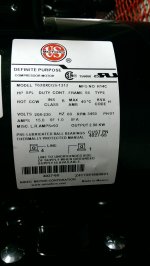
5) The motor data plate shows "Line" to terminal 4 and "Line to ungrounded side of supply when grounded supply is available" for terminal 1. What the heck does that mean? I can't see anything that indicates which is #1 and which is #4 and, other than the green wire to the unused ground screw at the switch, I didn't think it mattered what supply wire went to which line terminal. At the switch, I planned to just do black to black and red to white. Any problems with that?

6) The switch cover says, "Use copper 75C wire only break all lines." What does break all lines mean?

Here are pics of my motor data plate and the compressor switch itself.

Thanks again,
Paul
 

Attachments

  • motorinfo.jpg
    motorinfo.jpg
    129 KB · Views: 45
  • CompSw.jpg
    CompSw.jpg
    139.8 KB · Views: 39
OP
N

nwav8tor

Well-known member
Joined
Feb 21, 2012
Messages
239
Location
Spokane, WA
Compressor Location

Oh yeah, one more thing:

I know this isn't an electrical question, but I thought I'd ask it here anyway since you all are so smart and helpful.

My compressor manual says to locate the unit 15" from walls or other objects.

Why is that? I can't imagine why it'd need to be that far away from the wall, especially if the air intake filters are on the side of the tank facing away from the wall.

Have any of you placed your AC closer to a wall than that, and if so, did you ever have any associated problems?

I'd ask the manufacturer, but they are closed for the weekend :willy_nil

Thanks,
paul
 
To avoid these ads, REGISTER NOW!

pattenp

Well-known member
Joined
Jun 4, 2008
Messages
10,175
Location
Virginia - USA
Voltage drop is not an issue.

The 2 hots connect to the 2 open screws marked line/line on the pressure switch.

The distance is to allow good air flow around the pump for cooling.
 

pattenp

Well-known member
Joined
Jun 4, 2008
Messages
10,175
Location
Virginia - USA
After seeing the motor data label it's HP is listed as SPL. So at 15A it's under 3hp. You could have used a 20A circuit.
 
OP
N

nwav8tor

Well-known member
Joined
Feb 21, 2012
Messages
239
Location
Spokane, WA
After seeing the motor data label it's HP is listed as SPL. So at 15A it's under 3hp. You could have used a 20A circuit.

I thought 20A would be OK, but the existing outlet, CB and wiring are rated for 30A so I thought I'd just use what's already there.

Voltage drop is not an issue.

The 2 hots connect to the 2 open screws marked line/line on the pressure switch.

The distance is to allow good air flow around the pump for cooling.

Thanks for confirming that voltage drop won't be an issue using #10 and verifying that how I planned to connect the wiring was proper.

As for the spacing from the wall, if I need to locate the compressor real close to the wall due to clearance issues to still get a car through the garage door, do you think adding a fan to blow on the pumps would help the cooling sufficiently?

Paul
 

Norcal

Well-known member
Joined
Mar 16, 2008
Messages
13,753
The "break all lines" instruction means to break all ungrounded (hot) conductors, it is code compliant* to only break 1 line for single phase or 2 lines of a 3 phase line, but manufacturers instructions must be followed so both legs of a 240V circuit must be opened when the pressure switch reaches the set cut out pressure.

*Note: a disconnect must break all lines.
 

pattenp

Well-known member
Joined
Jun 4, 2008
Messages
10,175
Location
Virginia - USA
As for the spacing from the wall, if I need to locate the compressor real close to the wall due to clearance issues to still get a car through the garage door, do you think adding a fan to blow on the pumps would help the cooling sufficiently?

Paul

I'm sure it would. I have mine fairly close to the wall and the air flow feels fine coming off the pump fly wheel around the pump. You'll just have to test it setting close to the wall.
 
OP
N

nwav8tor

Well-known member
Joined
Feb 21, 2012
Messages
239
Location
Spokane, WA
The "break all lines" instruction means to break all ungrounded (hot) conductors, it is code compliant* to only break 1 line for single phase or 2 lines of a 3 phase line, but manufacturers instructions must be followed so both legs of a 240V circuit must be opened when the pressure switch reaches the set cut out pressure.

*Note: a disconnect must break all lines.

Is that something I need to worry about or is it an internal function of the pressure switch?

I'm not adding a disconnect since the compressor is within 25' of the panel and in sight of the panel.
 
Last edited:

Norcal

Well-known member
Joined
Mar 16, 2008
Messages
13,753
Is that something I need to worry about or is it an internal function of the pressure switch?

I'm not adding a disconnect since the compressor is within 25' of the panel and in sight of the panel.

Just make sure your breaking both legs through the pressure switch & your good to go.
 
OP
N

nwav8tor

Well-known member
Joined
Feb 21, 2012
Messages
239
Location
Spokane, WA
Any comments on using #10 stranded THHN rather than solid and if I should add connector "spades" or just wrap the wire around the terminal screws?
 

pattenp

Well-known member
Joined
Jun 4, 2008
Messages
10,175
Location
Virginia - USA
I used spades on mine. It made it easier getting the wire hooked up inside that small pressure switch box. Make sure to use the correct type spade, not automotive low voltage stuff.
 
OP
N

nwav8tor

Well-known member
Joined
Feb 21, 2012
Messages
239
Location
Spokane, WA
Just make sure your breaking both legs through the pressure switch & your good to go.

How do I make sure that both legs are broken? Since it's stated on the cover of the pressure switch, can I just assume that the switch does break both lines?
 

pattenp

Well-known member
Joined
Jun 4, 2008
Messages
10,175
Location
Virginia - USA
Using a voltmeter check for no voltage from each motor terminal on the switch to ground once the pressure is satisfied and comp turns off. I believe that is a double contact switch.
 
To avoid these ads, REGISTER NOW!
Top Bottom