To avoid these ads, REGISTER NOW!

40 amp GM relay to switch AC flourescent light?

sdowney717

Well-known member
Joined
Mar 17, 2010
Messages
964
The relay is the VF4 series SPDT standard type car relay.
40 Amp Relay with PC Board or Quick Connect Terminals for Automotive Applications
40A continuous contact rating @ 85 degree C
1 Form A and 1 Form C arrangements
Plug-in or PC board terminals
Optional mounting bracket
Various enclosure options

Curious if they can switch an AC load?
If I used that relay, Less than 60 watts of AC power would be turned off and on

I probably will just use the current DC/AC magnetic breaker switch.

Currently I have three 12 volt DC engine room lights with edison bases. I plan to switch to using three flourescent screw in bulbs.
 
To avoid these ads, REGISTER NOW!

gatchel

Well-known member
Joined
Dec 12, 2009
Messages
672
Location
West of King of Prussia, PA
I would have to say that you shouldn't switch more current or voltage than the relay is rated for. Probably 12 or 24 vdc. Do you have any other specs or a part number.
 
Last edited:

BillK

Well-known member
Joined
Aug 24, 2006
Messages
9,426
Location
Beautiful Southern Maryland
s,
40 amps @ 12 volts is 480 Watts so that part would be ok but you need to see if the relay is rated at higher voltages or not. It should say on the case. If it doesn't, it probably isn't :)
 

Norcal

Well-known member
Joined
Mar 16, 2008
Messages
13,792
It's a automotive electrical item, that by it's self is good reason not to use it for line voltage applications.
 

nehog

Well-known member
Joined
Jan 2, 2010
Messages
7,935
Location
Jaffrey, NH
I would strongly recommend not using that relay for line voltage applications. Proper AC line voltage relays are easy to obtain, and will be safe.

There are issues with power handling, and insulation that will make this a potentially unsafe application.
 

I void warranties

Well-known member
Joined
Mar 1, 2011
Messages
605
The relay is the VF4 series SPDT standard type car relay.


Curious if they can switch an AC load?
If I used that relay, Less than 60 watts of AC power would be turned off and on

I probably will just use the current DC/AC magnetic breaker switch.

Currently I have three 12 volt DC engine room lights with edison bases. I plan to switch to using three flourescent screw in bulbs.

so your using a transformer of some kind? the relay is dc wound? the lamps are 12 volt.. i think we need more info... or ... you answered your own question...
 

Steevo

Well-known member
Joined
Aug 18, 2009
Messages
8,738
Location
43.49600, -112.04300
I did this in a garage at a previous house.
I got a relay from Radio Shack for about $10, that uses 120v for the primary, and had 15A switch contacts with NO and NC contacts for the switched side.
I wired it so that when my garage door opener light went on, it tripped the relay and switched on two fluorescent fixtures also.
 
To avoid these ads, REGISTER NOW!

Charles (in GA)

Well-known member
Joined
Jan 11, 2006
Messages
12,489
Location
50 mi south of Atlanta

He needs a 12v coil. He is switching 120v to supply the fluorescent lights, and is using the existing 12 volt that supplies the edison bases to control the relay, thus the need for 12 volt on the coil.

I too agree that the GM relay is probably not insulated properly for 120v to be switched.

More like This one here with a proper base to plug it into.

Charles
 

ddawg16

Well-known member
Joined
Jul 11, 2008
Messages
21,005
Location
S. California
I concure as well..

FYI...the contact material used for DC relays is typically a lot different than that used for AC. DC relays will have a larger surface area where as AC will be smaller.

If using a DC relay for and AC application, you are going to get increased arching and early failure.

Conversly, using an AC relay in a DC application usually results in welded contacts due to the higher currents.
 

ishiboo

Well-known member
Joined
Oct 27, 2010
Messages
9,481
Location
Oshkosh, WI
I concure as well..

FYI...the contact material used for DC relays is typically a lot different than that used for AC. DC relays will have a larger surface area where as AC will be smaller.

If using a DC relay for and AC application, you are going to get increased arching and early failure.

Conversly, using an AC relay in a DC application usually results in welded contacts due to the higher currents.

And the contact gap is higher, and the insulation is different between the coil and the relay contacts.

Definitely do not use a relay if it is not rated for the voltage you're switching... and I've never seen an automotive relay that is rated for 120/240.
 

Greatbear

Well-known member
Joined
Jan 17, 2008
Messages
1,702
Location
Columbia/Fulton, MD
The contacts of that relay are not designed for a 120VAC circuit. Also, and more to the point, the isolation of the coil and armature is not designed for it either. If the insulation breaks down you will have 120V heading to your control circuit.

You can buy a relay with a 12VDC coil that is rated to switch 120-240VAC at 10 amps at Radio Shack.
 
OP
S

sdowney717

Well-known member
Joined
Mar 17, 2010
Messages
964
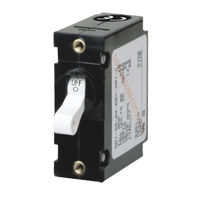
turned out my current marine switch can handle DC and AC. So I just used the switch with no relay and it works fine. The switch has 1/4 inch tabs, not screw terminals. I used the TYCO covered connectors from HDepot, those work well.

Some of these switches use tabs, some use screws.
they are just like these here
http://www.jamestowndistributors.com/userportal/product.do?part=39136&BASE
00004307.jpg


I had forgotten that some of these do both AC and DC.
 
To avoid these ads, REGISTER NOW!
Top Bottom