To avoid these ads, REGISTER NOW!

5 HP air compressor wire size for 90' run

mjr5253

New member
Joined
Dec 25, 2022
Messages
3
Just bought a 5 HP IR TS4N5 air compressor. It is a single stage, 230 V compressor. The book states right in it that they recommend using a 40 amp breaker with 8 gauge wire for runs < 50'.
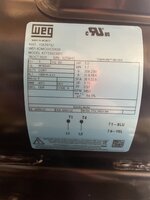
Where I was going to originally put it was about 45 feet from the panel, so I bought what they recommended. After putting some thought into it, the ideal spot for me would be the complete opposite corner of the breaker panel. My thought was that I would put a Fusible 60 amp shut off switch like the one in the attached picture about halfway between the compressor and the panel just to make it a little easier to turn off and on when I am not in the shop (obviously I would use 40 amp fuses). The issue with this is that it is about 66 feet from the panel to the compressor. And that does not include the vertical distance coming out of the panel, up and down to the switch, and back down to the compressor. With these vertical runs, it will be about 90 feet of wire.
Is this too far of a run? If not, would I be OK with the 40 amp breaker and 8/2 wire?

Thanks in advance
IMG_3409.jpegIMG_3410.jpegIMG_3411.jpeg
 
To avoid these ads, REGISTER NOW!

mike93lx

ALLIANCE MEMBER
Joined
Dec 9, 2013
Messages
38,398
Location
Richmond, VA
The breaker size wouldn't change, just the wire size. But 8/2 should be fine at that distance based on 20a running current
 

Mainiac Mat

Well-known member
Joined
Sep 2, 2020
Messages
408
Location
Maine
The disconnect is required to be within sight of the machine, so whoever works on the machine can see that power is secured.

That said, the disconnect can be a plug... but when you get over 30 amps, those get just as expensive as the fused knife switches..

8/2 seems like overkill to me (and will be expensive as heck).

If you try this calculator, it might save you some cash.

1703603293742.png
 

PoorUB

Well-known member
Joined
Mar 29, 2021
Messages
11,889
Location
Fargo, ND
The disconnect is required to be within sight of the machine, so whoever works on the machine can see that power is secured.

That said, the disconnect can be a plug... but when you get over 30 amps, those get just as expensive as the fused knife switches..

8/2 seems like overkill to me (and will be expensive as heck).

If you try this calculator, it might save you some cash.

1703603293742.png
Bad advice! 5HP motors have what most people would consider, weird requirements. 8 guage wire is required, although one would assume 10 Guage would meet the requirements. Also, 5HP motors and larger are required to be direct wired.
 

CraigStu

Well-known member
Joined
May 22, 2014
Messages
4,075
Location
Blacksburg, Va
Don't forget that startup amps are usually greater than running amps. Also depending on how the wire will be run, it might be easier to install a contactor in line. I don't know about code requirements but I once put a contactor up at the basement ceiling to interrupt a 240V circuit out to a remote drive where the original owner parked his camper. The wire ran through that unfinished ceiling and there was just enough slack that I could cut it and install the contactor. The contactor was controlled by a standard 15A 120V wall toggle switch so I saved maybe 10ft of the heavy wire because I didn't need to run it down and back up to a switch. Plus I saved the aggravation of running that heavy stuff up/down including the bends that would have been needed. In your case you may be able to reduce the overall length of the run which might allow the lighter wire????
 

Norcal

Well-known member
Joined
Mar 16, 2008
Messages
13,786
When sizing conductors for motors you can't use the data plate amperes, the tables in NEC art 430 must be used based on the type of motor is on the equipment, and
Don't forget that startup amps are usually greater than running amps. Also depending on how the wire will be run, it might be easier to install a contactor in line. I don't know about code requirements but I once put a contactor up at the basement ceiling to interrupt a 240V circuit out to a remote drive where the original owner parked his camper. The wire ran through that unfinished ceiling and there was just enough slack that I could cut it and install the contactor. The contactor was controlled by a standard 15A 120V wall toggle switch so I saved maybe 10ft of the heavy wire because I didn't need to run it down and back up to a switch. Plus I saved the aggravation of running that heavy stuff up/down including the bends that would have been needed. In your case you may be able to reduce the overall length of the run which might allow the lighter wire????
A contactor does not and cannot replace a disconnect.
 
To avoid these ads, REGISTER NOW!

micromind

Well-known member
Joined
Sep 24, 2023
Messages
3,127
Location
Fernley, Nevada, about 30 miles east of Reno.
Code-wise, the minimum wire size would be #10 if using conduit. It'd be #8 if using type NM cable (Romex). In my opinion, the #10 would be good up to 100' and the #8 would be fine up to 150'.

The maximum breaker size would be 70 amp.

Yes, with motors, you can indeed oversize the breaker. Motors, welders and HVAC, not much else.

I would not use a fused disconnect. All you need is a simple switch, a non-fused disconnect will do fine plus it's one less point of failure.
 

Mainiac Mat

Well-known member
Joined
Sep 2, 2020
Messages
408
Location
Maine
5HP motors and larger are required to be direct wired.
I don't know about your neck of the woods, but in 2021 I project managed standing up our company's new factory (30,000 s.f. change of use of existing space with a 57,000 s.f. addition) in a city with a very, very fussy code dept. The electrical contracts for two new distribution panels, new sprinkler pump feed, and wiring up some 40 machines we moved tallied up to ~$180,000. About 1/3 of the machines with motors are connected via. twist lock plugs (which we prefer for the flexibility of moving things around later) and the smallest motor out there is 7 HP, with most being 15-20 HP.

I'll have to call up the master electrician (who runs three crews and does a lot of industrial work) and tell him that he screwed it all up. :)
 

PCustoms

Well-known member
Joined
Jul 23, 2011
Messages
23,684
Location
VT
I don't know about your neck of the woods, but in 2021 I project managed standing up our company's new factory (30,000 s.f. change of use of existing space with a 57,000 s.f. addition) in a city with a very, very fussy code dept. The electrical contracts for two new distribution panels, new sprinkler pump feed, and wiring up some 40 machines we moved tallied up to ~$180,000. About 1/3 of the machines with motors are connected via. twist lock plugs (which we prefer for the flexibility of moving things around later) and the smallest motor out there is 7 HP, with most being 15-20 HP.

I'll have to call up the master electrician (who runs three crews and does a lot of industrial work) and tell him that he screwed it all up. :)
Curious to see others opinions on this, as I've seen it done as well, but pretty darn sure it's against code.
 

Mainiac Mat

Well-known member
Joined
Sep 2, 2020
Messages
408
Location
Maine
Section 5.3.3.2 of NFPA 79-2015 states that if an attachment plug and receptacle is used as the disconnecting means it must have a load-break rating or be interlocked with a switching device that is load-break rated. A plug and receptacle rated more than 20 amperes and used as a disconnecting means must be listed as a switch-rated plug and receptacle. An additional witching device must be provided for routine witching of the machine as stated in 5.3.3.3.

Most of our machines have factory control boxes on them with either a knife switch or a barrel switch... then we run the cable to a wall box with the twist lock plug and receptacle. So I'm guessing that switch on the machine is "load-break" rated... or maybe that's why some of these twist lock plugs were so darn expensive. Fortunately, most of the machines were already set up that way, so they just had to wire the receptacle. All of them have LVP motor starters with thermal overloads.... but that doesn't count as a disconnect.

OBTW... I'm not an electrician, nor do I play one on the internet. I just ask a lot of questions and have reasonably good Google-fu.
 
Last edited:
To avoid these ads, REGISTER NOW!
Top Bottom