I've settled on 6pt sockets and 12pt wrenches unless there are specific applications that require a 12pt socket. (See below.)
12pt tools can be used on square fasteners, but it's a bit of a pain. For starters, the angles are off (60 degrees vs 90 degrees.) Also, the sizes aren't right anymore. I think that's because hex fasteners (and tools) are measured across the flats. When you engage a square fastener, you're engaging it across the diagonal, so the measurements aren't right anymore.
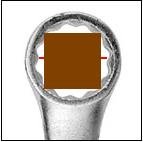
If you look at picture1, it's 24mm across the flats. But if you look at picture 2, you can see that the square isn't engaging in the same notches that a hex fastener would. It's not 24mm across the flats anymore. It's 24mm along the diagonal which is about 17mm across the flats.
I would have thought 12 point was better due to more angles it can get on the nut, so I'm surprised you guys like 6 point better. Is it because it won't round off nut edges, why is it that you guys prefer 6 points?
A 12pt
wrench will require half the arc that a 6pt
wrench will. (ie, 30degrees vs 60 degrees.) On wrenches, having 12pts means that you can work in tighter spaces. On wrenches without flank drive (or the equivalent), it means that you have a slightly higher chance of rounding a fastener.
But on sockets and ratchets, the ratchet already has a much smaller arc. Even the coarsest of modern ratchets only require about 10 degrees between engagement, so you're not giving anything up by using 6pts instead of 12pts. If anything, you get a slightly lower chance of rounding a fastener.
But as previously noted, there are applications where you come across a 12pt fastener, and you don't have any choices. In addition to those noted above, the MINI Cooper uses a 14mm "bi-hex" deep well socket for the sparkplugs. Beginning gearheads bought the special $50 "bi-hex" socket that MINI offers. Older gearheads just grabbed the 12pt socket that was rolling around their toolbox.






 ).
).