Hey Kirk, can I ask you... do you do vertical up or vertical down welds on your trailers?
The reason I ask, I just bought a new Lincoln 256 and it welds great (or I do..) horizontally but I'm having a tough time getting my vertical welds to look nice. I think because this machine has more heat than my 110v one, and likely mostly my technique. I'm running 035 wire, 75-25 gas, around 18v and 230 wire speed, 1/8" thickness on all the stock, and trying to get vertical up to look good.
Any thoughts?
Keeping in mind that -most- welder's dials/gauges/meters are not 100% 'calibrated' and as such should mostly be used as 'relative' reference readings (some machines may be more 'accurate', but most of the time as long as they are -consistent- you can use the numbers to get you close and then adjust as needed), I think you have your welding parameters a bit off there.
0.035 solid wire in short-circuit transfer mode with C25 gas would usually be about 16-17V and ~80 amps at 100 ipm WFS (a bit on the low side for welding 1/8 inch material), about 17-18V and ~120 amps at 150 ipm WFS (sounds just about right for welding 1/8 inch material), and 20-21V and ~175 amps at 250 ipm WFS (a bit on the 'hot' side for welding 1/8 inch material).
Vertical you usually will run at a slightly lower power setting (I'm purposely not using 'heat', as a lot of people call the voltage setting the 'heat' setting and that is not really correct, in wire-feed welding the voltage setting is the voltage setting and the WFS setting is the 'amperage' setting, but you have to have a 'correct' balance of the right voltage to use with the approximate amperage/WFS) than you would for horizontal welding, as you do have gravity working against you in the vertical or overhead welds. You still need enough power/amperage to get adequate fusion (penetration) for your welds, but you can't blast quite as much power/amperage as you could with a horizontal weld where gravity is not trying to drip the molten weld puddle out of the joint before it can solidify like when you are doing vertical or overhead welds.
Usually (excepting pipewelders running SMAW), most of the time vertical down is just used for 'thin' sheetmetal stuff, as you race the puddle downward with gravity so you are running pretty fast and thus not (usually) blasting right through the sheetmetal thin stuff.
Once you get away from 'gauge' thickness material and into thicker metal, vertical-up would usually be more appropriate, as you have enough material thickness that you are not quite as worried as instantly blasting right through the material as you weld and can build a small 'shelf' of weld-bead as you progress upwards with your weld. (not that you couldn't instantly blast right through some 1/8 inch steel, especially with a PM256!!)
YMMV, but I think you are just a bit 'off' in your parameters (a lot of the welding parameter charts/tables list CO2 as the shielding gas for short-circuit transfer mode by default and then in the footnote or fine-print remind you to use 1-2V less if using C25).
Using the general rule-of-thumb of 1 amp per 0.001 inch material thickness, you want ~125 amps for welding 1/8 inch thick material. That works out to around 200 ipm WFS for 0.035 solid wire, maybe a little bit less on the WFS/amperage because you are running vertically instead of horizontally (but not too low, remember about having adequate fusion/penetration!!!) So about 150-200 ipm WFS with that 0.035 solid wire, and adjust the voltage to about 18V or so (voltage too low and the wire stubs into the workpiece and voltage too high gives an unstable arc and excessive spatter, set the voltage midway between the two). Or set the voltage to 18V and the WFS to about 175 (since you have those nice meters on the PM256, eh? I'm jealous.) and run a few vertical-up test beads. Adjust slightly for machine 'quirks' (see above about most machine meters/gauges/dials not being 100% calibrated) as well as for personal preferences in how you run weld beads (fast-n-furious or slightly slower and more methodical).


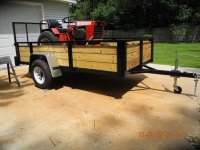
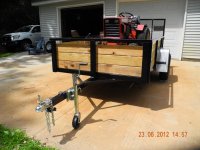

 I am jumping in because of your Case tractor!
 Is that the only one you have?Looks to be late '70's 446. I have 2 444PK's, a 222 and a great little 648 FEL. Are you over on casecoltingersoll.com?