To avoid these ads, REGISTER NOW!

60 degree vee end mills

Yankeefarmer

Well-known member
Joined
Jul 25, 2011
Messages
1,200
Location
Connecticut
I am machining a new emergency/parking brake mechanism to replace the worn out teeth on my early ‘28 roadster pickup. It seems to make more sense to cut each tooth in a single setup using a vee endmill rather than in two steps using a slitting saw. The cuts will be shallow, so a 1/4” endmill will easily do the job, but would I be better off using a 1/2” for greater rigidity, or do I risk poorer definition at the root with a larger end mill?IMG_1432.jpeg
 
To avoid these ads, REGISTER NOW!

Innovate1

Well-known member
Joined
Jul 28, 2014
Messages
4,292
Location
Illinois near St. Louis, Missouri
Others with more experience will likely respond... A 1/4" EM should be fine. A V end mill will leave a sharper bottom than shown if that matters. Seems like slitting saw or EM would both be quick enough with the part mounted on a rotary table. Maybe drill the bottom of each tooth if the bottom shape matters but that's more trouble so probably not... If shape really matters you could use a tapered EM with ball nose but guessing it's not that critical and that would take two passes per tooth.
 
OP
Y

Yankeefarmer

Well-known member
Joined
Jul 25, 2011
Messages
1,200
Location
Connecticut
Thanks. Bottom shape doesn’t matter, and using an end mill will give me more clearance to the rotary table than a slitting saw would, so that’s preferred.
 

Innovate1

Well-known member
Joined
Jul 28, 2014
Messages
4,292
Location
Illinois near St. Louis, Missouri
The main issue then is how big the rotary table is (might limit how close to the work piece you can get the collet) and how much stick out is needed from the collet to the part. If that's long the larger EM may be best.
 

BigMike782

Well-known member
Joined
Dec 19, 2008
Messages
1,877
Location
49120
Uninformed question. Could you have a sharpening shop grind the angle on an endmill for you so each tooth could be cut in one pass?
 

txvwnut

Well-known member
Joined
Jan 1, 2015
Messages
7,650
Location
Bedford, Texas
The root shouldn't change at all or that much between a 1/4" to 1/2" endmill as the depth of cut will be same for both tools. I've never looked for a slitting saw with a V profile but that might be an option to look at as well.
 
OP
Y

Yankeefarmer

Well-known member
Joined
Jul 25, 2011
Messages
1,200
Location
Connecticut
I am concerned about the fragility of a 60 degree vee endmill, but not sure if the larger diameter would be stronger since my depth of cut would be pretty shallow anyway. If I use a slitting saw, my plan would be to use two setups, one for the radial edge, and another to open up the vee to form the ramp side.
 
To avoid these ads, REGISTER NOW!

niget2002

Well-known member
Joined
Oct 2, 2012
Messages
11,216
Location
Josephine, TX
Size of a V-endmill doesn't really affect the strength. The tip is still just as prone to breaking no matter what the size of the endmill is. There's a lot of sideways force on a really small area.

But a good quality v-endmill of either side should work OK for what you're doing.
 

larry_g

Well-known member
Joined
Apr 28, 2007
Messages
16,893
Location
oregon
Looks to me like you need a cutter in the form of a dovetail cutter with the points modified to a small radius. That tooth form is not a V. One side is at an angle to the radius of the circle but the other side is in line with the radius of the circle.

lg
no neat sig line
 
Last edited:
OP
Y

Yankeefarmer

Well-known member
Joined
Jul 25, 2011
Messages
1,200
Location
Connecticut
Looks to me like you need a cutter in the form of a dovetail cutter with the points modified to a small radius. That tooth form is not a V. One side is at an angle to the radius of the circle but the other side is in line with the radius of the circle.

lg
no neat sig line
Agree about the angles. One side must be radial, in order to engage the pawl. The other angle is not critical, as it simply serves as a “ramp” to lift the pawl as the brake is engaged.
 

Firebrick43

Well-known member
Joined
May 12, 2015
Messages
14,183
Location
West central Indiana
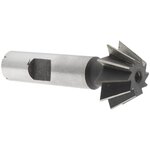
60 degree endmills are for engraving type operations and chamfers, the are not design for removing any appreciable amount of metal with the tip.

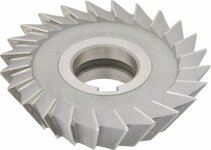
You need a 60 double angle cutter or a single angle depending on how you present the part to the spindle

IMG_0833.jpeg IMG_0834.jpeg

If you have the correct arbor you can use this type as well


IMG_0835.jpeg
 

Graham08

Well-known member
Joined
Dec 10, 2007
Messages
713
Location
Iron Station, NC
I agree with @Firebrick43 that something like a dovetail cutter is what you need. This part was done with an end mill with 0.060" corner radius to avoid a sharp root:

20140408_211215.jpg

I tilted the mill head 45 degrees so the part could be flat in the vise. Using the side of the end mill is a more rigid setup and gives better surface finish than trying to use the point of a tool.

Since you're only doing one and the part isn't very thick, you might consider grinding a form tool in a square HSS blank and run it in a fly cutter. I wouldn't want to do a lot of parts that way because your feed would have to be slowed down significantly vs. a multi-tooth cutter, the interrupted cut hammers the spindle, etc., etc. but I think it would work OK for one part.
 
To avoid these ads, REGISTER NOW!
Top Bottom