To avoid these ads, REGISTER NOW!

60A Subpanel Feed Questions

wyliesdiesels

Well-known member
Joined
Aug 14, 2012
Messages
19,991
Location
Modesto, CA
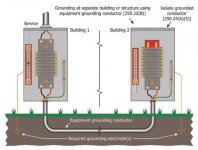
Is there a diagram (example or otherwise) that explains this, should they both be wrong in what they've told me? I understand the "read the NEC code", but to a layman like myself it's about as understandable as reading a legal document. A good visual would be very helpful. I understand and appreciate the concern and don't mean to come across wrongly - I simply defer to professions I've spoken with in person since the internet can often steer you wrong when you don't realize it.

Funny you should ask. Theres a diagram on my FAQ sticky comment #3:

https://www.garagejournal.com/forum/showthread.php?t=356460

Pattenp posted the code above. Its pretty easy to understand. Read it for yourself. Dont rely on someone else, even if theyre "professionals", to give you info that could be wrong. I worked for a licensed electrician years ago who didnt even know basic electrical theory 101- the difference between the neutral/grounded conductor and the equipment grounding conductor/grounding conductor.

Just because someone is labeled as "professional", that doesnt mean they actually know what theyre talking about. You know how many crappy attornys and doctors there are out there?

Your electrician and inspector are wrong.
 
Last edited:
To avoid these ads, REGISTER NOW!

mike93lx

ALLIANCE MEMBER
Joined
Dec 9, 2013
Messages
37,404
Location
Richmond, VA
Just because someone is labeled as "professional", it doesnt mean they actually know what theyre talking about. You know how many crappy attornys and doctors there are out there?

Your electrician and inspector are wrong.

What do you call the guy that finished last in his class in medical school?

Doctor
 
Last edited:

mm08822

Well-known member
Joined
Jan 13, 2012
Messages
5,866
Location
NJ
Here is the cartoon version of 250.32(B) and it also shows a ground rod as req'd for 250.32(A).

2nd grd rod not shown at either location b/c of another code detail. Adding the 2nd rod eliminates the need for expensive testing with only 1 rod in use.

Dettached_bldg_Gnd_Reqs.JPG

BTW pictures can be just as wrong as words.
 
OP
T

TurboEuro88

Well-known member
Joined
Feb 18, 2013
Messages
152
Location
Mentor, OH
I am not trying to argue over what is or isn't right/wrong. If the information I was given was wrong, so be it and I'll admit I was wrong too. I've been working with the information given to me by those having direct involvement in my project and doing the best I can with it. I am by no means an electrician and thus really have no experience with the more advanced codes. I read the ground rod code twice and none of the words made much sense without a visual to associate them with. Having that now makes it easier to know where I seem to have been misled. I apologize if my methods don't make much sense.
 
Last edited:
OP
T

TurboEuro88

Well-known member
Joined
Feb 18, 2013
Messages
152
Location
Mentor, OH
Any recommendations on how to drive the ground rods without having to invest $140+ into a rotary hammer drill and ground rod bit? Waiting for the ground to thaw a bit before I start this, but want to be ready whenever that happens.
 

pattenp

Well-known member
Joined
Jun 4, 2008
Messages
10,175
Location
Virginia - USA
Step ladder and sledge hammer. Be sure to put the wire clamp on the rod before pounding the rod with a hammer. The top of the rod will mushroom and you will not be able to slide on the clamp.
 

Norcal

Well-known member
Joined
Mar 16, 2008
Messages
13,752
You can rent the tools to drive the rods, 2 are required but with a little prior planning if a new build a ufer ( concrete encased electrode) could have been used eliminating the need for driving a couple of rods.
 

mm08822

Well-known member
Joined
Jan 13, 2012
Messages
5,866
Location
NJ
Step ladder and sledge hammer. Be sure to put the wire clamp on the rod before pounding the rod with a hammer. The top of the rod will mushroom and you will not be able to slide on the clamp.

It's really a bummer when you miss:shocking:

I used to use a short pipe w/round stock welded into it to increase the target size.

Now I use a hammerdrill w/driver.

For some soils, wetting the ground can help.

Set the rods far enough from wall so you dont hit the footer.
 
OP
T

TurboEuro88

Well-known member
Joined
Feb 18, 2013
Messages
152
Location
Mentor, OH
Forecast is calling for plenty of rain over the next week or so, which should help to thaw out the ground enough to make the job easier. Looked around locally and it doesn't look like any stores carry the ground rod bit as a rentable tool; just the rotary hammer drill. Some don't even sell the in stores. I'd like to avoid having to buy a $50-60 drill bit just to use it once, maybe twice... but it may just be a necessary evil to get this done right.
 

pattenp

Well-known member
Joined
Jun 4, 2008
Messages
10,175
Location
Virginia - USA
Rent a hammer drill and use it in hammer mode only, not drill mode. Stick hammer drill over rod end and hammer away. I've never used a special bit.
 

teamextreme

Well-known member
Joined
Aug 10, 2013
Messages
867
Location
Lakewood, CO
Use as big a sledge hammer as you can find too. I used to use a smaller one, the only one I had, maybe 5 or 8 lbs, then tried a friend's full size sledge (10, 12 lb?) and what a difference. I went out and bought a big one after that.
 
OP
T

TurboEuro88

Well-known member
Joined
Feb 18, 2013
Messages
152
Location
Mentor, OH
Rent a hammer drill and use it in hammer mode only, not drill mode. Stick hammer drill over rod end and hammer away. I've never used a special bit.

I had read of that but didn't know it was a legitimate option. How badly will it mushroom the head of the rod?
 

alfredeneuman

Well-known member
Joined
Mar 3, 2011
Messages
4,580
Location
Fullerton, CA
It will mushroom the head enough to not fit the acorn clamp on.
If you put it on before driving the rod, it will not be an issue.
 

teamextreme

Well-known member
Joined
Aug 10, 2013
Messages
867
Location
Lakewood, CO
Or just clean up the mushroomed portion with a grinder when you're done. Be careful though, I've heard of inspectors failing installs if it looks like the rod was cut, signalling that it was pounded only part-way in and then cut off. Just clean up the sides enough to get the clamp on.
 

mike93lx

ALLIANCE MEMBER
Joined
Dec 9, 2013
Messages
37,404
Location
Richmond, VA
Or just clean up the mushroomed portion with a grinder when you're done. Be careful though, I've heard of inspectors failing installs if it looks like the rod was cut, signalling that it was pounded only part-way in and then cut off. Just clean up the sides enough to get the clamp on.

So why take a chance? Just put the nut on first
 

Norcal

Well-known member
Joined
Mar 16, 2008
Messages
13,752
Or just clean up the mushroomed portion with a grinder when you're done. Be careful though, I've heard of inspectors failing installs if it looks like the rod was cut, signalling that it was pounded only part-way in and then cut off. Just clean up the sides enough to get the clamp on.

The manufacturers stamp will be near the top of the rod, which is what some inspectors look for when they think someone has cut the rod off.
 

Norcal

Well-known member
Joined
Mar 16, 2008
Messages
13,752
Or just clean up the mushroomed portion with a grinder when you're done. Be careful though, I've heard of inspectors failing installs if it looks like the rod was cut, signalling that it was pounded only part-way in and then cut off. Just clean up the sides enough to get the clamp on.

The manufacturers stamp will be near the top of the rod, which is what some inspectors look for when someone has cut the rod off
 
OP
T

TurboEuro88

Well-known member
Joined
Feb 18, 2013
Messages
152
Location
Mentor, OH
That means that some kind of "hole" where the rod(s) are would be necessary so the inspector can see the stamp before I cover the rods with dirt?
 
To avoid these ads, REGISTER NOW!

mm08822

Well-known member
Joined
Jan 13, 2012
Messages
5,866
Location
NJ
That means that some kind of "hole" where the rod(s) are would be necessary so the inspector can see the stamp before I cover the rods with dirt?

I normally leave out a gallon's worth(paint can volume) of soil around each rod while am trenching for the wire.

8 ft rods need to be fully driven - nothing left sticking out of ground permitted.
 

75gmck25

Well-known member
Joined
Jul 21, 2014
Messages
1,317
Location
Alexandria, VA
I might have just been lucky, but I was able to use a large hand hammer to get the rods in for the first couple of feet, and then used a standard size sledge hammer from there. The biggest challenge was to have a good aim with the sledge, but the rod went in fairly quickly when I hit it square. I initially drove the rod in at a slight angle so that it was easier to hit with the sledge, but pulled it straight vertical for the last 2-3 feet.

Bruce
 

ford33

Well-known member
Joined
Feb 26, 2011
Messages
2,118
Location
Chicago, IL. USA
A small 4 - 6 lb sledge will work well while standing on the ladder holding the rod. Then transition to a heavier sledge hammer, if one is available, while standing on the ground. It is not difficult to drive the rod into the ground. I've done it with a 6 lb sledge. Just take your time and don't over do it and hurt yourself. Make sure you are at least 2 feet away from the foundation so you don't strike the footer or hit the drain tile around the foundation.

As others have said, put the connector on the rod before you drive it in.

Finally, are you sure there is no water, gas, drain or electrical service conductors near where you are driving the ground rods?
 
Last edited:

alfredeneuman

Well-known member
Joined
Mar 3, 2011
Messages
4,580
Location
Fullerton, CA
More than anything the tool depends on the soil conditions. There is no right tool for the job.
I had one right next to a bay that I was able to drive the first 5' with just my hands gripped around it and others that hit bedrock a foot down.
 

Higgins

Well-known member
Joined
Dec 25, 2009
Messages
1,928
Location
Shepheardsville, KY
Upgrade our house panel back in Kane Co. IL and installed a 135 Amp panel in 2nd garage.

So the county inspector wanted to see the TOP of the ground rod and had to be able to see the cable connector connection to the GR.
 

mike93lx

ALLIANCE MEMBER
Joined
Dec 9, 2013
Messages
37,404
Location
Richmond, VA
Upgrade our house panel back in Kane Co. IL and installed a 135 Amp panel in 2nd garage.

So the county inspector wanted to see the TOP of the ground rod and had to be able to see the cable connector connection to the GR.

So leave it exposed and pound it in the rest of the way after it passes, right?
 

Norcal

Well-known member
Joined
Mar 16, 2008
Messages
13,752
Upgrade our house panel back in Kane Co. IL and installed a 135 Amp panel in 2nd garage.

So the county inspector wanted to see the TOP of the ground rod and had to be able to see the cable connector connection to the GR.

135A? Not a standard rating just like 75A breakers. 125A is a stock panel.
 
OP
T

TurboEuro88

Well-known member
Joined
Feb 18, 2013
Messages
152
Location
Mentor, OH
A small 4 - 6 lb sledge will work well while standing on the ladder holding the rod. Then transition to a heavier sledge hammer, if one is available, while standing on the ground. It is not difficult to drive the rod into the ground. I've done it with a 6 lb sledge. Just take your time and don't over do it and hurt yourself. Make sure you are at least 2 feet away from the foundation so you don't strike the footer or hit the drain tile around the foundation.

As others have said, put the connector on the rod before you drive it in.

Finally, are you sure there is no water, gas, drain or electrical service conductors near where you are driving the ground rods?

I am severely limited in my options for installation of the ground rods due to the shape, size, and layout of my property. My best option for an "out of the way" place is to run the ground rods in behind my garage instead of next to it opposite of the wall the panel is on. This would mean the ground wire would have to run about 15ft before reaching the first electrode and I am not certain this would be ideal for grounding impedance.

As far as utilities, the only concern would be my sewer line, but again going behind the garage would avoid this.

**edit**
Just got the records from the county engineer and confirmed that my sewer line is buried in the space between my house and my garage. This means the best place to avoid any potential buried "treasure" would be behind my garage, but puts the first electrode a solid ~17' from the sub panel box.
 
Last edited:

pattenp

Well-known member
Joined
Jun 4, 2008
Messages
10,175
Location
Virginia - USA
Just got the records from the county engineer and confirmed that my sewer line is buried in the space between my house and my garage. This means the best place to avoid any potential buried "treasure" would be behind my garage, but puts the first electrode a solid ~17' from the sub panel box.

That's fine, 17ft is no big deal. If the electrode conductor could be subject to damage where run the 17' you should run it in a sleeve of 1/2" PVC conduit.
 
OP
T

TurboEuro88

Well-known member
Joined
Feb 18, 2013
Messages
152
Location
Mentor, OH
I don't need to run the GEC in a conduit, though... right? There's no real risk for damage, but conduit is cheap insurance.

What are the requirements/limitations of how the GEC is run? The way I've come to understand it is the GEC just needs to go from the ground block in the sub panel to the first electrode (and then continuing to the second electrode), and how it gets there is pretty open to interpretation. My original thought was just coming down out of my subpanel and running it through the studwall to the back corner of my garage near where I am going to drop the first electrode... but I don't know this is going to be "OK" by code standards. Would this be OK or do I need to get the GEC outside and bury it on its way over to the electrode?
 

alfredeneuman

Well-known member
Joined
Mar 3, 2011
Messages
4,580
Location
Fullerton, CA
NEC 250.64 (B)
Securing and Protection Against Physical Damage.
Where exposed, a grounding electrode conductor or its enclosure shall be securely fastened to the surface on which it is carried. Grounding electrode conductors shall be permitted to be installed on or through framing members.

(1) Not Exposed to Physical Damage. A 6 AWG or larger copper or aluminum grounding electrode conductor not exposed to physical damage shall be permitted to be run along the surface of the building construction without metal covering or protection.
 

teamextreme

Well-known member
Joined
Aug 10, 2013
Messages
867
Location
Lakewood, CO
That's fine, 17ft is no big deal. If the electrode conductor could be subject to damage where run the 17' you should run it in a sleeve of 1/2" PVC conduit.

I always thought that was one of the silly code rules. Take a sledge hammer to a piece of PVC, sch 40 or 80, then do the same to a piece of bare solid cu and tell me which one survives better.

BTW, if you run #4 bare cu then you don't have to worry about protection. Something to consider.
 

alfredeneuman

Well-known member
Joined
Mar 3, 2011
Messages
4,580
Location
Fullerton, CA
#4 Cu on a 60A subpanel?:headscrat
That's bigger than the #6 Cu required feeder.
All that's required is #8, and if you want to run it without conduit a #6 is the minimum.
 

dscheidt

Well-known member
Joined
Apr 26, 2017
Messages
2,884
I always thought that was one of the silly code rules. Take a sledge hammer to a piece of PVC, sch 40 or 80, then do the same to a piece of bare solid cu and tell me which one survives better.

BTW, if you run #4 bare cu then you don't have to worry about protection. Something to consider.

A string trimmer will destroy a piece of 6awg wire. It'll do the same to a piece of PVC, but even most landscapers will notice before the wire is damaged.
 

wyliesdiesels

Well-known member
Joined
Aug 14, 2012
Messages
19,991
Location
Modesto, CA
I always thought that was one of the silly code rules. Take a sledge hammer to a piece of PVC, sch 40 or 80, then do the same to a piece of bare solid cu and tell me which one survives better.

Typically, GECs are ran in metal conduit NOT PVC. In fact i have never seen a GEC ran in pvc pipe.

BTW, if you run #4 bare cu then you don't have to worry about protection. Something to consider.

#4 is overkill. The min. size code permits to be ran without protection is #6.

#8 could be used but requires protection from physical damage.
 

checkthisout

Well-known member
Joined
Sep 5, 2008
Messages
5,232
You can just run the grounding conductor up in the trusses over to the back of the garage then down the stud cavity and out of a just big enough hole right where your rods will be located.

And smart man for getting your as built for the ******* pipe before banging the rods in.
 

teamextreme

Well-known member
Joined
Aug 10, 2013
Messages
867
Location
Lakewood, CO
Yes #4 is overkill, but you avoid the protection requirements, if that's an issue...
And GEC runs are usually pretty short, so it's not some exorbitant amount of money.
 
To avoid these ads, REGISTER NOW!
Top Bottom