To avoid these ads, REGISTER NOW!

6’10”x12’ Utility Trailer

StangStang

Well-known member
Joined
Aug 22, 2016
Messages
50
Hey all!

I am in the planning phase of building my trailer. I’ll be building it in my garage and I have a question on the beginning of the build.

How do I ensure that the frame is on the same plane when I build it?

I thought of using a laser level and make sure every location I measure from on the frame is the same distance from the laser line. Seems like that would work.

I also thought of getting two 2x6s and clamping the ends together in a V shape and then putting a 2x4 under each point of the V and building on top of that.

Anyway, any suggestions would be great!
 
To avoid these ads, REGISTER NOW!

Firebrick43

Well-known member
Joined
May 12, 2015
Messages
14,260
Location
West central Indiana
two strings corner to corner with a block under each corner(such as a 2x2). If the two strings touch where they cross in the center its on plane.

Measuring corner to corner and having the same measurements means its square. No need for a laser.
 
OP
S

StangStang

Well-known member
Joined
Aug 22, 2016
Messages
50
two strings corner to corner with a block under each corner(such as a 2x2). If the two strings touch where they cross in the center its on plane.

Measuring corner to corner and having the same measurements means its square. No need for a laser.
Trying to follow. Is this the same thing as my V idea above? Would you use wood? Thanks for the reply!
 

Firebrick43

Well-known member
Joined
May 12, 2015
Messages
14,260
Location
West central Indiana
Trying to follow. Is this the same thing as my V idea above? Would you use wood? Thanks for the reply!
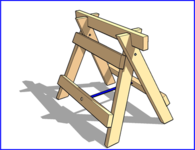
No, just build on a set of saw horses with long top rail. Temp tack a 2x2 to each corner to lift the string up. Run a string corner to corner so it crosses in the center. IF the strings touch they are in plane. if they are spaced out or deflect one another they are not. Use tapered shims to adjust so they just barely touch. Then assemble the frame, and just tack weld it together. Do the same thing above the frame and check again before completely welding. Welding will however typically cause the warping especially of a flatbed trailer. The biggest then however to check is that the axle/axles are 90 degrees to the hitch point and each other.
 

PoorUB

Well-known member
Joined
Mar 29, 2021
Messages
11,753
Location
Fargo, ND
I have built a few trailers and just welded up the main frame on the floor. After that was welded to the point it wouldn't move around then it went up on jack stands.
 
OP
S

StangStang

Well-known member
Joined
Aug 22, 2016
Messages
50
No, just build on a set of saw horses with long top rail. Temp tack a 2x2 to each corner to lift the string up. Run a string corner to corner so it crosses in the center. IF the strings touch they are in plane. if they are spaced out or deflect one another they are not. Use tapered shims to adjust so they just barely touch. Then assemble the frame, and just tack weld it together. Do the same thing above the frame and check again before completely welding. Welding will however typically cause the warping especially of a flatbed trailer. The biggest then however to check is that the axle/axles are 90 degrees to the hitch point and each other.
Ok I think I see what you’re getting at. My main side rails (5x2) are 12’ in length. I am using 4” c channel for the front and rear perimeter cross members. At each corner of the main rails I tack a spacer on top at each corner and run a string from, for example, front right to the aft left. Do the same thing on the other side.

With everything on the saw horses I then shim the main rails until the strings fall within plane.

sound right?

Also, what do you mean by long top rail?

Thanks!
 

Firebrick43

Well-known member
Joined
May 12, 2015
Messages
14,260
Location
West central Indiana
Ok I think I see what you’re getting at. My main side rails (5x2) are 12’ in length. I am using 4” c channel for the front and rear perimeter cross members. At each corner of the main rails I tack a spacer on top at each corner and run a string from, for example, front right to the aft left. Do the same thing on the other side.

With everything on the saw horses I then shim the main rails until the strings fall within plane.

sound right?
Yes or shim the saw horses.
Also, what do you mean by long top rail?

Thanks!
Most saw horses are only 4' long. You want to make some that are 5 or 6 feet long, ie a long top rail of the saw horse
 
OP
S

StangStang

Well-known member
Joined
Aug 22, 2016
Messages
50
Yes or shim the saw horses.

Most saw horses are only 4' long. You want to make some that are 5 or 6 feet long, ie a long top rail of the saw horse
Ah! Is it beneficial in this instance to build the trailer on two saw horses instead of four?
 

Firebrick43

Well-known member
Joined
May 12, 2015
Messages
14,260
Location
West central Indiana
Ah! Is it beneficial in this instance to build the trailer on two saw horses instead of four?
It is easier to align. Never done even the 18' trailer dad and I built on more than 2. That one we placed the front one 4' back from the front edge and 4' forward of the rear edge so there was only 10' span between the two.

When you say 4 do you mean one on each corner? Or 1 across the front, one rear and two in the middle?

If doing more than two across you would want to do the first and last one corner to corner to set your plane. Then place strings from front right to rear right and front left and rear left and align your middle ones to those strings.
 
OP
S

StangStang

Well-known member
Joined
Aug 22, 2016
Messages
50
No, I meant 1 at each corner. I don’t have saw horses big enough. Id have to get creative
 
To avoid these ads, REGISTER NOW!

nadogail

Well-known member
Joined
Jan 23, 2009
Messages
32,084
Location
Coronado, CA
I built a pair saw horses with 6' long 2X6 Top Rails and 2X4 Legs for heavy work when I was building with Hardi Planks. They have served me well for years.
 

KEH

Well-known member
Joined
Jan 31, 2010
Messages
5,142
I assume you are going to use springs, which I highly recommend. An issue is welding the spring hangers on. It is easier to weld the spring hangers on the side rails before they are welded up to make the frame but then you have the problem of supporting the rails up in the air while welding the hangers on, then laying on your side to do the welding. I did all that on my last trailer and did not enjoy it. You could weld the hangers on the side rails before welding the end pieces on, then flipping them over to weld the end pieces. This will involve setting the side rails on jackstands which may be a problem if you are working alone.

Should have covered this first. Cut side rails and end pieces, clamp the 4 corners with c clamps, use a carpenter's square to get square. Measure corner to corner and when the measurements are equal the frame is square. Tighten clamps firmly, remeasure. Use a level along the sides and across the end pieces. Have cross members cut and clamp them one at a time then weld them in.

At this point you can have the frame raised enough to roll the axle and springs assembly under the frame and bolt the springs to the spring hangers. If you prefer to bolt the springs in place first, that's fine. At this point you can Weld the tongue in place, then start on the uprights and top rails.

I have used pieces of angle equal in size or a little larger long enough to hold the spring hangers and then weld the spring hangers to them. I drilled holes in them and the frame rails and bolted them in place. This makes it possible to easily move the axles forward or back to distribute the load for proper balance. I did this for a small cattle trailer thinking that the cows might want to bunch up at one end and cause weight distribution problems, but as it happened I never had any problems. I turned the angle iron frame rails flat side up so I could put the wood flooring on top of the frame because, as a cattle trailer, it was going to accumulate manure which is corrosive and mounting the wood that way made hosing the trailer off easier.

OK, I'll make my usual comments here about the cost of buying new steel to make a trailer being more expensive than buying a new complete trailer. Do the math and have fun.

KEH
 

mike93lx

ALLIANCE MEMBER
Joined
Dec 9, 2013
Messages
38,119
Location
Richmond, VA
Looking at these, seems the way to go.

Those look flexible and easily adaptable to future needs, but they are not cheap at all.

I primarily use a pair of sawhorses that are 100% wood, from Mattias Wandel. They were cheap and easy to build and are very well suited to woodworking, which won't require a really wide spread.
 

Firebrick43

Well-known member
Joined
May 12, 2015
Messages
14,260
Location
West central Indiana
I assume you are going to use springs, which I highly recommend. An issue is welding the spring hangers on. It is easier to weld the spring hangers on the side rails before they are welded up to make the frame but then you have the problem of supporting the rails up in the air while welding the hangers on, then laying on your side to do the welding. I did all that on my last trailer and did not enjoy it. You could weld the hangers on the side rails before welding the end pieces on, then flipping them over to weld the end pieces. This will involve setting the side rails on jackstands which may be a problem if you are working alone.
You just make the main frame upside down, after its welded together set the axle on top(upside down) and it allows you to carefully measure and adjust before welding in place.

I have used pieces of angle equal in size or a little larger long enough to hold the spring hangers and then weld the spring hangers to them. I drilled holes in them and the frame rails and bolted them in place. This makes it possible to easily move the axles forward or back to distribute the load for proper balance. I did this for a small cattle trailer thinking that the cows might want to bunch up at one end and cause weight distribution problems, but as it happened I never had any problems. I turned the angle iron frame rails flat side up so I could put the wood flooring on top of the frame because, as a cattle trailer, it was going to accumulate manure which is corrosive and mounting the wood that way made hosing the trailer off easier.

KEH
This is not a bad choice either. Especially for dual axle trailers. Adds extra cost/weight to small trailers but the trailers (boat) that were built this way made later adjustment easy. And larger trailers will allows the axle hangers to be welded right side up but not have to flip a trailer or axles over afterwards.
 

KEH

Well-known member
Joined
Jan 31, 2010
Messages
5,142
Yes, it works better to weld on the frame with it upside down, but for the last trailer i made i was not physically able to flip the trailer by myself.

KEH
 

CraigStu

Well-known member
Joined
May 22, 2014
Messages
4,062
Location
Blacksburg, Va
You may be overthinking this a little. You don't need it perfectly level. I would make the front and rear main frame members level. Just a simple level set on each and shim the low end up w/ plywood or thin vinyl tile. You can do it right on the floor or on stands. If the front and rear are level it doesn't matter if they are the same height or not because it doesn't matter if the side rails are level. Think of the definition of level vs flat. You want to end up w/ a flat trailer frame. BTW you could also level the side rails and not worry about the front and rear rails.
 
To avoid these ads, REGISTER NOW!
Top Bottom