To avoid these ads, REGISTER NOW!

80 x 40 Machine Shed

wingfootedgodhead

Active member
Joined
Feb 5, 2009
Messages
41
Location
Oregon (dry side)
Everything starts with a beginning. In my case purchase of farm land in Eastern Oregon with a 80 x 40 machine shed in not so good condition.

First real project was to repair the ceiling insulation bats that were held in place with twine, presumably as a stopgap until drywall could go in, which never happened. Over the years the twine rotted leaving a dreadful mess.

2.%20Machine%20Shed%20-%20Before.jpg


A rental scissors lift was used to access the ceilings 20' off the ground and each bat was replaced or restapled into its place.

50% of the job completed (2 days).
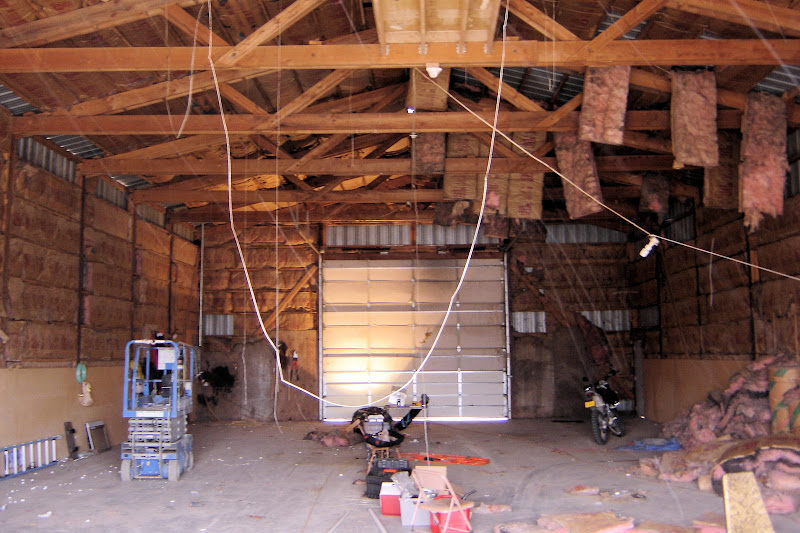
3.%20%20Machine%20Shed%20insulation%20repair%2050%25%20complete.jpg


All ceiling bats repaired or replaced - 7000 staples and three staple guns later (4 days).
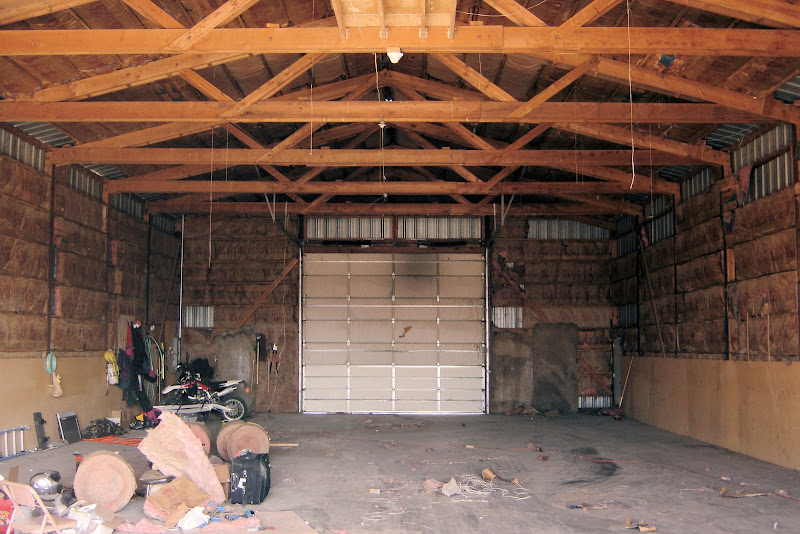

4.%20%20Machine%20Shed%20insulation%20100%25%20done.jpg


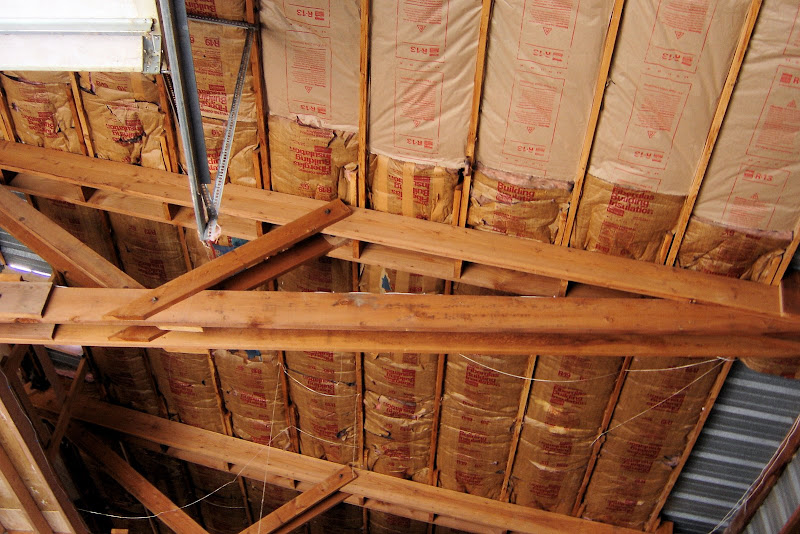
Detailed shot of rework


5.%20Machine%20Shed%20insulation%20detail.jpg


Hauled off 3500 pounds of trash, mostly ruined insulation bats.

Next project in September (funds permitting) will be installation of OSB in the ceiling / walls and running 240V/120V power conduit along the walls and in the ceiling for lighting.
 
To avoid these ads, REGISTER NOW!

JohnK007

Well-known member
Joined
Sep 13, 2007
Messages
807
Location
Downers Grove, IL
Wow a clean slate to work with! Lucky dog! That is really going to be nice when you get it the way you want it. One suggestion: Prime and paint your OSB on the ground first before you nail it up there. It'll save you a lot of grief. You'll be surprised by the amount of light the white ceilign reflects. Keep us posted on your progress.
 

autoist

MEMBER EMERITUS
Joined
Aug 20, 2005
Messages
1,107
Location
Gurley, Alabama
Nice! Wonder why he insulated the rafters instead of just insulating the trusses? Or do you plan a small storage area up there?
 

Old61

Well-known member
Joined
Nov 12, 2008
Messages
157
Fiberglass insulation is always a fun job. It's be a good size space and well worth the effort.
 
OP
W

wingfootedgodhead

Active member
Joined
Feb 5, 2009
Messages
41
Location
Oregon (dry side)
Nice! Wonder why he insulated the rafters instead of just insulating the trusses? Or do you plan a small storage area up there?


Not sure but possibly because insulating off the trusses would have created a huge dust trap (this is farm area with quite a bit of dirt blowing around) and a big space for birds and other critters to nest.
 

lost

Member
Joined
Jun 17, 2008
Messages
9
Great space!! looks like a husky sitting there. Great bikes.
 
To avoid these ads, REGISTER NOW!

35mastr

Well-known member
Joined
Dec 6, 2007
Messages
2,534
Location
Norcal
Nice shop.But since you have everything wide open.

Why use conduit??

You could run everything inside the walls and the ceiling and have a nice clean look.
 

Ggg

Well-known member
Joined
Mar 17, 2008
Messages
230
Location
N.W. IL.
Conduit may be required by code. In the Chicago area (4 counties) any electrical above 24V IIRC must be in conduit, no matter if in the walls or out in the open.
 

tdkkart

Well-known member
Joined
Jun 17, 2006
Messages
6,887
Location
Eastern Iowa
First real project was to repair the ceiling insulation bats that were held in place with twine, presumably as a stopgap until drywall could go in, which never happened. Over the years the twine rotted leaving a dreadful mess.


The mistake the original owners/builders made was installing the insulation up against the roof tin with no decent vapor barrier.
With any kind of heat in the building the roof tin will sweat, can't hardly be stopped. Once the insulation starts getting wet it makes things worse and then then it's a never ending battle.

Put a ceiling in below the trusses, with a vapor barrier, and then install the insulation on top of the ceiling.
 
OP
W

wingfootedgodhead

Active member
Joined
Feb 5, 2009
Messages
41
Location
Oregon (dry side)
1. Why use conduit

This is a post and beam structure. The trusses are held up by six inch thick square posts. To put the electrical inside the walls I would need to drill the posts. I am of the understanding that drilling the posts is a 'no go' as it would weaken the structure.

2. Vapor Barrier

Does the fact that this is Eastern Oregon (dry desert climate with less than 9 inches of rain annually) make any difference ? Wont the prevailing low humidity sop up any moisture ?
 

Skyline

Well-known member
Joined
Nov 11, 2008
Messages
3,586
The mistake the original owners/builders made was installing the insulation up against the roof tin with no decent vapor barrier.
With any kind of heat in the building the roof tin will sweat, can't hardly be stopped. Once the insulation starts getting wet it makes things worse and then then it's a never ending battle.

Put a ceiling in below the trusses, with a vapor barrier, and then install the insulation on top of the ceiling.
Usually in a house or other structure where you are going to use the attic space as heated space, the roof structure consists of conventional joists, that go from the eaves to the ridge. You would use that ribbed plastic steeting under the insulation that creates a ventilation tunnel from the vents in the eaves to a continuous ridge vent.

How you accomplish this same thing when the joists go in the direction of this building is beyond me, but I would guess it is nowhere near as simple as what tdkkart is suggesting.

There is also the issue of heating / coooling all that unused space from the bottom of the trusses and up. It will add plenty to your utilities cost.
 
Last edited:

toadjammer

Well-known member
Joined
Apr 14, 2007
Messages
296
Location
WI
The mistake the original owners/builders made was installing the insulation up against the roof tin with no decent vapor barrier.

I was under the impresion that putting the insulation right nrxt to the insulation was the proper way to insulate a metal building. It doesn't allow the metal to sweat. By putting the ceiling at the bottom of the rafters and insulation just above it allows for an air gap to allow the metal to sweat and rain on the insullation.
 
To avoid these ads, REGISTER NOW!
Top Bottom