To avoid these ads, REGISTER NOW!

85% gas boiler hydronic baseboard and digital T-stat settings to help efficiency?

vwpieces

Well-known member
Joined
Apr 28, 2020
Messages
5,925
Location
Hills, PA
Kinda big 100+yr old house with 5br & 3.5 baths. NG boiler about 5 yrs old. 2 story house with BRs upstairs along with 2 full baths. Basement is split in half where one half is... basement and the other side is a garage/woodshop. I put 1.25in of foam board insulation on the garage door and that garage door is the only way into that half. Only basement heat is one radiator close to the garage door but the basement stays relatively warn in winter and cool in summer. Also next to that garage door is where the water main and meter are. I think the main froze and burst at some point and the solution was the radiator in that area.
House has been reasonable to heat on gas the past 5yrs with thermostat set to 66*F and I am OK with that.
There are 3 loops in the system and with 3.5 baths and 2 occupied bedrooms there are no loops I can turn off. Prices are going up for gas and I am curious if there is anything I can do for settings on boiler or the wi-fi style thermostat I can do to help lower costs.
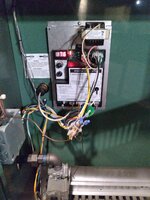
Boiler temp runs at 180*F (digital controller in boiler) 85% cast iron which I think is 155K BTU
Single thermostat has a differential (swing) setting that I just realized is set to 0.25* and now I have it at 0.75* differential. The T-stat is located in the middle of the first floor. Someone is here all day so can't really use a night or at work lower setting. Keep it 66* 24/7
If my understanding is correct for loop systems, I can not really install a ball valve to shut off one room without effecting or restricting the flow of the system.
Whole house is circulated on one circulator pump motor. There is a thermostat in the return line before it enters boiler and it does return at a temp within spec of the heater. Circulator seems undersize but its what came with the heater.

I do not want to admit it on here but I did the install of the NG boiler myself. I went undersize, by a lot, from what the old oil burner was but I also understand I am still on the large size for the boiler I bought. I was in a time crunch as winter was approaching. The estimates I got were outrageous and there was absolutely no way I was going to fill the (2) 350gal oil tanks. My DIY install was about 25% of the lowest estimate and I was able to pull it off myself and never worked on a home heating system before this.

About half of the heaters were air bound and had blocked bleed *******. And there was one box style heater in the washroom that I could not get to flow initially. Has cast iron ends with the fin section in the middle. Had to hit it many times with a hammer to get it working and bled out. There are 2 of those box style heaters and they do work well. All baseboards have been cleaned and they were nasty. Also this fall I raised 2 baseboards that had very small gaps under them from subfloor and or carpet installs. All 5 BRs upstairs have full width flappers under the baseboard that can be raised up to restrict the convection. 3 unused BRs and also my room are closed up, I like it cool to sleep.
I have done a lot to fix and bring the old heaters back to life and work as well as they can. Hate to know what this place was like with almost half of them not working and blocked up with nasty shtuff.

Something that has been on my mind is when the Tstat signal says off the boiler just stops. All that heated mass going to waste. Usually by the next heat cycle, the boiler temp is room temp. If it need to heat up again from ambient anyway, why not have the circulator run for a few min after the signal? Maybe there are smarter systems I don't know. I did try to look up possibilities but I think those programable circulators are for instant hot tap water.

I blocked the "Smart" thermostat from wifi because it was costing more than when I cut it off wifi. Short cycling mainly. But I really don't understand why other than it knowing the outside temp and thinking it can do better. But the heater and gas bill show it ain't too smart in the end.
Some of the setting in the thermostat are
System settings:
Type: Boiler- no fan
Available mode: Heat only
Stage 1 Swing: +/- 0.75*
Stage 2 offset: Heat and this I have set to "Disable" but it can be set to 1deg higher increments. Is this if there is an outside temp sensor?
Minimum Run: On Time - 7min, Off Time - 5min. I can change each time and also have the option to Suspend
Calibration: Seems to be accurate temp reading in comparison to the other central air thermostat.
Thermostat brand is

Lux Products GEO-WH Wi-Fi Thermostat

with link if it helps...

If you made it this far... Sorry. But if there is anything to change like lowering the boiler a bit or thermostat settings that may help I do appreciate any suggestions.
 
To avoid these ads, REGISTER NOW!

PoorUB

Well-known member
Joined
Mar 29, 2021
Messages
11,889
Location
Fargo, ND
I agree with the above comments. You may be able to run the boiler at a lower temp, but keep the boiler over 140F degrees. Cold return is hard on a cast iron boiler.

If it will heat the house on 160F water there is no reason to run it at 180F.

As far as thermostat settings for saving money? Not much you can do. If you have individual loops that you can zone and control separately you could add zone valves or pumps and thermostats and run those areas cooler when you are not using them, other than that not a whole bunch you can do.

Also, when the boiler shuts off it really is not wasting the heat stored in the boiler. The boiler is inside the house and all that heat leaves the boiler and goes into the house. You just can not control where. I have had people get all excited about insulating heating pipes, but any heat escaping from the pipes goes in to the house, same sort of deal.

You can buy off delay timers and rig it up so the pump runs a bit longer, but I doubt if it will save any money in the long run.

Insulation, better windows, more blankets on the bed will save you money in the long run. We have a heated matteress pad on the bed and can turn it on if we are cold at night instead of heating the whole house. We do turn the main thermostat down at night.
 

Jackfre

Well-known member
Joined
Dec 26, 2010
Messages
4,425
Location
N CA
Good for you that you were able to do this yourself. Operating that system as a single zone got you heat but I think you will want to look at the piping lay-out and begin to look at zoning the system. Prior to doing so order up Dan Holahn’s books, “Pumping Away” and “Primary Secondary Piping.” They are short and Dan writes so the layman can understand what he is saying. Should you reduce the boiler operating temp as suggested make sure that the boiler is seeing a min 140* return water temp. Otherwise you can shorten the life of the boiler dramatically. It may need a mixing vbalve on the return.
 

TurnipTruck

Well-known member
Joined
Aug 28, 2005
Messages
1,610
Location
Southcentral Alaska
Root around in here for awhile.

Without adding insulation, I suspect you won’t be able to increase efficiency much.
With baseboard heaters even a modulating/condensing boiler can’t attain its rated efficiency, that will require low-temp radiators.
 

Bert_

Well-known member
Joined
Dec 24, 2016
Messages
9,861
Location
NW Iowa
Have to be careful when installing a smaller boiler like you did. To much radiation and your return temps will be low and cause condensation in the boiler. This can be an issue anyway when dealing with a system originally designed for gravity circulation. A boiler protection loop is a good idea.

Could definitely go to 160* if it provides enough heat.

Best thing I did in my house was ditch the programmable thermostat and install a mercury thermostat with the anticipator set fairly high. I get a bit more temperature swing but much longer run times and my fuel usage is less. This was with forced air.
 
OP
V

vwpieces

Well-known member
Joined
Apr 28, 2020
Messages
5,925
Location
Hills, PA
Thanks all so far. Will give the 160* a go.
I should zone out the whole system but one of those things you think about once you turn on the heat and by that time of the year it's too late.
Return temp was a big concern when I did the install and there only being one circulator. I piped in the T for the return thermometer to make sure it was within spec of heater. I am unsure of the temp difference cause I haven't watched it in years but I will look again next time it kicks in at the 180* setting, before lowering so I have a base for comparison.

Whole house has older vinyl double pane replacement windows. I have removed the wood molding and used spray foam around most of the upstairs windows to wood frame and a few of them done some down stairs that I know were issues. Those also got new caulk or silicone on the outside. All the doors and windows in this house have been a project, just to make all the doors close in the house. Most of the pivots on the windows were broken and I found a place to buy them. Think I had 76 on that order and still have 30 left for some not yet broken. I could hear the sound difference just from the foam around the windows. Another thing I did to help save water & get Hot water to the Kit sink faster was ran a dedicated 1/2in PEX line from the HW heater, fully insulated that pipe run all the way up the faucets. May have been able to get away with 3/8in but hindsight. I have also tapped the down stairs bathroom sink into that line now. Left the downstairs tub on the main 3/4in copper HW line. NIt is nice to still have Hot water 30seconds after using a sink let alone not waiting so long for the hot to get to the sink.
 
OP
V

vwpieces

Well-known member
Joined
Apr 28, 2020
Messages
5,925
Location
Hills, PA
You need to find the equivalent to the heat anticipator setting on an old analog thermostat. This will account for the temperature rise after the boiler shutdown.
Not 100% sure what the equivalent is on the T-Stat but I believe the Boiler-no fan choice in the settings is what makes it use some anticipation. Lousy setup manual on this one but there are 6 different choices for heater type in that setting.
Your return water temperature needs to be 145 degrees or more on a cast iron boiler. The boiler I&O manual has piping diagrams.
It is definitely higher than 145 once the boiler reaches the 180*, but I will double check it again on the next heat cycle and report back. Will also give a lower setting on boiler a try and monitor that temp too.
There should be a check valve installed on the boiler outlet, this keeps "ghost flow" from happening and cooling off the boiler faster.
That I do not have and all the research I did at the time of install I never seen one used. I will check into that though. I installed a new pressure reducing fill valve for the cold water feed into the system but not on boiler outlet.
The boiler should also have a flue damper to minimize standby losses. I'd also put in a barometric damper.
I did install a motorized damper
Hopefully you installed some sort of combustion air source.
OLD house but again never heard nor seen an air source for a cast iron boiler. Will look into that too.
 
OP
V

vwpieces

Well-known member
Joined
Apr 28, 2020
Messages
5,925
Location
Hills, PA
I agree with the above comments. You may be able to run the boiler at a lower temp, but keep the boiler over 140F degrees. Cold return is hard on a cast iron boiler.

If it will heat the house on 160F water there is no reason to run it at 180F.

As far as thermostat settings for saving money? Not much you can do. If you have individual loops that you can zone and control separately you could add zone valves or pumps and thermostats and run those areas cooler when you are not using them, other than that not a whole bunch you can do.

Also, when the boiler shuts off it really is not wasting the heat stored in the boiler. The boiler is inside the house and all that heat leaves the boiler and goes into the house. You just can not control where. I have had people get all excited about insulating heating pipes, but any heat escaping from the pipes goes in to the house, same sort of deal.

You can buy off delay timers and rig it up so the pump runs a bit longer, but I doubt if it will save any money in the long run.

Insulation, better windows, more blankets on the bed will save you money in the long run. We have a heated matteress pad on the bed and can turn it on if we are cold at night instead of heating the whole house. We do turn the main thermostat down at night.
Thanks, helps...
This house has 2ft thick stone foundation. I have tried to put some fiberglass insulation in the sections of joists just above the foundation. Window work described above etc but I will never gut this place to insulate it. Not sure the walls even have any except the few rooms remodeled. I know I am splitting hairs here but in all honesty when I tell others my total heat cost for a winter and the size, age of the house I am doing good in comparison. About $1-1.1K/year for NG bill and pretty equal year to year.

Gas utility here is reasonable but a price increase is scheduled for early Dec. That is my main concern for now... the unknown.


Heat kicked on.
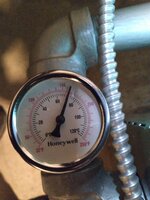
I am seeing 179* at the boiler tank and 162* on my return thermometer.
Took pics but temps changed to 177 @ boiler and 160 on the return.
20221116_173805.jpg20221116_173755.jpg
 
Last edited:
OP
V

vwpieces

Well-known member
Joined
Apr 28, 2020
Messages
5,925
Location
Hills, PA
Mix of fin tube and assumed cast iron radiation is not ideal on one zone or loop.

You really need to assess the installed radiation and figure out the equivalent square footage. This is how boilers are sized.

In order to know how much radiation is needed, you need a load calculation. Then you need btu's per foot equivalent at the designed or anticipated water temperature.

If you have a bunch of extra radiation, you can lower the water temperature going to them. But you should know where you are going, rather than guessing.

I'd figure out what I have, then what I need.

You could do a primary/secondary system and run the boiler loop at 150 and send cooler water to the radiators. There are boiler protection valves that will keep the return temperature up above 145.

The small loop will heat up fast, minimizing flue condensation and prolonging boiler life.

You can't run it colder.

"Efficiency" stays the same, but less energy is expended to run the lower water temperature.
There is Only One radiator and that is in the basement garage by the door. Everything else is finned baseboard except the 2 Box type heaters that are only cast iron on the end caps where the pipes come in and the finned sections attach. I did not change or ad anything from it's original configuration, only assume the one radiator at the basement garage door was added later. It may have not... But this system has to be from the 60's except the boiler now.
 

PoorUB

Well-known member
Joined
Mar 29, 2021
Messages
11,889
Location
Fargo, ND
So, a low mass system. Not much water in it.

There are resources to determine btu per foot of fin tube, which then depends on water temperature.

Still need to determine feet of fin tube and the heat loss for each room where it's installed.

Then look at the charts for btu per foot at xxxx water temperature and do the math.

Only then will you know what temperature the system can be run at.
Why over complicate it? It isn't like designing a new system, it is what it is! He can run what ever temp it takes to heat the home, start low, turn it up if it doesn't heat the place in cold weather. Just keep the boiler above 140F'ish.
 
OP
V

vwpieces

Well-known member
Joined
Apr 28, 2020
Messages
5,925
Location
Hills, PA
Why over complicate it? It isn't like designing a new system, it is what it is! He can run what ever temp it takes to heat the home, start low, turn it up if it doesn't heat the place in cold weather. Just keep the boiler above 140F'ish.
Thank You.
 
To avoid these ads, REGISTER NOW!

Bert_

Well-known member
Joined
Dec 24, 2016
Messages
9,861
Location
NW Iowa
Whole house has older vinyl double pane replacement windows.
Hopefully your's are decent. I had 3 older vinyl replacement windows in my place when I bought it and they were absolutely the worst/coldest windows in the house.
 
OP
V

vwpieces

Well-known member
Joined
Apr 28, 2020
Messages
5,925
Location
Hills, PA
Hopefully your's are decent. I had 3 older vinyl replacement windows in my place when I bought it and they were absolutely the worst/coldest windows in the house.
I think Decent is accurate. But there are too many for me to consider all new ones. The foam around the frames and some frame adjustments have helped a lot. If I had to guess they are more than 20yrs old. None are fogged out so that's a plus.
Certainly could be worse.
 

PoorUB

Well-known member
Joined
Mar 29, 2021
Messages
11,889
Location
Fargo, ND
Whatever.
Seriously? That is your argument?

He isn't building a new system, it is in place and running. He isn't going to rip out and and replace radiators or the boiler.

Your points were valid on a new system, starting from scratch, buying all new components, but not on an old up and running system.

If he was rplacing the boiler I would tell him to measure to length of all the fin tube, add it up, figure out the BTU per foot it will emit and buy a boiler to match, but he isn't.
 
OP
V

vwpieces

Well-known member
Joined
Apr 28, 2020
Messages
5,925
Location
Hills, PA
Is what it is, Is truly what it IS.

Ran it at 160*F and was seeing 142-145* on the return thermometer.
Went up to 165 on the boiler and it stays over 145 through the heat cycle even as the burner turns off and on while circulating, does not go under 145. Mostly closer to 150 now.

It does run longer and I realize now that is a good thing. In the 27x18ft LR and 10ft ceilings, the colder air on the floor now has a chance to more thoroughly circulate. Warmer feet and at a quick observation it is just more comfortable even with the wider swing (+/-0.75*) on the T-stat.
Hope the result is the same at single digits.
 

PoorUB

Well-known member
Joined
Mar 29, 2021
Messages
11,889
Location
Fargo, ND
Nothing wrong with longer heating cycles. The home will be more comfortable heating it slower.

If the boiler doesn't keep up in severe cold, just turn the temp back up for that cold snap.
 

PoorUB

Well-known member
Joined
Mar 29, 2021
Messages
11,889
Location
Fargo, ND
Knowing what the system is, is better than making assumptions and guessing.

Then a direction is known.

But, that isn't an easy path.
I agree, but once you figure out the heat loss, length of baseboard required and the BTU of the boiler required are you going to tear it out and rebuild the system if it is wrong? Probably not. That is why I just say to see if it heats the home at a lower boiler temp.
You can do all the math, hire a Manual J and re-engineer the whole system and most people do nothing. So all you have done is burned up a lot of brain cells, paper and spent some money.

Like I mentioned earlier all of this makes sense on a new system, new home or remodel, or if the homeowner is willing to spend thousands of dollars revamping the old system.

I have been doing HVAC for twenty years. It is a rare day when you get a call from a customer that wants the whole system analyzed. The great majority want heat and AC and they could care less how it happens.
 

fitter30

Well-known member
Joined
Jun 23, 2019
Messages
3,022
Location
Peace Valley,mo
Outdoor reset will vary water temp on outdoor temp. If the thermostat differential is to close could move the w wire to w2. Is there a setting in the t stat to pick the correct heating devise? That would change the differential/ algorithm.
 

PoorUB

Well-known member
Joined
Mar 29, 2021
Messages
11,889
Location
Fargo, ND
Outdoor reset will vary water temp on outdoor temp. If the thermostat differential is to close could move the w wire to w2. Is there a setting in the t stat to pick the correct heating devise? That would change the differential/ algorithm.
That depends largely on the thermostat.

I have a 90%+ furnace. I set the thermostat for one cycle per hour thinking it will run fewer cycles and longer cycles when it does. I can't tell the difference from the recommended settings. If I set it to 72F, it always says 72F for the room temp. I thought it might drop a bit, but not as far as I can tell.

There are some thermostats you can set the dead band, so on at 70F and off at 72F or what ever settings you choose.
 

danski0224

Well-known member
Joined
Jan 29, 2005
Messages
13,748
Location
Near Naperville, IL
I agree, but once you figure out the heat loss, length of baseboard required and the BTU of the boiler required are you going to tear it out and rebuild the system if it is wrong? Probably not. That is why I just say to see if it heats the home at a lower boiler temp.
You can do all the math, hire a Manual J and re-engineer the whole system and most people do nothing. So all you have done is burned up a lot of brain cells, paper and spent some money.

Like I mentioned earlier all of this makes sense on a new system, new home or remodel, or if the homeowner is willing to spend thousands of dollars revamping the old system.

I have been doing HVAC for twenty years. It is a rare day when you get a call from a customer that wants the whole system analyzed. The great majority want heat and AC and they could care less how it happens.
Whether or not it is torn out would depend on what the customer wants to do. I NEVER assume what the customer is willing to pay for, because sometimes that call comes when they are at the end of their rope with hacks and they WILL GLADLY pay.

Yes, I have had major tear out work that came from the what is essentially "what can I do to make this better" question. Or, "do you have problems heating/cooling these rooms"? It does happen, certainly not every time.

Whether or not the OP in this case would go that far is unknown. Considering that almost all that ask questions here are looking for the easy answer, I'd guess not.

I'd still maintain the position that knowing the answers puts one in a better position to know what can be done. I have always worked this way. It's important when one is being paid to fix something rather than guess and hope.

In most instances, if the person seeking the information WANTS to know, the information is out there, readily available to those that seek it.

Given all of the bitching on this forum about ****** HVAC contractors, one would think that people would be seeking this information, but no, posters still want to be spoon fed information, much of which is questionable.

In my case, when people are asking the difficult questions, but refuse to pay for diagnostics, I may give them a small piece of the puzzle, but I have no problems suggesting that they find someone else to butch it in and then walk from the job.

Unfortunately, actually fixing boiler system problems is much more expensive than fixing forced air system problems.

In this case, knowing the heat loss and knowing the amount of fin tube installed coupled with a btu per foot chart can easily tell you what water temperature is necessary for each room to heat it. Then, if you don't want to correct any shortfalls by adding more fin tube, the minimum water temperature is known. Tearing the system apart isn't a required outcome. But, changing near boiler piping may be.

Even if the answer IS that tearing it all out is the best approach, that route may not happen today, but it can happen down the road. I've been there.
 

PoorUB

Well-known member
Joined
Mar 29, 2021
Messages
11,889
Location
Fargo, ND
Whether or not it is torn out would depend on what the customer wants to do. I NEVER assume what the customer is willing to pay for, because sometimes that call comes when they are at the end of their rope with hacks and they WILL GLADLY pay.

Yes, I have had major tear out work that came from the what is essentially "what can I do to make this better" question. Or, "do you have problems heating/cooling these rooms"? It does happen, certainly not every time.

Whether or not the OP in this case would go that far is unknown. Considering that almost all that ask questions here are looking for the easy answer, I'd guess not.
Well since his question was about a thermostat, and not re-engineering the system I tried to answer his question and not assume he was interested in a system rebuild.
 

American Locomotive

Well-known member
Joined
Jan 8, 2017
Messages
11,128
Location
Rhode Island
The best way to save energy is to keep the house colder. That is the unfortunate reality of an old house with poor insulation. Wear a sweater and keep the house at 62.
 

dogdog

Well-known member
Joined
Nov 15, 2011
Messages
12,711
usually when the boiler manufacture says 85% efficiency that is the max you can get out of the boiler though... nothing to do with the temperature set. That is just the heat exchanger boiler, burner thing. Things you can save money on in these type of heating is the radiator. Heavy cast iron radiator retain heat longer and better, same for steam heats. Reason I kept all the original cast iron radiators as much as I can.. saved 6 total old style from 1920s ... the rooms with just pipe and fins warms but gets cold easier.... all are insulated about the same.
 

u3b3rg33k

Well-known member
Joined
Dec 18, 2017
Messages
4,068
Nothing wrong with longer heating cycles. The home will be more comfortable heating it slower.

If the boiler doesn't keep up in severe cold, just turn the temp back up for that cold snap.
I think Tekmar makes a relatively inexpensive reset controller that'll do that for you.
 
To avoid these ads, REGISTER NOW!
Top Bottom