To avoid these ads, REGISTER NOW!

A/C Condensing Unit Broke (Technical Help Needed)

OP
J

jonathan75

Well-known member
Joined
Mar 27, 2013
Messages
1,451
Location
NC
Can I just hook up the low side and tank and ignore the high liquid side and not connect it when charging? Or is there a reason I would need to monitor the high side?
 
To avoid these ads, REGISTER NOW!
OP
J

jonathan75

Well-known member
Joined
Mar 27, 2013
Messages
1,451
Location
NC
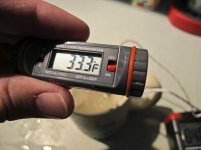
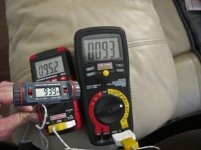
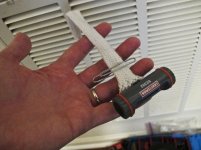
I got delayed by rain and work phone calls so I practiced taking wet bulb readings. I wet a cloth draw string and attached it to the probe as recommended to me. It would seem that my digital stem thermometer may be more accurate then my K type for my meters. What I did is test with ice water and the digital stem probe was closest to 32F followed my my old Craftsman Professional Meter and then the new Craftsman Meter. My old Craftsman is only accurate with direct contact but for some reason it can't read ambient temperatures correctly, it has to touch something.

So to measure my superheat using the vapor line I am not sure if I should use my stem probe touching it or attach the K Type from my meter directly to it? My K Type probes attached to my meter all seem 3 degrees or so high.

The last picture I pinched all the probes between my fingers for testing.

Edit: Update, the rain stopped but everything is frozen up. So I need to wait for everything to defrost before I can charge now.
 

Attachments

  • IMG_4576-1.jpg
    IMG_4576-1.jpg
    73 KB · Views: 14
  • IMG_4578-1.jpg
    IMG_4578-1.jpg
    68.9 KB · Views: 12
  • IMG_4591-1.jpg
    IMG_4591-1.jpg
    75.8 KB · Views: 13
  • IMG_4592-1.jpg
    IMG_4592-1.jpg
    117.9 KB · Views: 12
  • IMG_4594-1.jpg
    IMG_4594-1.jpg
    56.2 KB · Views: 10
  • IMG_4596-1.jpg
    IMG_4596-1.jpg
    69.7 KB · Views: 10
Last edited:

brewchief

Well-known member
Joined
Sep 20, 2008
Messages
2,370
Location
Michigan
Use what is going to be easiest and correct your temperature as needed, most of the time with superheat you will have a plus/minus of 5 degrees or so anyways.

Sent from my SM-G900V using Tapatalk
 
OP
J

jonathan75

Well-known member
Joined
Mar 27, 2013
Messages
1,451
Location
NC
Use what is going to be easiest and correct your temperature as needed, most of the time with superheat you will have a plus/minus of 5 degrees or so anyways.

Sent from my SM-G900V using Tapatalk

Thank you, I am using both on it right now so I won't need two switch them.

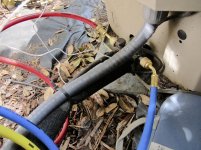
I think I may of found where my leak is coming from. Last time I put some Nylog on the schrader valve connections before I put the caps on. This time when I took the cap off from the high side the Nylog on the schrader valve started bubbling out. It looks like my schrader valve is bad and leaking. How do I fix this? I know if I use the core removal tool I have it will blow out like crazy and I would have a hard time getting the new core in and loose a lot of R22 in the process.

It is charging now, I added up to 50 PSIG and letting it stabilize some before I start taking temp readings.
 

danielzig

Well-known member
Joined
Dec 14, 2008
Messages
175
Location
Chicago, IL
As long as nothing was leaking from the cap, i wouldnt worry about it. The cap is there to account for small leaks on the valve. But if you want to spend the 40 bux on the tool, its a nice thing to have.
 
To avoid these ads, REGISTER NOW!
OP
J

jonathan75

Well-known member
Joined
Mar 27, 2013
Messages
1,451
Location
NC

Thank you for the link and praise. Studying for EPA test was actually very educational and I learned a lot.

As long as nothing was leaking from the cap, i wouldnt worry about it. The cap is there to account for small leaks on the valve. But if you want to spend the 40 bux on the tool, its a nice thing to have.

I tested the cap for leaking after I was done and it was fine. I put generous amounts of Nylog on it and tighten it down tight. Seems okay so far.

Here comes a post with pictures next, but it is working great so far. Blowing very cold!
 
OP
J

jonathan75

Well-known member
Joined
Mar 27, 2013
Messages
1,451
Location
NC
Thank you for everyone's help and input. This was a long process that started over a month ago. But I am happy to report it is working great now and blowing very cold! No ice up yet and it has been running for almost two hours straight.

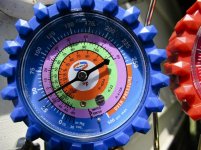
In the first picture you can see the bubbles coming out from the valve on the high side. As soon as I took the cap off the bubbles started to come up from the Nylog I put on it last time before putting the cap on. Since it is leaking I put more Nylog on and made sure it was very tight when I was finished.

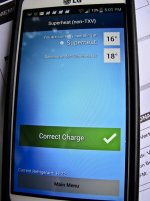
You can see in the pictures that I started off with very low pressure. Probably after I disconnected the hoses last time I lost some R22. I kept adding until I got to 50 PSIG then I started to take some readings. Also I found a app for my phone that would calculate superheat so I wouldn't have to manually calculate it every time and just input the numbers.

The interesting thing is that the high side ended up right where one video I saw on YouTube said it would. In the video they said add 30F to the ambient temperature outside and that would be where it will be at on the high side. And sure enough after calculating superheat it ended up right at 110F on the high side R22 scale. It was 80F outside today. 80 + 30 = 110. Does that not always match up? Or is it just better to calculate superheat or subcool?
 

Attachments

  • IMG_4614-1.jpg
    IMG_4614-1.jpg
    117.8 KB · Views: 9
  • IMG_4612-1.jpg
    IMG_4612-1.jpg
    119.3 KB · Views: 15
  • IMG_4613-1.jpg
    IMG_4613-1.jpg
    118.4 KB · Views: 14
  • IMG_4604-1.jpg
    IMG_4604-1.jpg
    129.5 KB · Views: 14
  • IMG_4603-1.jpg
    IMG_4603-1.jpg
    110.4 KB · Views: 11
  • IMG_4602-1.jpg
    IMG_4602-1.jpg
    121 KB · Views: 12
  • IMG_4600-1.jpg
    IMG_4600-1.jpg
    68.6 KB · Views: 12
OP
J

jonathan75

Well-known member
Joined
Mar 27, 2013
Messages
1,451
Location
NC
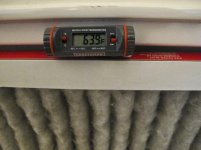
Here are the final numbers and worksheet I did. Now the air out of the vent is coming out much colder too. Around 15 degree offset from the air at the filter, before I only had around a 9 degree difference.

In the end I used around 2 pounds of R22. I used a luggage scale to test before and after.

The only thing that went bad was when I was disconnecting the low side hose. It shot out like crazy and I couldn't get the hose off fast enough. My rubber glove froze solid white and it was super cold. Good thing I had thick rubber gloves on because I didn't get any frost bite. I really need some low loss connections because that was nuts the amount that came out. I wonder if I should of had the unit running when disconnecting the low side so it would of been under more pressure to close the valve faster? Or was most of what I saw coming out from the hose and not from the unit valve?

Anyway this was a very good learning experience that saved me a lot of money. The next step is I want to practice brazing using nitrogen and pressure testing with nitrogen. And just learn to braze period. After that I think I may have enough knowledge between this and my mini split install to attempt to replace my whole system with a newer 410A system. For now I will try and keep this one running for as long as I can. It will be a good learning experience to keep fixing this one.
 

Attachments

  • IMG_4616-1.jpg
    IMG_4616-1.jpg
    45.8 KB · Views: 15
  • IMG_4617-1.jpg
    IMG_4617-1.jpg
    47.4 KB · Views: 13
  • IMG_4619-1.jpg
    IMG_4619-1.jpg
    63.5 KB · Views: 9
  • IMG_4624-1.jpg
    IMG_4624-1.jpg
    111.2 KB · Views: 15
  • IMG_4625-1.jpg
    IMG_4625-1.jpg
    85.9 KB · Views: 7

danielzig

Well-known member
Joined
Dec 14, 2008
Messages
175
Location
Chicago, IL
I would normally disconnect the suction side when running. It will be under a lower pressure and there will be no liquid in the line to shoot out. Suction disconnection should never be a problem. It is the easier line.

A high side low loss fitting works great. If you have the low loss fitting, all you do is disconnect the high side hose, and bleed the liquid back into the low side by opening the valves to each other. Don't forget to bleed the air out of both lines before performing this.

You could get the actual low loss fitting or a hose end with a ball valve. Either perform the same function.
 
OP
J

jonathan75

Well-known member
Joined
Mar 27, 2013
Messages
1,451
Location
NC
I would normally disconnect the suction side when running. It will be under a lower pressure and there will be no liquid in the line to shoot out. Suction disconnection should never be a problem. It is the easier line.

A high side low loss fitting works great. If you have the low loss fitting, all you do is disconnect the high side hose, and bleed the liquid back into the low side by opening the valves to each other. Don't forget to bleed the air out of both lines before performing this.

You could get the actual low loss fitting or a hose end with a ball valve. Either perform the same function.

The high side was easy for me this time. Just the suction side was a mess. Next time I will disconnect the suction side while running. Good thing my Superheat was a little bit on the low side so I was able to loose a little and still be fine. Just I didn't like freezing my glove and cutting my hand due to my exaggerated reaction.

You said a ball valve is simular. Could you explain to me how a low loss fitting works? I am not sure about the concept. All I know is in videos online when someone disconnects a low loss fitting all I hear is a slight hiss and not a crazy flash freeze avalanche like I had.
 
OP
J

jonathan75

Well-known member
Joined
Mar 27, 2013
Messages
1,451
Location
NC
As far as hooking up to your current system, just use the access ports on the condenser. Your gauges should have 1/4" standard connections. I would use the ball valve and put it on the end of the high side hose.

After you hook the hoses up, bleed the "air" from the hoses (high and low). Get your readings with an unfrozen coil. When going to disconnect, close the ball valve on the high side. Open the high side to the low side and let the refrigerant that has condensed in the high side hose back into the system. Disconnect both hoses.
I finally get it. It takes me some time for gears to start clicking in my head. I usually have to do it to understand it.
 
To avoid these ads, REGISTER NOW!
Top Bottom