To avoid these ads, REGISTER NOW!

A/C Manifold Gauge Sets

bob smith1

Well-known member
Joined
Jul 2, 2026
Messages
138
Yes. The above quoted still doesn’t say “pressures alone” like you falsely claimed I said and you insult yourself by not quoting where I stated you needed temps, and RH, and even talked about superheat and sub cooling in post 29


I didn’t come to the conclusion that weighting in is the only right method. I was pointing out your contradictory statement, there is a word for telling people there is only one way to do something and then doing the opposite yourself.
Is all that supposed to be a "gotcha"? Dude, you are an armchair non-tech, here to insult for whatever reason. Read above in my first posts to realize I already know this industry is SHADY, as in GUESS with pressures and "that vent seems about right"...lol This is your path.

You really think you have circled in on a "gotcha" with "topping off", because you are not in the industry. This is COMMON to add some charge BY PRESSURES and GUESS, UNTIL you can do a proper repair! We call it "gas and go", because it's the hottest day of the year and grandma needs to survive. Topping off GUARANTEES there is a leak, and a real repair is needed. That is usually the time to inject dye, let the system run, and work through the issue.

That does NOT mean it's charged right! But while we are here, and you are educating me, let me go grab that BS you cited for me.


"Weight is an easy way for an initial fill and some places with recovery machines may do repair or top off a system via recovery and weight back in, but its to avoid math and reading temps not absolutely imperative to do it that way. Systems with accumulators might be hard to use Superheat or sub cooling, but that is more in modern residential heat pump systems."

So techs avoid math and temps by weighing in a charge? Have you ever seen or taken an ASE test? If you go find one on the net, you might learn something! It's weighed in because that is the ONLY RIGHT WAY, and procedures are a full eval of pressures and temps.

The one that proves your FOS is insertion of SH/SC, without a clue what that even is! "More in modern residential heat pumps".....lol Spit my beer out...... SH/SC is literally the foundation of ALL air conditioning, EVER! And 100% you can check it with an accumulator! But where? But what about a receiver? Do you need AI to help you now?

I 100% use SH/SC on ALL systems! Do you know why? What am I looking for?

I can tell by what you wrote, you don't grasp the dynamics of an auto system, and that alone makes them NEED to be weighed in. That is NOT my opinion, you will get that from any educational packet you can find, any course, any votech, any college. As I said from the beginning, "gassing by pressures and temps alone will be a guess". The type of gas matters none, it is the wildly changing evap load, latent load, enthalpy variables, variable pump displacement, condensing efficiency, etc, etc.

And for the record, there is not a system out there that aligns with your method. Not a single RTU, package unit, split unit, heat pump, etc, etc. We weigh them in!

It just irritates me that you insulted someone for talking about doing it right. All while I literally posted about how this industry is notorious for "half ***", and that is what your method is!
 
To avoid these ads, REGISTER NOW!

Firebrick43

Well-known member
Joined
May 12, 2015
Messages
14,330
Location
West central Indiana
You keep putting words in peoples mouths they never said and leaving other pertinent info out.

Again, I don’t by “pressures alone” you keep accusing me of. I go by pressures/temps/rh in relation to a manufacture chart, which even posted. Manufacture have used that as an acceptable method for decades.

And I didn’t insult him for weighing in charges. I even posted some systems such as heat pumps with accumulators, that it is the only real method.

I very specifically challenged his assertion that weighting in for an R134 for a vehicle was the ONLY method acceptable. If any insult has been leveled it was to those who have been doing a fine job with a couple of thermometers, a manifold, and a manufacture service info since r134 was introduced in 1994

I am quite baffled how you have me associated with all these other crimes of humanity in your mind. Have you contacted the residential and commercial manufactures and told them of their sins of charging by sub cooling and super heat over the past 80 years?
 
Last edited:

bob smith1

Well-known member
Joined
Jul 2, 2026
Messages
138
You keep putting words in peoples mouths they never said and leaving other pertinent info out.

Again, I don’t by “pressures alone” you keep accusing me of. I go by pressures/temps/rh in relation to a manufacture chart, which even posted. Manufacture have used that as an acceptable method for decades.

And I didn’t insult him for weighing in charges. I even posted some systems such as heat pumps with accumulators, that it is the only real method.

I very specifically challenged his assertion that weighting in for an R134 for a vehicle was the ONLY method acceptable.

I am quite baffled how you have me associated with all these other crimes of humanity in your mind. Have you contacted the residential and commercial manufactures and told them of their sins of charging by sub cooling and super heat over the past 80 years?
You're just digging a deep hole of ignorance! I'd love to learn about your charge methods. Please enlighten. What temps? collection methods? What do you do if you keep juicing and it doesn't align with OEM charts?

Then you say "for an R134 vehicle", like that means something? Is it different for R1234YF? What about R410A? R32?
 

bob smith1

Well-known member
Joined
Jul 2, 2026
Messages
138
I am quite baffled how you have me associated with all these other crimes of humanity in your mind. Have you contacted the residential and commercial manufactures and told them of their sins of charging by sub cooling and super heat over the past 80 years?
Since I used to design for one, if a call came to me, I would be telling you the same. General discrepancies are typically due to inaccurate adjustments for lineset and hose sets.

But since I am learning today, just walk out to your home condenser today and realize the WEIGH IN chart is literally printed on the label, for YOU to follow! SH/SC is to verify proper operation and detect system issues.
 

The Metric System

Well-known member
Joined
Apr 28, 2025
Messages
287
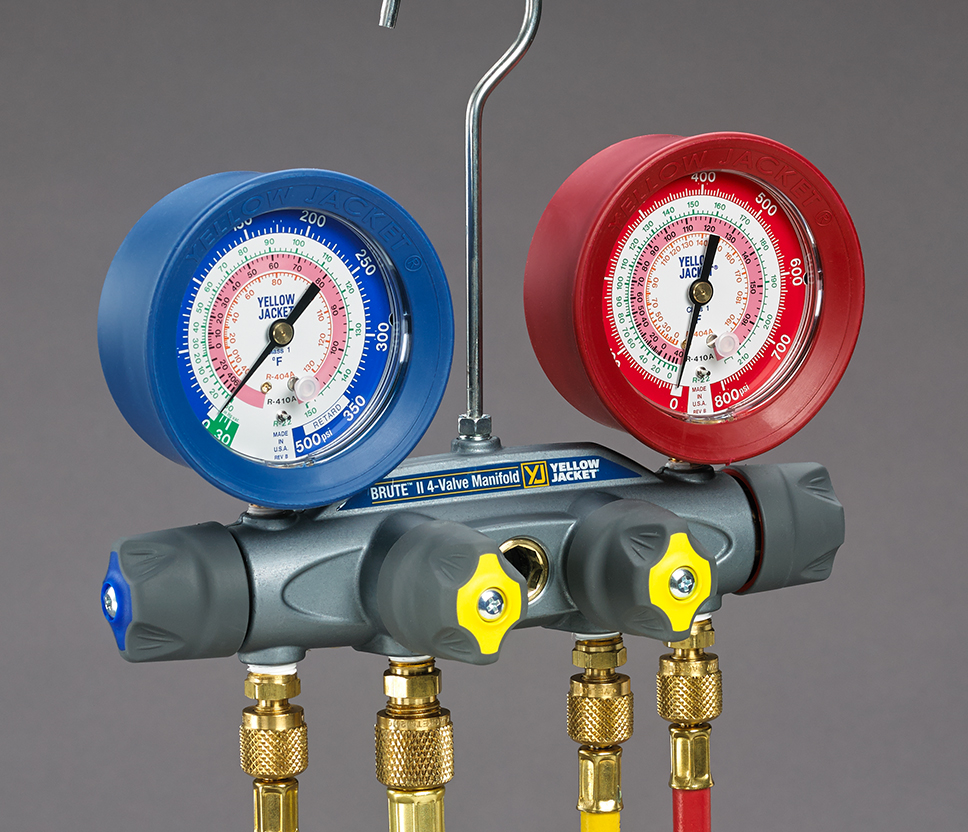
All of my A/C tools are Yellow Jacket.
I have tested a whole lot of manifold sets, the best one I've found has been the Yellow Jacket Brute series:

There are absolutely refrigeration systems in the world where charging to a pressure value is not just the "correct" or "preferred" way but indeed the only approved method to do the job. As far as I know, none of these systems are used in automotive AC.
 
Last edited:

Firebrick43

Well-known member
Joined
May 12, 2015
Messages
14,330
Location
West central Indiana
You're just digging a deep hole of ignorance! I'd love to learn about your charge methods. Please enlighten. What temps? collection methods? What do you do if you keep juicing and it doesn't align with OEM charts?
Maybe you would like to look once again at post 29 the charts I posted have a lot of that already.

Mainly Ambient air temp and RH as I have already mentioned and cabin vent output with other places if malfunctions occur.

Collection methods? A pocket thermometer, thermocouple, or IR thermometer

The chart I posted has zones not a target pressure. If one pressure or the other goes out that zone or you don’t have good delta T over the evaporator core then you have problems. And depending which zone it out in the manual list further trouble shooting steps, just like if you charged by weight and it was out.
Then you say "for an R134 vehicle", like that means something? Is it different for R1234YF? What about R410A? R32?
R 134 is what the OPs vehicle uses. They are simple office or txv systems. Lots of newer R1234YF systems on the expanding hybrid/ev are heat pumps now and not as simple but we were not talking about those for the most part
 

Hakeem

Well-known member
Joined
Jan 22, 2024
Messages
1,312
Location
Chicago
That is not true for R134.

I have not seen a vehicle manufactures manual yet that didn't have pressure/temp charts and tables for OS/Temp/RH/discharge temp yet.

Snippets from a GM manual

Screenshot 2026-08-05 081253.png

Screenshot 2026-08-05 081313.png

Weight is an easy way for an initial fill and some places with recovery machines may do repair or top off a system via recovery and weight back in, but its to avoid math and reading temps not absolutely imperative to do it that way. Systems with accumulators might be hard to use Superheat or sub cooling, but that is more in modern residential heat pump systems.
I’m willing to believe you, but then why do all the automotive AC machines charge systems based on weight? Surely the machine could be programmed to do the necessary math automatically.
 

Buckaroo5

Well-known member
Joined
Oct 18, 2012
Messages
855
Location
Central Ohio
You're just digging a deep hole of ignorance! I'd love to learn about your charge methods. Please enlighten. What temps? collection methods? What do you do if you keep juicing and it doesn't align with OEM charts?

Then you say "for an R134 vehicle", like that means something? Is it different for R1234YF? What about R410A? R32?
Bob....let him go. I think he is an old angry guy that just shakes his fist at clouds. You are right of course but there is no convincing him and it just takes too much energy.....you, however, gave it a spirited go and I am impressed.
 
Last edited:

ihateminimumwage

Well-known member
Joined
Jan 26, 2012
Messages
3,962
Just went through the same on my truck. AC parts kit from Rockauto, 2-3 cans of AC flush from local auto parts store, HF for tools (gauges, vac pump, resealing can adapter, scale) and R134 cans. Good to buy extra R134 cans in case of a bad seal, then return whatever you don't use.
 

Wrench97

Well-known member
Joined
Jun 23, 2018
Messages
12,282
Location
Southeastern Pa
What is the scale for? I know they weigh the refrigerant for a residential application so that they know how much refrigerant to charge the customer, but when would you use a scale for automotive?
Yes every car since at least the 90's left the factory with a sticker listing the type and amount of oil and refrigerant.
 

Wrench97

Well-known member
Joined
Jun 23, 2018
Messages
12,282
Location
Southeastern Pa
Yes, you weigh the little cans. You are going to likely add less than 2. Weigh it before you start with your gauge hose attached and then watch the scale as it feeds in to get the amount added.. Obviously, you want to take the tare weight after you have purged your line. Don't depend on the 12 oz can label weight - you may not be able to get it all out of the can.

You cannot use the pressure to determine the correct fill - that may have worked for R-12 but for the newer refrigerants like R-134a, it is not accurate enough. Too much or too little will affect your AC system performance.

As I said before, there is a lot to know about this. Many years ago I tried to replace a compressor that had blown without knowing enough. I had a guy helping me that knew more than me but still not enough. It didn't work and I traded in the car with the AC not working. That was my rocky intro to automotive AC work.
It's tough to weigh in with the little cans since there is always some left in the can and you have to know how much to account for in the hoses.
Unless he's in the deep south pressures can get you pretty close.
 
Last edited:
To avoid these ads, REGISTER NOW!

Buckaroo5

Well-known member
Joined
Oct 18, 2012
Messages
855
Location
Central Ohio
It's tough to weigh in with the little cans since there is always some left in the can and you have to know how muck to account for in the hoses.
Unless he's in the deep south pressures can get you pretty close.
I always use a pan of hot water. You have to put them in, swish them around, wipe them off and put them back on the scale. But yes, it is not eash.
 

Wrench97

Well-known member
Joined
Jun 23, 2018
Messages
12,282
Location
Southeastern Pa
I’m willing to believe you, but then why do all the automotive AC machines charge systems based on weight? Surely the machine could be programmed to do the necessary math automatically.
Weight is the correct way, if there is a issue with system they expect you to repair whatever it is so it works correctly, a evaporator plugged with mud(I'm talking about you Ford SD with no cabin filters) sometimes you can cheat the charge to keep it cool and the truck working same goes for condensers with eaten away fins, the worst thing imo we've done to auto systems is adding flow valves to the compressor.
 

Firebrick43

Well-known member
Joined
May 12, 2015
Messages
14,330
Location
West central Indiana
I’m willing to believe you, but then why do all the automotive AC machines charge systems based on weight? Surely the machine could be programmed to do the necessary math automatically.
Once again, no matter how Bob twist and misquotes what I said, I in no way think charging by weight is a bad idea. For a dealership/independent repair shop, or fleet shop with an AC machine, charge by weight is absolutely the best choice.

My comments to charge to the charts were based entirely on the DIY, mobile equipment mech, or shop that does a few incidental jobs a year. As this is not a Pro forum and the OP is DIY. I think its ridiculous the gate keeping and some peoples notion that everything has to be pro level or take it to a dealer.

As far as possible, Yes it is. They all ready make a manifold in the HVAC world that will automatically charge to superheat, subcooling, or weight. The Testo 560I. It measures line temps, pressures, ambient temp, humidity, and evaporator delt T via the manifold body itself and remote blue tooth sensors, figures the correct superheat or subcooling, and adds refrigerant to bring it into the correct values.


To implement it to automobile systems however they would need to program in the thousands charts/tables for every vehicle, some having 3 or 4 different system options. Would be insanely expensive for that subscription I imagine.
 

bob smith1

Well-known member
Joined
Jul 2, 2026
Messages
138
Once again, no matter how Bob twist and misquotes what I said, I in no way think charging by weight is a bad idea. For a dealership/independent repair shop, or fleet shop with an AC machine, charge by weight is absolutely the best choice.

My comments to charge to the charts were based entirely on the DIY, mobile equipment mech, or shop that does a few incidental jobs a year. As this is not a Pro forum and the OP is DIY. I think its ridiculous the gate keeping and some peoples notion that everything has to be pro level or take it to a dealer.

As far as possible, Yes it is. They all ready make a manifold in the HVAC world that will automatically charge to superheat, subcooling, or weight. The Testo 560I. It measures line temps, pressures, ambient temp, humidity, and evaporator delt T via the manifold body itself and remote blue tooth sensors, figures the correct superheat or subcooling, and adds refrigerant to bring it into the correct values.


To implement it to automobile systems however they would need to program in the thousands charts/tables for every vehicle, some having 3 or 4 different system options. Would be insanely expensive for that subscription I imagine.
Wrong yet AGAIN if you think you will charge any MVAC system by SH/SC alone! NOT happening! Read next post for VERY fresh insight. No techs are going to buy an "auto SH/SC charge system".... Just another shelf warmer. You spend only a few weeks in the field and you would realize you are dealing with plugged coils, bad fan motors, capacitors, and the list is endless! Unless ALL of those are good, your SH/SC BS dun shi* the bed son! What your proclaimed is EXACTLY what gets rookie techs in deep shi*! Again, read next post to learn something.
 

bob smith1

Well-known member
Joined
Jul 2, 2026
Messages
138
This was MY little emergency job today, and my manifold setup..... :ROFLMAO: :ROFLMAO: :ROFLMAO: This is an MVAC industrial system and I got stuck getting it cold so it can do work tomorrow. A couple hoses tapped out. Pulled her down to 500 microns, decay tested while I cleaned up, and stuffed the first DIY can in and I shut off the compressor quickly after because I could see head pressure was not stable. I didn't like it. I realized the back door of the machine has to be closed to get some fan action. Once I got that solved, I was in business.

Next can, an entire 12oz was only 20lb difference in head. I had some temp clamps in various places so I was watching, but that "pressure" was only within a table window shown in this thread! Do NOT trust that shi*! I could have dropped 20psi in a blink by moving a little more air!

My target charge you can CLEARLY see on the tag, was .81kg, so I needed 4oz off a 3rd. I weighed that one in while noting the head pressured changed ZERO! What did that tell this "rookie"? That and other measurements told me I have no restrictions or condensing issues. I checked temp split on condenser when I was done and was good with all of the data I collected.

If I was doing this one by pressures or even pressures/temps, I could have been off by 50% and not even known! Well, with careful testing in the heat, I could have evaluated the temp split and SC on condenser, but man, charging by weight saved me TIME! But here is what I will note again, I shut this party down because I saw head pressure beyond what I wanted. It was not stable and climbing. I knew that pointed to the condenser. I corrected it quickly and we moved on. If I didn't do that, it would have tripped on high head, no question!
 

Attachments

  • 20260805_211139.jpg
    20260805_211139.jpg
    562.5 KB · Views: 17
  • 20260805_211221.jpg
    20260805_211221.jpg
    615.1 KB · Views: 17

mikey03

Well-known member
Joined
May 17, 2024
Messages
2,180
I only did car ac once or twice and I had access to a yellow jacket and a HF Pittsburgh and I used the HF because it had some feature the yellow jack didn’t got, or I was too stupid know how to use the Yellowjacket. Honestly I can’t remember what, here’s pics of the two. Maybe lack of a purge valve on the middle yellow line on the Yellowjacket

I just remember watching YouTube videos and the guys all used HF and one step I couldn’t figure out how to do with the Yellowjacket because it seemed to be missing one feature. Or maybe it’s there in a different method of performing it

edit: maybe a lack of a way to lock off the middle line at the top? HF has a valve on top so when you put the refrigerant can connector on the other end, you can open the yellow top valve, open the can side valve, fill the yellow line with refrigerant, close the top valve, close the can valve and now the yellow line is full of refrigerant. With the Yellowjacket I think to close off the yellow line I guess you have to close both high and low valve on top and that’s like doing it but honestly I don’t remember what the issue was.

IMG_0842.jpegIMG_0843.jpeg
 
Last edited:

Hakeem

Well-known member
Joined
Jan 22, 2024
Messages
1,312
Location
Chicago
Once again, no matter how Bob twist and misquotes what I said, I in no way think charging by weight is a bad idea. For a dealership/independent repair shop, or fleet shop with an AC machine, charge by weight is absolutely the best choice.

My comments to charge to the charts were based entirely on the DIY, mobile equipment mech, or shop that does a few incidental jobs a year. As this is not a Pro forum and the OP is DIY. I think its ridiculous the gate keeping and some peoples notion that everything has to be pro level or take it to a dealer.

As far as possible, Yes it is. They all ready make a manifold in the HVAC world that will automatically charge to superheat, subcooling, or weight. The Testo 560I. It measures line temps, pressures, ambient temp, humidity, and evaporator delt T via the manifold body itself and remote blue tooth sensors, figures the correct superheat or subcooling, and adds refrigerant to bring it into the correct values.


To implement it to automobile systems however they would need to program in the thousands charts/tables for every vehicle, some having 3 or 4 different system options. Would be insanely expensive for that subscription I imagine.
Ok, much of this discussion is over my head but I think I understand.

Would it be fair to characterize your position as “it is possible to correctly charge an R134 system by measuring system pressures, temperatures, SH/SC, and other variables. Charging a system by weight does not require the user to measure these additional variables “?
 

mikey03

Well-known member
Joined
May 17, 2024
Messages
2,180
You do NOT, EVER, properly charge ANY system, regardless of refrigerant, whether R-12, or R1234YF, by pressures alone. Those values are provided as a GUESS for quick diag and maybe topping one off. You would need SH/SC values, temp splits, ambients, fan speeds, etc, etc.
i was taught there’s no proper way to top off a ac system since you got no way of knowing how much refrigerant is inside from the pressure. The only proper way is to vacuum and drain all the refrigerant out and start from zero based on weight.

now if you got a beater and don’t want to fix it right and wait to bandaid I suppose you can use the gauges to add some more in. If you add too much you brake the system. wouldn’t do it unless you literally ready to trash the car since maybe you turned a $10 leak repair into a $500 compressor repair by overcharging it but they got pressure sensors and supposed to turn off if pressure too high so honestly idk
 

Firebrick43

Well-known member
Joined
May 12, 2015
Messages
14,330
Location
West central Indiana
Ok, much of this discussion is over my head but I think I understand.

Would it be fair to characterize your position as “it is possible to correctly charge an R134 system by measuring system pressures, temperatures, SH/SC, and other variables.
SH and SC is usually reserved for HVAC systems not mobile AC. Not other than that yes. It been done as long as R134 has been around and before without issue if the person doing it follows the charts and understands the issues
Charging a system by weight does not require the user to measure these additional variables “?
No, they still need to measure these values, as problems such as plugged orifices, stuck txt pistons, improper airflow and condensers/evaporators plugged will also show up in the pressures and temps being out of specs
 

bob smith1

Well-known member
Joined
Jul 2, 2026
Messages
138
i was taught there’s no proper way to top off a ac system since you got no way of knowing how much refrigerant is inside from the pressure. The only proper way is to vacuum and drain all the refrigerant out and start from zero based on weight.

now if you got a beater and don’t want to fix it right and wait to bandaid I suppose you can use the gauges to add some more in. If you add too much you brake the system. wouldn’t do it unless you literally ready to trash the car since maybe you turned a $10 leak repair into a $500 compressor repair by overcharging it but they got pressure sensors and supposed to turn off if pressure too high so honestly idk
Correct. I've lost count how many trashed compressors I've seen due to slugging. Piston compressors don't tolerate it. Generally the scenario is someone (incompetent tech/DIY) gets to adding refrigerant based on either a chart they found on the googles, or from a friend of a friend. They add a little, they feel some cold at the vent......lets keep going! More makes it colder!!!

They over charge, but it doesn't blow up right away because it's hot outside. They don't understand a single thing about an accumulator or receiver, so when the conditions are right, you end up with liquid at the compressor and ****, they are at Oreilly to get a reman junker.

I will be honest though, I've had to explain this at tech schools, in the auto mechanic trade, ASE, etc, there is very little education in HVAC. Just enough to follow the book and know what not to do. I've helped countless techs that are stumped. I'm not insulting them, I'm saying they have to learn ALL the systems, where an HVAC guy does ONE thing! There are some sneaky techniques I use. You 100% CANNOT charge a mobile system by SH/SC. Can't do it and there are reasons. HOWEVER, I use the data to find issues that is never taught in ASE education. It's outside the scope.

You are 100% correct about evac too! It is standard procedure as a PRO, NOT to use the stupid charts that circulate the net, but rather evac the system, weigh the contents, make repairs, and either put that charge back in, or go new. We are talking 1.5lbs guys!

The very first thing is determine the expected vapor pressure and compare to the pressure in the vehicle. I also do a few test tricks so I can figure out a few things before opening the system. You are trying to learn if it's really low charge, and if so, where is the leak, is the TXV working, does it even have one, can the compressor compress, is there a blockage, etc.


The two main things that smoke compressors are overcharge (liquid migration), and lack of sub cooling due to either low charge or unacceptable condensing. This leads to compressor overheat but no cooling either.
 

Wrench97

Well-known member
Joined
Jun 23, 2018
Messages
12,282
Location
Southeastern Pa
SH/SC in automotive systems are not used for charging because the compressor varies in rpm and cooling potential changes by mph air flow across the condenser, and also because the newer systems use flow valves in the compressor in a attempt to increase fuel mileage.
We did use them in reefer trailers once upon a time but it's been 40+ years since I've worked on them it was R12 or R502.
 
To avoid these ads, REGISTER NOW!
Top Bottom