To avoid these ads, REGISTER NOW!

A couple of vises

Southern Forester

Active member
Joined
Mar 27, 2017
Messages
31
Location
Southern Mississippi
I've used GJ for years, more in the sockets/wrenches department as a resource and have bookmarked a number of items (I'm a Williams USA socket/ratchet guy and have an excellent set of Wright Grip SAE and Metric wrenches and Armstrong reversible ratchets - I repair my own vehicles. I restored a 1949 Ford F1, now have a 1978 Ford F100 Ranger for the farm - I'll work my own plumbing, carpentry, roofing, wiring, and will work on most systems on a vehicle except the transmission due mostly to time constraints).

Recently, I have lucked into a couple of vises and wanted to get a bit of information about them. I'm not interested in selling or value but more about the intended use, durability, quality, etc. In the corner of my barn is my first vise, an unmarked 4" Chinese that I killed rebarrelling a Savage 110 rifle which started me down the road of quality vises. I'm a vise user not restorer (except where work would be needed) so my interests lie solely in use.

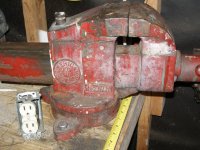
First is an Athol 114a vise. There is a thread from this year but the information wasn't all that detailed without photographs. It's a 4 inch vise without any repairs. I have cleaned and greased the screw but that is all. What can folks tell me about this vise? What is the kind of work this vise should be limited to (or what can I expect out of )?

The second is an American Scale No. 6 vise. I don't have a photograph of it, but it's a 3" jaw but the slide is a semi-circle in shape and slides within grooves milled in the static jaw base. It looks virtually the same as a Parker I found in the attached photo. What was the general purpose and durability of these smaller vises?

Lastly, I have no photographs of it right now, but I inherited my father's American Scale Red Seal No. 77A vise. It has a 4.5 inch jaw width and is also a swivel jaw with a swivel base. The vise itself is really big for its jaw size. This guy is every bit as large as my Reed 105. I mention that part as in the catalog of vise information on this site, no mention is made of a 77A Red Seal.

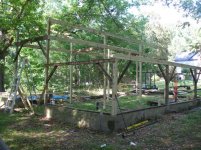
I keep them in the right side shop inside the barn I built using an old treated privacy fence and roofing material I salved from a stable being torn down. The shot's are older - the barn now has doors and is secure.
 

Attachments
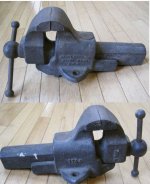
  • atholvise.jpg
    atholvise.jpg
    86.1 KB · Views: 97
  • parkervise.jpg
    parkervise.jpg
    58.7 KB · Views: 82
  • barn raising.jpg
    barn raising.jpg
    154.6 KB · Views: 73
  • barn b.jpg
    barn b.jpg
    120.9 KB · Views: 88
Last edited:
To avoid these ads, REGISTER NOW!

dirt_dobber

Well-known member
Joined
Jul 9, 2016
Messages
327
Location
Bee Cave, TX
great first post. I can't help you with the vise info but you have some nice ones. You might want to put a general location in your profile as there are a lot of people who help out in this forum. Welcome aboard.
 

thehorse13

Well-known member
Joined
Mar 15, 2015
Messages
3,479
Location
Jefferson County, WV
The Athol stationary vise is high quality. If you treat it right, it will outlast you. The American Scale is also a very well made vise.

Their use is only limited to your imagination. What you shouldn't used them for is bearing presses or anvils. Outside of that, they will last forever.
 
OP
S

Southern Forester

Active member
Joined
Mar 27, 2017
Messages
31
Location
Southern Mississippi
The Athol has a more rounded slide and seems somewhat smaller than other Athol 4" vises I have seen. Is this merely because of age or does it imply more of a shop-use design vs machinist design?

For example, this is a 114a, but there is a posting about a 114x that is different in design here:

http://www.garagejournal.com/forum/showthread.php?t=56148

It may simply be that the 114a is older and the difference is merely in aesthetics.

Also, with the semi-circle kind of slide, groved to match the main housing on the Parker in the photograph, what use is that kind of vise intended for? By that, I mean what end-user was that kind of vise intended to support? Ultimately I know they are clamping/holding tools, but am curious as to the kind of applications they were originally intended for.
 
Last edited:

drivesitfar

Well-known member
Joined
Oct 23, 2013
Messages
36,037
Location
Pacific Northwest
SF: as far as vises go you are dealing with some quality old names and you have a great selection of sizes and styles. maybe your best all around vise for daily use is your REED 105 that should take care of 95% of all the work in any member's shop. any pictures of it? as said vises were not made to be a press or an anvil so buy those tools (blacksmith vise for hammering or an anvil or piece of RR track and either a bench or stand up press) for those jobs and don't break a vise that will last 100's of years as something to hold objects.

your American Scale 77a sounds interesting and if you have time to take a post a few pictures please do.

Athol had several vises and like any company back in the early 1900's they had to have sort of an economy or cheaper vises to sell as i'm sure their bigger 5,6 & 8 inch vises were not cheap. sure there were certain vises built for certain jobs like coachmakers with the high bigger jaws that were also called by other names, swivel jaw vises like your AS 77a to hold angled pieces, and some specialty vises that were made for round shapes or pipes. i'm not sure your little Athol vise had a specific use in mind and would like to hear if it did other than just holding something and having a unique design.

welcome to the forum and nice looking barn/shed/shop build which i'm guessing you built by yourself?

cheers
 
To avoid these ads, REGISTER NOW!
OP
S

Southern Forester

Active member
Joined
Mar 27, 2017
Messages
31
Location
Southern Mississippi
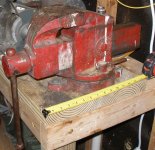
Here's a photo of the American Scale 77N (I was wrong on the suffix).

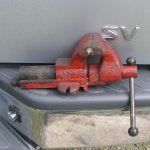
Also is a photo of the little American Scale No. 6 on the bumper of my pickup.

As to the barn, yeah, my son and I built it. The siding is actually from a privacy fence we took down and the roofing tin is from an old stable we took down.
 

Attachments

  • red seal 1.jpg
    red seal 1.jpg
    113.1 KB · Views: 47
  • red seal 2.jpg
    red seal 2.jpg
    132.5 KB · Views: 43
  • red seal small.jpg
    red seal small.jpg
    74.7 KB · Views: 45

454ragtop

Well-known member
Joined
Mar 24, 2008
Messages
5,011
Location
Carver, MA
That 77N with its swivel jaw and swivel base is a real sweetheart, looks pretty minty too. Do you ever use the swivel jaw? They're all excellent quality vises.
 

CNGsaves

Well-known member
Joined
Sep 26, 2012
Messages
13,233
Location
KS and OK
Welcome to GJ . . . .you'll fit in great here OP !!
Those vises you have are some real keepers !! :thumbup:
 
OP
S

Southern Forester

Active member
Joined
Mar 27, 2017
Messages
31
Location
Southern Mississippi
Honestly, I have not used the swivel jaw. I just picked it up from my dad's shop - Mom passed away and we are settling her estate (Dad passed away just before 9/11). Indeed, I had not realized it had a swivel jaw even though I had used the vise many times before. I have a brother-in-law who is a blacksmith (Maytower Forge) and he's the one who pointed out the feature with no small amount of envy. I actually offered him the vise as he is a blacksmith, does it for a living, and was more likely to need the feature than I (even though I have done metal work since high school - I made a suit of armor for my senior year out of stainless steel). He declined as it was my dad's vise and all.

It was researching the vise that brought me back to GJ. I'd used the site for tool selection, gradually building up my set based on reviews from this site. Most recently I snagged some WrightGrip wrenches for that reason. My Dad was originally a broadcast engineer, moved into industrial instrumentation, and when the 1990's downsizing occurred, moved into industrial maintenance at an aluminum foundry. My brother-in-law is a blacksmith and my grandfather was in charge of maintenance at Eglin Airforce Base during the 1960's and 70's. His dad was a farmer. So, while I am a Forester/Teacher/Writer, I got my wrench-turning (and general refusal to hire others to do work when I can do it) from them.

As a kid, I felt a certain kind of disdain for men whose hands were soft or who couldn't do basic vehicle or home maintenance.
 
To avoid these ads, REGISTER NOW!
Top Bottom