To avoid these ads, REGISTER NOW!

A different approach to lighting?

87jeepwrangler

Well-known member
Joined
May 23, 2013
Messages
195
As I finalize my final lighting plan for my garage (700 sq ft, 8' ceilings, ~20 4' fixtures w/ led bypass bulbs from the 'best light fixture' thread), I can't help but think there has to be a better way. Is putting a clunky metal fixture that's large enough to hold a ballast, but no longer has to, along with bypass bulbs that are an inch in diameter only because t-8's are that size, really the best we've come up with?

If bypass bulbs are nothing more than led strips with built in drivers in an acrylic tube, why can't we skip the whole metal fixture/bypass bulb all together? A quick Google search yields all kinds of strip light rolls and both metal and plastic channels that hold the led strips. You'd obviously need to power these with some type of power source/power supply, but is there any merit to doing something like this and having it provide light that rivals traditional methods? I'd obviously want to consider all the same things you'd consider when picking traditional fixtures such as cost, overall brightness, evenness of light, color, CRI, "fixture" appearance, work involved to install, longevity, reliability, upgradable, etc.

Thoughts? Am I way off base? Has this been covered and I missed it? Here's a couple pics I randomly pulled from Google for reference...
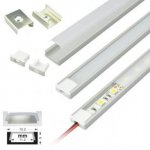
image.jpg

image.jpeg
 
To avoid these ads, REGISTER NOW!

cybrdyke

Well-known member
Joined
Sep 9, 2014
Messages
3,444
Location
USA
Optics.
Bare LED strips, bars or boards have no optics, so there's no telling where all the light goes. This makes them undesirable for general illumination.
I agree with you though, that for new installations, the empty fixture and bypass tubes is a pretty weak system. But this is Garage Journal. If you read the lighting threads you will quickly see that most members are looking for the cheapest POS that they can find. I am constantly amazed at the level of **** that they find on the internet sites.
LED technology has exploded recently. There are some amazing products out there and some really cool looking fixtures, but you get what you pay for. The cool new stuff isn't the cheapest stuff, so you'll rarely see it on this forum.
CD
 
OP
8

87jeepwrangler

Well-known member
Joined
May 23, 2013
Messages
195
Optics.
Bare LED strips, bars or boards have no optics, so there's no telling where all the light goes. This makes them undesirable for general illumination.

4' bypass LEDs are nothing more than LED light strips in a plastic tube (correct me if i'm wrong). while the fixture a bypass bulb is put in certainly will have an effect on the optics and where all the light goes, I fail to understand how a simple LED light strip channel behaves so differently that it is undesirable for general illumination. care to elaborate?


Hyperikon 4FT Fixture, 22W, 2200lm, 5000K, Frosted, Utility Shop Light, UL, 142 Lumens/$1 (linked to Amazon)
while that is an interesting fixture that I might have very well been interested in, i don't like the clunky plug/wire/switch attached to this specific one, i was hoping for something i could hardwire or have less bulky wiring (think hidden wires like a flush mount f32t8). i was also hoping for something in the 4000k color range, but its nice to see some other products out there. and while my purpose here isn't to come up with cheaper solutions than what are in the "best light fixture" thread, i still feel like these solutions are all overprices after seeing the cost of the actual LED strips.
 
To avoid these ads, REGISTER NOW!

cybrdyke

Well-known member
Joined
Sep 9, 2014
Messages
3,444
Location
USA
4' bypass LEDs are nothing more than LED light strips in a plastic tube (correct me if i'm wrong).
Those made by quality manufacturers are not just light strips shoved into a tube. Look closely and you will see very specifically chosen beam angles. These angles are not chosen randomly, they are chosen so that the lamp will perform a certain way. With this information, we can now create photometric data which will show us exactly where all the light goes.
while the fixture a bypass bulb is put in certainly will have an effect on the optics and where all the light goes, I fail to understand how a simple LED light strip channel behaves so differently that it is undesirable for general illumination. care to elaborate?
In LED tubes designed for general illumination, diodes can be placed at angles on the boards to create a beam angle. Other equipment, such as reflectors or prismatics can be used to harness the light into the chosen direction. In generic LED tape rolls or bars, there is no chosen direction of beam. The only optic is the primary optic over the diode which is typically very directional, therefore not allowing a proper spread of light. These tapes and boards are either for decorative light, gizmo lights, or accent lights. They are also used as OEM products to be installed in some sort of fixture where the light can be re-directed at a certain angle for a certain purpose.
Does that help?
CD
 

chipss36

Well-known member
Joined
Dec 1, 2015
Messages
158
Location
texas
I sure would like to know how they get an angle on surface mounted diodes?

reminds me of the cost of HDMI cable when they first came out....give it a few years.
 

Platonic Solid

Well-known member
Joined
Nov 29, 2014
Messages
3,587
Location
CT-USA
87jeepwrangler - Industrial light fixtures are designed for maximum installation flexibility for the purpose of appealing to the largest possible market. There are minimum AC wireway space requirements that must be complied with for a hardwired electrical enclosure that permits continuous row mounting. Add to that the typical options: emergency battery backup, motion sensor, dimming, and DALI control which take up space. If you want hardwired strip lights as small as the picture in your first post, you'll have to feed it with low voltage DC from a remote power supply. This is a viable option, just not a popular one (yet).

chipss36 - There are several LED shapes. Some use silicone lenses which provide excellent beam control vs flat chips and multi-chip COBs that provide mostly spherical outputs. The interior angled sides of a typical flat LED chip die has some influence on the resulting beam spread.
 
To avoid these ads, REGISTER NOW!
Top Bottom