To avoid these ads, REGISTER NOW!

A large lathe and mill on one circuit?

Noltz

Well-known member
Joined
Mar 10, 2020
Messages
377
Location
Ontario, Canada
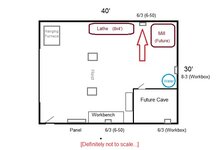
I'm bringing home a large 240v 5HP Willson lathe from a friend next week. My shop has a 6/3 run from the panel to a 6-50 outlet that's about 10' away, and I plan for a knee mill in the future that'll be 5' on the other side of this current outlet.

What's the best way to install these two to share the 6/3 run? I'm thinking a small sub panel but if there's a better option I'd like to hear it.
ShopLayout1.jpg
 
To avoid these ads, REGISTER NOW!

theoldwizard1

Well-known member
Joined
Feb 22, 2011
Messages
43,142
Location
SE MI
I'm bringing home a large 240v 5HP Willson lathe from a friend next week. My shop has a 6/3 run from the panel to a 6-50 outlet that's about 10' away, and I plan for a knee mill in the future that'll be 5' on the other side of this current outlet.
I am pretty sure that a 6-50 is not rated for a 5 HP motor.

Yes, a sub panel with flexible conduit to each tool is the best solution.
 
OP
N

Noltz

Well-known member
Joined
Mar 10, 2020
Messages
377
Location
Ontario, Canada
Yeah the runs were terminated with 6-50's because he was welding in there. There's multiple drops as illustrated including a dedicated one for electric heat in that future cave room (which is very heavily insulated, was used for mixing and curing epoxies where temperatures were critical). Seems they went overkill on the wiring.

Quick Edit; 6-50s are on the walls but the walls have 6-3 wires in them. I just need to connect the neutrals in the LC.
 
Last edited:

lund

Well-known member
Joined
Nov 2, 2019
Messages
766
Location
Michigan
6-50 is only rated for 3 hp.
Sorry dumb question: Why is a 6-50 plug rated to only 3 hp? Is that the max hp that code allows to be plugged? 6-50 can source 50 A @ 240 V which delivers 12,000 Watts. Using online conversion calculators, 3hp = 2237.1 Watts, which is only about 19% of the plug's power rating.
 
OP
N

Noltz

Well-known member
Joined
Mar 10, 2020
Messages
377
Location
Ontario, Canada
The key take away is... the existing wiring would NOT POWER the lathe.
The wiring is fine. It's 6-3 in my walls to 6-50s. It's much larger than the wire that fed the lathe in it's old home. I have to check but I believe the lathe was on a 30A breaker. Unless you meant the existing plug would not (safely) power the lathe. I'd agree and I'm hoping Wylie will chime in on if a 5HP must be hardwired.
I run my mill, lathe, MIG, TIG, and spot welder all on one circuit.
I'm a one man shop so only one of those is running at a time
Did you use a sub panel to split the circuit or are they on plugs?
 

sparky 1971

Well-known member
Joined
Oct 9, 2018
Messages
7,969
Location
Central Iowa
Sorry dumb question: Why is a 6-50 plug rated to only 3 hp? Is that the max hp that code allows to be plugged? 6-50 can source 50 A @ 240 V which delivers 12,000 Watts. Using online conversion calculators, 3hp = 2237.1 Watts, which is only about 19% of the plug's power rating.
Because some people are a special kind of stupid and can't be trusted to not unplug to cord while the machine is running, which could potentially make a heck of an arc flash.

To plug in a 5HP, A pin and sleeve connector should be used. It's a whole bunch cheaper to hardwire.
 
To avoid these ads, REGISTER NOW!

mm08822

Well-known member
Joined
Jan 13, 2012
Messages
5,904
Location
NJ
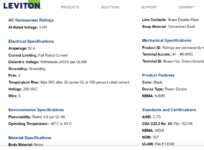
Devices used in a motor circuit must be HP rated per NEC - 430.109(F). This is ensure sufficient connection capacity during a locked rotor condition and start-up.
1692144807089.png
 

mm08822

Well-known member
Joined
Jan 13, 2012
Messages
5,904
Location
NJ
Sorry dumb question: Why is a 6-50 plug rated to only 3 hp? Is that the max hp that code allows to be plugged? 6-50 can source 50 A @ 240 V which delivers 12,000 Watts. Using online conversion calculators, 3hp = 2237.1 Watts, which is only about 19% of the plug's power rating.
Type of load matters. A resistive load (heater) is not an issue for the contacts. An inductive load (motor) has high in-rush current until up to speed, if it doesn't get up to speed or turn at all (locked rotor) it could be drawing several times motor nameplate current. Also, if disconnected under load or a locked rotor, the arc flash would be tremenous, possibly damaging plug/recept and the person pulling them apart.
 
OP
N

Noltz

Well-known member
Joined
Mar 10, 2020
Messages
377
Location
Ontario, Canada
Why? 5HP @230VAC single phase requires 32A, add 25% (8A) = 40A. Even NM-B #6 is good for 50A. THHN or XHHW is higher.

This is the actual condition I'm asking about right now. I have NM-b #6 in the wall there currently on a 40A breaker. I don't use the 6-50 and want to change it to a sub panel unless someone else has a better idea. Although I'm happy we're discussing the proper useages of a receptacle I'm still curious if anyone else would do something other than replacing this 6-50 with a sub panel and hard-wiring the two tools. One man shop. If the motors are 3HP or smaller (on the lathe and the future mill) I could use the existing receptacle but I don't think swapping plugs between machines is a good solution.
 

mm08822

Well-known member
Joined
Jan 13, 2012
Messages
5,904
Location
NJ
I would add the panel so I wouldn't have to plug in each equipment each time when needed.
 

rsanter

Well-known member
Joined
Dec 22, 2007
Messages
18,510
Location
visalia ca
The wiring is fine. It's 6-3 in my walls to 6-50s. It's much larger than the wire that fed the lathe in it's old home. I have to check but I believe the lathe was on a 30A breaker. Unless you meant the existing plug would not (safely) power the lathe. I'd agree and I'm hoping Wylie will chime in on if a 5HP must be hardwired.

Did you use a sub panel to split the circuit or are they on plugs?
They are on plugs
 

lund

Well-known member
Joined
Nov 2, 2019
Messages
766
Location
Michigan
Because some people are a special kind of stupid and can't be trusted to not unplug to cord while the machine is running, which could potentially make a heck of an arc flash.

To plug in a 5HP, A pin and sleeve connector should be used. It's a whole bunch cheaper to hardwire.
Thanks. Make some sense at least in a Murphy's Law context.

The arc concern really applies to anything with a significant amount of inductance though. A welder with a transformer is probably in a similar category. So it is odd that the code rules things out by Hp for motors but not something with a plug in transformer. Granted, people are not generally lugging around 3 hp + electric motors so hard wire is probably fine for most large motors. But high power welders and other stuff need to be moved.
 

dave*99

Well-known member
Joined
May 5, 2009
Messages
4,263
Location
Coastal NJ
Thanks. Make some sense at least in a Murphy's Law context.

The arc concern really applies to anything with a significant amount of inductance though. A welder with a transformer is probably in a similar category. So it is odd that the code rules things out by Hp for motors but not something with a plug in transformer. Granted, people are not generally lugging around 3 hp + electric motors so hard wire is probably fine for most large motors. But high power welders and other stuff need to be moved.
A spinning motor creates back EMF too. So pull the plug on a running motor and you have the mass and inertia of the spinning rotor and load equipment driving energy into the collapsing magnetic field. It's the combination of inductance and back EMF that makes the BIG SPARK.

A welder...... not so much.
 
To avoid these ads, REGISTER NOW!
Top Bottom