To avoid these ads, REGISTER NOW!

A morning with my weird tools...

M635_Guy

Well-known member
Joined
Dec 5, 2019
Messages
4,335
Location
NC
My old BMW has been having issues starting lately. I cleaned up the plugs and replaced the cap and rotor, but I've strongly suspected it's a fuel issue. I never got to it this weekend, so I decided to steal a couple hours and poke at it a bit. It wound up being a series of seldom-used or weird tools (I'm thinking about the bit-ratchet here).

I went to the trunk to see anything was going on at the top of the gas tank, which was recently replaced. There wasn't, but I noticed one of the many wires tied into the positive terminal had pulled free of its ring connector. I was sure that had nothing to do with anything else, but decided to fix it. Out came the new bit ratchet kit and some other stuff to replace and crimp the new ring connector, and to put a heat-shrink on it.
F7GPc5.jpg
(one of these days I need to have all that stuff tidied up...)

Then the bit ratchet kit went to work. Getting to the band clamp nut for the fuel hose at the beginning of the rail was a PITA. I replaced all the fuel hoses a few years ago, and somehow managed to put the clamp in a very stupid position...
rcqDGp.jpg

It was a quarter-turn at a time for a little but, but finally loosened it enough that I could switch to a socket:
luOd2S.jpg

All this was to tie in the Maddox fuel pressure test kit:
My long-reach fuel hose pliers were especially handy...
PsL7jh.jpg

d16EcA.jpg
Ki4zfJ.jpg

Not unexpectedly, the result is low. Guess I'm changing the fuel pump.
ImL2tg.jpg

I'm happy to say all this stuff worked extremely well, and it's really satisfying to have good tools. If I had any doubts about the utility of the Icon bit ratchet kit and the super-short sockets, they're long-gone now. I don't get to use the hose pliers very often, but holy hell are they a godsend when you need them. The Maddox Fuel pressure test kit is more than I need, but very nice and very easy. For less than the price of towing the car, it will definitely be handy to have around.
 
Last edited:
To avoid these ads, REGISTER NOW!

larry_g

Well-known member
Joined
Apr 28, 2007
Messages
16,885
Location
oregon
If that is a rail system that has a fuel pressure regulator at the end of the rail to bypass excess fuel back to the tank you need to confirm if the pump is not pressurizing the system or the regulator is releasing to much. There may be more that one devise controlling the pressure in the system.

lg
no neat sig line
 

Dave455

Well-known member
Joined
Mar 19, 2013
Messages
5,821
Location
Sussex, England
I find myself using my bit ratchet(s) at least weekly now, sometimes several times a week.

Sometimes a bit ratchet is the most convenient tool, but a lot of times it’s the only tool that will do a job.

That’s a lot of use for a tool that I didn’t own twenty years ago, which I think is a reflection on how a lot of vehicles are built now.

I have two BMW’s in the fleet, and I think I can say that the newer they get, the worse they become in this regard.

I have the Facom version of basically the same tool. Although they are made in Taiwan they’re a good quality tool, and incredibly well designed.622C830D-0601-4B01-AB6C-075EBED02771.jpeg

The Icon set seems to be incredibly good value. If I could obtain them at comparable prices this side of the pond, I’d probably leave a set in every vehicle I own.
 
OP
M

M635_Guy

Well-known member
Joined
Dec 5, 2019
Messages
4,335
Location
NC
Sometimes the manufacturer creates reasons for you to buy specialty tools...and sometimes YOU create reasons to buy specialty tools. That BMW seems to have a mix of both.
LoL - the stupidity of the hose clamp placement was all my fault. Several years ago I had a lot of trouble getting it on the hard line (down by the driver's side wheel well) and probably had some tension/twist in there that turned the hose clamp over time. I'll definitely flip it and place it better when I'm buttoning things up.

There's not a lot of truly-special tools for this car. It's mainly down to some tight spaces that are often of my own creation one way or another (e.g. I put in an all-aluminum radiator that is thicker, making the cap/rotor challenging to access.). The spark-plug socket is a bit unique (very tight space in the socket tube) but there is a tool in the trunk for that (I have the much-nicer/better factory socket). Hell - I've heard more than one old-BMW-mech say you could do a massive amount of stuff for the car with the tools in the tray in the trunk. You wouldn't want to, but you could...
 
Last edited:
OP
M

M635_Guy

Well-known member
Joined
Dec 5, 2019
Messages
4,335
Location
NC
If that is a rail system that has a fuel pressure regulator at the end of the rail to bypass excess fuel back to the tank you need to confirm if the pump is not pressurizing the system or the regulator is releasing to much. There may be more that one devise controlling the pressure in the system.
It does. The fuel pressure is a bit low, but not massively low (43psi is the spec), so I have more investigation to do.

I need to make sure the AFM is opening, and I kinda wonder how healthy the Throttle Position Sensor is. I'll suss these out and eventually things will get sorted. It's a learning process.
 

joel63

Well-known member
Joined
Oct 9, 2012
Messages
1,909
Location
Central FL
LoL - the stupidity of the hose clamp placement was all my fault. I had a lot of trouble getting it on the hard line (down by the driver's side wheel well) and probably had some tension/twist in there that turned the hose clamp over time. I'll definitely flip it and place it better when I'm buttoning things up.

There's not a lot of truly-special tools for this car. It's mainly down to some tight spaces that are often of my own creation one way or another (e.g. I put in an all-aluminum radiator that is thicker, making the cap/rotor challenging to access.). The spark-plug socket is a bit unique (very tight space in the socket tube) but there is a tool in the trunk for that (I have the much-nicer/better factory socket). Hell - I've heard more than one old-BMW-mech say you could do a massive amount of stuff for the car with the tools in the tray in the trunk. You wouldn't want to, but you could...
Don't listen to them, you need more tools. :lol:
 
OP
M

M635_Guy

Well-known member
Joined
Dec 5, 2019
Messages
4,335
Location
NC
Another morning, another job that turned out to be harder than I expected. I was replacing the PCV/Oil Separator in the family Volvo V70. It's kinda jammed against the firewall, and access to four of the bolts in the back is pretty tight and awkward (that sucker has a long engine bay to lean over. and I'm 6'1"). They weren't tight, so I'm guessing whoever did this before had the same access issues I had.
GblbYR.jpg
(that's the new one installed)

I got them out with my 3/8" torx socket, using one hand to turn and one to hold the socket, and the assembly came out, but I wanted to get it properly tight on those four bolts in the back.

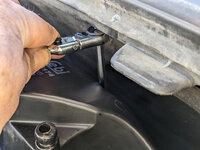
Nothing I had was working well. I kept using the 3/8" socket, but on my shortest 3/8" extensions it was still too tall and would foul on the cowling, even before I put a ratchet on it. With an adapter, I had similar issues with 1/4" sockets. I tried various combinations of ratchets, extensions, flex joints, bendy/flexible extensions and sockets before remembering there were torx bits in the Icon set. With the extension, it fit near-perfectly.
H3yUpA.jpg

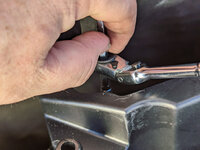
I did need to clear a fastener on the firewall, so flipping it over to allow the extension to slide through the ratchet a bit:
Bb2gei.jpg

I was having a bit of trouble keeping the bit on one of the bolts, so I slid the ratchet down more so I could steady the extension.
SrZfpJ.jpg

I'm sure there are other techniques/tools I'm missing, but I sure was glad to have that gizmo today.
 
To avoid these ads, REGISTER NOW!

nadogail

Well-known member
Joined
Jan 23, 2009
Messages
31,969
Location
Coronado, CA
When I replaced the Brake Master Cylinder on my 1973 Toyota Pickup the factory manual that i made them include when I bought the truck called for a special tool to adjust the Free Play. I used a vernier caliper and got it right the fist attempt.
 

VolvoRyan

Well-known member
Joined
Dec 29, 2019
Messages
1,339
Location
Kentuckiana, USA
Another morning, another job that turned out to be harder than I expected. I was replacing the PCV/Oil Separator in the family Volvo V70. It's kinda jammed against the firewall, and access to four of the bolts in the back is pretty tight and awkward (that sucker has a long engine bay to lean over. and I'm 6'1"). They weren't tight, so I'm guessing whoever did this before had the same access issues I had.
GblbYR.jpg
(that's the new one installed)

I got them out with my 3/8" torx socket, using one hand to turn and one to hold the socket, and the assembly came out, but I wanted to get it properly tight on those four bolts in the back.

Nothing I had was working well. I kept using the 3/8" socket, but on my shortest 3/8" extensions it was still too tall and would foul on the cowling, even before I put a ratchet on it. With an adapter, I had similar issues with 1/4" sockets. I tried various combinations of ratchets, extensions, flex joints, bendy/flexible extensions and sockets before remembering there were torx bits in the Icon set. With the extension, it fit near-perfectly.
H3yUpA.jpg

I did need to clear a fastener on the firewall, so flipping it over to allow the extension to slide through the ratchet a bit:
Bb2gei.jpg

I was having a bit of trouble keeping the bit on one of the bolts, so I slid the ratchet down more so I could steady the extension.
SrZfpJ.jpg

I'm sure there are other techniques/tools I'm missing, but I sure was glad to have that gizmo today.


Alweays funny to see a Volvo 3.2L on a BMW thread. I'll have to see if the PCV box is that tight on the wife's XC60. That engine has all the room in the world to work on in the XC90. :)

Have you replaced the serp belt drive on that engine yet? You'll probably need that bit ratchet again for the water pump.

What EFI does the BMW use? All BMW? Not sort of a cookie-cutter flavor of Bosch-Jetronic that VAG and the Scandiavians used?

-Ryan
 
OP
M

M635_Guy

Well-known member
Joined
Dec 5, 2019
Messages
4,335
Location
NC
Always funny to see a Volvo 3.2L on a BMW thread. I'll have to see if the PCV box is that tight on the wife's XC60. That engine has all the room in the world to work on in the XC90. :)
We have a weird set of cars in the family right now. Technically it is six, though the '10 Volvo V70 is new to us as we bought it from a family friend to replace the '06 X5 that is just too hungry for gas. The rest include my old BMW and a '10 Mini Clubman, an '05 Odyssey and a '12 Mazda3. And I do whatever I can for my mother's '02 Camry.

Lots of opportunities for weird tools. The Mini especially represents opportunity for space/access challenges.

Have you replaced the serp belt drive on that engine yet? You'll probably need that bit ratchet again for the water pump.
The serp belt was replaced (by my friends at the local Saab/Volvo specialty shop) in 2019 at 155K, along with the tensioner/rollers. The car is flirting with 200K at this point, but I'd guess it's still in decent shape. I'll have to make a point to look though. They replaced the 'water pump coupler' at the same time. Seeing that (and not a water pump) in the records I have that go back to 130K miles, I asked that Swedish-import specialist about the replacement cycle on water pumps. His response blew my mind - "We've only ever done a handful of water pumps in over 20 years. The coupler is a 150K service item, so you should be fine." He explained that since the pump isn't belt-driven, it's just not something that needs proactive replacement on these cars.

I noticed looking at the records I have that the "oil trap" is on the records as having been replaced just under five years ago by the Volvo dealership. I didn't recognize it as the PCV until just now. Assuming it's the same one I removed (and would almost certainly have records for it in this case if it wasn't), I'm a little surprised the bolts were so loose. I couldn't find a torque spec, so I buttoned it down firmly-but-not-cranked, but I have to think they weren't as tight as they were supposed to be overall, and the back four bolts I was struggling with weren't much more than finger-tight. I can see it if someone was using a u-joint at that tight angle and not something better, but surprised a dealership didn't have a better tool. Maybe the tech just sucked.

What EFI does the BMW use? All BMW? Not sort of a cookie-cutter flavor of Bosch-Jetronic that VAG and the Scandiavians used?
Bosch-Jetronic. I don't know loads about it though.
 

All

Well-known member
Joined
Mar 28, 2013
Messages
606
Maddox fuel pressure test kit:

ImL2tg.jpg

I'm happy to say all this stuff worked extremely well, and it's really satisfying to have good tools. The Maddox Fuel pressure test kit is more than I need, but very nice and very easy. For less than the price of towing the car, it will definitely be handy to have around.


When I used this exact same Maddox Master Fuel Pressure Test kit shown in the photos quoted above, I discovered that the gauge can trap pressure (and gasoline) between the quick release fitting and the gauge itself, and that pressure does not consistently, nor completely, get released by the push button drain.

The inconsistency and inability of the gauge to release all pressure and fuel after repeatedly and deeply pressing the release button... ultimately led to inaccurate diagnosis of fuel pressure decay.

I changed Schrader valves in the brass T block, which made a difference, but did not definitively solve the problem.

I disassembled the quick release, change springs, doubled springs, lightened springs... all to no corrective avail.

When initially using the gauge, it seemed quite responsive, and therefore was assumed to be accurate. It was only after draining the rail and still seeing the Maddox gauge report 10 psi was present that I began to investigate. The pressure gauge would return to zero only after inserting a brass drift pin to manually actuate the detent, and of course, getting gas all over my hand when doing so.

I really wanted to like this $89 Maddox Master test kit... which is a huge step up from the $49 Maddox fuel pressure tester kit in a case, nevermind the $29 Maddox fuel pressure tester on a blister card without a case. The gauges themselves of the latter two less expensive Maddox fuel pressure testers have smaller dial faces, but better overmold grip surrounds, than the larger $89 Maddox Master Test Kit shown above. But otherwise, the Maddox Master kit looks and feels better in every other way over the less expensive Maddox counter parts.

In fact, there were several aspects about this Maddox Master kit that looked better than the $299 Icon Master Fuel Pressure kit, as follows:

- The Maddox Master Kit lower tray had defined organization for the longer hoses, making them easier to put away, and easier to see what is missing. The structure also keeps the fittings protected, and makes it easier to insert the top tray and close the case.

- The ICON Master Kit lower tray has no organization whatsoever... it is just an open tray, forcing one to play tetris when cramming the longer hoses back into the case, and allowing any exposed Schrader pins in the fittings to potentially get bent.

- The Maddox Master Kit pressure release button is metal brass

- The ICON Master Kit pressure release button is plastic, and slightly smaller, making it harder on the finger to press.

- The Maddox Master Kit Schrader valve pins are all recessed within the quick release fittings.

- The ICON Master Kit Schrader valve pins are all EXPOSED and external to the quick release fittings, making them vulnerable to damage from inadvertent bumps, or inadvertent misalignment when engaging the couplings.


It is important to note at this juncture that the quick release couplings between the Maddox Master test kit versus the ICON Master Test Kit are NOT compatible, and NOT interchangeable. They are a fundamentally different design, and this design change could help explain why the ICON gauge actually WORKS, and consistently so, whereas the Maddox gauge did not, in my experience.

Based on appearance alone, the Maddox pin actuator in the female end of the quick coupler appears more robust, with a broader face for a more forgiving engagement with the Schrader valve pin.

By contrast, the ICON pin actuator is actually another Schrader pin, such that the coupling engagement is two Schrader pins horizontally opposed, and these two pins have to align with each other to actuate each other. It looks wonky, but it works.

I broke down and bought the ICON Master Fuel Pressure Gauge kit, because I wanted to know what the actual fuel pressure was in the FUEL RAIL, not the pressure that was erroneously trapped in the gauge itself, by virtue of poor tolerances and/or manufacturing execution of the coupling design of the fittings.

After a long and tortuous journey owning and using the $50 Maddox Fuel Pressure Test Kit (read no pressure at all, due to fitting design), the $90 Maddox Deluxe Master Fuel Pressure Test kit pictured above (read pressure all the time, and did not release pressure), and finally, the $300 ICON Master Fuel Pressure Test kit... I would recommend skipping the Maddox versions, and going straight to the ICON version, if one cannot afford or justify spending $800 on OTC or Snap-On kits.

And if continuing to use the Maddox gauge shown above, test to confirm that all pressure has been released from the gauge.
 

dscheidt

Well-known member
Joined
Apr 26, 2017
Messages
2,897
I've seen a truck where the fuel pump in the tank had a screen over the inlet. Covered with some weird gunk. He cleaned the screen andd the pump, and the problem went away.

On vehicles with an external lift pump, problems with the pickup tube are pretty common. The filter screen at the end gets gunked up, or the tube gets a hole in it, which is only a problem when the fuel level is below the hole. In tank pumps are more robust at resisting that -- they have bigger filter socks, and external leaks between the engine and tank spray fuel, not **** air. (which makes them easier to find, if nothing else.)

A had a customer that had an intermittent stalling problem. Car would run fine, but occasionally stall, or buck like crazy. As described, it sounded like a fuel problem. Restarted fine, would run for a day or a week, and then do it again. We tested everything, and maybe threw some parts at it, but we couldn't get it to do it when we had it. Eventually, it came in on the hook, with a dead fuel pump. There was a plastic bag or sheet in the gas tank, which got stuck to the strainer sock on the pump, and would sometimes flip into position where it was choking off the pump. Turning the pump off broke the suction, so it would work again. Customer had no idea how the debris got in the tank, and had owned the car since it was new. We'd suggested dropping the tank to inspect the pump, but he didn't want to pay for it.
 
OP
M

M635_Guy

Well-known member
Joined
Dec 5, 2019
Messages
4,335
Location
NC
When I used this exact same Maddox Master Fuel Pressure Test kit shown in the photos quoted above, I discovered that the gauge can trap pressure (and gasoline) between the quick release fitting and the gauge itself, and that pressure does not consistently, nor completely, get released by the push button drain.

The inconsistency and inability of the gauge to release all pressure and fuel after repeatedly and deeply pressing the release button... ultimately led to inaccurate diagnosis of fuel pressure decay.

I changed Schrader valves in the brass T block, which made a difference, but did not definitively solve the problem.

I disassembled the quick release, change springs, doubled springs, lightened springs... all to no corrective avail.

When initially using the gauge, it seemed quite responsive, and therefore was assumed to be accurate. It was only after draining the rail and still seeing the Maddox gauge report 10 psi was present that I began to investigate. The pressure gauge would return to zero only after inserting a brass drift pin to manually actuate the detent, and of course, getting gas all over my hand when doing so.

I really wanted to like this $89 Maddox Master test kit... which is a huge step up from the $49 Maddox fuel pressure tester kit in a case, nevermind the $29 Maddox fuel pressure tester on a blister card without a case. The gauges themselves of the latter two less expensive Maddox fuel pressure testers have smaller dial faces, but better overmold grip surrounds, than the larger $89 Maddox Master Test Kit shown above. But otherwise, the Maddox Master kit looks and feels better in every other way over the less expensive Maddox counter parts.

In fact, there were several aspects about this Maddox Master kit that looked better than the $299 Icon Master Fuel Pressure kit, as follows:

- The Maddox Master Kit lower tray had defined organization for the longer hoses, making them easier to put away, and easier to see what is missing. The structure also keeps the fittings protected, and makes it easier to insert the top tray and close the case.

- The ICON Master Kit lower tray has no organization whatsoever... it is just an open tray, forcing one to play tetris when cramming the longer hoses back into the case, and allowing any exposed Schrader pins in the fittings to potentially get bent.

- The Maddox Master Kit pressure release button is metal brass

- The ICON Master Kit pressure release button is plastic, and slightly smaller, making it harder on the finger to press.

- The Maddox Master Kit Schrader valve pins are all recessed within the quick release fittings.

- The ICON Master Kit Schrader valve pins are all EXPOSED and external to the quick release fittings, making them vulnerable to damage from inadvertent bumps, or inadvertent misalignment when engaging the couplings.


It is important to note at this juncture that the quick release couplings between the Maddox Master test kit versus the ICON Master Test Kit are NOT compatible, and NOT interchangeable. They are a fundamentally different design, and this design change could help explain why the ICON gauge actually WORKS, and consistently so, whereas the Maddox gauge did not, in my experience.

Based on appearance alone, the Maddox pin actuator in the female end of the quick coupler appears more robust, with a broader face for a more forgiving engagement with the Schrader valve pin.

By contrast, the ICON pin actuator is actually another Schrader pin, such that the coupling engagement is two Schrader pins horizontally opposed, and these two pins have to align with each other to actuate each other. It looks wonky, but it works.

I broke down and bought the ICON Master Fuel Pressure Gauge kit, because I wanted to know what the actual fuel pressure was in the FUEL RAIL, not the pressure that was erroneously trapped in the gauge itself, by virtue of poor tolerances and/or manufacturing execution of the coupling design of the fittings.

After a long and tortuous journey owning and using the $50 Maddox Fuel Pressure Test Kit (read no pressure at all, due to fitting design), the $90 Maddox Deluxe Master Fuel Pressure Test kit pictured above (read pressure all the time, and did not release pressure), and finally, the $300 ICON Master Fuel Pressure Test kit... I would recommend skipping the Maddox versions, and going straight to the ICON version, if one cannot afford or justify spending $800 on OTC or Snap-On kits.

And if continuing to use the Maddox gauge shown above, test to confirm that all pressure has been released from the gauge.

Hmm... I didn't have that issue with mine, and probably can't justify the Icon kit as a DIYer. The Maddox fit the bill of avoiding an hour of shop time and a tow (though strictly-speaking the Icon would too...). The Icon has a lifetime warranty vs. the 90-days of the Maddox, which might have tipped me toward the Icon at the time.

Lastly, I'm also noticing the Maddox kit doesn't have any reviews - I'm wondering if they revised the kit to address the problems you saw?
 

All

Well-known member
Joined
Mar 28, 2013
Messages
606
My guess is that HF took down the reviews, because the $90 Maddox Master Test kit has been on the market for several years, proven by when you purchased yours.

Moreover, this particular fuel pressure test kit is the ONLY kit that HF sells that imposes a 20% restocking fee upon return, and returns cannot be processed in store, not even within 90 days (or even 5 days) of purchase.

The less expensive (and differently designed, as it is absent of the quick release gauge coupler) $50 Maddox Fuel Pressure Test Kit in a case can be easily returned and happily accepted in store without a restocking fee, and without emailing HF mothership.

The same readily accepted return policy holds true with the even cheaper $30 Maddox Fuel Pressure gauge without a case... no restocking fee, no need to ship the unit to HF headquarters. And as you pointed out, the most expensive ICON Fuel Pressure Master Kit, with the "lifetime guarantee" can be returned also, without a restocking fee.

I asked about the return policy of all of these different fuel pressure testers... at 4 different HF stores, whose reports corroborated with each other. Only the $90 Maddox Master Kit has the 20% restocking fee, and no return in store policy.

I suspect HF knows that something is wrong with the design of the quick coupling system of this kit, and has had a lot of complaints and prior returns. Perhaps that is why they came up with the ICON kit. Perhaps that is why we find that there are ZERO reviews, which is odd for a very attractive and appealing product and value proposition that has been sold for several years.

I actually had to visit 4 different stores to find the ICON kit in stock, since the computer at all of the stores indicated that they had ICONs in stock, but when showing up to pick it up, come to find out that the stock indicated was not present. The store employees surmised that the ICON kits were stolen, as they were MIA. I finally learned to call ahead and ask and employee to lay hands on the kit before I showed up. At last, I found one, that was previously opened, but I took a chance anyway, after being given a substantial discount, since all the pieces were there, and there was no smell of fuel.

The ICON gauge was the first one that worked as expected out of the gate. I learned to test with regulated air pressure first, before hooking it up to the fuel system. The ICON worked with both fluids, in both reading and releasing pressure.

My post was not an attempt to denigrate your decision making, or disparage what worked for you. After all, I made the same decision as you did, and for the same reasons. But I did not have the same experience... and more importantly, I would not have even been aware of a problem with the $90 Maddox Master Test kit, if I was only seeking to determine the presence of pressure, and not also seeking to determine rate of pressure decay.

Once I discovered the issue with the Maddox gauge retraining residual pressure trapped between the gauge itself and the quick release coupler, I searched Garage Journal forum to find out what other folks have experienced with this same gauge. Yours was the only post I found, so I reported my experience here, as a heads up to you for when you might use the gauge again, and as a heads up to others to be aware of this issue.
 
OP
M

M635_Guy

Well-known member
Joined
Dec 5, 2019
Messages
4,335
Location
NC
My guess is that HF took down the reviews, because the $90 Maddox Master Test kit has been on the market for several years, proven by when you purchased yours.

It's highly unlikely they wiped all of the review IMHO. I'm aware it has been available for a while, but I have seen HF replace a part number with a very-slightly updated new one any number of times. Certainly if they had a flawed kit it would behoove them to replace it with a better one and sunset the older, likely-poorly-reviewed one, giving the new part number a chance for better reviews.

Moreover, this particular fuel pressure test kit is the ONLY kit that HF sells that imposes a 20% restocking fee upon return, and returns cannot be processed in store, not even within 90 days (or even 5 days) of purchase.

The less expensive (and differently designed, as it is absent of the quick release gauge coupler) $50 Maddox Fuel Pressure Test Kit in a case can be easily returned and happily accepted in store without a restocking fee, and without emailing HF mothership.

The same readily accepted return policy holds true with the even cheaper $30 Maddox Fuel Pressure gauge without a case... no restocking fee, no need to ship the unit to HF headquarters. And as you pointed out, the most expensive ICON Fuel Pressure Master Kit, with the "lifetime guarantee" can be returned also, without a restocking fee.

I asked about the return policy of all of these different fuel pressure testers... at 4 different HF stores, whose reports corroborated with each other. Only the $90 Maddox Master Kit has the 20% restocking fee, and no return in store policy.

I suspect HF knows that something is wrong with the design of the quick coupling system of this kit, and has had a lot of complaints and prior returns. Perhaps that is why they came up with the ICON kit. Perhaps that is why we find that there are ZERO reviews, which is odd for a very attractive and appealing product and value proposition that has been sold for several years.

There are lots of products where HF imposes a restocking fee where people (who ****) commonly get them, use them and return them. Pressure washers and others have the same thing. My guess is they impose those selectively where they see that phenomenon.

My post was not an attempt to denigrate your decision making, or disparage what worked for you. After all, I made the same decision as you did, and for the same reasons. But I did not have the same experience... and more importantly, I would not have even been aware of a problem with the $90 Maddox Master Test kit, if I was only seeking to determine the presence of pressure, and not also seeking to determine rate of pressure decay.

Once I discovered the issue with the Maddox gauge retraining residual pressure trapped between the gauge itself and the quick release coupler, I searched Garage Journal forum to find out what other folks have experienced with this same gauge. Yours was the only post I found, so I reported my experience here, as a heads up to you for when you might use the gauge again, and as a heads up to others to be aware of this issue.

I didn't take your post as anything more than sharing your experience, which is what makes this place so valuable. I have no explanation for how bad yours was (and certainly don't defend it). If I'd caught a 25% or 30% off coupon, I probably would have opted for the Icon.

I realize a buddy of mine used my kit to help with another friend's car with success, so I guess all I can say is mine has worked with the minimal amount of uses it has had.
 
Last edited:

Chipm

Well-known member
Joined
Mar 10, 2020
Messages
431
Location
Georgia
If that is a rail system that has a fuel pressure regulator at the end of the rail to bypass excess fuel back to the tank you need to confirm if the pump is not pressurizing the system or the regulator is releasing to much. There may be more that one devise controlling the pressure in the system.

lg
no neat sig line
This is where you use the shut off valve that came In your fuel pressure test kit.
 
To avoid these ads, REGISTER NOW!
Top Bottom