
Blue Chips
Well-known member
Just a little purpose-built project.
I'm in the process of installing roughly 250 short lengths of tongue-and-groove boards between the ceiling joists/beams in the old house that my wife and I are restoring. There will be fiberglass insulation between the T&G boards and the underside of the attic floor boards. Additional insulation may be added in the attic later on.
Each T&G board has to be measured individually because the beams are hand-hewn (over 200 years old) and vary dimensionally, and we want to get a snug fit against the beams for a clean and rustic Federal-period farmhouse appearance while eliminating the need for a molding strip to cover the ends of the boards, which will also leave as much of each beam exposed as possible for aesthetic reasons.
There were three prerequisites: 1. The measurements need to be accurate; 2. Measurements must be made exactly perpendicular to the beams for best accuracy; 3. Measurements need to be quick and easy to transfer to the boards to be cut.
Getting accurate inside measurements with a tape measure can be done, but the tape must be held exactly perpendicular to the beam for accuracy, which isn't always easy to do. Also, measurements from a tape would need to be committed to my short-term memory (or written down), and then transferred to the boards to be cut, which introduces the possibility of adding to any measuring error.
(BTW, I have a laser distance measuring device that is supposed to give +/- 1/16” accuracy, with increments of 1/32”, but I’ve found that it can vary a little with factors like reflectivity, temperature, small dimples/nail holes, etc., and there is still the need to make sure that it’s aimed exactly perpendicular to the beam.)
Okay, TBH, I was actually just looking for an excuse to play in the shop and make a tool, so I fabbed up a purpose-built measuring tool that will provide quick, accurate measurements taken perpendicular to the beam and make it easy to quickly and directly transfer the measurement to each piece of wood without significantly compounding any error. I’m sure it’s not a new idea, but it was a fun little project and an excuse to dust off my mill.
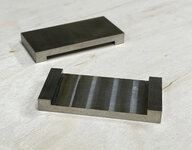
First, I milled a couple of small stainless plates on my Bridgeport:

Then I drilled mounting holes, welded a couple of nuts onto the plates, mounted the plates on a 2-inch-wide rule, and installed a retractable spring-loaded drag and a locking screw (both with nylon tips). I also chamfered the edges a bit to avoid sharp edges. As you can see, the black L-shaped rule that slides in and out of the the longer rule makes it easy to take a measurement perpendicular to the beam.


All I do is add the extended distance to the 24-inch length of the larger rule, or even better, I can simply lock the length with the locking knob and transfer the length directly to the board for cutting…no need to even note or remember the measurement.
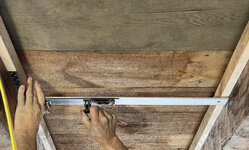
Here’s a demonstration of measuring between the beams with my gadget. Note the hand-hewn surfaces of the beams. FYI, the beams average anywhere between 7.5" x 7.5" and 8" x 8" and are about 16 feet long.
Work in progress. We've installed about 2/3 of the boards between the beams so far, but it won't be finished for a while, as I've temporarily shifted to a couple of higher-priority tasks in the house renovation work.

If I want to use this gadget for longer inside measurements later on, I can remove the small L-shaped black rule and install a longer 1-1/2-inch-wide rule.
I'm in the process of installing roughly 250 short lengths of tongue-and-groove boards between the ceiling joists/beams in the old house that my wife and I are restoring. There will be fiberglass insulation between the T&G boards and the underside of the attic floor boards. Additional insulation may be added in the attic later on.
Each T&G board has to be measured individually because the beams are hand-hewn (over 200 years old) and vary dimensionally, and we want to get a snug fit against the beams for a clean and rustic Federal-period farmhouse appearance while eliminating the need for a molding strip to cover the ends of the boards, which will also leave as much of each beam exposed as possible for aesthetic reasons.
There were three prerequisites: 1. The measurements need to be accurate; 2. Measurements must be made exactly perpendicular to the beams for best accuracy; 3. Measurements need to be quick and easy to transfer to the boards to be cut.
Getting accurate inside measurements with a tape measure can be done, but the tape must be held exactly perpendicular to the beam for accuracy, which isn't always easy to do. Also, measurements from a tape would need to be committed to my short-term memory (or written down), and then transferred to the boards to be cut, which introduces the possibility of adding to any measuring error.
(BTW, I have a laser distance measuring device that is supposed to give +/- 1/16” accuracy, with increments of 1/32”, but I’ve found that it can vary a little with factors like reflectivity, temperature, small dimples/nail holes, etc., and there is still the need to make sure that it’s aimed exactly perpendicular to the beam.)
Okay, TBH, I was actually just looking for an excuse to play in the shop and make a tool, so I fabbed up a purpose-built measuring tool that will provide quick, accurate measurements taken perpendicular to the beam and make it easy to quickly and directly transfer the measurement to each piece of wood without significantly compounding any error. I’m sure it’s not a new idea, but it was a fun little project and an excuse to dust off my mill.
First, I milled a couple of small stainless plates on my Bridgeport:
Then I drilled mounting holes, welded a couple of nuts onto the plates, mounted the plates on a 2-inch-wide rule, and installed a retractable spring-loaded drag and a locking screw (both with nylon tips). I also chamfered the edges a bit to avoid sharp edges. As you can see, the black L-shaped rule that slides in and out of the the longer rule makes it easy to take a measurement perpendicular to the beam.
All I do is add the extended distance to the 24-inch length of the larger rule, or even better, I can simply lock the length with the locking knob and transfer the length directly to the board for cutting…no need to even note or remember the measurement.
Here’s a demonstration of measuring between the beams with my gadget. Note the hand-hewn surfaces of the beams. FYI, the beams average anywhere between 7.5" x 7.5" and 8" x 8" and are about 16 feet long.
Work in progress. We've installed about 2/3 of the boards between the beams so far, but it won't be finished for a while, as I've temporarily shifted to a couple of higher-priority tasks in the house renovation work.
If I want to use this gadget for longer inside measurements later on, I can remove the small L-shaped black rule and install a longer 1-1/2-inch-wide rule.
