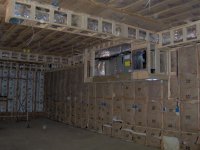
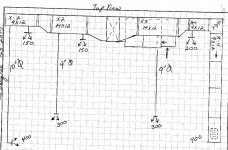
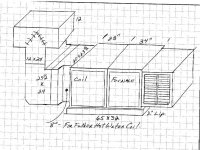
This could be a very cost-effective approach for conditioning your garage. Virtually every residential HVAC manufacturer has one or more "multi-poise" or horizontal indoor units for either furnace or heat pump applications. You are far more likely to get an aggressive bid price on one of these units than for a unit heater. As a side benefit, this unit should probably be a good bit quieter than a unit heater, especially if the duct design is done correctly.
For a ceiling-hung horizontal unit, the only real downside is the difficulty in servicing while standing on a ladder, and the slightly increased installation costs compared to a floor-mounted unit. The ductwork can be very simple, depending on the layout of your garage, and could be run concealed or exposed. The condensate discharge can be configured to slope by gravity or you may utilize a condensate pump if lift or a long discharge is required. Freeze proofing of the system can be achieved by selecting a thermostat that allows turn down to 40 degrees (frequently t'stats don't allow setpoints below 60-55 degrees). Unless you have some exceptional requirements, condensate drainage should be able to be configured so that if freezing conditions are encountered, no damage should be incurred. If you intend to provide cooling as well, position the equipment so that the refrigerant piping run from the indoor unit to the outdoor condensing unit is kept as short as possible. Discharge the condensate in compliance with local requirements.
Not certain where you are located, but typically the garage is not conditioned to the same extent as a residential unit. If reasonably well insulated, the HVAC requirements could be as little as 1-1/2 tons. The 75,000 btuh that you mention seems at first glance to be a bit high. Be certain to perform a load calculation. It seems that many of the posters on this site find out, after the fact, that they oversized their heaters and have less than perfect performance as a result. Size the unit according to typical conditions - not for record setting conditions. Place air outlets and inlets to "stir" the air as much as possible. Provide adequate fresh air in take. Coordinate duct placement with lighting layout/ceiling mounted equipment.
Be aware that many manufacturers have a substantial price difference between the high efficiency units (90%) and the super efficiency units ((96%). Unless you are utilizing the garage as occupied full time, it will take a long time to recover the increased initial cost of the super efficiency units. The best savings come from lowering the thermostat, especially when the space in unoccupied. Select from name brand units (Carrier, Trane, York, etc.). I have seen several 'off brands' that perform very poorly and end up being replaced by the owner.
Take lots of pics

Offered only as opinion

 . He can go from 20* to 75* real quick. We also ran 6" ducts off of the main trunk to each corner of his garage and also one over the workbench and one over where he stands when working under the hood of his car