To avoid these ads, REGISTER NOW!

A Slightly Different 'Sub in the Gar' Question

ScottG

Active member
Joined
May 29, 2009
Messages
36
Location
Cleveland, Ohio
Having just spent the weekend combing this forum I'm very aware of the numerous "sub panel in the garage" questions that have been posted here. Unfortunately none of them seems to address my particular issue so I guess I'll add to the litany of sub panel questions already here.

First some background:
Mine is a small, detached one car garage (14'x20') with a 12'x12' shop stuck on the back. It's currently fed by one 20A-120V circuit that runs lights, a 25 gallon air comp. , a table saw, a mitre saw and garage door opener. I plan on adding a 100A main wired as a sub in the garage fed via three 4AWG CU conductors (plus ground) from a 60A or 80A 240V breaker installed in the house panel (currently 100A service; no A/C; all gas house except for clothes dryer). Future additions in the garage will include a small electric heater (Fahrenheat/Dayton G73 type) and maybe a small MIG welder.

I've wired subs before, so I'm familiar with separating the neutral and ground
busses, installing ground rods for the sub, etc. What I'm struggling with is how to get the feeder from the house to the garage. My tiny excuse of a garage is separated from the house by concrete...everywhere...While it takes different forms (driveway/poured concrete patio/rear bedroom addition on concrete slab) from the north side of the lot to the south side of the our city sized lot is nothing but concrete. So my options for running the feeder seem to come down to these:

#1 Cut the driveway and dig a trench for an underground conduit run directly from the basement mounted main to the sub in the garage (abot 20'-25'). This is the shortest run but probably the most expensive as I'd have to pay a mason to repair the driveway.

#2 Run the feeder across the basement (about 15'), around my furnace/hot water tank and through a brick wall and into a conduit hung on the inside wall of our enclosed patio. After travelling the fifteen foot length of patio the conduit would enter a trench in the yard that would travel the last five or so feet to the garage. I would eventually box-in the exposed conduit in patio since "industrial" isn't how the patio is decorated.

#3 Run the feeder almost all the way across the basement (20 ft) and then to the rear of the house where it would enter 2" Rigid snaked underneath the rear house addition. This addition is a slab but is set on a modest brick foundation so, while there's no crawl space, per se, there is a void space that would accept the 2" Rigid. (Since the NEC only requires 2" Rigid to be supported every 16 feet and the addition is only 15 feet long, I shouldn't have to worry about supporting it from underneath the slab.) The feeder, once it emerges from underneath the slab, would then enter a trench and travel the ten or so feet to the garage.

#4 Run the feeder out of the basement, up the side of the house and then cross the driveway at a height of 12' via messenger supported overhead wire to a mast that would need to be supported by guy wires at the garage end. (Shed roof on garage is only 9.5' above grade).

Now it's your turn. What do I do? In my mind, option one and option four seem the most straight-forward. Option one would cost more as I'd need a pro to fix the driveway but it is the most direct run using the least amount of materials. Option four is almost as direct as option one, but would require more cable and materials to make it work plus, as I've never run wire overhead, I'd need to figure out exactly what such an endeavor involves before I commit. The other options are doable (I think) but really give me heartburn when I think about them.

So there you have it...another sub in the garage question but with a twist. Thanks in advance for the input and advice.
 
To avoid these ads, REGISTER NOW!

mrb

Well-known member
Joined
Dec 31, 2008
Messages
3,734
hows your soil? if its not super rocky or incredibly compacted, you can dig a big hole on either side of the driveway, make up a series of fittings to taper from 1-1/2" pvc down to 3/4, put male GHT fitting on the 3/4" end with a long jet type nozzle. Glue this to a suitable length of PVC conduit, make up a fitting to get from garden hose to 1-1/2" pvc and glue that to the other end (make sure your conduit is long enough to cross the driveway + 5ft or so) turn the water on and work the pipe under the driveway. It will take forever and make a huge mess but it works. Make sure you get deep enough so your under the base material under the driveway.
 

gatchel

Well-known member
Joined
Dec 12, 2009
Messages
672
Location
West of King of Prussia, PA
Even though it will be more difficult I would go with one of the underground options. I can't stand the look of overhead cabling. The difficulty will directly reflect on the final product.
 

creativecars

Well-known member
Joined
Nov 15, 2010
Messages
4,300
Location
Indiana- where horse and buggies still roam
When I did a simmilar thing, the city made me run the whole distance with service entrance cable (SEC) for 100 amps. A $600 piece of wire. They can use triplex, but would not let me. They did not care where I ran it, above or below ground.
 

Aceman

Well-known member
Joined
Jan 28, 2007
Messages
2,513
Location
Eastern Oregon
Is running a new overhead service to the garage an option?

If not, I'd probably shoot for option #1.
 
Last edited:
OP
S

ScottG

Active member
Joined
May 29, 2009
Messages
36
Location
Cleveland, Ohio
Wow, thanks for the quick replies. I'll try and address some of the responses:

hows your soil?

I just finished putting up a fence around the yard and can say with confidence that the soil is mostly compacted clay. Besides, the drive forms the property line on one side and abuts the house on the other side. There was barely enough room to stick fence posts along my neighbor's side of the drive; definitely no room to dig anything bigger.

Is running a new overhead service to the garage an option?

As far as I know the NEC allows it. It's not the prettiest type of install but ours is an older neighborhood and many of the garages have their 120V branch circuits strung overhead so it wouldn't be out of place.

How does the existing circuit get to the garage?

Via flex that exits the house above grade, then runs under the drive and emerges outside of the garage and enters the building under the siding. It's currently rusted through and probably taking on water as we speak. :shocking:

When I did a simmilar thing, the city made me run the whole distance with service entrance cable (SEC) for 100 amps.

I'm assuming you ran yours overhead. What did you use as the messenger wire to support the cable?

Second meter on the garage?

Possible, but probably overkill for the garage in question. It's an option that I'm keeping in my back pocket though.

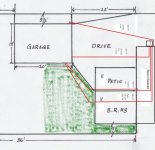
Here's a quick diagram of what's going on...
 

Attachments

  • Yard Dwga.jpg
    Yard Dwga.jpg
    94.6 KB · Views: 80

mrb

Well-known member
Joined
Dec 31, 2008
Messages
3,734
When I did a simmilar thing, the city made me run the whole distance with service entrance cable (SEC) for 100 amps. A $600 piece of wire. They can use triplex, but would not let me. They did not care where I ran it, above or below ground.

you cant use 'triplex' a subpanel requires 4 wires. What kind of cable did you buy that was $6 a foot? Copper?
 

Kevro

Well-known member
Joined
Jan 20, 2010
Messages
108
Location
Chester County, PA
My vote is for #3. I think that would provide the nicest-looking finished product, without carving a line across your driveway.
 

Grumpy365

Well-known member
Joined
Jan 21, 2010
Messages
623
Location
Brazoria County Texas
For some reason i think dong a 80 amp sub panel on a 100 amp main panel is against code in a residential application ,but i could be wrong.

(its your house, i fully support you doing what you want, but you may want to check, just so ya know)

Edit: i looked and you are 80% of the main, so you are good to go.

The next question is what is the biggest breaker available for your breaker box?
 
Last edited:

p_mori7

Well-known member
Joined
Mar 23, 2010
Messages
3,340
Location
Montreal, QC., Canada
How about running the wire in a conduit and hanging along the underside of the fence ? Might make for a longer run, but easier to do.

Maybe it's a silly thought...

skip it...just looked at your sketch...I would run it through the house, under the addition...then bury it to the garage.

good luck !
 
Last edited:
OP
S

ScottG

Active member
Joined
May 29, 2009
Messages
36
Location
Cleveland, Ohio
The next question is what is the biggest breaker available for your breaker box?

It's an older GE panel that accepts GE TR or TQL breakers. I've seen them as large as 100A. Unfortunately, it's an older, small enclosure (12 spaces/12 circuits). Consequently the main is running a 100A sub through an 80A breaker powering the living area of the house. That way the main panel is free for the 240V branch line to the dryer, 120V branch for furnace, 120V for basement lights and, hopefully, 60A or 80A feeder to the garage.
 
To avoid these ads, REGISTER NOW!

antolod

Well-known member
Joined
Jun 25, 2009
Messages
46
Location
Illinois
If it were me, I'd go with option #1, but move over enough so you are entering the garage at the side rather than the end. This keeps the conduit away from the "traffic" side of the garage. You're looking at anywhere from 2 to 3 times the length of wire to go around the drive. You need to figure out the cost of the additional wire and conduit and fittings to run the longer length. Also remember that the longer the run, the tougher the pull and you won't be able to make all of those bends without wire pulling access.

To trench the 22 feet from the house to the garage, you can saw and break out a 1 foot wide strip of the drive. You could even make it only 6 or 8 inches wide if you want, you just need to have an opening wide enough to excavate the trench easily. You can repair the drive yourself using Quikrete. Using the handy calculator here, it looks like for 5" thickness a foot wide you need 15.3 of the 80 pound bags which Lowe's sells for $5.26 each. So 16 bags is just under $85. A 6" wide patch would be half that. If you are not comfortable doing the concrete yourself, you could check with landscaping or deck contractors who are used to doing those smaller jobs.

You didn't mention in your post, so I'll throw in the reminder that you want to penetrate the basement wall above the ground using an LB so you don't have water problems. Also, if you are planning on doing this in the winter, you need to protect the ground and fresh concrete from freezing until it is cured.
 

mrb

Well-known member
Joined
Dec 31, 2008
Messages
3,734
For some reason i think dong a 80 amp sub panel on a 100 amp main panel is against code in a residential application ,but i could be wrong.

(its your house, i fully support you doing what you want, but you may want to check, just so ya know)

Edit: i looked and you are 80% of the main, so you are good to go.

The next question is what is the biggest breaker available for your breaker box?

got a code section to back that up? you can install a 200 amp subpanel off a 100 amp main if you want, but no matter what you do your connected load cannot exceed the capacity of your service -do a load calc.
 

Steevo

Well-known member
Joined
Aug 18, 2009
Messages
8,738
Location
43.49600, -112.04300
I like option #3, and if I were doing it, I'd opt for that one if only because it avoids cutting concrete and messing up your driveway.
 

Grumpy365

Well-known member
Joined
Jan 21, 2010
Messages
623
Location
Brazoria County Texas
got a code section to back that up? you can install a 200 amp subpanel off a 100 amp main if you want, but no matter what you do your connected load cannot exceed the capacity of your service -do a load calc.

The way i understand it,is he has 100 amp service to the house coming into a main distribution / breaker box. His intent is to install a big *** breaker (80 amp) in his existing 100 amp panel in the house.

He is coming out of the panel and running # 4 wire to the garage and terminating it in a "sub panel"

It was my understanding you could not exceed 80% of the main breaker panel ( the one in the house). While yes you could install a 200 amp load center SUB PANEL your breaker feeding it could not /
Should not exceed 80% of the main service for the house.

I don't have a code book but i will see what i can find.

Of course i am probably mistaken and am just working on hear say.

Ps. I want him to have the right to do whatever he wants,its his house and his business, it is just what i heard, and if i am wrong i want to know so i wont make the same mistake again.
 

mrb

Well-known member
Joined
Dec 31, 2008
Messages
3,734
The way i understand it,is he has 100 amp service to the house coming into a main distribution / breaker box. His intent is to install a big *** breaker (80 amp) in his existing 100 amp panel in the house.

He is coming out of the panel and running # 4 wire to the garage and terminating it in a "sub panel"

It was my understanding you could not exceed 80% of the main breaker panel ( the one in the house). While yes you could install a 200 amp load center SUB PANEL your breaker feeding it could not /
Should not exceed 80% of the main service for the house.

I don't have a code book but i will see what i can find.

Of course i am probably mistaken and am just working on hear say.

Ps. I want him to have the right to do whatever he wants,its his house and his business, it is just what i heard, and if i am wrong i want to know so i wont make the same mistake again.


i think the 80% you are thinking of is the continuous load cant be more than 80% of the circuit ampacity. For example you cant put 2200w of lighting on a 20 amp circuit. -think about it, most 200 amp services have 300 or 400 amps worth of branch breakers on them. The purpose of the breaker feeding the subpanel is to protect the feeder to the subpanel. All that matters is the breaker feeding that wire is the right size for the wire, and the rating of the subpanel is the same or higher than the breaker supplying the feeder.
 

mobetta

Well-known member
Joined
Feb 10, 2010
Messages
370
Location
twin cities, mn
Id look into a whole new service drop to the garage. call your utility and see what they charge to read a second meter. this way you can put 100, 200 or even 400amp service to the garage no problem.
 
OP
S

ScottG

Active member
Joined
May 29, 2009
Messages
36
Location
Cleveland, Ohio
Thanks for the input. It's helped bring me closer to a decision to forget the aerial idea and focus on the underground run. Of the three underground runs discussed, going through the patio is out as the penetration point in the basement wall is too close to plumbing and furnace/boiler/hot water tank to be a workable solution. So, I'm looking at running under the addition as my first option and breaking the drive (ugh!) as the second.

Also, if anyone sees any problem with the following plan I'd appreciate the input:

  • 100A main breaker installed in garage wired as a sub (neutral and ground busses seperated; neutral isolated from can; ground bus bonded to can)
  • Sub fed through a 70A or 80A breaker in main panel in house basement.
  • 75' feeder run between main and sub panel with 3 conductors, 3AWG CU (rated at 100A@75C) with an 8AWG CU ground conductor. If there's a huge price difference, I might consider 4AWG copper knowing that I'm then limited to 85A @ 75C.
  • Conductors to be run in 1-1/2" conduit: EMT in basement and garage; Rigid underneath house (for reasons mentioned in original post); Rigid or PVC underground
  • 6AWG bare copper from sub panel to two ground rods driven six feet apart.

So then, three quick questions:

  1. Am I reading the NEC correctly when it indicates that Rigid buried in the yard need only be 6" deep? That's a a lot less digging than 18" for PVC and the run is less than 15' so I don't really care about the cost difference.
  2. Similarly, is there any reason not to run galvanized Rigid underground? (I'm OK with the fact that in 2060 it will have rusted and need replaced)
  3. Also, if I went with PVC for the underground run, is it Sch40 or Sch 80 that I need?

Again, thanks for all the input!
 

Charles (in GA)

Well-known member
Joined
Jan 11, 2006
Messages
12,489
Location
50 mi south of Atlanta
Make sure the wire you run in that underground conduit is rated for a wet location, as conduit underground is always considered as a wet location by code.

Biggest problem with rigid underground is that it generally only comes in 10 ft lengths, and will require a coupler. Since it is electrical, it cannot have any kind of sealing on the threads, and most likely will allow water to seep into the conduit rather quickly. While PVC may eventually fill with water, it is much less likely to with good glued joints.

Charles
 
Last edited:

Norcal

Well-known member
Joined
Mar 16, 2008
Messages
13,752
Make sure the wire you run in that underground conduit is rated for a wet location, as conduit underground is always considered as a wet location by code.

Biggest problem with rigid underground is that it generally only comes in 10 ft lengths, and will require a coupler. Since it is electrical, it cannot have any kind of sealing on the threads, and most likely will allow water to seep into the conduit rather quickly. While PVC may eventually fill with water, it is much less likely to with good glued joints.

Charles

Conduits will fill with water just because of temperature differences, how well the glue joints are done will make little to no difference.
 

walrus

Well-known member
Joined
Nov 12, 2008
Messages
11,675
Location
Maine
Since it is electrical, it cannot have any kind of sealing on the threads, and most likely will allow water to seep into the conduit rather quickly. While PVC may eventually fill with water, it is much less likely to with good glued joints.

Charles
You can use Kopr Shield on the threads but seeing as the Couplings are running thread no sealant that I know would work anyway.
 

ddawg16

Well-known member
Joined
Jul 11, 2008
Messages
21,005
Location
S. California
How about option #1....but instead of cutting the driveway....go under using MRB suggested in post #2. You would need to cut out a hole near the box....but it looks like you would have enough room to aim the 'snake' towards the box.
 
OP
S

ScottG

Active member
Joined
May 29, 2009
Messages
36
Location
Cleveland, Ohio
Well, it seems that option #3 was the winner. It wasn't fun driving the conduit under the house, though. What I thought was loose fill turned out to be solid clay. Regardless, the pipe is in and I'm now going about cleaning the clay out of it.

A couple other quick questions:

1) NEC calls for 8AWG copper for the feeder circuit equipment ground when using 4AWG to power a 95A (or less) sub. This seems rather small to me and I'm inclined to go 6AWG for the equipment ground. Am I just wasting money or does the slightly larger wire offer better insurance?

2) When running two 120V-20A circuits in one conduit do I need a separate equipment ground for each circuit or will a single ground (connected to both circuits) suffice? In the past I've always run a separate ground for each circuit but copper is getting expensive and I'd rather not waste it if it's not necessary.

As usual, thanks for sharing your insight and advice.
 

ishiboo

Well-known member
Joined
Oct 27, 2010
Messages
9,481
Location
Oshkosh, WI
Well, it seems that option #3 was the winner. It wasn't fun driving the conduit under the house, though. What I thought was loose fill turned out to be solid clay. Regardless, the pipe is in and I'm now going about cleaning the clay out of it.

A couple other quick questions:

1) NEC calls for 8AWG copper for the feeder circuit equipment ground when using 4AWG to power a 95A (or less) sub. This seems rather small to me and I'm inclined to go 6AWG for the equipment ground. Am I just wasting money or does the slightly larger wire offer better insurance?

2) When running two 120V-20A circuits in one conduit do I need a separate equipment ground for each circuit or will a single ground (connected to both circuits) suffice? In the past I've always run a separate ground for each circuit but copper is getting expensive and I'd rather not waste it if it's not necessary.

As usual, thanks for sharing your insight and advice.

1) NEC is pretty conservative, plus the ground is not normally "in use" in any capacity unless there is a fault condition in an appliance/tool/etc. 4AWG sounds fine.

2. Shared ground is fine for similar reason to #1.
 
To avoid these ads, REGISTER NOW!
Top Bottom