
You are using an out of date browser. It may not display this or other websites correctly.
You should upgrade or use an alternative browser.
You should upgrade or use an alternative browser.
A what is it and how are they used?
- Thread starter Snaparxon
- Start date
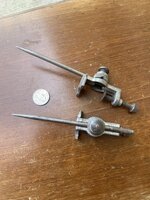
look up trammel points
Milton Shaw
Well-known member
- Joined
- Feb 11, 2011
- Messages
- 4,845
Most sets have a slot to hold a pencil to mark circles and arcs. Most of the ones I have seen fit on a yard stick or similar piece of wood. Both sets I have hold a pencil and the best pencil is a flat carpenters pencil, round #2's don't fit as well.
WoodsTruck
Well-known member
- Joined
- Jan 12, 2013
- Messages
- 1,025
I'll be darned.
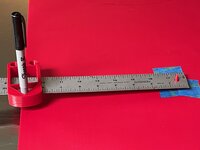
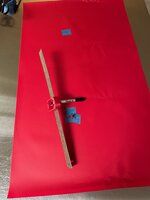
I needed to mark out some large circles on some coated vinyl material for water cooler covers.
Printed out a pivot and a clamp block. Used to tape to mark center then taped the pivot down given I printed an open 90° on the bottom to match center, then measured the distance needed and clamped the marker. Didn't know there were fancier versions.
I needed to mark out some large circles on some coated vinyl material for water cooler covers.
Printed out a pivot and a clamp block. Used to tape to mark center then taped the pivot down given I printed an open 90° on the bottom to match center, then measured the distance needed and clamped the marker. Didn't know there were fancier versions.
Attachments

RoninB4
Well-known member
-Trammel points were/are commonly used for layout work by (machinists, sheet metal, wood workers, etc.) scribing thin lines on surfaces. Creating reference points or geometric shapes (half-way location, perpendicular lines, tangency points, etc.) can often be done without measuring. They're very handy for point-to-point measuring (center-to-center or edge) minimal weight, and can use whatever shape/length contact probe as needed. Need more/less length? Use a different beam. They're often cheap and often only limited by your imagination.Didn't know there were fancier versions.
Beerhippie
Well-known member
I used to have a set of stair stops for my steel lay-out square that could also take points. Uber handy!-Trammel points were/are commonly used for layout work by (machinists, sheet metal, wood workers, etc.) scribing thin lines on surfaces. Creating reference points or geometric shapes (half-way location, perpendicular lines, tangency points, etc.) can often be done without measuring. They're very handy for point-to-point measuring (center-to-center or edge) minimal weight, and can use whatever shape/length contact probe as needed. Need more/less length? Use a different beam. They're often cheap and often only limited by your imagination.
I can't count the number of field-expedient trammels I've made on the jobsite. Usually two nails and a two-by, but sometimes for a pencil or saw. Need to trim a 24' radius arc on a round deck? No problemo.
OccupantRJ
Well-known member
A precision type of trammel point such as Starrett has one attachment with a fine tuning screw for more precise adjustments.
RoninB4
Well-known member
-Necessity is .......Usually two nails and a two-by, but sometimes for a pencil or saw.
Beerhippie
Well-known member
And the two by was still usable as construction lumber.-Necessity is .......
I suppose a couple of plastic wire staples would work too.I used to have a set of stair stops for my steel lay-out square that could also take points. Uber handy!
I can't count the number of field-expedient trammels I've made on the jobsite. Usually two nails and a two-by, but sometimes for a pencil or saw. Need to trim a 24' radius arc on a round deck? No problemo.