To avoid these ads, REGISTER NOW!

Acetylene cutting

BusterBarker

Member
Joined
May 20, 2022
Messages
7
Hi all, newbie here and I hope this is the correct forum for my question!
Trying my hand at cutting with Acetylene oxygen torch. Trying to cut 1/8” to 3/8” material but I can’t get a good cut. I followed numerous YouTube setups, made sure my tip size and pressure settings are good.
Not matter what I tweak or change it the setup, my cuts just re-fuse behind the cut. It doesn’t matter what I do, I just can’t get a clean cut!
Any suggestions or resources that might help is appreciated.
 
To avoid these ads, REGISTER NOW!

tester19

Well-known member
Joined
Apr 25, 2021
Messages
225
Location
chigago
Are you using a cutting torch with the extra lever for Oxygen?
If so yes maybe a bit slower cut? Like everything there is a bit of a learning curve and technique to it.
.
.
.
 

steel 35

Well-known member
Joined
Feb 20, 2011
Messages
2,105
Location
Between the PNW and the Emerald Triangle
This bring’s back memories. (drag tip) google! I won’t do it again!
Years ago when I learned there was a optional tip made to drag on the steel.
Biggest one mentioned already point that flame forward, on thin stuff.
 

Yale

Well-known member
Joined
Oct 22, 2014
Messages
84
1/8" is pretty thin. As Old Man Roger suggests, angle your torch in the direction of the cut on thin material so that it 'appears' thicker to the flame.
MAKE SURE THAT YOUR TIP IS CLEAN! Most times, if I'm getting a bad cut, cleaning the tip fixes it. All of the blue cones should be the same length (or very close) when you hit the cutting lever.
I usually run about 20 psi oxygen and 7 acetylene. Fire up your torch on just acetylene and then gradually open the cutting valve (when cutting, the oxygen valve on the handle should be fully open and all adjustments made with the valve by the cutting handle). When the flame looks good, hit the cutting lever and adjust the valve until you get the blue cones as short and even as possible.
If the cut is melting back together, you could be going too slow or too fast. Try speeding up until the metal doesn't cut and then back off. Also, be aware of your torch height. It should be close enough so that the oxygen jet doesn't diffuse but far enough away that garbage doesn't get blown back up into the tip.
As you pointed out, there are many 'How to use a Cutting Torch' videos on YT. Some better than others. I recommend checking out Essential Craftsman's video on the subject. He breaks it down quite well.
One last thing. Some tips are better than others. I have a cheap scarfing tip that I cannot get a decent cut out of no matter what I try. So, if nothing else works, try swapping the tip or try your hand at someone else's setup and see if that helps.
Keep practicing and you'll get there. A cutting torch is like a magic wand once you get the hang of it.
 

u3b3rg33k

Well-known member
Joined
Dec 18, 2017
Messages
4,047
Remember, it's not actually Acetylene cutting, it's OXY-Acetylene cutting. heavy emphasis on the former. you're oxidizing away the material, so it has to be hot enough for that to be possible to do fast, and then you dump a metric ****-ton of oxygen on it.
 
To avoid these ads, REGISTER NOW!

engineer2

Well-known member
Joined
Dec 13, 2009
Messages
11,795
Location
Chicago burbs
When you pull the lever, the increased oxygen should blow the slag out of the cut.
I once worked with a plant maintenance guy whose oxy-acetylene cuts looked like saw cuts. He spent a lot of time keeping the tip clean. When he stick welded, the slag would just curl up behind his weld. Rarely used a chipping hammer. Amazing to watch.
 
Last edited:

fitter30

Well-known member
Joined
Jun 23, 2019
Messages
2,962
Location
Peace Valley,mo
Tip angle, tip face off metal, pressures and once the level is pressed its pressed all the way. Wrong time of the year some high schools have night school classes two nights a week will teach the basics.
 

claymont

Well-known member
Joined
Oct 26, 2010
Messages
434
Location
CLAYMONT, DE
Hi all, newbie here and I hope this is the correct forum for my question!
Trying my hand at cutting with Acetylene oxygen torch. Trying to cut 1/8” to 3/8” material but I can’t get a good cut. I followed numerous YouTube setups, made sure my tip size and pressure settings are good.
Not matter what I tweak or change it the setup, my cuts just re-fuse behind the cut. It doesn’t matter what I do, I just can’t get a clean cut!
Any suggestions or resources that might help is appreciated.
A lot of good information here:
OXY-ACETYLENE WELDING AND CUTTING

This is under the "Manual Cutting" tab
Legend for Fig. 22-2
1. This well-made cut has square edges; the drag lines are essentially vertical, and not too pronounced.
2. Because preheat flames were too small, this cut was made too slowly, causing bad gouging at the bottom of the cut.
3. Because preheat flames were too strong, the top edge is melted, the cut is irregular, and there is adhering slag.
4. Oxygen pressure was too low, and cutting speed too slow. The result was excessive melting of the top edge.
5. Here the nozzle used was too small, while the oxygen pressure was too great for the nozzle. Control of the cut was lost.
6. This would have been a good cut if the cutting speed has been somewhat greater. Drag lines are too pronounced.
7. In this case, the cutting speed was too high. The drag lines break sharply, and there is excessive slag adherence.
8. Failure to maintain a steady cutting speed was the major problem in this case. Part of the cut is excellent, part is poor.
9. The deep gouges in this cut are the result of careless restarting after interruption of cutting.

589oxy21pg5.jpg
 
OP
B

BusterBarker

Member
Joined
May 20, 2022
Messages
7
1/8" is pretty thin. As Old Man Roger suggests, angle your torch in the direction of the cut on thin material so that it 'appears' thicker to the flame.
MAKE SURE THAT YOUR TIP IS CLEAN! Most times, if I'm getting a bad cut, cleaning the tip fixes it. All of the blue cones should be the same length (or very close) when you hit the cutting lever.
I usually run about 20 psi oxygen and 7 acetylene. Fire up your torch on just acetylene and then gradually open the cutting valve (when cutting, the oxygen valve on the handle should be fully open and all adjustments made with the valve by the cutting handle). When the flame looks good, hit the cutting lever and adjust the valve until you get the blue cones as short and even as possible.
If the cut is melting back together, you could be going too slow or too fast. Try speeding up until the metal doesn't cut and then back off. Also, be aware of your torch height. It should be close enough so that the oxygen jet doesn't diffuse but far enough away that garbage doesn't get blown back up into the tip.
As you pointed out, there are many 'How to use a Cutting Torch' videos on YT. Some better than others. I recommend checking out Essential Craftsman's video on the subject. He breaks it down quite well.
One last thing. Some tips are better than others. I have a cheap scarfing tip that I cannot get a decent cut out of no matter what I try. So, if nothing else works, try swapping the tip or try your hand at someone else's setup and see if that helps.
Keep practicing and you'll get there. A cutting torch is like a magic wand once you get the
 
OP
B

BusterBarker

Member
Joined
May 20, 2022
Messages
7
Wow…thanks for all the great info.
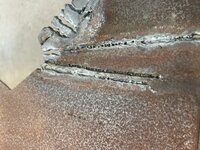
After many trials I was able to make a cut that didn’t re-fuse.
My final speed was much faster than I had started with and I also started using a guide.
This is what I started out looking like, and what I finally got. Much more to learn for sure!

E3C23611-2A24-4CA0-8BFA-9D3BD2EC7942.jpeg9B464432-27D4-44FB-BB07-309D2B9FA4F3.jpeg
 

ATC

Well-known member
Joined
May 12, 2012
Messages
8,263
Location
VA
Wow…thanks for all the great info.
After many trials I was able to make a cut that didn’t re-fuse.
My final speed was much faster than I had started with and I also started using a guide.
This is what I started out looking like, and what I finally got. Much more to learn for sure!

E3C23611-2A24-4CA0-8BFA-9D3BD2EC7942.jpeg9B464432-27D4-44FB-BB07-309D2B9FA4F3.jpeg

Yup...I was going to go against the consensus here and suggest that you travel faster.

When traveling slow, you heat the metal too much, causing it to liquify and flow back together behind the cut. Traveling faster allows the metal right before the center to liquify and get blown out, while quickly solidifying behind the center so it doesn't flow back together again.
I had (and still do sometimes) the same issue you did. Sometimes I can't get it into my head to cut any faster.
 

KenC

Well-known member
Joined
Dec 20, 2009
Messages
2,577
Lots of mention of 'blowing the metal out" in the discussion. That is incorrect as what happens in a good cut is most of the metal actually burns. that is why there is very little re-fusing on a proper cut. No (or very little) molten metal remains in the cut area.

Practice, Practice and more Practice is the key. After matching you tip size to the metal thickness, setting gas pressures and working on holding the flame at the correct angle then getting the speed right.

For me the biggest reason for re-fusing is moving too slow. Metal adjacent to the cut/burn area is melted but not consumed by the O2 flow. That is what re-fuses. I don't cut often and have to relearn the methodology every time!
 
OP
B

BusterBarker

Member
Joined
May 20, 2022
Messages
7
Thanks again for the help!! I’ll be cutting up some 3/8” beam this weekend. We’ll see what I have learned?
 
To avoid these ads, REGISTER NOW!
Top Bottom