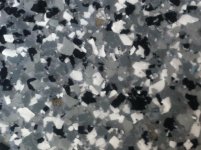
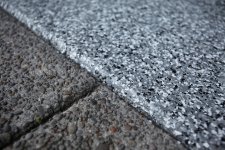
I had a BASF Acrylic floor installed. This is a MMA - Methyl methacrylate.
Degadur "Speciality Resin Systems" B71 primer, R61 body and color coat, flakes, R71 top coat #1, sanded, and top coat #2 w/Al Oxide. 4 coat process. All in one day. Took them about 12 hours however because I also had 8" speedcove w/corners (and they were miter-saw challenged). Prep was done with a diamond grinder and it looked great.
B71: http://www.buildingsystems.basf.com...es/buildingsystems/products/items/Degadur_B71
R61: http://www.buildingsystems.basf.com...es/buildingsystems/products/items/Degadur_R61
R71: http://www.buildingsystems.basf.com...es/buildingsystems/products/items/Degadur_R71
Why Acrylic?
Downside: It has less tensile and compressive strength vs. Wolverine Epoxy, for example, and is also very very expensive...It also stinks quite badly when it is being applied (see MSDS). Yet, I don't think the strength will be an issue as it is so far beyond anything I will put in there -- and I am putting industrial woodworking equipment in there!
Upside: The material is much thicker than Epoxy (~100mils), has a lifetime warranty (I'm sure it has lots of loopholes), moves better (note that many Epoxy floors have Acrylic sealers for the cracks), and is a 1-day process. It is often used in commercial applications, such as stadiums and restaurants. Also, it can be re-coated quite easily...I am told.
It always comes down to the installation however...
The company I hired does a lot of commercial work here in the Portland area.
I think the speedcove work set them back quite a bit and they were were rushing to try to finish by midnight.
So, what happened? I think they walked on the floor (with spikes!!) while it was still drying...and now I see brown-sandy pits...They broke right through the flakes.
I've attached 5 photos:
2 Close-up views
Before & After (which looks quite nice IMO, which is too bad)
..and the dreaded PITS.
Now I'm wondering what I should do next -- and I wouldn't be surprised if no one on this forum has ever used this product...It isn't very DIY friendly.
Options:
1. Do nothing - I'm worried water could get into the pits and compromise the floor.
2. Fill - likely a rigged job??
3. Re-do the top coats...re-broadcast flakes, top coat, sand, top coat #2.
Help would be appreciated. I'm meeting with the company this weekend to discuss options.
Regards, -mark
Degadur "Speciality Resin Systems" B71 primer, R61 body and color coat, flakes, R71 top coat #1, sanded, and top coat #2 w/Al Oxide. 4 coat process. All in one day. Took them about 12 hours however because I also had 8" speedcove w/corners (and they were miter-saw challenged). Prep was done with a diamond grinder and it looked great.
B71: http://www.buildingsystems.basf.com...es/buildingsystems/products/items/Degadur_B71
R61: http://www.buildingsystems.basf.com...es/buildingsystems/products/items/Degadur_R61
R71: http://www.buildingsystems.basf.com...es/buildingsystems/products/items/Degadur_R71
Why Acrylic?
Downside: It has less tensile and compressive strength vs. Wolverine Epoxy, for example, and is also very very expensive...It also stinks quite badly when it is being applied (see MSDS). Yet, I don't think the strength will be an issue as it is so far beyond anything I will put in there -- and I am putting industrial woodworking equipment in there!
Upside: The material is much thicker than Epoxy (~100mils), has a lifetime warranty (I'm sure it has lots of loopholes), moves better (note that many Epoxy floors have Acrylic sealers for the cracks), and is a 1-day process. It is often used in commercial applications, such as stadiums and restaurants. Also, it can be re-coated quite easily...I am told.
It always comes down to the installation however...
The company I hired does a lot of commercial work here in the Portland area.
I think the speedcove work set them back quite a bit and they were were rushing to try to finish by midnight.
So, what happened? I think they walked on the floor (with spikes!!) while it was still drying...and now I see brown-sandy pits...They broke right through the flakes.
I've attached 5 photos:
2 Close-up views
Before & After (which looks quite nice IMO, which is too bad)
..and the dreaded PITS.
Now I'm wondering what I should do next -- and I wouldn't be surprised if no one on this forum has ever used this product...It isn't very DIY friendly.
Options:
1. Do nothing - I'm worried water could get into the pits and compromise the floor.
2. Fill - likely a rigged job??
3. Re-do the top coats...re-broadcast flakes, top coat, sand, top coat #2.
Help would be appreciated. I'm meeting with the company this weekend to discuss options.
Regards, -mark