To avoid these ads, REGISTER NOW!

Adding 240V and 120V Circuits at Meter Main Panel?

highaltitude

Active member
Joined
Jul 22, 2013
Messages
30
I'd love some input on this as it's just new to me. Hopefully I'm using the right terms. I've done lots of wiring, running conduit, installing new receptacles, etc... but I've never done anything inside the breaker box itself. I plan to have everything inspected by a pro, if not installed by them as well.

I've got a lovely new attached garage that has one sad 120V circuit, 15 amp. I do lots of work in the garage and that lonely circuit won't do. I'm going to be installing a parking lift and 60 gallon air compressor so I'll need at least a couple 220V circuits and would like to add a couple dedicated 20 amp 120V as well.

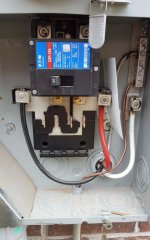
My main breaker panel with all the used breakers is in my basement. At the meter, however, there is a panel with what appears to be 9 unused breaker slots. This meter is on the outside wall of my garage and would be a perfect spot to tap into power to run conduit in the garage. Attached is a picture of the meter panel in question.

Running wires from the basement would be a pain. I'm hoping I can simply install new breakers at the meter panel and run a J-box thru the wall and into the garage and go nuts from there.

What do you more knowledgeable folks say to this? I was initially thinking a sub-panel in the garage was needed, but after seeing these unused slots in the meter panel, perhaps not.

Thanks!

PS: assuming I am able to tap into this meter panel, it appears the cost of running new circuits is really low - just the cost of the breakers, wire, conduit and receptacles, right? And then of course an inspection to insure everything is up to code and proper.
 

Attachments

  • IMG_20170506_193504.jpg
    IMG_20170506_193504.jpg
    136.8 KB · Views: 234
To avoid these ads, REGISTER NOW!

CrashmanS

Well-known member
Joined
Jun 25, 2015
Messages
147
That's exactly what I did. But in my case that meter panel was on the house. One 220 breaker fed a sub panel in the garage and one 220 fed my outdoor ac/heat pump.

Sent from my SM-N920P using Tapatalk
 

Marctrees

Well-known member
Joined
Mar 5, 2015
Messages
6,265
Location
TX/LA border - Toledo Bend
If you take a moment, you will see this post should be in the "Lighting and Electrical" sub forum to get the proper attention.

Not knowing a quicker way - I would copy, repost and delete OP once I saw it reposted in appropriate place.

Or a Mod may move it for you if he sees it and has time. Marc
 

matt_i

Well-known member
Joined
Mar 14, 2008
Messages
10,728
Location
SE Michigan
Id pull off the cover panel just to make sure there are lugs in there intended for individual breakers and its not just a generic cover panel used on many models.

That bridge crossed, you can probably do what you wish. I would advise powering off when running conduits or drilling into the backplane of the open panel.

The "inspection" you mention would require you pulling a permit and submitting drawings to your local building authority. You might be able to get an electrician to inspect your work but it might be tough also unless you have a friend in that trade. You will find a lot more answers in the Electrical subforum as suggested.

Edit: use of that panel might invoke your current main panel now being classified as a sub-panel, and you'd have to make sure the bonding screw was removed between neutral and ground bar in the current circuit panel.
 
Last edited:

ard

Well-known member
Joined
Feb 16, 2015
Messages
4,391
Location
Sierra Foothills... California
How about a real nice, clear, full frame picture OF THAT LABEL?

Of course, take the cover off and snap a pic too...but that label should tell us precisely how you can use it.
 

tjdux

Well-known member
Joined
Feb 4, 2014
Messages
801
Location
Southern Nebraska
Its already been said that as long as the inside of the box is kosher your all good so to add my 2 cents...

A large breaker and subbox inside the actual garage may be more handy if you ever trip a breaker it would save you from having to go clear outside.

Sent from my SM-G900V using Tapatalk
 

redmondjp

Well-known member
Joined
Nov 25, 2014
Messages
2,318
Location
Redmond, WA
To the OP: on that panel below your meter base - see the 1/4" hex head screw at the bottom of the panel inside? Remove that screw, and then remove that cover - (you may have to flip off the circuit breaker(s) at the top, which may shut off your entire house).

Take a picture of the inside and post it here and we can give you more advice on how to proceed.
 

sberry

Banned
Joined
Jun 18, 2005
Messages
35,747
Location
Brethren, Michigan
They make an 8 space panel just for this. I would add a sub and while the convenience of clearing a breaker is great it actually would save wiring and equipment. It would have local breakers for disconnects for the hoist and the comp. You could add an outlet to the hoist to share with a modest wire welder, one for the comp and it would still leave 4 spaces, 2 for 120V would be adequate. Could use the existing 15 for lights. Would have 2 spaces left when finished.
 

Ole Slewfoot

Well-known member
Joined
Feb 22, 2016
Messages
5,098
Location
Freedom, CA
I just found myself in a boat with OP today.
New to me garage has one circuit which services the two outlets and garage door.
Unfortunately some previous resident got that power by extending the line from the kitchen which already has 2 outlets, a microwave, and the refrigerator. Doh
 

EOC_Jason

Well-known member
Joined
Jun 25, 2012
Messages
11,388
Location
Bentonville, AR
That meter can setup is similar to mine, if they are that big then most definitely there are breaker slots in there.

I would do as others have suggested, install a sub-panel on the other side in the garage and go from there. That way you don't have to go outside if a breaker trips, likewise you won't have a bunch of wires to pull through that wall. Sub-panels are cheap.
 
OP
H

highaltitude

Active member
Joined
Jul 22, 2013
Messages
30
Wow, lots of great replies. Sorry about the thread location being off. I found a very similar one via google and posted my thread in the same location as that one. I guess I duplicated a mistake, oops.

I'll see if I can take off that panel at some point. I do believe the power has to be turned off so I'll have to find a time that works for the family. I'll also grab a picture of the sticker. My original image was clear enough to show the sticker detail, but the website's auto-resize made the pic small enough that you can't read much.

Thanks guys, lots of good help so far.
 

bastage

Well-known member
Joined
Feb 6, 2017
Messages
234
Location
Kuna ID
I feel the garage wiring pain.. it's been like 2 months since I went from a single 15a circuit in my garage to that circuit along with 2x 20a and a 230v circuit for my air compressor.
 

EOC_Jason

Well-known member
Joined
Jun 25, 2012
Messages
11,388
Location
Bentonville, AR
The sticker will say the max size breaker you can put in there...

Yes, for safety I would throw that main breaker in the panel, but you don't have to get to poco to come remove your meter can, just be careful because the lugs above it will be hot.

My garage originally had 1 circuit / 3 plugs (one on each wall), and 3 measly light bulbs...

I added a 20A/220V for my compressor. Now have 5 x 8' T8 florescent lights & 2 x regular light bulbs, and added a second circuit of I think 7 x 110V plugs around on the walls. Oh, and put a 50A plug beneath my breaker panel in the garage for electric heater & future welder & whatnot...
 
Last edited:

plumbing101mike

Active member
Joined
Jun 12, 2016
Messages
41
Location
Southern Minnesota (The balmy part of the state)
Its already been said that as long as the inside of the box is kosher your all good so to add my 2 cents...

A large breaker and subbox inside the actual garage may be more handy if you ever trip a breaker it would save you from having to go clear outside.

Sent from my SM-G900V using Tapatalk
This would be how I approached it also.

Sent from my SM-G930V using Tapatalk
 

sberry

Banned
Joined
Jun 18, 2005
Messages
35,747
Location
Brethren, Michigan
It just saves having to add disconnects and lets a guy add from there vs running more wires. With a bit of care the main does not have to be shut off to pull the cover, it should be prior to any work. This is also an advantage of a sub, can shut the second panel off and work on it without interrupting the rest of the house.
 
OP
H

highaltitude

Active member
Joined
Jul 22, 2013
Messages
30
Alright, update and potential problem.. or not. Help me out here.

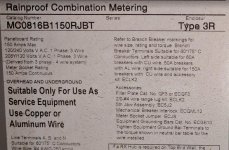
Here's a clearer picture of the meter combo box. It states the panel is rated for 150 Amps... and that's what it looks like the current breaker is. Now, I assume the 150 4-wide breaker is in series with the other breakers in the house and the "accessory slots" within the meter combo panel. Assuming that, I think I'm good to add breakers in the meter combo, up to 60 Amps on the left and 150 Amps on the right.

Am I on the right track here? I'm inching closer to buying the lift and a compressor which will both require this electrical work to be completed. Hopefully this won't be tooooooo big an ordeal.

Thanks again.
 

Attachments

  • Electrical Box.jpg
    Electrical Box.jpg
    154.6 KB · Views: 89

EOC_Jason

Well-known member
Joined
Jun 25, 2012
Messages
11,388
Location
Bentonville, AR
^^^ Yes, assuming you use copper wire.

And depending on the wire size you use, you might have to get a separate neutral lug that can accept the larger size, no big deal.
 

wyliesdiesels

Well-known member
Joined
Aug 14, 2012
Messages
20,021
Location
Modesto, CA
Id pull off the cover panel just to make sure there are lugs in there intended for individual breakers and its not just a generic cover panel used on many models.

That bridge crossed, you can probably do what you wish. I would advise powering off when running conduits or drilling into the backplane of the open panel.

The "inspection" you mention would require you pulling a permit and submitting drawings to your local building authority. You might be able to get an electrician to inspect your work but it might be tough also unless you have a friend in that trade. You will find a lot more answers in the Electrical subforum as suggested.

Edit: use of that panel might invoke your current main panel now being classified as a sub-panel, and you'd have to make sure the bonding screw was removed between neutral and ground bar in the current circuit panel.


Not true. Where did u hear that?

The OPs panel is a combination meter main. Adding branch breakers does not effect its classification as the main service panel....

Out here in california the majority of houses have this type of setup, my house included, without any subpanels...

Alright, update and potential problem.. or not. Help me out here.

Here's a clearer picture of the meter combo box. It states the panel is rated for 150 Amps... and that's what it looks like the current breaker is. Now, I assume the 150 4-wide breaker is in series with the other breakers in the house and the "accessory slots" within the meter combo panel. Assuming that, I think I'm good to add breakers in the meter combo, up to 60 Amps on the left and 150 Amps on the right.

Am I on the right track here? I'm inching closer to buying the lift and a compressor which will both require this electrical work to be completed. Hopefully this won't be tooooooo big an ordeal.

Thanks again.

Maybe i missed it but what is the potential problem you perceive??
 
OP
H

highaltitude

Active member
Joined
Jul 22, 2013
Messages
30
[/b]

Not true. Where did u hear that?

The OPs panel is a combination meter main. Adding branch breakers does not effect its classification as the main service panel....

Out here in california the majority of houses have this type of setup, my house included, without any subpanels...


Maybe i missed it but what is the potential problem you perceive??

The potential problem I saw was if the 150 amp breaker at the top of the combo panel was in parallel with the accessory slots. If that was the case, then it seemed that I've breaker had already consumed all available 150 amps.

I'm thinking now though, that the top 150 amp four wide breaker is actually in series with everything else and disconnects all the service to the house, including the accessory slots in that same panel. Therefore, no problem!
 
To avoid these ads, REGISTER NOW!

EOC_Jason

Well-known member
Joined
Jun 25, 2012
Messages
11,388
Location
Bentonville, AR
I'm thinking now though, that the top 150 amp four wide breaker is actually in series with everything else and disconnects all the service to the house, including the accessory slots in that same panel. Therefore, no problem!

Yes, that 150A breaker at the top is your main disconnect. It will kill power to the rest of the slots in that panel and also your breaker panel in the house.

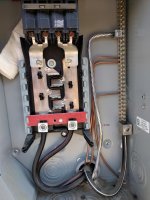
Once you remove the cover you will see how it's wired. Here's a pic of mine, you can see how the lugs up top are connected to wires coming from the meter can above. The 125A breaker controls the 4 breaker slots in that panel, but also the wires going to my main panel in the garage which are connected on the side lugs.
 

Attachments

  • 20160425_124522.jpg
    20160425_124522.jpg
    144.4 KB · Views: 87
OP
H

highaltitude

Active member
Joined
Jul 22, 2013
Messages
30
Thanks Jason.

I'm dialing in this project and am now running some rough Electrical Load Calcs. I'm seeing that my existing house and electrical system is in the neighborhood of a 100A calculated load. 2700 sq ft, AC, washer, dryer, DW, fridge, microwave, Electric Range/Oven. I got 8,100W for the sq ft calc and around 10,500W for the appliances load. Add together, multiply by 1.25, divide by 240 and I'm right around 100A.

As I understand it, I'm not supposed to (or allowed to?) overload the existing 150A main service breaker. So... am I left with 50A service limit for my sub-panel if my 100A existing load calc is correct? That wouldn't be a deal breaker as I estimate my future load needs to be about 50A, but I was hoping to have some headroom.

I plan to get this whole deal inspected and final hook up done by a pro. Perhaps I should just have them come out and help out with this planning stage as well? Or am I about there with these basic calcs?
 

EOC_Jason

Well-known member
Joined
Jun 25, 2012
Messages
11,388
Location
Bentonville, AR
I would think you would be okay with a larger size than 50A because they might be high current but they will be short duration. It's kind of a common sense thing... Do you plan on running numerous things all at once? Can you weld / use a lift / run a saw all at once?
 
OP
H

highaltitude

Active member
Joined
Jul 22, 2013
Messages
30
I would think you would be okay with a larger size than 50A because they might be high current but they will be short duration. It's kind of a common sense thing... Do you plan on running numerous things all at once? Can you weld / use a lift / run a saw all at once?

I'm more concerned from a legality/code standpoint. By my estimation it would be exceedingly rare for me to ever use more than 40A at any given time on these new garage circuits.

If there's no code requirement stopping me I'd like to wire it up for 80A or so and give myself plenty of capacity. I suppose even if there is a code requirement I can simply swap out the main breaker that feeds the sub-panel.

This all seems pretty wishy washy anyways. What's to stop anyone from wiring it to code, then using a heavy duty 3-way extension cord to tie in all their garage toys and overloading the system?

I digress... If there's no code requirements then I think I'll aim for 75-80A, even though I only estimate I'd need 40-50A.
 

EOC_Jason

Well-known member
Joined
Jun 25, 2012
Messages
11,388
Location
Bentonville, AR
I digress... If there's no code requirements then I think I'll aim for 75-80A, even though I only estimate I'd need 40-50A.

I don't know if there is a "code", I don't really read that much NEC, might have to google a bit and see. Likewise I've never seen anything mentioned in local jurisdictions about something like that. Typically they just want to make sure your breakers are sized properly for the wire...
 

75gmck25

Well-known member
Joined
Jul 21, 2014
Messages
1,325
Location
Alexandria, VA
Let me make a simple suggestion for your garage sub-panel off the 150 amp main panel.

You can buy a 30 (or more) circuit subpanel and wire up every garage device you need to use. Then connect it with 2-2-2-4 MHF wire (which should be rated for up to 100 amps) to the main panel. However, if you then install a 50 amp breaker (for the sub-panel) in your main panel you will always limit your garage to a 50 amp max amperage. If you ever draw too much total amperage at the garage it will just trip the breaker for the sub-panel.

Bruce
 

sberry

Banned
Joined
Jun 18, 2005
Messages
35,747
Location
Brethren, Michigan
Chances are you are not in the shower running laundry and dryer with AC on and the wife cooking holiday dinner while you are sandblasting and welding with a couple 500 watt lights. Could wire 100a service to the garage thru max legal breaker. I feed them with a 60 usually.
I sub my house with 50 from my folks 100 and they have electric appliances minus air con. I have gas appliances, use a air con on occasion and a heater, microwave on occasion. Doesn't even add anything to their load demand.
Unless a guy is putting in electric heat or oven a garage doesn't add much to load. Often the same people, just in different part of the house.
 
Last edited:
OP
H

highaltitude

Active member
Joined
Jul 22, 2013
Messages
30
Let me make a simple suggestion for your garage sub-panel off the 150 amp main panel.

You can buy a 30 (or more) circuit subpanel and wire up every garage device you need to use. Then connect it with 2-2-2-4 MHF wire (which should be rated for up to 100 amps) to the main panel. However, if you then install a 50 amp breaker (for the sub-panel) in your main panel you will always limit your garage to a 50 amp max amperage. If you ever draw too much total amperage at the garage it will just trip the breaker for the sub-panel.

Bruce

I think you're right. I just need to run wire planning for the most I would ever need - 100A would certainly do it. My only desire to use smaller wire would be to save cost if the sub-panel ends up 30' away from the Main. Even then though... the cost difference may not be huge.

Chances are you are not in the shower running laundry and dryer with AC on and the wife cooking holiday dinner while you are sandblasting and welding with a couple 500 watt lights. Could wire 100a service to the garage thru max legal breaker. I feed them with a 60 usually.
I sub my house with 50 from my folks 100 and they have electric appliances minus air con. I have gas appliances, use a air con on occasion and a heater, microwave on occasion. Doesn't even add anything to their load demand.
Unless a guy is putting in electric heat or oven a garage doesn't add much to load. Often the same people, just in different part of the house.

You don't know me! For all you know, I do my best welding in front of my space heater AND AC unit while my electric dryer dries my wife while my jeans make a roast using the microwave, oven and toaster at once.

Seriously though, you're right. I could see the compressor running (~20A) while the mini-AC is running (15A) while the lift is lifting (~20A I think), but that's a rare event and still barely pushing 55A, likely a lot less.

I need to determine the breaker box location before I get much further... I should figure that out soon. The garage doesn't have a lot of open wall space close to the meter main. I may need to re-arrange some things...
 

75gmck25

Well-known member
Joined
Jul 21, 2014
Messages
1,325
Location
Alexandria, VA
Remember that for mounting the breaker panel you need a wall area 30 inches wide, and with 3 feet of clearance in front of it.

Bruce
 

Norcal

Well-known member
Joined
Mar 16, 2008
Messages
13,759
Let me make a simple suggestion for your garage sub-panel off the 150 amp main panel.

You can buy a 30 (or more) circuit subpanel and wire up every garage device you need to use. Then connect it with 2-2-2-4 MHF wire (which should be rated for up to 100 amps) to the main panel. However, if you then install a 50 amp breaker (for the sub-panel) in your main panel you will always limit your garage to a 50 amp max amperage. If you ever draw too much total amperage at the garage it will just trip the breaker for the sub-panel.

Bruce


In the application suggested by the poster above, in bold/underline, #2 AL cannot be used for 100 amperes.
 
OP
H

highaltitude

Active member
Joined
Jul 22, 2013
Messages
30
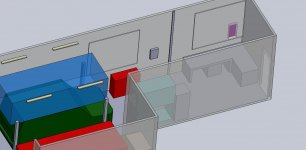
Update with a CAD screenshot! The purple box is the main combo panel outside. The grey box on the wall just right of the red toolbox is the supposed new sub panel.

Workbench is in teal opposite the red toolbox. The built in wood work-benchtop is the L shaped deal in the rear corner. Compressor would likely go right next to the end of the L-workbench, between the breaker box and the bench. The distance between the new sub box right now and the bench is 5 feet.

Remember that for mounting the breaker panel you need a wall area 30 inches wide, and with 3 feet of clearance in front of it.

Bruce

In the application suggested by the poster above, in bold/underline, #2 AL cannot be used for 100 amperes.

Bruce, Thanks. that's actually going to force me to rearrange the garage a little to open up that much wall space. See the attached CAD drawing though. I think I can make a real wide space for the sub-panel.

Norcal, good call.

To the person above that said something about the house only being 100A: wouldn't my existing 150A main breaker be a big no-no if the wiring to the house was only 100A? I think I can confidently say the house is good for 150A at least. It was built in 2012.
 

Attachments

  • Garge CAD breaker 1.JPG
    Garge CAD breaker 1.JPG
    90.8 KB · Views: 34
  • IMG_20170524_170358.jpg
    IMG_20170524_170358.jpg
    141 KB · Views: 49
  • IMG_20170524_170402.jpg
    IMG_20170524_170402.jpg
    131.7 KB · Views: 41

EOC_Jason

Well-known member
Joined
Jun 25, 2012
Messages
11,388
Location
Bentonville, AR
To the person above that said something about the house only being 100A: wouldn't my existing 150A main breaker be a big no-no if the wiring to the house was only 100A? I think I can confidently say the house is good for 150A at least. It was built in 2012.

It's 150A service...

Also, when you have the power turned off check those existing connections in that panel as I'm sure they will need to be tightened up a little. In my new house the ground wire was never tightened and you could wiggle it in & out by hand...
 
OP
H

highaltitude

Active member
Joined
Jul 22, 2013
Messages
30
Progress. Permit in hand. Materials bought for 100A service to the sub. I could use some wisdom.

My plan was to use 2-2-2-4 Al SE wire from Home Depot to feed my new sub from the existing meter main combo panel.

I have to cover about 15' of exterior wall then go through the wall right into the back of the new sub-panel

OR

Punch straight through my garage wall right by the existing main combo and make the horizontal run inside the garage.

It'd be nice to run outside the garage just to keep that conduit and cable out of the work area.

I'm having a hard time seeing the best path forward on the transition from exterior to interior with that big old 2-2-2-4 cable. Initially I thought I'd use PVC conduit and an "LB" (1 1/2" size). However... now I'm reading that may not be ok per code and min bend radius requirements.

I'm not finding many (or any) examples online of exterior to interior transitions with this cable.

Should I be using a different cable type? MHF? Individual conductors? I'm still in the planning phase so if I change plans, no biggie. I want to do what's proper and what makes sense. I thought I was there, but after handling the 2-2-2-4 and seeing how difficult it'd be to wrestle through the LB I came across folks mentioning potential code violations.

As always, thanks!
 

wyliesdiesels

Well-known member
Joined
Aug 14, 2012
Messages
20,021
Location
Modesto, CA
Thanks Jason.

I'm dialing in this project and am now running some rough Electrical Load Calcs. I'm seeing that my existing house and electrical system is in the neighborhood of a 100A calculated load. 2700 sq ft, AC, washer, dryer, DW, fridge, microwave, Electric Range/Oven. I got 8,100W for the sq ft calc and around 10,500W for the appliances load. Add together, multiply by 1.25, divide by 240 and I'm right around 100A.

As I understand it, I'm not supposed to (or allowed to?) overload the existing 150A main service breaker. So... am I left with 50A service limit for my sub-panel if my 100A existing load calc is correct? That wouldn't be a deal breaker as I estimate my future load needs to be about 50A, but I was hoping to have some headroom.

I plan to get this whole deal inspected and final hook up done by a pro. Perhaps I should just have them come out and help out with this planning stage as well? Or am I about there with these basic calcs?

There is no code that forbids you from putting in a breaker larger than 50a since your load calc came out at 100a for the house.

The worse thing that may happen is you will trip the main.

However, which load calc sheet or formula did u use to come up with 100a. The way I read what u wrote is that u multiplied everything by 1.25 including non continuous loads...
 

wyliesdiesels

Well-known member
Joined
Aug 14, 2012
Messages
20,021
Location
Modesto, CA
It's 150A service...

Also, when you have the power turned off check those existing connections in that panel as I'm sure they will need to be tightened up a little. In my new house the ground wire was never tightened and you could wiggle it in & out by hand...

never re-torque lugs. Its a really bad practice. If its loose back off the lug, cut the wire and start over. Otherwise u could overtorque the connection.

Progress. Permit in hand. Materials bought for 100A service to the sub. I could use some wisdom.

My plan was to use 2-2-2-4 Al SE wire from Home Depot to feed my new sub from the existing meter main combo panel.

I have to cover about 15' of exterior wall then go through the wall right into the back of the new sub-panel

OR

Punch straight through my garage wall right by the existing main combo and make the horizontal run inside the garage.

It'd be nice to run outside the garage just to keep that conduit and cable out of the work area.

I'm having a hard time seeing the best path forward on the transition from exterior to interior with that big old 2-2-2-4 cable. Initially I thought I'd use PVC conduit and an "LB" (1 1/2" size). However... now I'm reading that may not be ok per code and min bend radius requirements.

I'm not finding many (or any) examples online of exterior to interior transitions with this cable.

Should I be using a different cable type? MHF? Individual conductors? I'm still in the planning phase so if I change plans, no biggie. I want to do what's proper and what makes sense. I thought I was there, but after handling the 2-2-2-4 and seeing how difficult it'd be to wrestle through the LB I came across folks mentioning potential code violations.

As always, thanks!

If u want 100a, then you will need #1 al or #3 cu.

#2 al is limited to 90a in this application.

MHF will need to be in conduit but since the conductors arent in a sheath it may be easier to get a tight bend radius...
 
OP
H

highaltitude

Active member
Joined
Jul 22, 2013
Messages
30
never re-torque lugs. Its a really bad practice. If its loose back off the lug, cut the wire and start over. Otherwise u could overtorque the connection.


If u want 100a, then you will need #1 al or #3 cu.

#2 al is limited to 90a in this application.

MHF will need to be in conduit but since the conductors arent in a sheath it may be easier to get a tight bend radius...

Thanks for this. After I posted last night I was cruising more forum discussions and found people stating that gauge was good for 90A. I apparently dont quite understand the ampacity rating system, but that's ok. I can just put in a smaller breaker in the main combo panel. I likely don't need anything over 70A service anyways.

I'm still unsure on the code compliance regarding the 1.5" LB conduit body with the 2-2-2-4 SER. I called my local inspector, but not sure if they'll respond to that kind of question prior to an initial inspection. The LB I have states "3 wire max fill - 2AWG".

So does the ground wire count as a "wire" in that statement? If not then I guess the LB is all good and I can proceed.
 
OP
H

highaltitude

Active member
Joined
Jul 22, 2013
Messages
30
Alternate plan possibility: I feel scatterbrained, but stick with me...

I could reduce feeder breaker to 60A, keep the 240V circuits at 30A instead of one at 50A, use 6-3 NM-B thru the back of the existing meter combo and straight through the exterior wall into the garage. EMT conduit inside the garage about 15 feet to the new panel, done.

I think that may be a lot easier than all this SER stuff and realistically, 60A should serve my current (and most my future) needs.

This plan also eliminates the need to run any exterior conduit and eliminates all that associated headache. I'll save on the Siemens breaker (60A vs 100A), the conduit, the 8-3 cable I was going to try to run for 50A service to either 240 outlet, and managing the wiring should be much easier. I already have lots of leftover 10-2 Romex so I could use that for the 20A 120 and the 30A 240.

Any flaws in that plan for those of you patient enough to bare with my novel?
 
Last edited:
To avoid these ads, REGISTER NOW!
Top Bottom